
 Design
 App Development
 Web Engineering
 AI Services
 Cloud
Cloud Staffing
 Startups
 Health / Fitness
 Education
 Social
 Nonprofit
 Fintech
 Construction
 Logistics
 Government
 Travel/Hospitality
 HR Software
 About Simpalm
 Our News
 Client Testimonials
 Careers
 Our Blog
 Awards
 Resources
 Information
Key Takeaways
- Time to build a website depends upon the purpose of the website, a single page website can be built in a few days whereas a corporate website might take months.
- The right development approach matters. A DIY website builder, a freelancer, and a full-service agency each deliver different outcomes on different timelines.
- Creating content, design, and SEO of the website takes a significant portion of the development timeline.
- Having your copy, images, and approvals ready by the project’s beginning can compress timelines by weeks.
________________________________________________________________________________________
Developing a website can take from just one day to a better part of a year. And it’s not an exaggeration or a delusional timeline but the reality of web development. While a simple portfolio website or PPC campaign landing pages can be launched in 1-3 days, building a fully customized website with advanced integrations can take more than 6 months.
To understand how the timeline varies while building a website, you must understand the most crucial factors impacting the timeline. Your website timeline depends on five core variables:
- The type of website you need,
- The features it requires,
- How complex the design is,
- What type of content is needed.
- The method you use to build it.
Each of these factors compounds the others, which is why two businesses asking the same question can receive completely different answers.
This guide breaks down realistic timelines for every major website type, explains the development process stage by stage, and covers the most common reasons projects run over schedule, so you can avoid them.
Website Development Timeline by Website Type
Not all websites are built the same way, and understanding the differences between each type helps you set realistic expectations before you finalize the deadline and budget for the project.
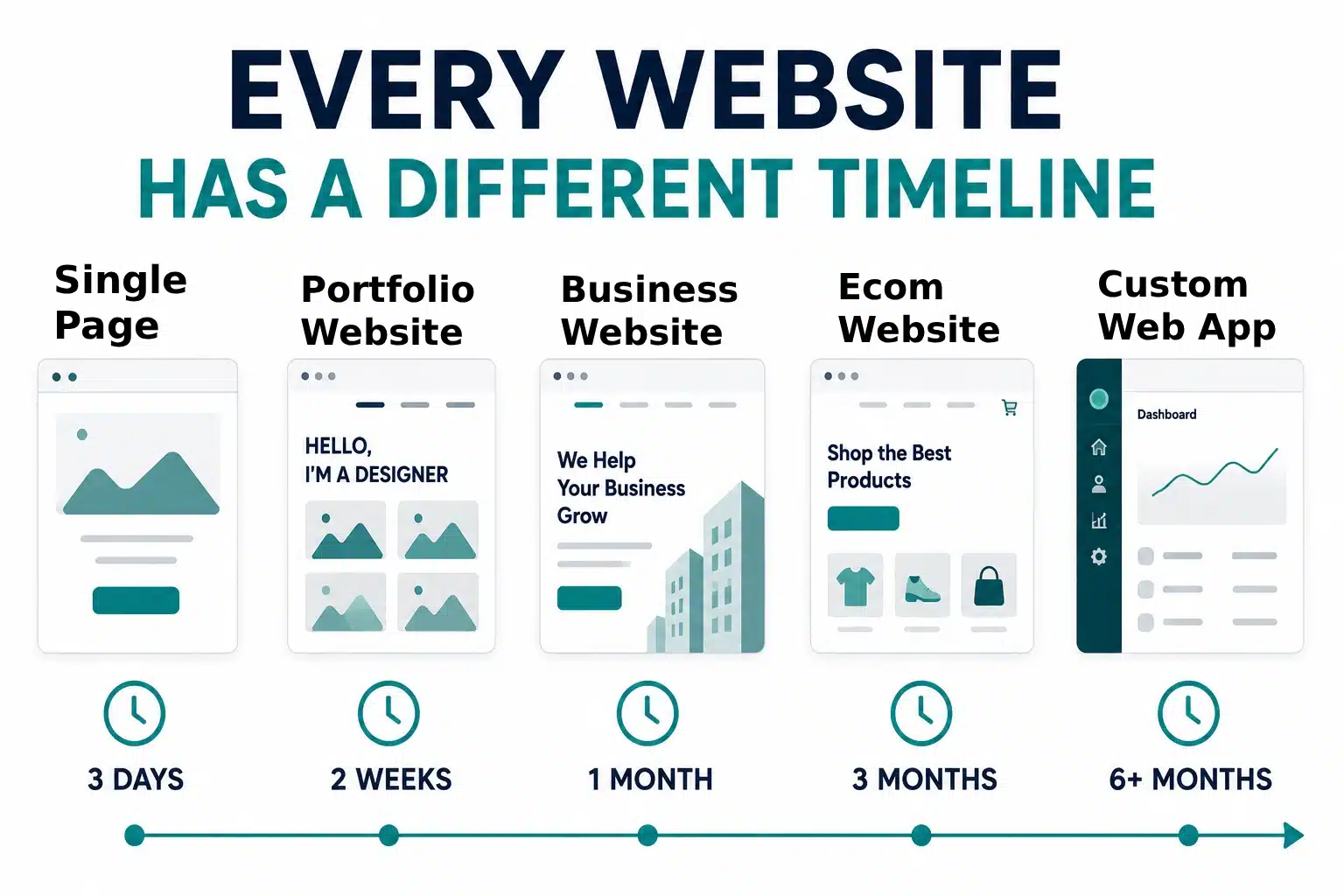
| Website Type | Average Timeline |
| Single Landing Page | 1–5 days |
| Portfolio Website | 1–2 weeks |
| Small Business Website | 2–6 weeks |
| Corporate Website | 6–12 weeks |
| E-commerce Website | 2–4 months |
| Membership Website | 2–5 months |
| Custom Web Application | 4–9+ months |
Single Landing Page Website (1–5 Days)
A single landing page is the fastest type of website to build, and for good reason: it is built for one purpose and one audience. When you know exactly what the page needs to accomplish, the development process is straightforward.
This category includes product launch pages, PPC campaign landing pages, event registration pages, and one-page portfolio sites. Using a website builder like Wix or Squarespace, or deploying a pre-built WordPress template, a professional can have one of these live within a single working day. Building from scratch with a custom design pushes that to three to five days.
The reason these pages come together quickly is structural simplicity. A typical landing page includes a hero section, a primary call to action, a brief service or product overview, social proof in the form of testimonials, and a contact or signup form. There is no backend logic, no multi-page navigation, and no complex integrations to worry about. When your content is already written and your design direction is clear, execution is fast.
Portfolio Website (2–4 Weeks)
A portfolio website is slightly more involved than a landing page, but it can still move quickly when built on the right foundation. Freelancers, designers, photographers, and other creative professionals often build these on Wix, Squarespace, WordPress or SendPlus.
SendPulse can be used to create a basic website using its built-in drag-and-drop website builder. It allows you to design simple single-page or multi-page sites without any coding, using templates and standard content blocks like text, images, and forms. The platform also hosts the site for you and supports custom domains. It’s best suited for small business sites, landing pages, or simple informational websites rather than complex, highly customized projects.
By using any of these platforms, a basic portfolio with template-based design can go live in one to two weeks.
A custom portfolio with original visual design, interactive project displays, or unique layout requirements takes two to four weeks. The additional time accounts for
- Other pages involved (typically an About page, a Projects or Work section, a Services page, and a Contact page),
- The custom visual treatment each project might require, and
- The time needed to upload, organize, and display portfolio assets properly.
Small Business Website (2–6 Weeks)
For small businesses such as law firms, restaurants, clinics, local service providers, and similar businesses, a custom WordPress build is generally the right approach. Website builders may feel tempting for speed, but they limit your SEO flexibility, customization capability, and long-term scalability in ways that tend to create problems down the road.
A properly built small business website typically includes a Home page, an About page, individual Service pages, a Blog, and a Contact page with an inquiry form. The timeline of two to six weeks accounts for SEO setup, mobile optimization, content integration across multiple pages, and basic third-party integrations such as Google Analytics, Search Console, and a CRM or inquiry management tool. For the SEO setup itself, many businesses take help from a b2b SEO agency like Contomatix, which can align keyword strategy with the site structure right from the start.
The range within that window depends primarily on how quickly client feedback is provided and whether content is ready before development begins.
Corporate Website (6–12 Weeks)
Corporate websites serve larger organizations with multiple departments, multiple stakeholders in the review process, and a larger sitemap that may span dozens of pages across several sections. Platforms like WordPress, Drupal, and Kentico are well-suited to projects of this scale.
The additional complexity comes not just from the technical build but from the organizational layer on top of it. Custom UI/UX design aligned with established brand guidelines, an advanced CMS structure that allows different teams to manage their own content areas, and a multi-stakeholder approval process all extend the timeline. In corporate web projects, the approval cycle is consistently the most significant source of delays. A design that a smaller team would approve in two days can take two weeks when it needs sign-off from multiple departments.
Ecommerce Website (2–4 Months)
Ecommerce development is a significant step up in complexity compared to informational websites. Whether you are building on Shopify, WooCommerce, Magento, or BigCommerce, the technical requirements extend far beyond what most people anticipate at the outset.
Beyond designing the storefront, an ecommerce project requires uploading and organizing product data, configuring payment gateways, setting up shipping rules and tax logic, building out product filtering and search functionality, and running thorough checkout testing before launch. Each of these tasks carries its own timeline, and each one is dependent on information provided by the client.
The single most variable factor in ecommerce timelines is product count. A store with 50 products and a single category structure can launch in eight to ten weeks. A store with 500 products across multiple categories, with custom filtering logic and third-party inventory management integration, can take four months or more. Product data migration from an existing platform adds additional time on top of that.
Membership or Subscription Website (2–5 Months)
Membership and subscription websites require backend architecture that most informational websites do not. Online course platforms, paid communities, and subscription content platforms all depend on user authentication systems, subscription billing integration, access control logic, and personalized member dashboards.
Custom development, WordPress with membership plugins, or a purpose-built CMS are the typical approaches. The timeline of two to five months reflects the genuine complexity of these builds. Unlike a standard website where the experience is largely the same for every visitor, membership platforms serve dynamic content based on user identity, subscription tier, and access permissions, all of which must be built, tested, and secured properly.
Custom Web Application (4–9+ Months)
A custom web application is not a website in the traditional sense. SaaS platforms, CRM systems, booking marketplaces, and multi-sided platforms are software products that happen to run in a browser. They are built with technology stacks like React, Node.js, .NET, and Python, and they require the full scope of software development: architecture planning, API design, database engineering, custom dashboards, multi-user role systems, and comprehensive QA and security testing.
Four to nine months is the realistic window for a well-scoped MVP of a custom web application. Larger platforms with complex functionality or significant integrations can take longer. Any estimate shorter than this for a genuinely custom application should be treated as a red flag.
Website Builder or AI-Generated Website
If you are using a website builder or an AI site generator, the timeline compresses significantly because you are working within a pre-structured environment rather than building from scratch.
| Phase | Timeline |
| Creating Information Architecture and Strategy | 1 day |
| Creating Content | 1–2 days |
| Creating Design | 2 days |
| Coding / Configuration | 2–3 days |
| Testing and Launch | 1–2 days |
Total: approximately 7–10 days for a straightforward site. This approach works well for landing pages, personal portfolios, and simple informational sites. It is not the right method for businesses that need strong SEO foundations, custom functionality, or a site that will scale over time.
Timeline and Process for a Customized Website
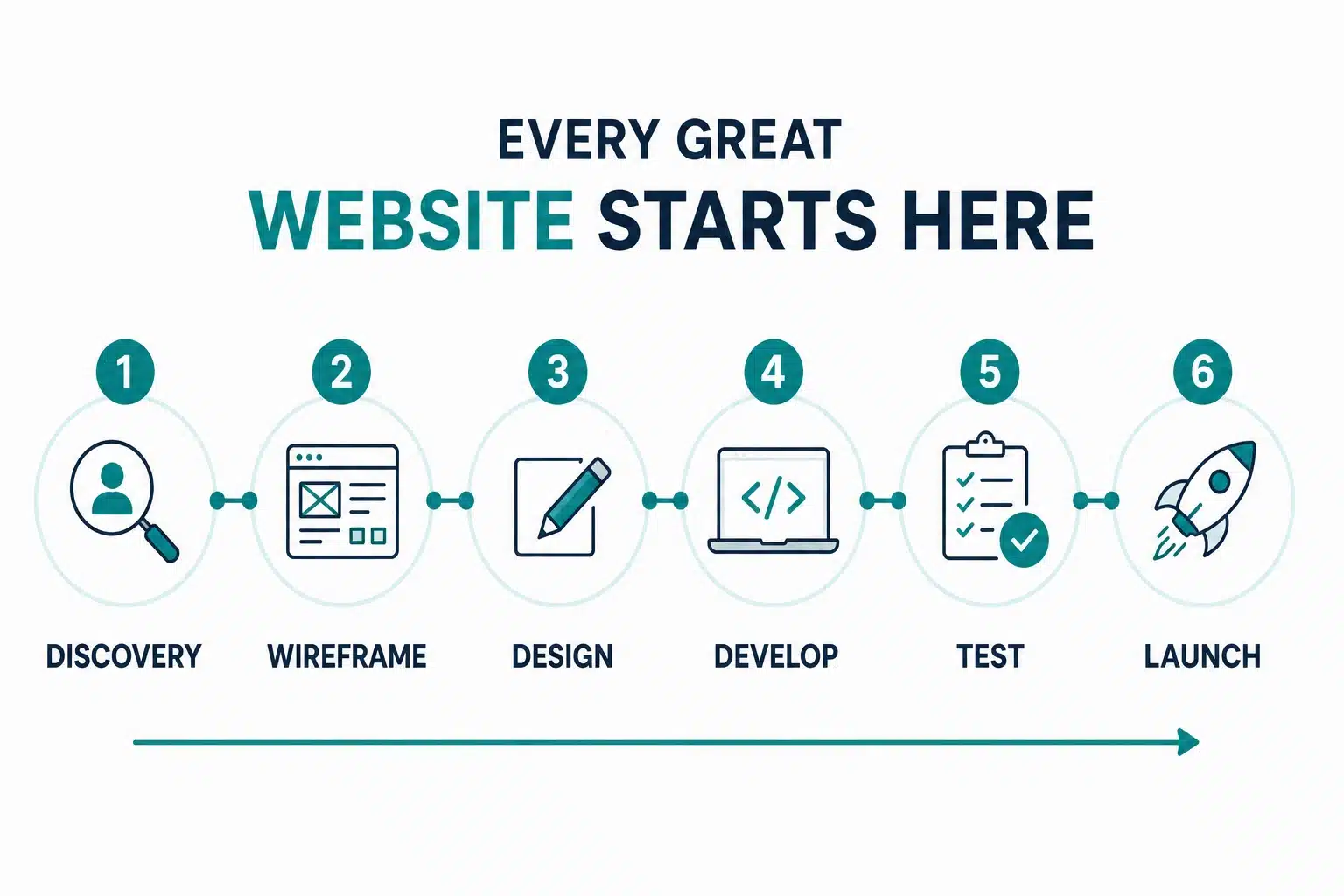
Understanding the distinct phases of a custom web development project shows you exactly where time goes and where the risks of delay are highest.
1. Discovery and Requirement Planning (3–7 Days)
Every well-executed website project begins with a structured discovery phase. This is where the development team, and the client, get clear on what the website needs to accomplish, who it serves, and how success will be measured.
During this phase, the team conducts competitor research, documents business goals, builds out the site’s information architecture, defines the full feature list, and maps the target audience. The output of this phase is a project brief or scope document that prevents misaligned expectations later. Skipping or rushing through discovery is one of the most reliable predictors of project delays and budget overruns.
2. Wireframing and Website Structure (2–5 Days)
Wireframing translates the information architecture into actual page layouts. These are low-fidelity, black-and-white blueprints that define where each element, such as navigation structure, content blocks, CTA placement, and user journey flow, lives on each page without any visual styling applied.
This phase is about usability, not aesthetics. The goal is to confirm that each page makes logical sense for the user before any design effort begins. Resolving structural problems at the wireframe stage costs hours; resolving them after design may extend development through days.
3. UI/UX Design (1–3 Weeks)
Once the wireframes are approved, the design phase begins in earnest. This involves defining or refining the visual identity: color system, typography, spacing, iconography, component styles, and mobile responsiveness. A full-fidelity mockup of each key page is created and reviewed.
The length of this phase depends almost entirely on the number of revision rounds. A decisive client with a clear brand direction can move through design in one week. A project with multiple stakeholders and evolving creative direction can extend this phase to three weeks or beyond. Building a structured feedback process with clear sign-off at each stage is the most effective way to keep design on schedule.
4. Content Preparation (1–3 Weeks)
Content preparation is the phase most frequently underestimated by clients and the one most responsible for project delays. Every page of the website needs a final, approved copy. Every section needs imagery. Product pages need product data. Blog posts need to be written. SEO metadata needs to be defined for every URL.
When clients treat content as something that can be handled after design begins, projects stall. The most effective approach is to begin content preparation during or immediately after the discovery phase, so that text and imagery are ready when development needs them. Content delays are responsible for more missed launch dates than any technical issue.
5. Frontend Development (1–4 Weeks)
Frontend development transforms the approved designs into a functional, responsive website. This phase covers building each page layout in code, implementing responsive behavior across screen sizes, integrating the CMS so content can be managed independently, and adding animations or interactive elements where specified.
The length of this phase scales with the number of pages and the complexity of the design. Template-based builds can move through frontend development in one to two weeks. Fully custom designs with complex layouts and unique interactive elements can take three to four weeks.
6. Backend Development and Integrations (1–6 Weeks)
Backend development covers everything that happens behind the scenes: database architecture, admin panel configuration, payment gateway integration, CRM and API connections, and any custom logic that powers dynamic features. Not every website requires this phase. For example, a simple informational site with a contact form may not have significant backend work beyond basic form handling.
For ecommerce sites, membership platforms, and custom web applications, however, this phase is where the most technically complex and time-consuming work lives. Integrations with third-party services add unpredictability because they depend on external APIs, documentation quality, and testing cycles that extend beyond the development team’s control.
7. Testing and Quality Assurance (3–10 Days)
A website that looks finished is not ready to launch until it has been tested across real-world conditions. This phase includes cross-browser and cross-device testing, form submission testing, speed and performance optimization, and systematic bug fixing.
Mobile testing is particularly important, given that more than half of web traffic is now mobile. A page that renders perfectly in a desktop browser can behave unexpectedly on a phone. Issues such as broken layouts, misaligned elements, and unresponsive interactive components emerge at this stage.
8. Website Launch (1–3 Days)
The launch phase involves moving the site from the development environment to the live server: connecting the domain, configuring hosting, installing the SSL certificate, setting up Google Analytics and Search Console, and running a final check on the live environment. For most projects, this takes one to two days. DNS propagation, server migration complexities, or last-minute content changes can extend this to three days.
Quick Q&A: How Long Does It Take to Redesign a Website?
A website redesign is, in most respects, equivalent to building a new website from scratch. You will need to rethink your information architecture, produce new content, create a new design, and rebuild the site. The fact that a previous site exists does not compress the timeline meaningfully.
The main difference is that a redesign should begin with an audit of the existing site to identify what is working (in terms of SEO, conversion, and content) and what needs to change. This audit informs the new information architecture and content strategy, which makes the discovery phase more data-driven than it would be for a new build.
Trying to “update” rather than “redesign” OR making incremental changes to an outdated structure rarely produces meaningful improvement. If your site’s architecture, positioning, or visual identity needs to change, treat it as a new project.
Factors That Increase Website Development Time
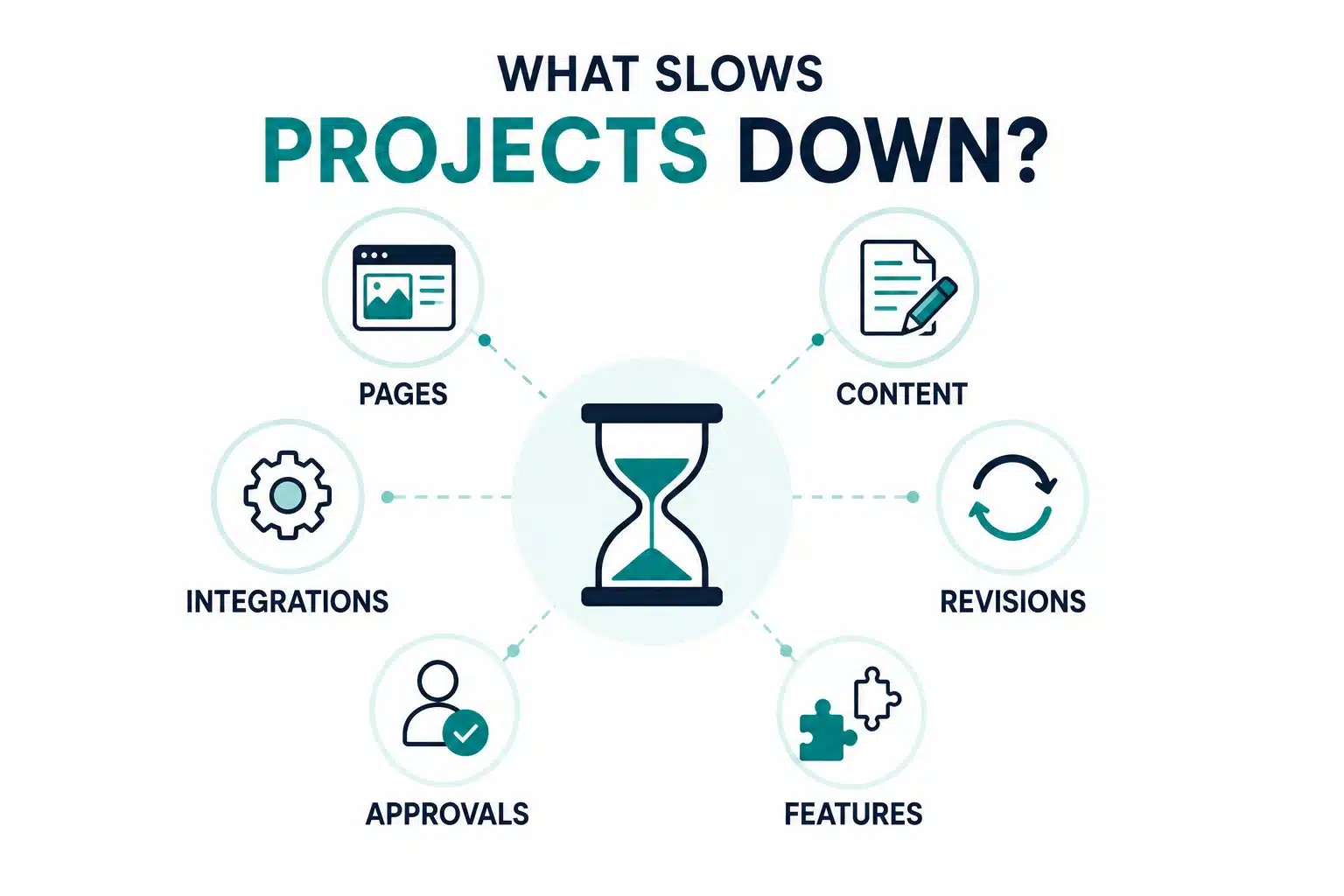
Number of Pages
This is the most direct driver of development time. Each additional page requires design work, development time, and content. These three factors multiply rather than add linearly to the development timeline. A 20-page site is not twice as long to build as a 10-page site; it often takes three times as long once you account for design consistency, navigation structure, and content requirements across every page.
Custom Design Requirements
Custom UI/UX design takes significantly longer than template-based development. When a designer starts from a blank canvas rather than an established template, the process involves more iteration, more rounds of feedback, and more time translating creative direction into implementation-ready specifications.
| Template Website | Custom Website | |
| Development Speed | Faster | Longer |
| Timeline | Shorter | Extended |
| Cost | Lower | Higher |
| Flexibility | Limited | Full customization |
| Scalability | Restricted | Unrestricted |
Advanced Features and Integrations
Every significant feature you add to a website extends the timeline. Booking systems, ecommerce functionality, user dashboards, membership and access control systems, and third-party API integrations each require design, development, and testing time that goes well beyond the core site build. Features that seem simple on paper, such as “I just want users to log in,” often introduce weeks of additional development work when the full scope of authentication, security, and session management is properly considered.
Budget and Development Approach
How you build the site determines how fast it gets built and how well it performs.
A DIY approach using a website builder is the fastest path for simple sites, but it creates limitations in SEO, performance, and extensibility that become costly to work around later. A freelancer offers speed and direct communication for small to mid-sized projects, but a single developer cannot parallelize design, development, and content work the way a team can. A dedicated professional design agency brings the capacity to run multiple phases simultaneously and the experience to anticipate and resolve problems before they become delays. However, agency timelines for complex projects are longer because the process is more thorough.
Content Delays
Content is the most consistently underestimated challenge in website development. When a client has not finalized their copy, gathered their imagery, or approved their product data, development cannot proceed, and the hours lost to waiting cannot be recovered on the back end. The most effective mitigation is to treat content preparation as a parallel workstream that begins at the same time as design, not after it.
Multiple Revision Cycles
Design and development changes requested mid-project are a significant source of timeline extension. Changing the visual direction after mockups are approved, adding features after development has begun, or requesting structural changes after pages have been built all require rework that was not planned into the original schedule. Clear scope documentation and structured approval checkpoints are the most reliable way to prevent this.
Team Size and Expertise
A solo freelancer working on your project part-time will take longer than a five-person agency running full-time sprints. Beyond headcount, experience matters enormously. Senior developers who have built dozens of similar projects will move faster, make fewer errors, and anticipate problems that junior developers encounter as surprises. When evaluating development teams, the difference in timeline between an experienced team and an inexperienced one can be measured in months, not weeks.
Scope Creep
Scope creep, including the gradual addition of features, pages, or requirements that were not part of the original project scope, is one of the most common and most damaging timeline risks. Individual additions often seem small in isolation, but cumulatively they can add weeks to a project. The antidote is a written scope document agreed to before development begins, with a formal change request process for anything added after work starts.
How to Reduce Website Development Time
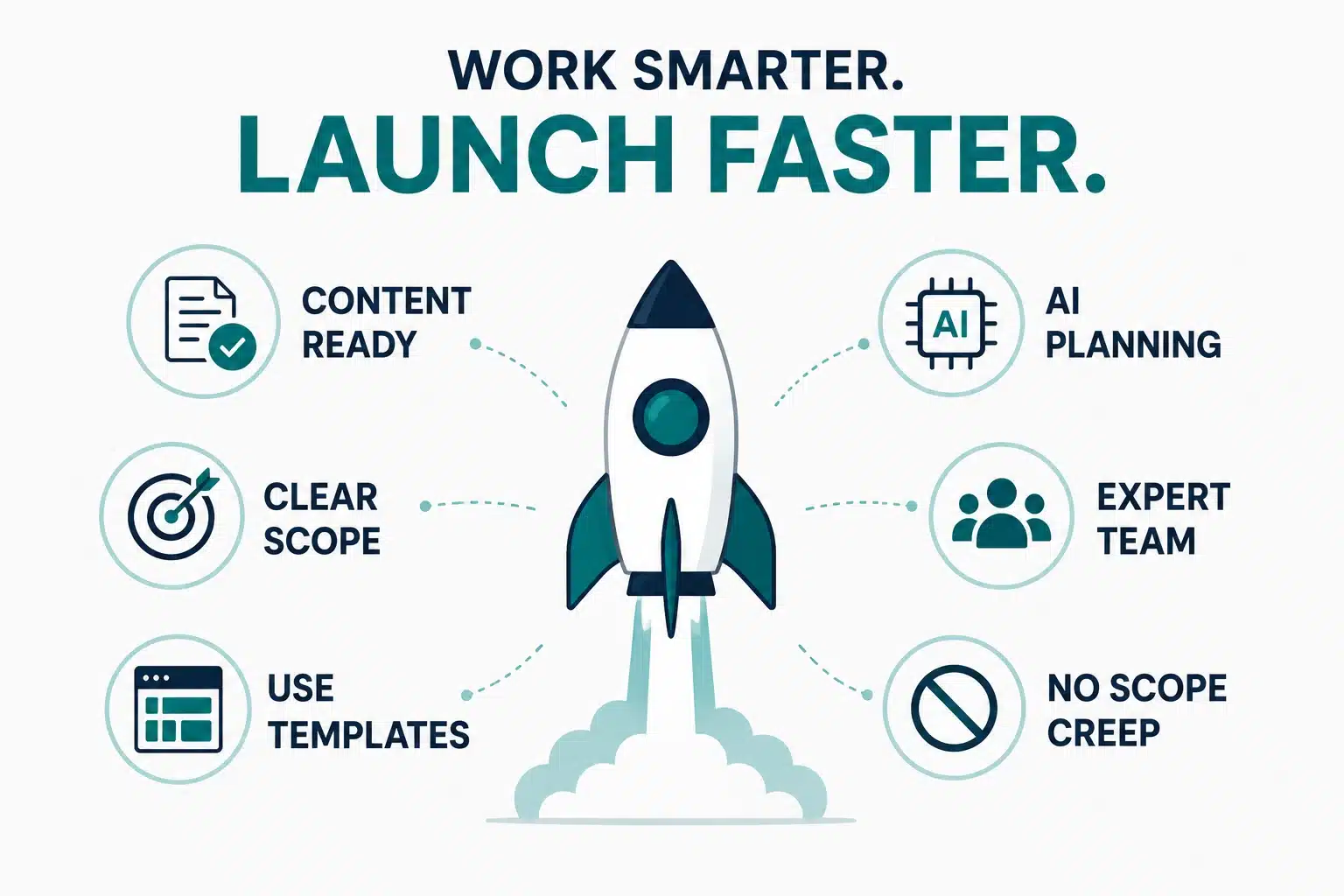
Here are a few tips that can significantly help you reduce the website development time:
Star working on content before the design begins
Write your copy, gather your imagery, and organize your product data before the development team begins. This single action has more impact on your launch date than any other.
Use AI for ideation
AI can accelerate the early planning phase by helping you brainstorm ideas, organize content, and validate your website strategy. Use it to identify the pages your website needs, define a logical information architecture, and generate initial wireframes or prototype mockups that visualize the user experience. While AI won’t replace strategic decision-making, it can significantly reduce planning time and help your team start design and development with greater clarity.
Define Scope in Writing Before Development Starts
A clear, written scope document covering pages, features, integrations, design requirements, and deliverables is the foundation of a project that stays on schedule. Ambiguity in scope leads directly to delays, disputes, and budget overruns.
Use Templates for Smaller Projects
For landing pages, portfolio sites, and small informational websites, a well-chosen template eliminates weeks of custom design work without meaningfully limiting the outcome. Reserve custom design budgets for projects where differentiation genuinely matters to the business.
Avoid Mid-Project Scope Changes
Changes requested after development has begun are disproportionately expensive in both time and cost. Build in a structured feedback cycle at the end of each phase, including wireframes, design, and development. Make all decisions before the next phase begins.
Choose an Experienced Development Team
An experienced team moves faster, makes fewer errors, and builds more robust systems. Prioritize demonstrated experience with your type of project over the lowest quoted rate.
Real Examples of Website Development Timelines
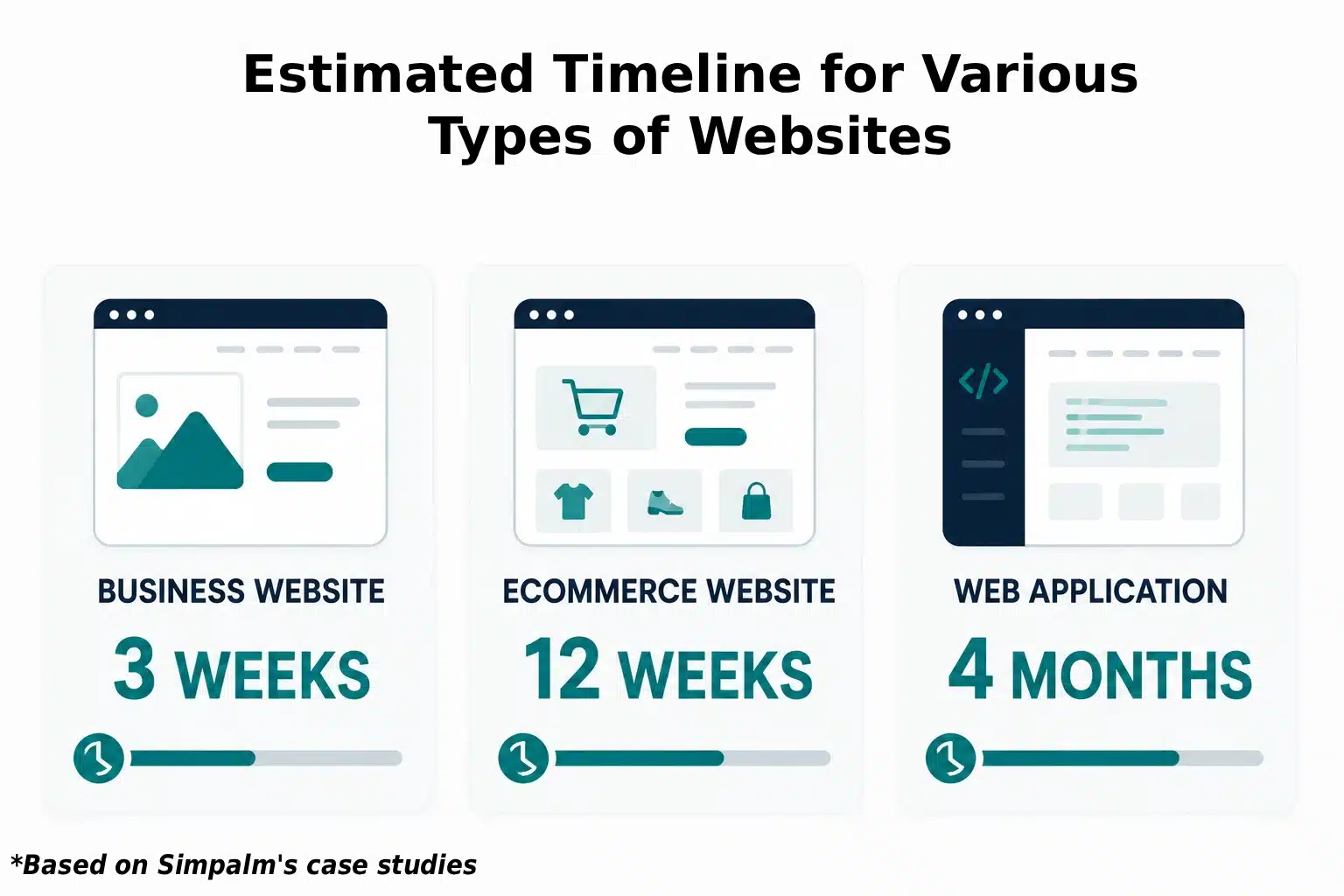
Example 1: Local Business Website (Similar to a Small Law Firm Website)
A local law firm needed a professional five-page website covering their home, about, practice areas, blog, and contact pages. The project used WordPress with a customized template, required no custom backend work, and was built by an experienced developer with content provided by the client at project kickoff.
Timeline: 3 weeks
The project stayed on schedule because content was ready from day one, the client had a clear visual direction, and revisions were consolidated into a single feedback round per phase.
Example 2: Ecommerce Store (Similar to an Allbirds or Gymshark Shopify Store)
A mid-sized retailer needed a Shopify store with approximately 200 products across multiple categories, a custom product filtering system, and integration with their existing inventory management software.
Timeline: 12 weeks
The extended timeline was driven by the product data migration (which required clean-up before import), the custom filtering logic, and the inventory system integration, which required a custom-built Shopify app.
Example 3: Nonprofit Website (Similar to ASRA)
A B2B software company needed a web application with user authentication, a multi-tier subscription model, a custom analytics dashboard, and integrations with three third-party APIs. The tech stack was React on the frontend and Node.js on the backend.
Timeline: 4 months
The timeline was determined primarily by the complexity of the backend architecture, the custom dashboard build, and a rigorous QA and security testing process before launch.
Can a Website Be Built in One Day?
Yes, only a specific type of website, though. A single landing page built on a website builder like Squarespace, Wix, or a WordPress template can go live in one day if the content is already prepared and the design direction is clear. Temporary campaign pages, event registration pages, and basic portfolio pages all fall into this category.
A one-day build is not realistic for any project that involves ecommerce, membership functionality, custom integrations, or a meaningful amount of custom design. These projects require planning, iteration, and testing cycles that cannot be compressed into a single day without producing results that fall short of professional standards.
Final Thoughts
Website timelines are not arbitrary. They are the logical result of scope, complexity, content readiness, and the quality of planning that precedes development. A well-planned project with a clear scope and ready content will consistently launch faster than a project that starts without those foundations, regardless of how experienced the development team is.
The most important decisions you can make before a website project begins are: defining scope of the website, choosing the right development approach for that scope, and committing to having your content ready before the first design mockup is delivered.
If you want a realistic timeline estimate for your specific project, our team at Simpalm can review your requirements and give you a grounded, accurate projection based on real development experience. You can also use our website cost calculator to get a preliminary sense of scope before reaching out.
Frequently Asked Questions
Can you make a website in 3 days?
Yes we can build a single landing page website in this time using a website builder like Wix. However, custom business websites with unique designs, advanced functionality, integrations, or CMS requirements typically take several weeks to ensure quality, performance, and proper testing.
How long does WordPress website development take?
A simple WordPress website built on a customized template typically takes two to four weeks. A custom WordPress build with unique design, advanced page templates, and third-party integrations takes four to eight weeks. Timeline depends heavily on the number of pages, the complexity of the design, and content readiness.
What is the fastest way to build a website?
The fastest way to build a website is to use a website builder like Wix or Squarespace, or to deploy a pre-built WordPress theme, with your content already prepared. Under those conditions, a simple site can launch in two to five days. Speed should be balanced against the site’s long-term requirements: builder-based sites have limitations in SEO performance and extensibility that can create costs later.
Why do custom websites take longer?
Custom websites require design work that starts from scratch rather than from an existing template. Every layout decision, color choice, and component style must be created, reviewed, and refined before development begins. This process produces better results and more unique outcomes, but it takes significantly more time than configuring an existing template. Custom sites also tend to have more complex feature requirements, which adds to both development and testing time.
Is AI replacing web design?
No. AI is transforming web design, not replacing it. It can quickly generate layouts, write content, create images, and speed up prototyping, making the design process more efficient. However, creating a website that aligns with your brand, delivers a great user experience, and supports business goals still requires the expertise of experienced designers and developers.
How long does e-commerce website testing take?
E-commerce testing typically takes one to three weeks, depending on store complexity. Testing must cover payment gateway functionality, checkout flow on multiple devices and browsers, product filtering and search accuracy, shipping and tax calculations, inventory behavior, and security of the transaction process. Skipping or compressing e-commerce testing is a high-risk decision, given the direct revenue impact of checkout failures.
How much time does website content creation take?
Content creation typically takes one to three weeks for a standard business website, but this varies widely based on the number of pages, whether a professional copywriter is involved, and how quickly internal approvals are completed. Product content for ecommerce sites takes longer; large catalogs with hundreds of products can require weeks of data preparation alone. Starting content creation at the beginning of the project, rather than after design, is the most reliable way to avoid content-driven delays.
How long does it take to build a website using custom coding?
Building a website entirely with custom HTML, CSS, and JavaScript is the most time-intensive approach. A small informational site built this way takes four to eight weeks. Any site with dynamic content, user authentication, or a database backend requires several months. Custom code from scratch is typically reserved for highly specialized performance-critical applications where no existing platform meets the requirements. For most business websites, a CMS-based build delivers a better outcome in significantly less time.