
 Design
 App Development
 Web Engineering
 AI Services
 Cloud
 Staffing
 Startups
 Health / Fitness
 Education
 Social
 Nonprofit
 Fintech
 Construction
 Logistics
 Government
 Travel/Hospitality
 HR Software
 About Simpalm
 Our News
 Client Testimonials
 Careers
 Our Blog
 Awards
 Resources
 Information
Key Takeaways
- Start AI adoption with low-risk administrative tasks. Scheduling, patient intake, and routine billing workflows offer practical starting points for healthcare organizations.
- Match AI autonomy to the risk of each task. Use human approval for higher-risk decisions and allow independent action only within defined limits.
- Address compliance and AI-related regulations before integrating AI into healthcare. Healthcare organizations must protect patient data, secure required business associate agreements, and prepare for applicable CMS requirements.
- Measure operational improvements against a baseline. Track denial rates, no-shows, wait times, days in accounts receivable, and overtime to verify results.
- Use a 90-day pilot to validate AI integrations in your healthcare business before scaling. Define success measures, put it to test in one department, review results, and expand only when the evidence supports it.
_________________________________________________________________________________________
In the healthcare sector, paperwork is one of the most time-consuming processes and adds to operating costs as well. The 2025 CAQH Index found that U.S. healthcare avoided an estimated $258 billion in administrative costs in 2024 through electronic transactions. It also identified another $21 billion in savings that stay out of reach until manual and partially manual transactions are fully automated. AI is now the main tool aimed at that gap.
This guide explains where AI delivers value in healthcare operations, how to pick a first project, how much autonomy to grant, and how to launch within 90 days.
What Counts as AI in Healthcare Operations?
AI in healthcare operations means software that learns from data to automate or improve the administrative and logistical work of running a care organization. It works behind the scenes by filling calendars, checking claims, forecasting staffing, and routing calls. It does not diagnose patients or recommend treatment. That work belongs to clinical AI, which carries a different regulatory burden.
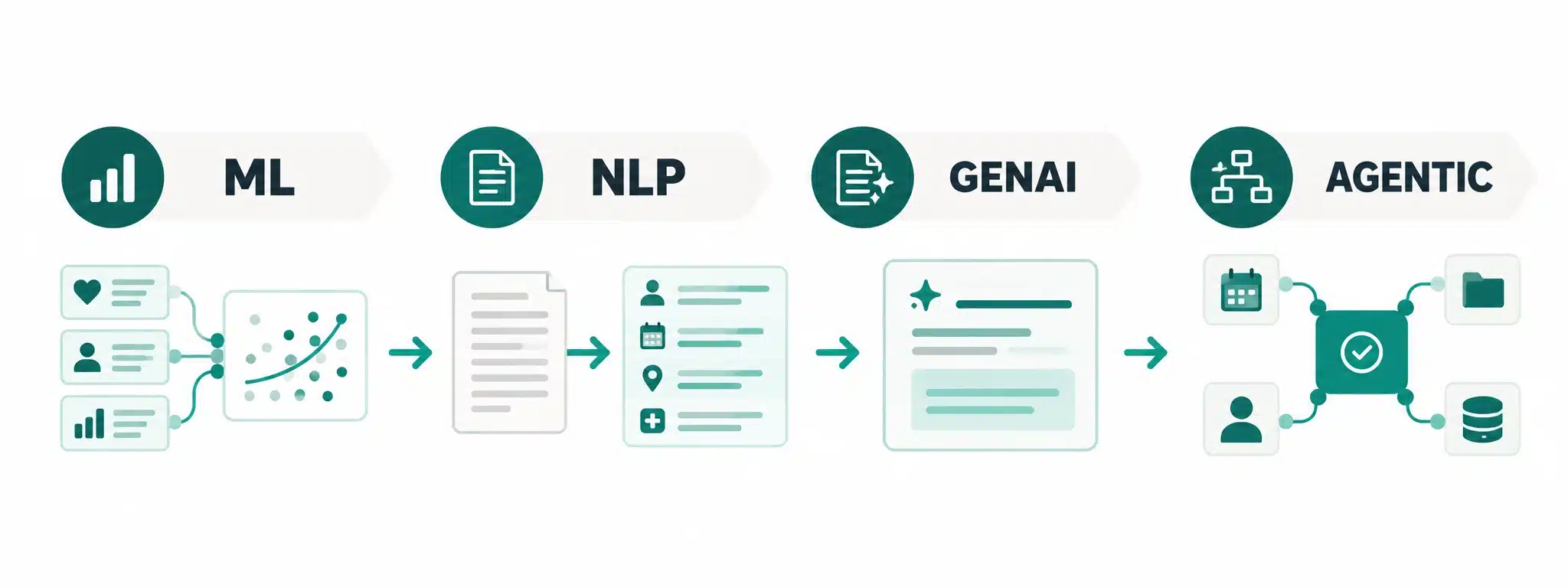
Four technology types appear in most operational projects:
- Machine learning: Finds patterns in historical data to predict outcomes such as no-shows, claim denials, or patient volume.
- Natural language processing: Reads and structures free text from faxes, referrals, call transcripts, and notes so downstream systems can use it.
- Generative AI: Drafts content such as appeal letters, patient messages, and call summaries, usually with a person reviewing the result.
- Agentic AI: Plans and carries out multistep tasks across systems, such as checking eligibility, submitting a request, and following up on its status.
These categories often work together. A single intake workflow might use language processing to read a referral, machine learning to predict the right appointment length, and an agent to book the visit.
Where Does AI Pay Off in Operations?
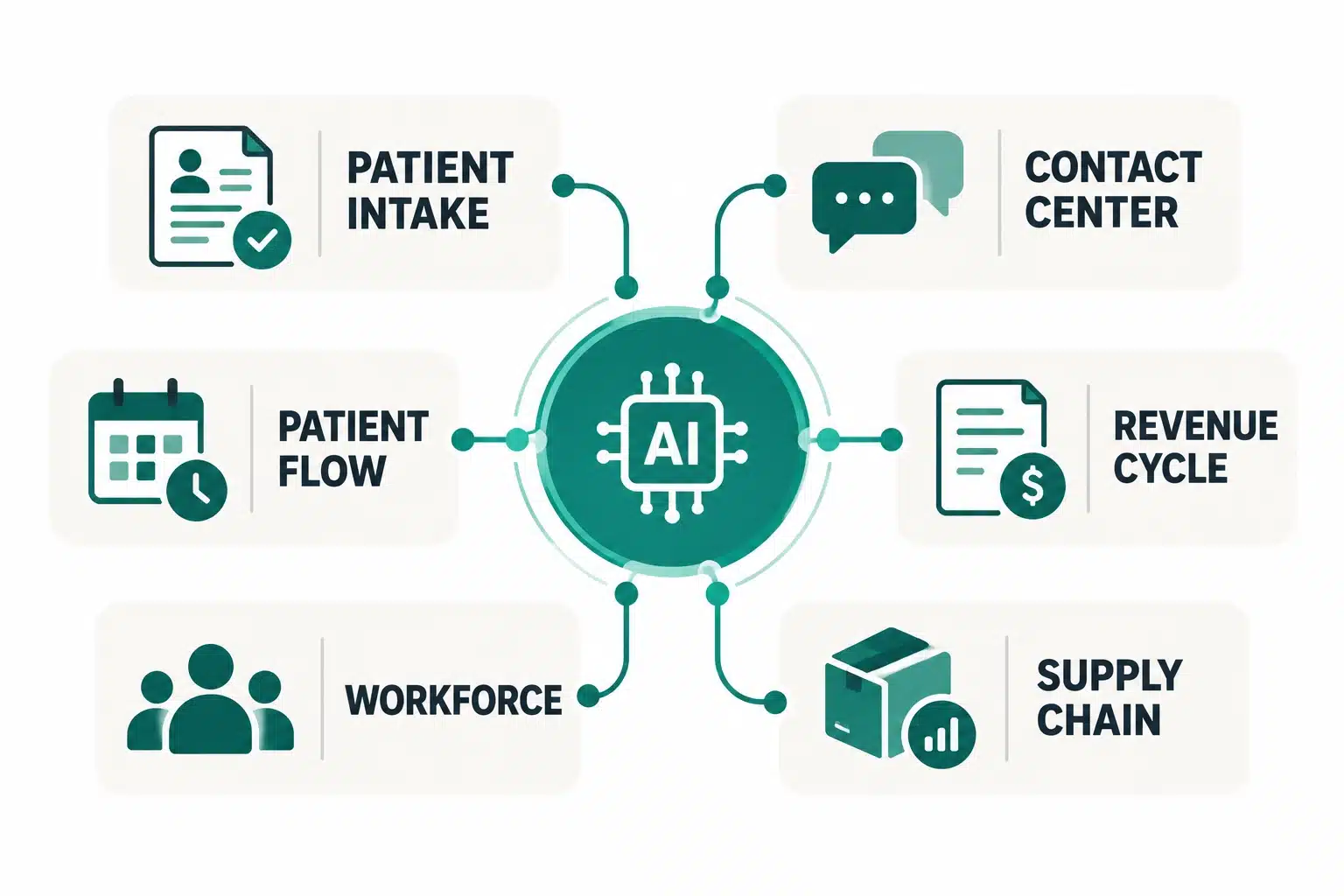
Operational AI delivers the strongest results where work is high in volume, heavy on rules, and repetitive. The six areas below are where healthcare organizations most often begin.
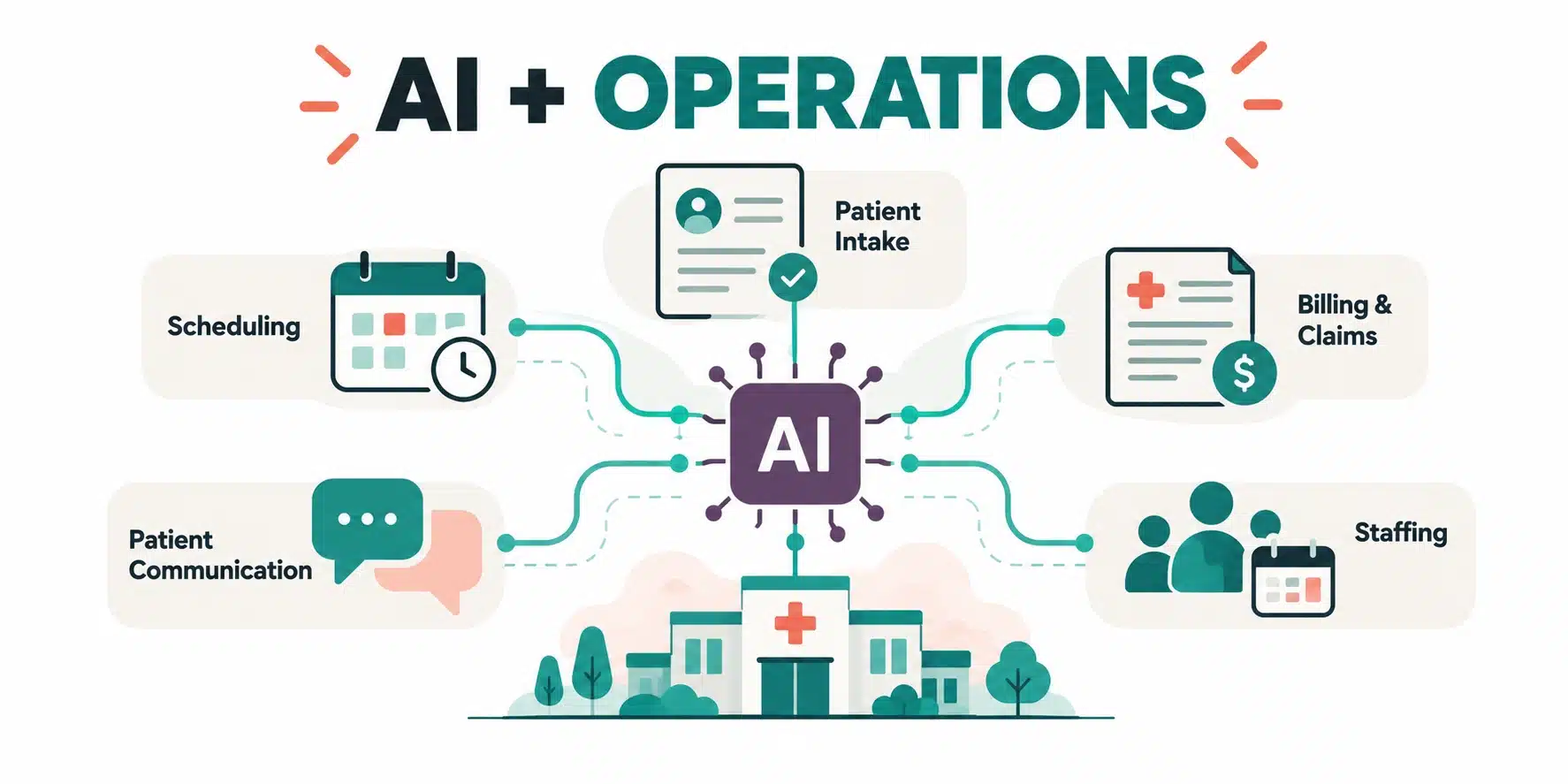
Patient Intake and Scheduling
Patient intake and appointment scheduling are often the first touchpoints in a patient’s care journey. When these processes rely on manual paperwork and outdated scheduling systems, they create delays, increase administrative workload, and lead to a poor patient experience. AI streamlines these front-office operations by automating routine tasks, improving scheduling accuracy, and ensuring patients receive timely care.
- Digital intake: Patients complete registration and medical history forms on their phones before arriving, while AI automatically extracts and organizes the information into the EHR, eliminating manual data entry.
- Smart booking: AI matches appointment types with the right providers, available time slots, and visit durations to optimize schedules, reduce gaps, and minimize double bookings. Teams building custom solutions can also explore Simpalm’s guide to healthcare appointment scheduling app development.
- No-show prediction: AI analyzes historical attendance patterns and patient behavior to identify at-risk appointments, enabling automated reminders, confirmations, or waitlist backfills.
- Referral and document processing: AI-powered document processing extracts information from referrals, insurance cards, and other medical documents, then routes them to the appropriate department or workflow without manual intervention.
Front Desk and Contact Center
Front desk teams and contact centers manage a constant stream of patient inquiries, appointment requests, and administrative tasks. Handling every interaction manually can lead to long wait times, overwhelmed staff, and inconsistent patient experiences. AI helps automate routine conversations, streamline call handling, and ensure patients receive quick, accurate support while allowing staff to focus on more complex requests.
- Voice and chat assistants: AI-powered virtual assistants handle common requests such as appointment booking, prescription refill inquiries, directions, and FAQs. When a case requires human intervention, the conversation is seamlessly transferred to staff along with a summary of the interaction.
- Call summarization: AI automatically generates concise summaries of every patient call, captures key discussion points, and creates follow-up tasks, reducing documentation time for administrative teams.
- Multilingual support: Real-time language translation enables healthcare providers to communicate effectively with patients who speak different languages, improving accessibility and delivering a consistent patient experience.
- Intelligent routing: AI analyzes the caller’s intent and automatically directs them to the appropriate department, specialist, or support team, minimizing transfers, reducing hold times, and improving first-call resolution.
Revenue Cycle and Prior Authorization
Revenue cycle management directly impacts a healthcare organization’s financial health, making it one of the most valuable areas for AI adoption. From verifying insurance coverage to processing claims and managing prior authorizations, AI reduces administrative bottlenecks, minimizes costly errors, and accelerates reimbursement. The result is a more efficient billing process, fewer denied claims, and improved cash flow.
- Eligibility and coverage checks: AI verifies patient insurance eligibility and coverage before appointments, identifying potential issues early so they can be resolved before services are provided.
- Coding support and claim scrubbing: AI reviews medical documentation, suggests accurate billing codes, and identifies missing information or coding errors before claims are submitted, reducing the likelihood of denials.
- Denial management: AI analyzes denied claims, prioritizes appeals based on recovery potential, and generates supporting documentation to improve appeal success rates and reduce revenue loss.
- Prior authorization: AI automates the collection of required clinical documentation, submits authorization requests, and tracks approval status across multiple insurance providers, reducing administrative delays.
- Payment posting and reconciliation: AI matches insurance remittances with submitted claims, identifies payment discrepancies or underpayments, and flags issues that require further investigation.
Editor’s Note: Revenue cycle projects tend to produce the clearest financial evidence because every claim ends in a paid, denied, or reworked state. That clean outcome makes before-and-after comparison simple.
Workforce Scheduling
Effective workforce scheduling is essential for maintaining quality patient care while controlling labor costs. However, balancing patient demand, staff availability, and compliance requirements can be challenging when managed manually. AI helps healthcare organizations create smarter schedules by forecasting staffing needs, optimizing shift assignments, and ensuring workforce compliance.
- Demand forecasting: AI analyzes historical patient volumes, seasonal trends, and operational data to predict staffing requirements for different departments and shifts, helping organizations avoid both understaffing and overstaffing.
- Shift matching: AI automatically assigns open shifts based on staff qualifications, licensure, availability, scheduling preferences, and overtime policies, improving workforce utilization while reducing scheduling conflicts.
- Credential tracking: AI continuously monitors employee licenses, certifications, and compliance requirements, sending alerts before expirations occur to prevent staffing disruptions and ensure regulatory compliance.
Patient Flow and Capacity
Efficient patient flow is critical to delivering timely care and maximizing the use of hospital resources. When admissions, discharges, operating rooms, and patient transfers are not well coordinated, delays can quickly spread across multiple departments. AI improves hospital capacity management by predicting patient movement, optimizing resource allocation, and reducing operational bottlenecks.
- Bed and discharge forecasting: AI predicts likely discharge times based on patient progress and clinical data, allowing care teams to prepare beds earlier and reduce emergency department boarding and admission delays.
- Operating room utilization: AI analyzes surgical schedules, historical procedure durations, and real-time updates to recommend operating room block adjustments and identify cases that are likely to exceed their scheduled time.
- Transfer and transport coordination: AI coordinates patient transfers, transport requests, and room cleaning activities to streamline bed turnover, reduce waiting times, and improve overall hospital capacity.
Supply Chain and Equipment Uptime
Healthcare providers rely on a continuous supply of medical inventory and fully operational equipment to deliver uninterrupted patient care. Stock shortages, expired supplies, or unexpected equipment failures can delay treatments, increase operational costs, and impact patient outcomes. AI helps healthcare organizations optimize inventory management, improve equipment reliability, and maintain smooth day-to-day operations.
- Inventory forecasting: AI analyzes historical consumption patterns, patient demand, and seasonal trends to predict inventory needs accurately, reducing stockouts, minimizing expired supplies, and lowering carrying costs.
- Predictive maintenance: AI continuously monitors data from medical devices such as imaging systems, ventilators, and infusion pumps to detect early signs of failure, enabling proactive maintenance before equipment breakdowns disrupt patient care.
- Automated reordering: AI tracks inventory levels in real time and automatically generates purchase requests when forecast-based thresholds are reached, ensuring critical supplies remain available while reducing costly emergency orders and manual procurement efforts.
Across all six areas, the pattern is the same. AI absorbs the repetitive first pass, and people keep the judgment calls.
Which Use Case Should You Start With?
The table below scores each use case on four factors with a simple High, Medium, or Low rating. Treat the ratings as starting assumptions and adjust them for your own data and risk tolerance.
| Use Case | Impact | Risk | Data Readiness | Time to Value |
| Patient intake and scheduling | Medium | Low | High | Short |
| Front desk and contact center | Medium | Medium | Medium | Medium |
| Revenue cycle and prior authorization | High | Medium | Medium | Medium |
| Workforce scheduling | Medium | Low | Medium | Medium |
| Patient flow and capacity | High | Medium | Low | Long |
| Supply chain and equipment uptime | Medium | Low | Low | Long |
Intake and scheduling combine low risk with ready data, which makes them a gentle first project. Revenue cycle offers the largest dollar impact but needs careful handling of payer rules.
Patient flow has high impact, yet it depends on real-time feeds from several systems, so it often works best as a second-wave project.
How Much Autonomy Should AI Have in Healthcare Operations?
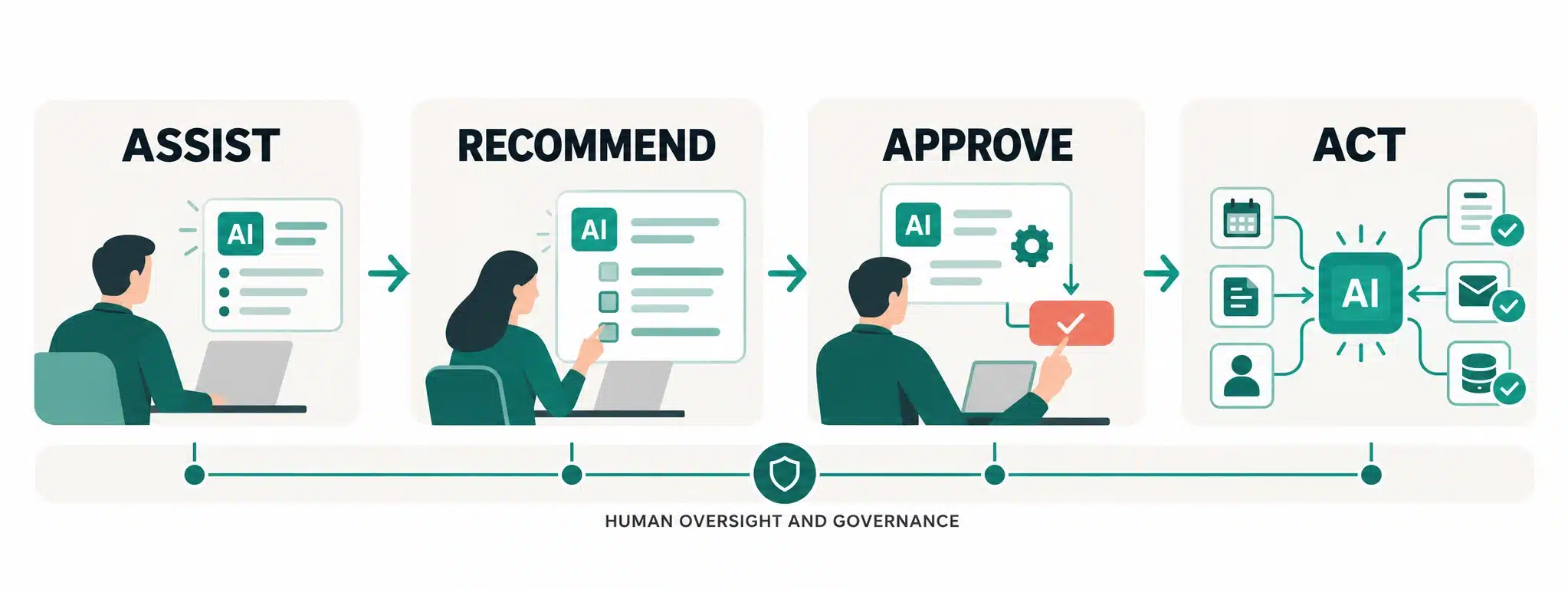
Autonomy is an operational decision, not a product feature. The right level depends on the task, and a single system can operate at different levels of autonomy for different jobs. The table maps four levels, what AI does, its example tasks, and the required human role.
| Level | What AI Does | Example Task | Human Role |
| Assist | Surfaces information | Pulls eligibility data for a staff member | Makes every decision |
| Recommend | Suggests the next step | Drafts a denial appeal letter | Accepts, edits, or rejects |
| Act with approval | Prepares and executes after sign-off | Submits a prior authorization request once a reviewer approves | Approves each action |
| Act alone | Executes within set limits | Sends appointment reminders | Audits samples and exceptions |
The same workflow can span several levels. In prior authorization, AI might help gather documents, recommend a submission packet, and act alone only for routine status checks. Mapping each step separately keeps risk proportional to the task.
Unlike a chatbot, an agent can plan steps and take actions. Readers who want the technical picture can review what AI agents are and how they are built.
To keep agentic workflows under control, build in four safeguards from the start:
- Escalate uncertain results: Send tasks to a staff member when the AI lacks confidence in its output.
- Create a clear review process: Route unresolved cases to a central queue where staff can review and handle them.
- Keep an audit trail: Record what the AI did, what information it used, and who approved each action.
- Provide a stop mechanism: Let supervisors pause the workflow immediately if the AI produces incorrect results.
Which Compliance Rules Come First in Healthcare Platforms?
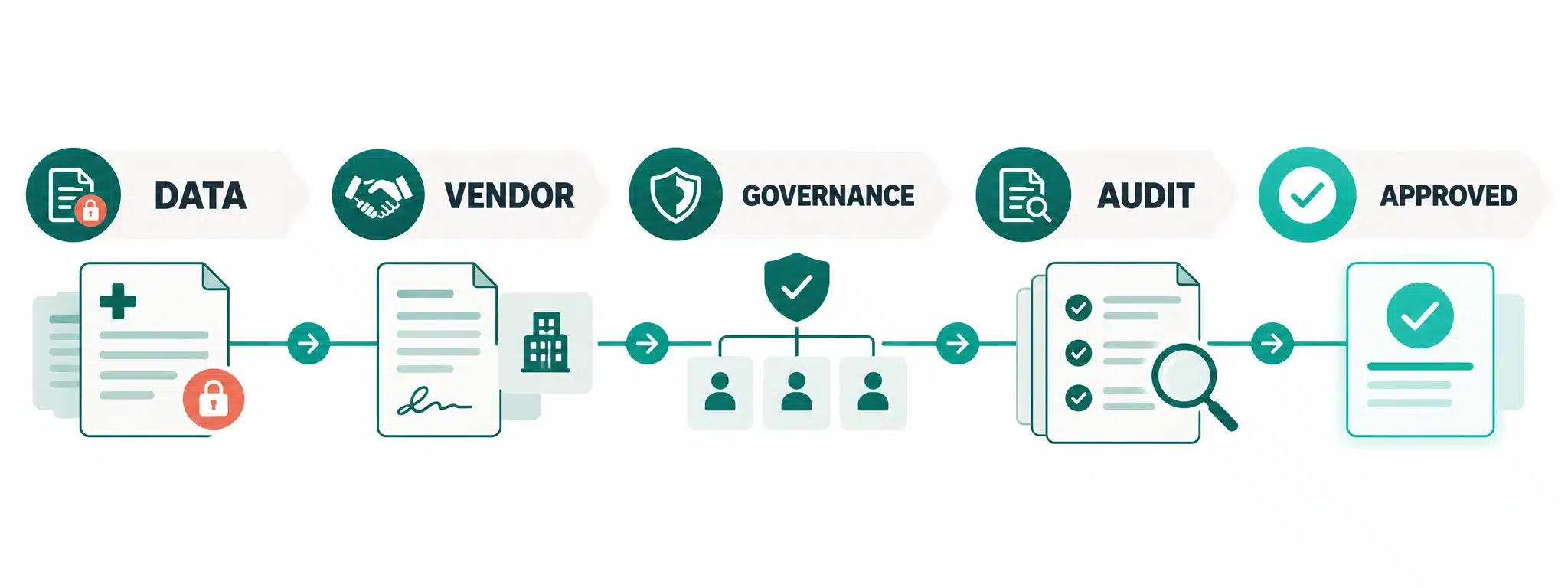
Compliance should be planned right from the start. Here are four key areas that deserve attention before launch:
- HIPAA and business associate agreements: An AI vendor that creates, receives, maintains, or transmits protected health information on your behalf is a business associate, and the agreement must be signed before any data is shared. Negotiate clear terms on model training, data retention, and subcontractors. Teams that have worked through these questions in other regulated products, such as the workflows in Simpalm’s medicine delivery app development guide, will recognize the pattern.
- PHI exposure in everyday tools: Staff who paste patient details into a free chatbot may be sending data to a vendor with no agreement at all. Keep an inventory of approved AI tools, prohibit the rest, and share only the minimum necessary information.
- CMS prior authorization timeline: Since January 1, 2026, impacted payers must send prior authorization decisions within 72 hours for expedited requests and seven calendar days for standard requests, excluding drugs. The FHIR-based Patient Access, Provider Access, Payer-to-Payer, and Prior Authorization API requirements take effect January 1, 2027, which is less than three months away.
- Internal governance: Name an owner for each AI system, document its intended use, and review it whenever the vendor changes the underlying model.
- Documentation for audits: Keep records of vendor agreements, risk assessments, and staff training so you can answer regulator or payer questions quickly.
What Rollout Challenges Can One Face?
As organizations move from planning to deployment, these five problems appear most often (we have covered each with a fix).
- Data silos – Scheduling, billing, and clinical records sit in separate systems, so AI sees only part of the picture. Fix: Start with one workflow whose data lives in two or three systems, establish a shared patient identifier, and use standards-based APIs instead of file exports.
- Staff resistance – Employees worry about job security, or they distrust output they cannot check. Fix: Involve front-line staff in design, show them the time saved, make overrides easy, and position AI as the tool that removes the tasks they dislike most. Providing effective AI training for employees can help healthcare organizations build staff confidence, strengthen trust in AI-generated outputs, and equip teams with the skills to use AI tools responsibly while maintaining human oversight.
- Pilot stall – A pilot works in one clinic but never reaches the rest of the organization because nobody owns the next step. Fix: Define scaling criteria before the pilot begins, name an executive sponsor, and budget for integration and support rather than licenses alone.
- Vendor lock-in – Workflow logic, prompts, and data formats end up trapped inside a single product. Fix: Contract for data portability and export rights, prefer open APIs, and keep your workflow documentation in your own repository.
- Model drift – Payer rules, coding guidelines, and patient behavior change, and accuracy quietly declines. Fix: Monitor accuracy monthly, set alert thresholds, and schedule regular tuning or retraining.
Most of these problems are predictable, which means they are also preventable. Reviewing this list at project kickoff costs an hour and can save months.
Which Metrics Prove AI Is Working?
To determine whether AI is improving healthcare operations, compare key performance metrics before and after implementation. Record a baseline for 60 to 90 days before launch, then track the following measures to identify improvements and areas that still need attention.
| Function | Core KPI | What It Tells You | Target Direction |
| Revenue cycle | Denial rate | How often claims fail on first submission | Down |
| Revenue cycle | Days in A/R | How quickly cash is collected | Down |
| Scheduling | No-show rate | How well reminders and waitlists fill the calendar | Down |
| Patient access | Wait time | How long patients wait for a call or an appointment | Down |
| Workforce | Overtime hours | How closely staffing matches demand | Down |
| Contact center | First-contact resolution | How many requests are finished without a transfer | Up |
| Supply chain | Stockout incidents | How often missing items disrupt care | Down |
What Does a 90-Day Rollout Look Like?
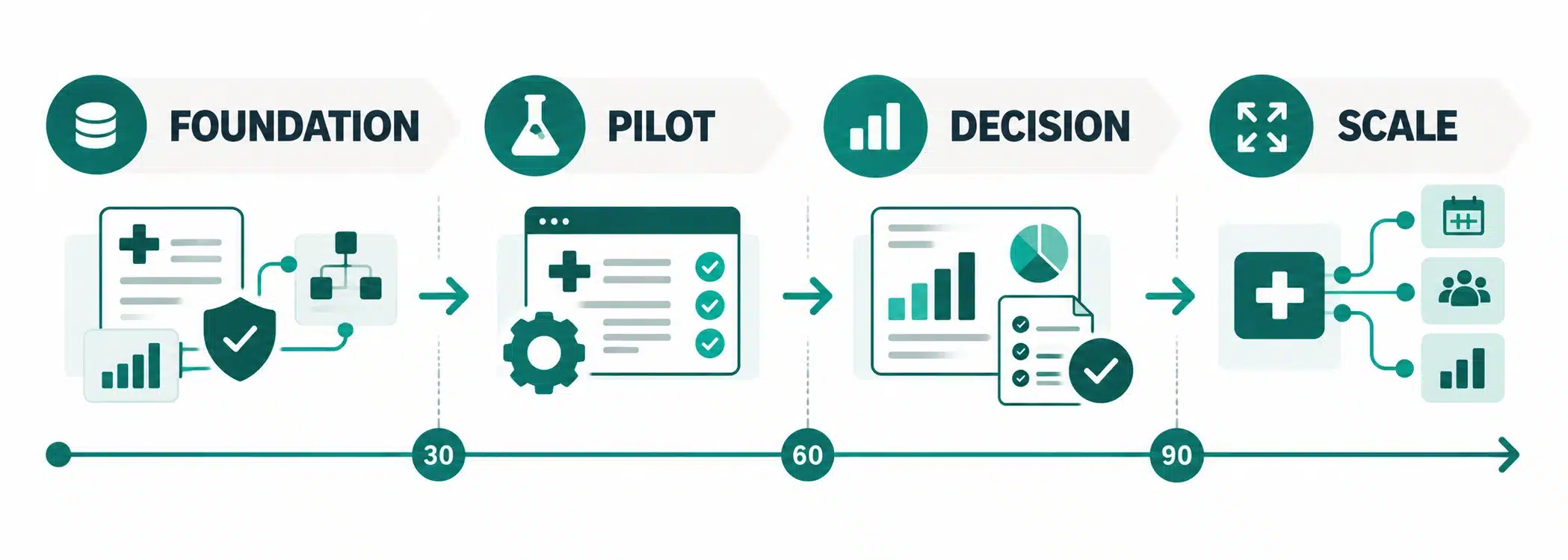
Healthcare organizations can evaluate AI in 90 days by starting with one use case, testing it in a controlled setting, and measuring the results before expanding. Each phase has a clear goal, from preparing the data and safeguards to deciding whether the pilot is ready to scale.
- Days 1 to 30, Foundation: Choose the use case with the scoring table, name an owner, record baseline metrics, complete vendor and agreement review, and audit the data the workflow depends on.
- Days 31 to 60, Pilot: Launch in one department or clinic at the recommended level of autonomy, review errors and overrides weekly, and gather staff feedback.
- Days 61 to 90, Decision: Compare results to the baseline, fix the main issues, and decide whether to scale, adjust, or stop. Write down what you learned and select the next use case.
- After Day 90, Scale: Extend to additional sites in waves, keep the review cadence, and reassess autonomy levels as accuracy data builds up.
Final Thoughts
Healthcare has spent decades layering digital systems onto manual processes. AI is the next layer, and it is beginning to behave less like a special project and more like infrastructure, comparable to the billing system or the EHR itself. Organizations that treat it that way will plan for uptime, ownership, measurement, and retirement just as they do for any other critical system. In that sense, the question for healthcare leaders is shifting from whether to use AI to how well it is run.
The real advantage will come from discipline rather than speed. Patients feel the result as shorter waits and clearer communication, and staff feel it as time returned to the work that needs a human being. The path there starts with one well-chosen use case, honest limits on autonomy, and metrics that tell the truth. If you are weighing where to begin, Simpalm’s AI strategy consulting team can help you score use cases, map integrations, and plan a pilot that fits your compliance requirements.
Frequently Asked Questions
Q1. How is AI in healthcare operations different from clinical AI?
Ans. Operational AI supports the business of delivering care, including scheduling, billing, staffing, supplies, and patient communication. Clinical AI supports decisions about diagnosis and treatment. The distinction matters because clinical tools face stricter validation and oversight, while operational tools can often be deployed faster and judged by cost, speed, and accuracy. Many organizations begin with operations to build confidence and governance habits before they consider clinical applications. For example, a tool that predicts no-shows can be judged on schedule fill rate, while a tool that suggests a diagnosis must be judged on clinical accuracy and patient safety.
Q2. Do we need to replace our EHR to use operational AI?
Ans. In most cases, the answer is no. Many tools connect through standards-based interfaces or through modules your current vendor already offers. What you do need is reliable data access and a way to write results back to the system of record. If your EHR cannot expose the data a workflow needs, address that gap first, because even a strong AI tool performs poorly when it works from partial information.
Q3. How long does it take to see results?
Ans. A narrow pilot can show movement on targeted measures within about 90 days, particularly for turnaround times, no-show rates, and call handling. Financial measures such as days in A/R take longer to reflect because they depend on payer cycles. Set expectations accordingly, and agree on the baseline and the review schedule before launch so that early results are judged fairly. A useful habit is to report one leading indicator, such as handling time, alongside one lagging indicator, such as cash collected, so leaders see progress early.
Q4. Is it safe to use patient data with AI tools?
Ans. It can be, provided the right protections exist. The vendor must sign a business associate agreement, restrict how your data is used, and support access controls and audit logging. Your organization must also train staff and block unapproved tools. A signed agreement alone does not make an application compliant, so treat vendor terms, internal policy, and technical safeguards as parts of one program.
Q5. Will AI replace administrative staff?
Ans. The more common pattern is a redistribution of work. AI handles repeatable steps such as data entry, reminders, and first-pass claim checks, while staff handle exceptions, patient conversations, and oversight. Organizations that frame the project as relief from backlog and overtime tend to earn more cooperation than those that frame it as headcount reduction. Training people to supervise and improve AI output becomes a valuable skill in its own right.