 Design
 App Development
 Web Engineering
 AI Services
 Cloud
Cloud Staffing
 Startups
 Health / Fitness
 Education
 Social
 Nonprofit
 Fintech
 Construction
 Logistics
 Government
 Travel/Hospitality
 HR Software
 About Simpalm
 Our News
 Client Testimonials
 Careers
 Our Blog
 Awards
 Resources
 Information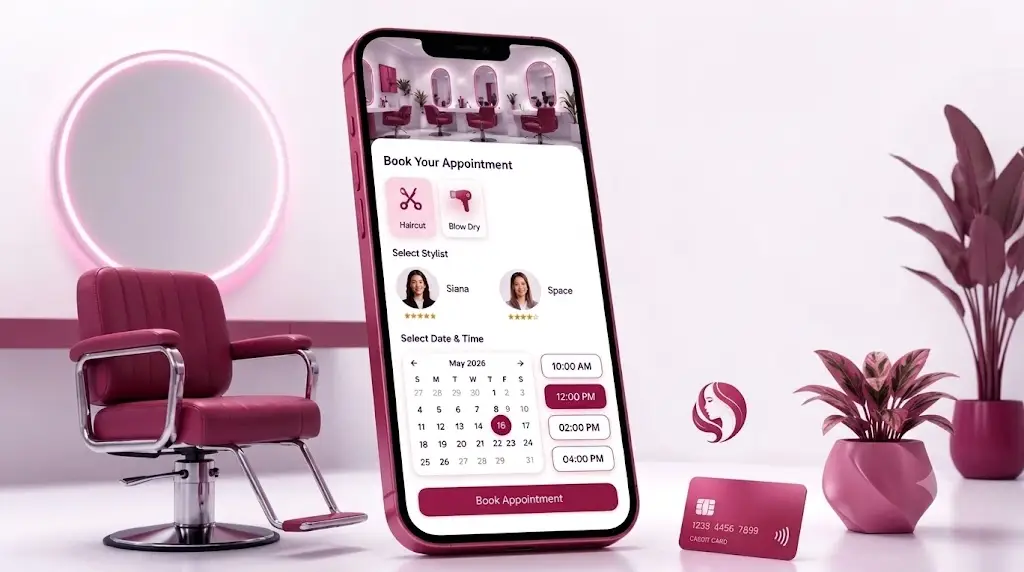
Key Takeaways
- The salon booking software market is growing steadily, with the beauty and wellness industry shifting rapidly toward digital scheduling rather than phone calls and walk-ins.
- Salon booking apps are not one product. A single salon app, a multi-location chain app, and a marketplace app that connects clients to many salons each need a different feature set and business model.
- The features that matter most reduce no-shows and friction, such as automated reminders, transparent service menus, and easy rebooking.
- Payment security and client data privacy shape how the app must be built, especially since it stores payment details and personal client history.
- Cost and timeline depend heavily on whether you are building for one location, a multi-location chain, or a marketplace connecting many independent salons.
________________________________________________________________________________________
Booking a haircut used to mean calling the salon, hoping someone picked up, and hoping your preferred stylist had an open slot. Today, apps like Fresha, Vagaro, and StyleSeat let clients see real-time availability, pick a specific stylist, and book a service in under a minute, all without a phone call. This shift has turned salon booking into one of the most active corners of local services technology, and it has created real opportunities for salon owners, chains, and independent developers building their own booking platforms.
This guide covers what a salon booking app actually is, the different types you can build, the features that matter most, the tech stack behind a modern booking app, the development process, security and compliance considerations, realistic costs, the team you need, and how some of the best-known salon apps built their businesses.
What is a Salon Booking App?
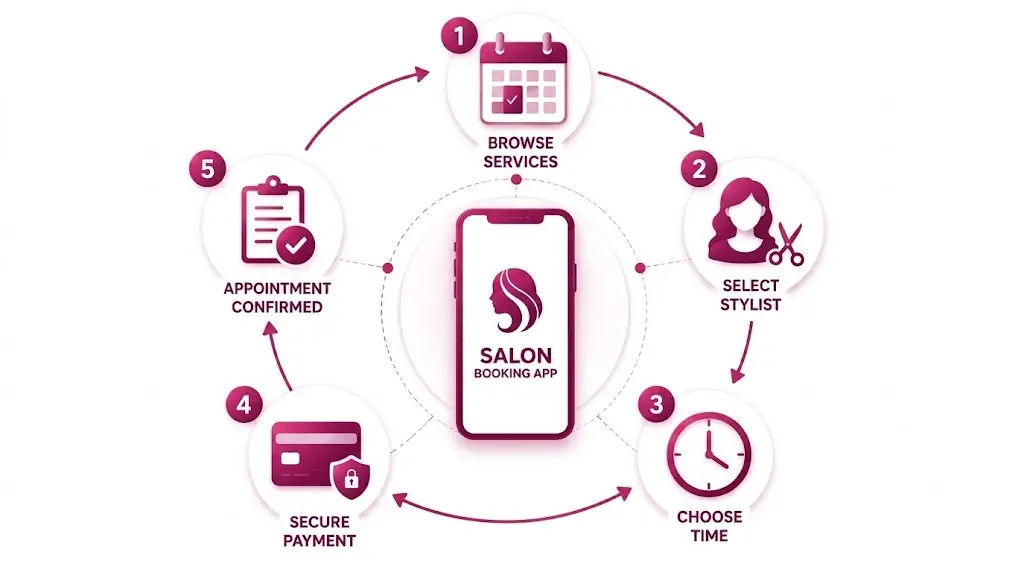
A salon booking app is a digital platform that lets clients view services, check stylist availability, and book an appointment without calling the salon directly. On the business side, it gives salon owners and staff a centralized calendar, automated reminders, and often payment processing and reporting tools in one place.
The app sits between three groups with different needs. Clients want a fast, simple way to find an open slot and their preferred stylist. Stylists and staff need a clear schedule that avoids double bookings and shows up-to-date availability. Salon owners need visibility into revenue, staff performance, and client retention. A well-built app balances all three without making any one group feel like an afterthought.
This is what makes salon booking apps more complex than a simple calendar tool. The app needs to handle real-time availability across multiple staff members, manage service durations that vary by treatment, and often process payments and deposits, all while staying simple enough for a client to book in a few taps.
The Salon Booking App Market in 2026
Salon booking software has moved from a nice-to-have to a standard part of running a beauty business. The global salon booking software market is estimated at around 629 million dollars in 2026 and is projected to grow past 1.1 billion dollars by 2035. More than three-quarters of salons worldwide have already adopted some form of online booking, and mobile bookings have climbed sharply since 2021 as clients increasingly expect to book from their phone rather than a desktop site or phone call.
For salon owners, chains, and independent developers, this growth translates into a real business opportunity in a few specific ways, some of which are explained below:
- Fewer no-shows mean more revenue. Automated reminders and deposit requirements have been shown to meaningfully reduce missed appointments, which directly protects revenue that would otherwise be lost to empty chairs.
- Multiple business models to choose from. You can build a booking app for a single salon, a multi-location chain, or a marketplace that connects clients with many independent salons and takes a commission or subscription fee.
- Recurring revenue through subscriptions or commissions. Marketplace apps like Fresha and StyleSeat earn through booking fees or premium subscriptions, while single salon apps typically operate as a fixed-cost tool that pays for itself through reduced no-shows and admin time.
- Strong client retention potential. Loyalty programs, personalized recommendations, and easy rebooking all encourage clients to return to the same salon or stylist rather than shopping around.
- Room to specialize. Categories like barbershops, medspas, and mobile beauty services each have distinct booking needs, and a focused app can build stronger loyalty than a generic scheduling tool trying to serve everyone.
Pro tip: Do not assume every salon needs every feature. A solo stylist needs a simple, fast booking flow far more than advanced staff scheduling tools built for a twenty-chair salon.
Types of Salon Booking Apps
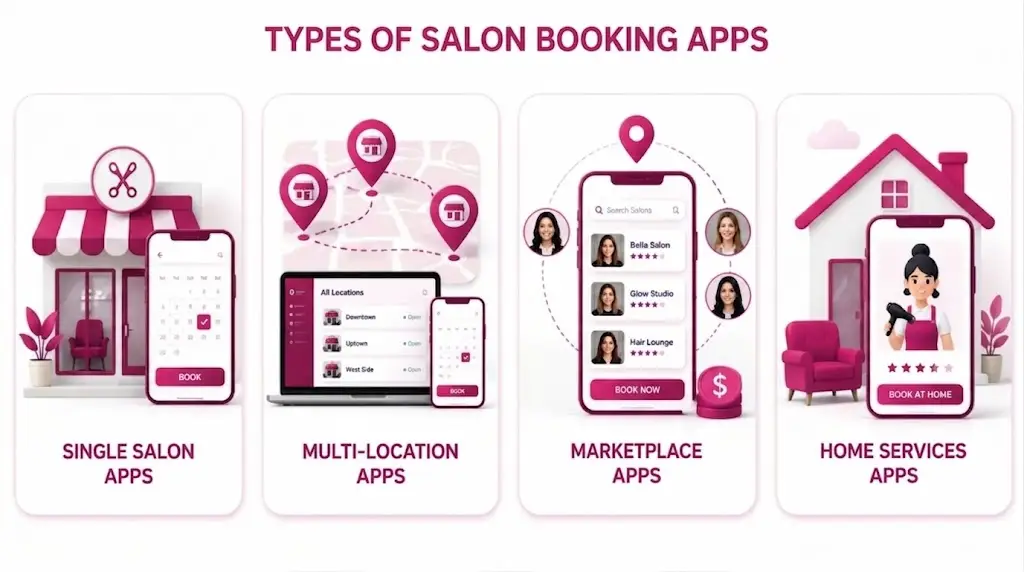
Not every salon booking app serves the same business model. Choosing the right type shapes your revenue model, your technical scope, and how much competition you will face at launch.
- Single salon apps are built for one business location, giving that salon a branded booking experience without competing marketplace listings. These apps work well for established salons that already have a loyal client base and want to reduce phone call volume and no-shows.
- Multi-location chain apps serve salon chains or franchises, letting clients book at any location while giving the business owner centralized reporting across all sites. These apps need stronger backend infrastructure to handle staff and inventory across multiple locations.
- Marketplace and aggregator apps connect clients with many independent salons in one place, similar to how Fresha and StyleSeat operate. These apps earn revenue through commissions or subscription fees from the salons listed, and they require significant investment in building a two-sided marketplace with enough salon supply to attract client demand.
- On-demand home service apps let clients book beauty professionals who travel to their home, which has grown quickly as convenience-focused beauty services expand. These apps need additional features like service area mapping and travel time buffers between appointments.
Read more: How to Build a Loan Lending App: Features, Cost, and Process
Which Type Should You Build? A Simple Decision Framework
Many founders assume a marketplace model is the most ambitious and therefore the best choice, but marketplaces are also the hardest to get off the ground since they need both salon supply and client demand at the same time.
The following three questions can help narrow the decision while you choose a framework and model for your Salon Booking App:
Q1. Are you building for yourself or for other businesses?
A salon owner building for their own location needs a single salon app. A developer or entrepreneur building a product to sell or license to many salons should consider a white label single salon app or a marketplace model instead.
Q2. How much competition already exists in your market?
Marketplace apps like Fresha and Booksy already have strong brand recognition in most major markets, which makes launching a new general marketplace difficult. A niche marketplace, such as one focused only on barbershops or medspas, faces far less direct competition.
Q3. What is your realistic timeline to build supply?
A marketplace app is only useful once enough salons have joined, which can take significant time and marketing investment before the app delivers real value to clients. A single salon or chain app delivers value from day one since the supply already exists.
Once you know your primary type, the next decision is which features actually belong in your first version.
Popular Features for a Salon Booking App
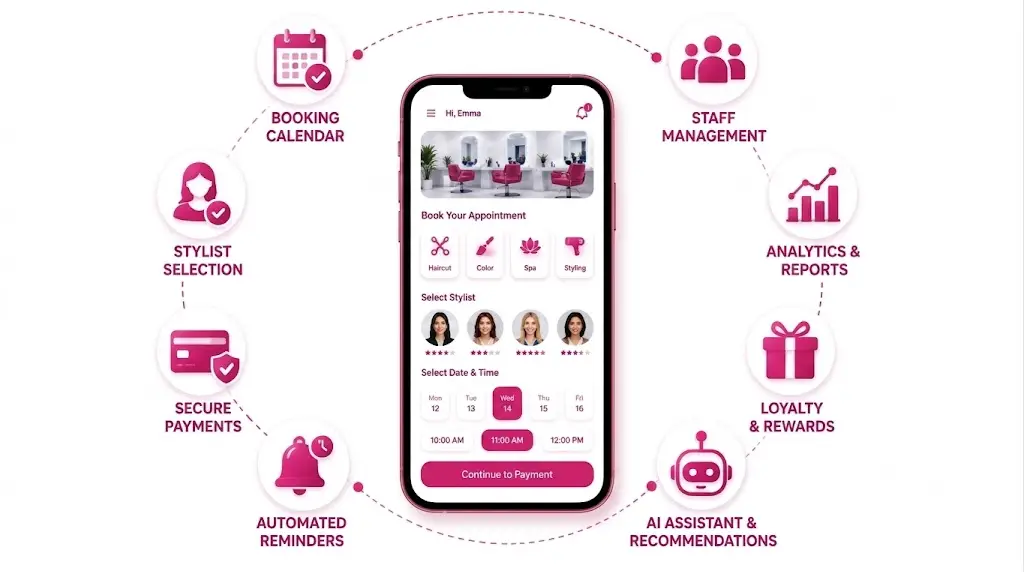
Every feature should either speed up booking or reduce the chance of a missed appointment. Below are the features that matter most, grouped by what they actually do for the user.
Core Features
- Booking calendar and real-time availability: Clients need to see accurate, real-time openings without the risk of double booking. This is the single most important feature in any salon booking app, since a booking error here breaks trust immediately.
- Service menu with pricing: A clear, browsable list of services with duration and price lets clients make an informed choice before booking, which reduces confusion and last-minute questions at check-in.
- Stylist selection: Letting clients choose a specific stylist, rather than being assigned one, builds loyalty and lets repeat clients stick with the person they trust.
Business Management Features
- Staff scheduling: Salon owners need a clear view of staff availability, time off, and workload distribution, ideally synced automatically with the client-facing booking calendar.
- Point of sale and payment processing: Accepting payments, deposits, and tips directly in the app speeds up checkout and reduces the amount of cash handling required at the front desk.
- Inventory and reporting: Tracking product usage alongside service bookings, along with reports on revenue and staff performance, gives salon owners the visibility they need to make better business decisions.
Pro tip: Build deposit collection into the booking flow early, even for a basic first version. Requiring a small deposit at booking is one of the most effective ways to reduce no-shows without adding real friction for genuine clients.
Client Engagement Features
- Automated reminders: Text and push notification reminders sent before an appointment are one of the most effective tools for reducing no-shows, and they require minimal ongoing effort once set up.
- Loyalty programs and rewards: Points, discounts, or free services after a certain number of visits give clients a reason to keep booking with the same salon rather than trying a competitor.
- Reviews and ratings: Letting clients rate their experience builds trust for new clients browsing the app and gives salon owners useful feedback on staff performance.
AI-Powered Features
- Smart scheduling and no-show prediction: Machine learning models can flag clients with a history of no-shows and adjust reminder timing or deposit requirements accordingly, which has been shown to meaningfully reduce missed appointments industry-wide.
- AI chatbots: A chat assistant that handles basic booking questions and rescheduling requests around the clock reduces front desk workload while keeping response times fast for clients.
- Personalized recommendations: Suggesting services or products based on a client’s booking history increases average order value and helps clients discover services they might not have considered on their own.
Features by App Type
| Feature | Single Salon App | Multi Location App | Marketplace App |
| Staff scheduling | Yes | Yes, per location | Managed by each salon |
| Centralized reporting | Optional | Yes | Not applicable |
| Commission handling | No | No | Yes |
| Salon discovery search | No | Limited | Yes |
Tech Stack for Salon Booking App Development
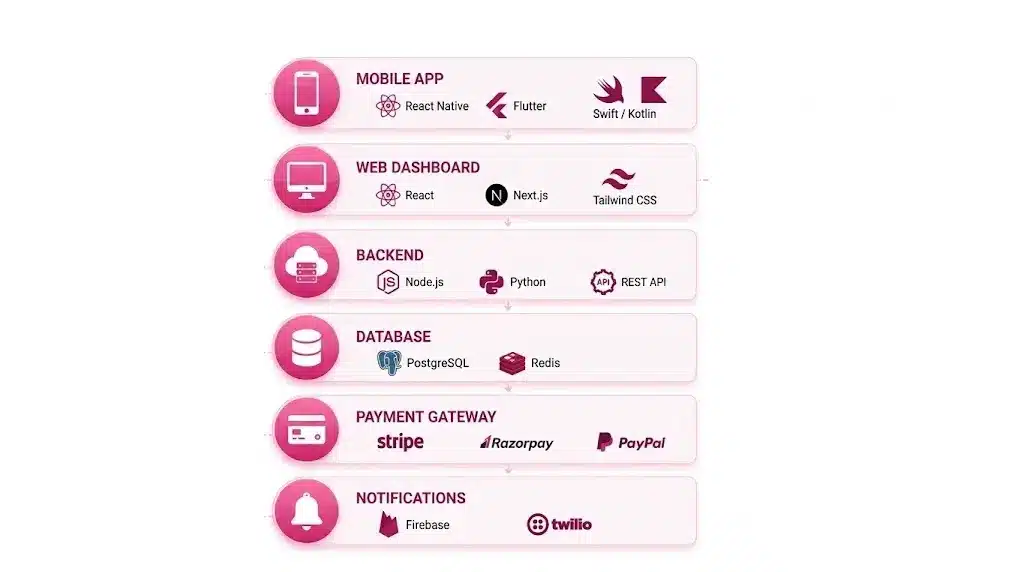
A modern salon booking app is built on a stack that can handle real-time scheduling, secure payments, and reliable notifications without downtime during peak booking hours.
On the frontend, React works well for a salon owner’s web dashboard where staff manage bookings and reports. For mobile, Flutter allows a single codebase to power both the client-facing app and the staff-facing app across iOS and Android, which keeps the booking flow consistent for everyone using it. Our mobile app development team typically recommends this approach for booking apps that need to launch on both platforms without doubling the budget.
On the backend, Node.js handles real-time scheduling logic well, since it manages many simultaneous booking requests efficiently without conflicts. PostgreSQL stores structured appointment and client data reliably, while Redis helps manage real-time availability checks during high-traffic periods like Monday mornings when many clients book for the week ahead.
The integration layer ties the whole experience together. Payments typically run through Stripe or Square, both of which handle deposits, tips, and refunds smoothly. Calendar sync often uses Google Calendar or a custom scheduling engine. SMS and push notifications run through Twilio or Firebase Cloud Messaging to keep reminder delivery reliable.
| Layer | Recommended Technology | Purpose |
| Mobile Frontend | Flutter | Cross-platform client and staff apps |
| Web Frontend | React | Salon owner dashboard and reporting |
| Backend | Node.js | Real-time scheduling and booking logic |
| Database | PostgreSQL | Structured appointment and client data |
| Payments | Stripe, Square | Deposits, checkout, and refunds |
| Notifications | Twilio, Firebase Cloud Messaging | Appointment reminders and alerts |
Read more: What is Cross-Platform App Development? A Complete Guide for 2026
Step by Step Development Process
Developing a salon app is not just about building an online booking system. It requires careful planning, intuitive user experience, reliable scheduling logic, secure payment processing, and continuous improvements after launch. While the process may vary depending on the project’s complexity, most successful salon apps follow these key development stages.
Step 1: Define Your Business Model
Decide early whether you are building a single salon app, a chain app, or a marketplace, since this decision shapes almost every feature and technical choice that follows. This phase should also include a review of direct competitors in your target market.
Step 2: UX and UI Design
Clients booking a salon appointment want speed and clarity above everything else. Wireframes map out the booking flow, from service selection through payment, and get tested against real booking scenarios before any code is written.
Step 3: MVP Development
This is where the biggest technical work happens. The backend needs to handle real-time availability across multiple staff calendars without conflicts, while the frontend delivers a fast, simple booking experience. Most successful salon apps launch with core booking, payments, and reminders before adding loyalty programs or advanced reporting.
Step 4: Testing and Quality Assurance
Testing needs to confirm that double bookings cannot happen, payments process correctly, and reminders send reliably. Beta testing with real salon staff often catches workflow issues that internal testing misses, particularly around how staff actually manage walk-ins alongside scheduled bookings.
Step 5: Launch and Post-Launch Support
After launch, the work continues. Salon hours change seasonally, new services get added, and payment or notification providers occasionally update their systems. Most teams plan for 15 to 20 percent of the annual development budget toward ongoing maintenance.
Security and Compliance Considerations
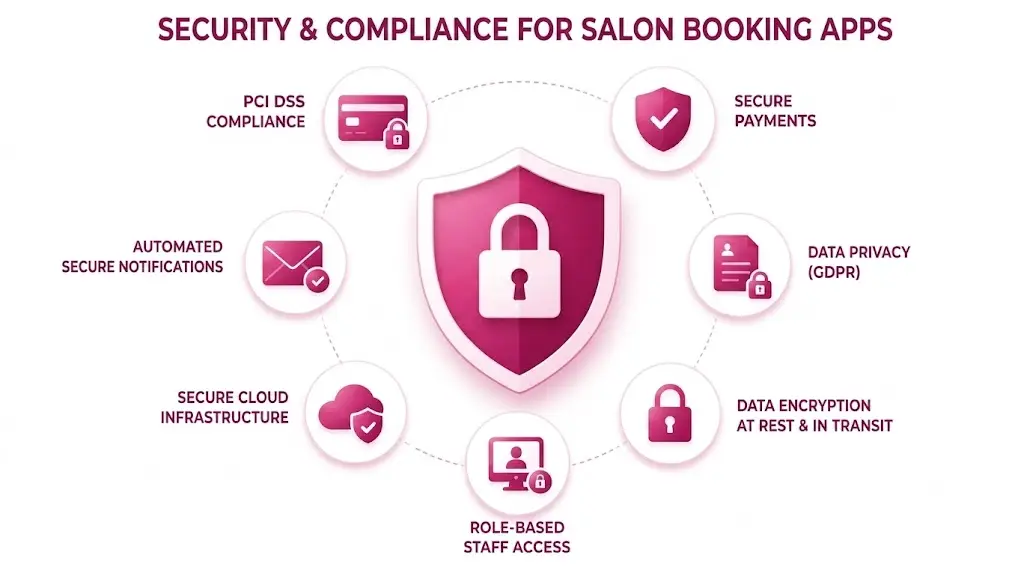
Salon booking apps handle payment information and personal client data, so security planning matters even though the industry is less regulated than sectors like healthcare or finance.
- PCI DSS compliance: Any app processing card payments or deposits directly must meet Payment Card Industry Data Security Standards. Most teams reduce this burden by using a processor like Stripe or Square that handles compliance at the infrastructure level rather than storing card data themselves.
- Client data privacy: Booking history, contact details, and sometimes health-related notes for treatments need to be stored securely. Apps serving clients in the European Union need to meet GDPR requirements around consent and data deletion requests.
- Cancellation and no-show policies: While not a legal requirement, clear in-app disclosure of deposit and cancellation terms before a client books protects the business from disputes and builds trust through transparency.
- Staff access controls: Not every staff member needs access to full client payment history or business reporting. Role-based permissions keep sensitive data limited to the people who actually need it.
Building these protections into the app from the beginning is far less expensive than adding them after a client complaint or payment dispute forces the issue.
How Much Does It Cost to Build a Salon Booking App?
Salon booking app costs vary based on complexity, business model, and how many integrations are required.
| App Tier | What You Get | Estimated Cost | Timeline |
| Basic MVP | Booking calendar, service menu, single location | $10,000 to $20,000 | 3 to 4 months |
| Mid Tier | Payments, staff scheduling, reminders, both platforms | $20,000 to $40,000 | 4 to 7 months |
| Advanced Marketplace | Multi-salon discovery, commission handling, loyalty programs | $40,000 to $80,000+ | 7 to 12 months |
Read more: How Much Does It Cost to Develop an App in 2026?
Real-time scheduling logic across multiple staff members is more complex than it looks, and it is one of the biggest sources of development time in a salon booking app. Payment processing integration, especially one that handles deposits, tips, and refunds cleanly, also adds meaningful development work.
Building a marketplace model adds high cost beyond a single salon app, since it requires salon onboarding tools, commission tracking, and a discovery search experience that a single location app simply does not need.
Where to Optimize Without Cutting Corners
Starting with a single salon or chain app rather than a full marketplace keeps early costs down while still delivering real value from day one. Choosing cross-platform development with Flutter instead of separate native apps typically saves 30 to 40 percent compared to native development. Leaning on established payment processors rather than building custom payment infrastructure also avoids unnecessary spend.
Who Do You Need on Your Team?
Building a solid salon booking app requires a specific mix of skills beyond general app development experience.
A product manager with local services or scheduling software experience understands the booking and cancellation logic that makes or breaks the user experience. Backend engineers with real-time systems experience are essential, since preventing double bookings across multiple staff calendars requires careful, reliable logic. A UI/UX designer focused on fast, simple flows ensures clients can book in a few taps rather than navigating a confusing multi-step process. A QA engineer should specifically test scheduling edge cases, such as overlapping appointments or last-minute cancellations, since these are the scenarios most likely to break in production. If you are building a payment-enabled app, a developer with payment integration experience should be involved from the start rather than added later.
Smaller teams do not need every role filled from day one, but skipping real-time scheduling expertise almost always leads to booking conflicts and frustrated users after launch.
Post-Launch: Retention and Growth Tips
Launching a salon booking app is only the beginning. The real test is whether clients keep coming back and whether the salon actually sees fewer no-shows and more repeat bookings. Here are key retention and growth tips that one can consider in their model:
- Loyalty programs that reward repeat visits give clients a clear reason to keep booking through the app rather than switching to a competing salon.
- Personalized rebooking prompts, such as a reminder sent around the time a client typically needs their next haircut or color touch-up, drive repeat bookings without feeling pushy.
- Clear communication around cancellation policies, paired with easy self-service rescheduling, reduces both no-shows and frustrated phone calls to the front desk.
- Regularly reviewing booking drop-off points, such as where clients abandon the app before completing a booking, helps identify friction that is costing real revenue.
Tracking the right metrics matters here too. No-show rate, rebooking rate, and average time between visits tell you far more about long-term health than total downloads alone, since a salon app’s success ultimately depends on keeping chairs filled, not just getting installed.
Conclusion
Salon booking app development sits at the intersection of real-time scheduling logic, payment processing, and a user experience that needs to feel effortless for clients booking in a hurry. The apps that succeed share a few clear traits.
- They choose a clear business model- single salon, chain, or marketplace- before building rather than trying to serve every model at once.
- They treat no-show reduction, through reminders and deposits, as a core feature from the very first version, not an afterthought.
- They build loyalty and rebooking tools that keep clients returning long after their first appointment.
Choosing the right type of salon app, building the right features for your business model, and getting the scheduling logic right from day one will determine whether your app becomes the tool clients open every time they need a haircut, or one they abandon after a single frustrating booking experience.
If you are ready to move from planning to building, working with an experienced mobile app development company that understands real-time scheduling and payment integration can save significant time and budget compared to learning these lessons mid-project.
Frequently Asked Questions
How long does it take to build a salon booking app?
A basic MVP typically takes three to four months from planning to launch. A mid-tier app with payments and staff scheduling usually takes four to seven months. A full marketplace app can take seven to twelve months or longer, since it requires both salon onboarding tools and client-facing discovery features.
Should I build a single salon app or a marketplace?
This depends on your goal. If you own a salon and want to reduce phone calls and no-shows, a single salon app delivers value immediately. If you want to build a business that connects many independent salons with clients, a marketplace model has bigger long-term potential but requires significant investment in building both salon supply and client demand before it becomes useful.
What is the most important feature for reducing no-shows?
Automated reminders and deposit collection are the two features that make the biggest difference. Reminders sent shortly before an appointment catch clients who simply forgot, while a small deposit at booking discourages casual cancellations without creating friction for genuine clients.
Do salon booking apps need to be PCI DSS compliant?
Yes, if the app processes card payments or deposits directly. Most teams handle this by using an established payment processor like Stripe or Square, which manages PCI DSS compliance at the infrastructure level rather than requiring the salon app to store card data itself.
Can a salon booking app help with marketing, not just scheduling?
Yes. Many successful salon apps include loyalty programs, personalized rebooking reminders, and promotional tools that help salons win back lapsed clients. These features are increasingly expected rather than optional, since they directly affect how often clients return after their first booking.