 Design
 App Development
 Web Engineering
 AI Services
 Cloud
Cloud Staffing
 Startups
 Health / Fitness
 Education
 Social
 Nonprofit
 Fintech
 Construction
 Logistics
 Government
 Travel/Hospitality
 HR Software
 About Simpalm
 Our News
 Client Testimonials
 Careers
 Our Blog
 Awards
 Resources
 Information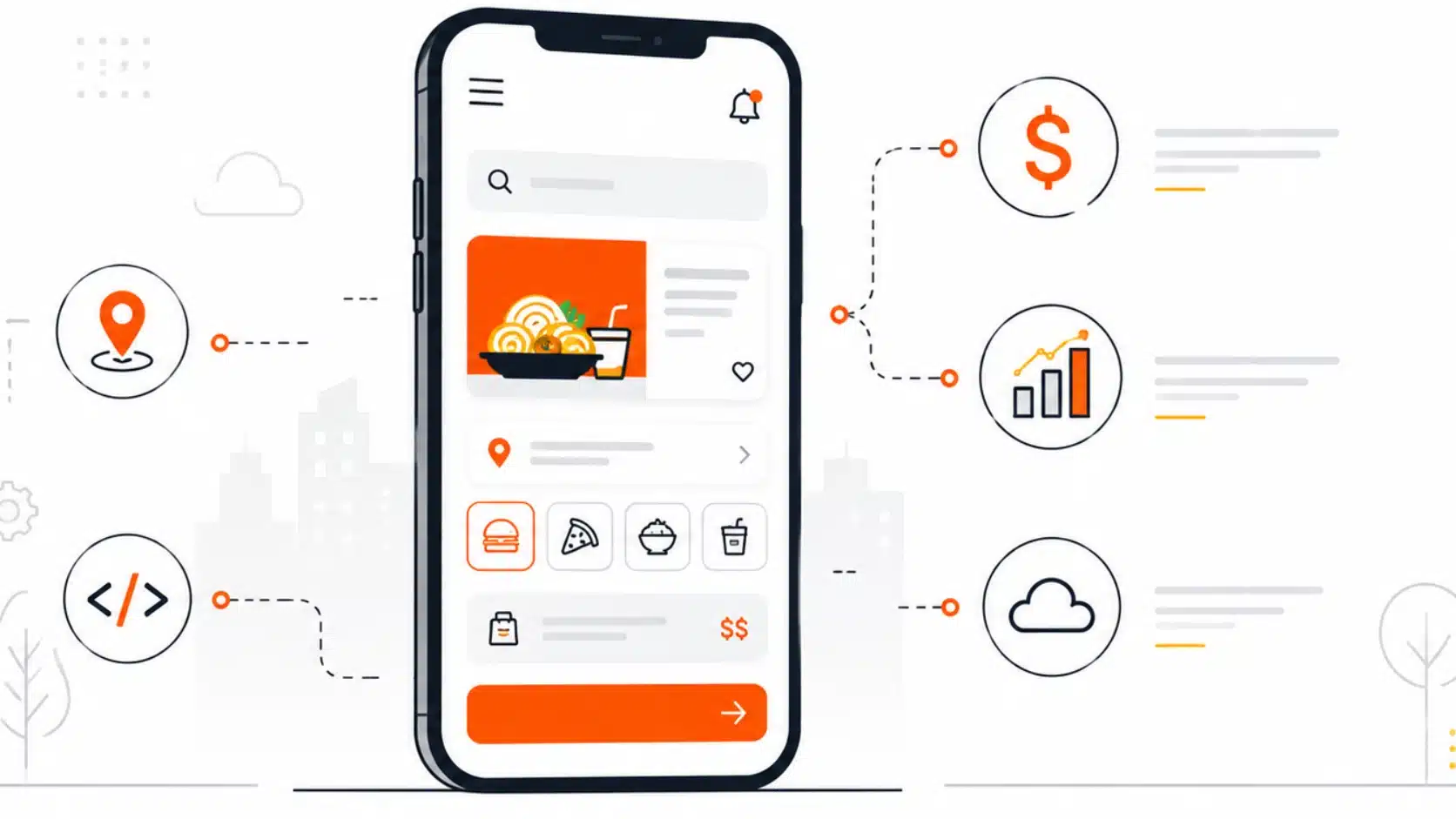
Key Takeaways
- A complete food delivery platform is really four connected products: the customer app, the restaurant panel, the driver app, and the admin dashboard, and each one carries its own budget line.
- Your business model, whether that is a marketplace, an owned-fleet operation, or a white-label build, shapes your cost structure more than any single feature does.
- Hidden costs such as hosting, third-party API fees, compliance, and customer acquisition often add 25 to 40 percent to your first-year investment beyond the initial build.
- Food delivery app development cost typically falls between $50,000 for a lean single-restaurant MVP and $350,000 or more for a multi-city platform with AI-driven dispatch and four fully built apps.
- Starting with an MVP and expanding based on real order data is the most reliable way to control spend without under-building the platform.
________________________________________________________________________________________
The online food delivery market is projected to reach $1.51 trillion in revenue worldwide in 2026, according to Statista, and that growth shows no sign of slowing. For a restaurant group, a regional startup, or an entrepreneur eyeing the on-demand economy, that scale represents genuine opportunity. It also represents genuine risk if you walk into development without a realistic budget.
Here is the problem most founders run into. They see a headline number like “$20,000 to $300,000” and walk away with no clearer picture than when they started. That range is technically accurate and practically useless, because a $25,000 build and a $250,000 build solve completely different business problems. One proves a concept. The other competes with established platforms for market share.
This guide breaks down exactly where your food delivery app development cost comes from: the business model decisions that set your budget ceiling, the four apps that make up a real platform, the features worth paying for first, the platform choice that can swing your bill by tens of thousands of dollars, and the hidden costs that catch founders off guard after launch. If you are also weighing a grocery-focused build, our guide to grocery delivery app development covers how that closely related model differs in cost and structure.
What Does Food Delivery App Development Actually Cost in 2026?
Before diving into the factors that move the number, it helps to see the full range laid out by complexity tier. Your app’s scope, not any single feature, is the primary driver of where you land.
| Tier | Cost Range | Timeline | What You Get |
| MVP | $50,000 – $100,000 | 3 – 5 months | Single-market customer app, basic restaurant panel, manual or semi-automated dispatch, one payment method |
| Mid-Market | $100,000 – $200,000 | 6–9 months | Multi-restaurant marketplace, dedicated driver app, real-time GPS tracking, multiple payment gateways, ratings and loyalty features |
| Enterprise | $200,000+ | 10–12 months | AI-powered dispatch and recommendations, multi-city or multi-region support, advanced analytics, deep POS integrations, dedicated compliance tooling |
A lean MVP is not a lesser version of a real app. It is the fastest, cheapest way to find out whether restaurants and customers in your target market actually want what you are building, before you commit six figures to features nobody asked for.
Quick estimate formula: Developer hourly rate multiplied by total development hours gives you a rough starting point. A 2,500-hour MVP build at $40 per hour lands around $100,000, while the same scope built through an offshore team at $25 per hour comes closer to $62,500. Rate alone does not determine quality, but it does explain why quotes for seemingly identical apps can vary by a factor of three or four.
Which Business Model Should Shape Your Budget?
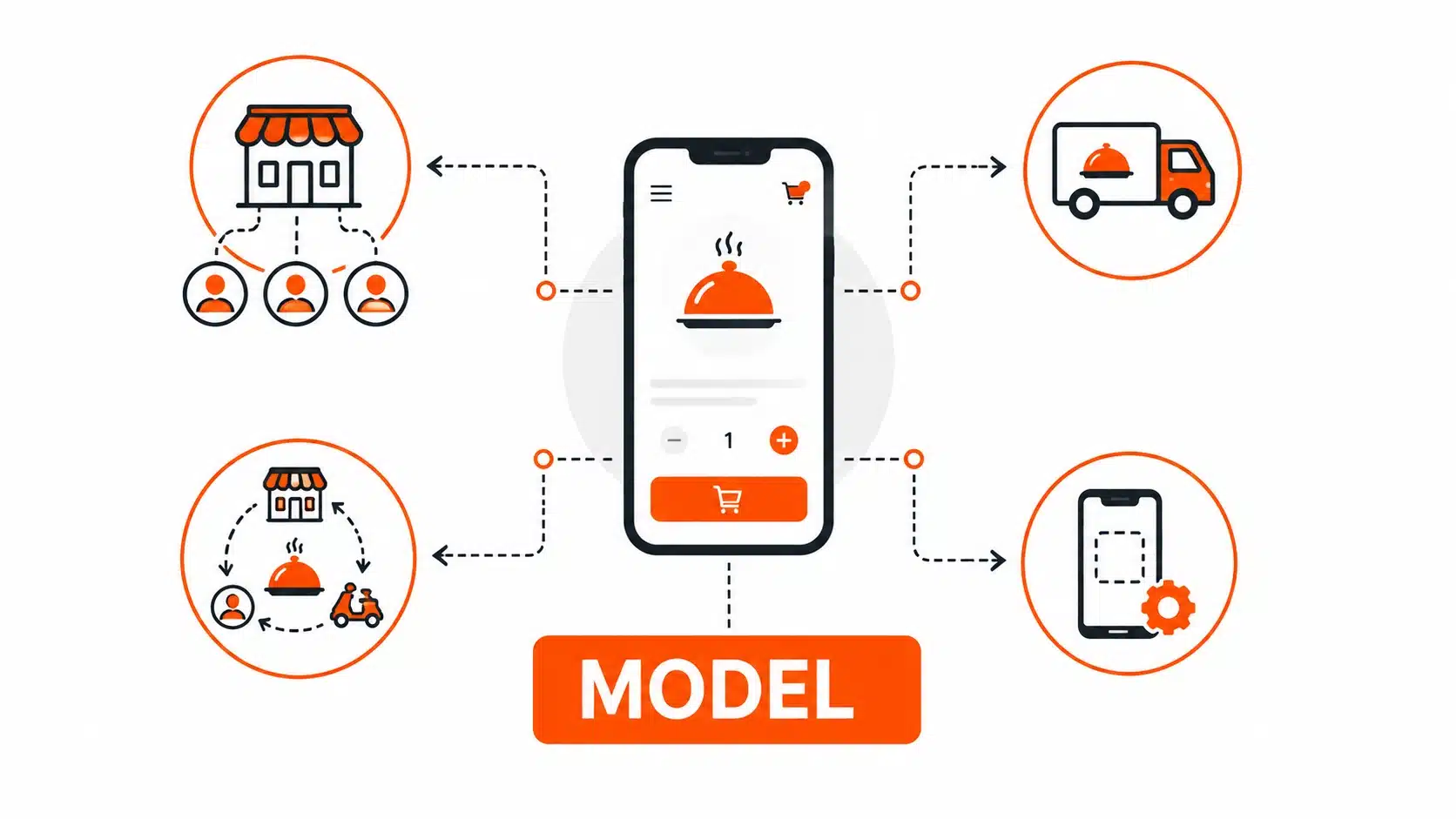
The single biggest decision you will make before writing a line of code is your business model, because it determines which systems you actually need to build. Skip this step, and you risk building the wrong foundation entirely.
- Marketplace aggregator: You connect existing restaurants with customers and take a commission per order, similar to how DoorDash or Uber Eats operate at scale. This model needs strong multi-vendor tools and merchant onboarding but avoids the cost of owning inventory or a delivery fleet outright.
- Owned-fleet or dark kitchen model: You control the kitchen, the inventory, or the delivery fleet directly. This gives you tighter quality control but demands far more backend investment in logistics, staffing tools, and route optimization.
- Hybrid model: You run your own delivery fleet for a subset of restaurant partners while also aggregating others who handle their own delivery. This flexibility comes at the cost of a more complex admin panel that has to manage two operational workflows at once.
- White-label clone: You license a pre-built platform and customize the branding. This is the fastest and cheapest path to market, typically $15,000 to $50,000, but you sacrifice data ownership, deep customization, and long-term differentiation.
Most founders entering a competitive local market start with a marketplace model because it validates demand without the overhead of owning delivery infrastructure. Once order volume justifies it, some shift toward a hybrid approach to capture more margin per order.
It is worth noting that your business model choice is rarely permanent, but changing it after launch is expensive. A marketplace app that later decides to bring delivery in-house has to retrofit driver management, route optimization, and payout systems onto an architecture that was never designed for them. Deciding this upfront, even if it means a slightly longer discovery phase, is one of the cheapest insurance policies available in the entire development process.
Pro tip: If your capital is limited, start with the marketplace model and treat inventory or fleet ownership as a phase-two decision. This keeps your initial development cost lower and gives you real order data to justify the bigger investment later, rather than betting on assumptions about which restaurants and delivery zones will actually perform.
Do You Need Four App Modules or Can You Start With Two?
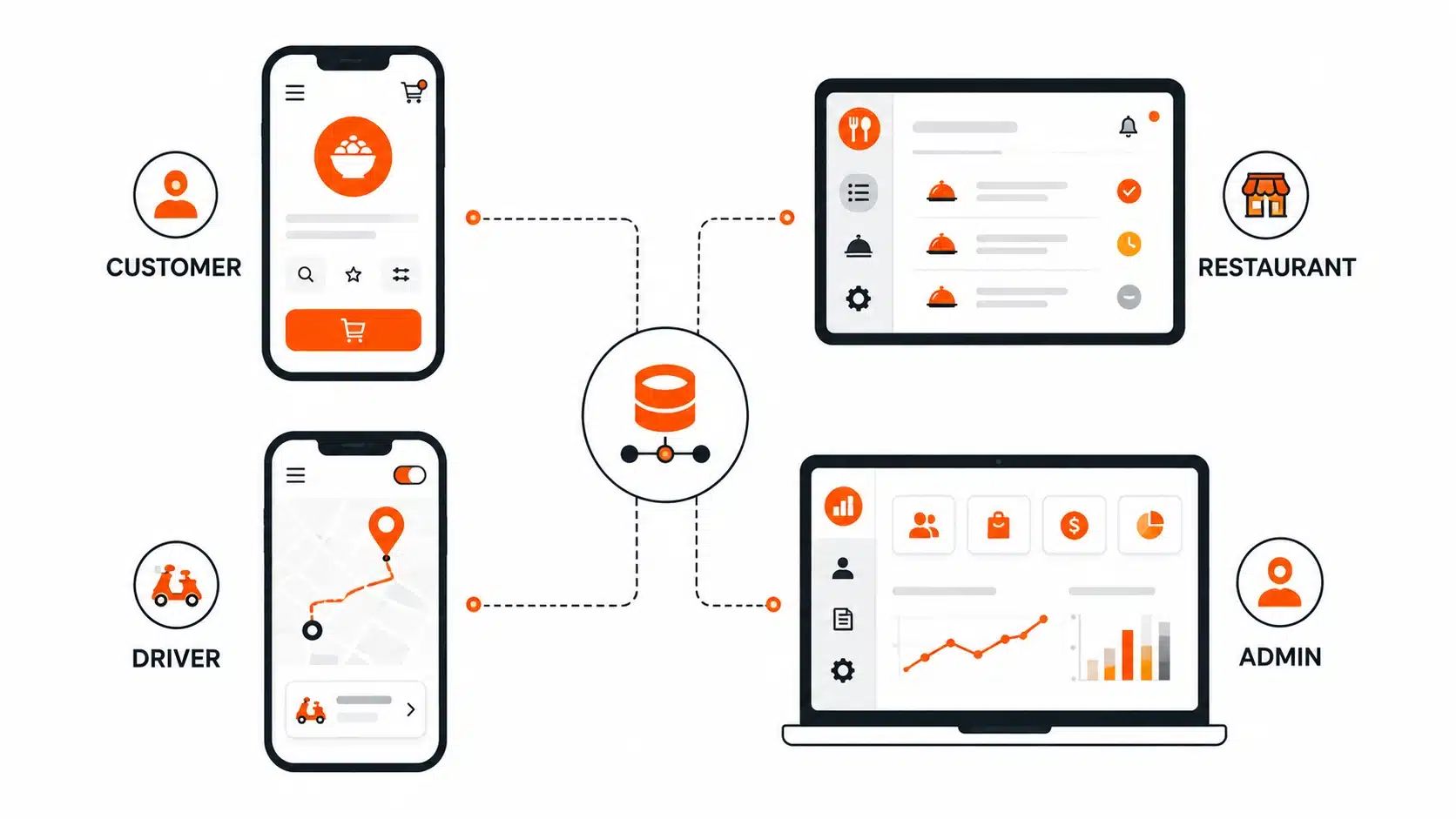
A working food delivery platform is not one product. It is four interconnected applications, each serving a different user and each with its own development timeline and cost.
| Module | Core Purpose |
| Customer App | Restaurant discovery, ordering, payments, live order tracking |
| Restaurant Panel | Menu management, order acceptance, sales reporting, promotions |
| Driver App | Order assignment, navigation, earnings tracking, delivery status |
| Admin Dashboard | User and vendor management, dispute resolution, payments oversight, analytics |
Most successful launches do not build all four simultaneously at full scope. A common sequencing strategy is to launch the customer app and restaurant panel first, run deliveries manually or through a light dispatch tool, and build the dedicated driver app once order volume justifies the investment. This is the same phased-MVP logic covered in our guide to building an MVP app, and it applies just as directly here: prove the ordering flow works before automating the logistics layer around it.
What Features Are Worth Paying For First?
Not every feature deserves a place in your initial budget. The features below split cleanly into what your MVP genuinely needs and what can wait until you have real usage data to justify the spend.
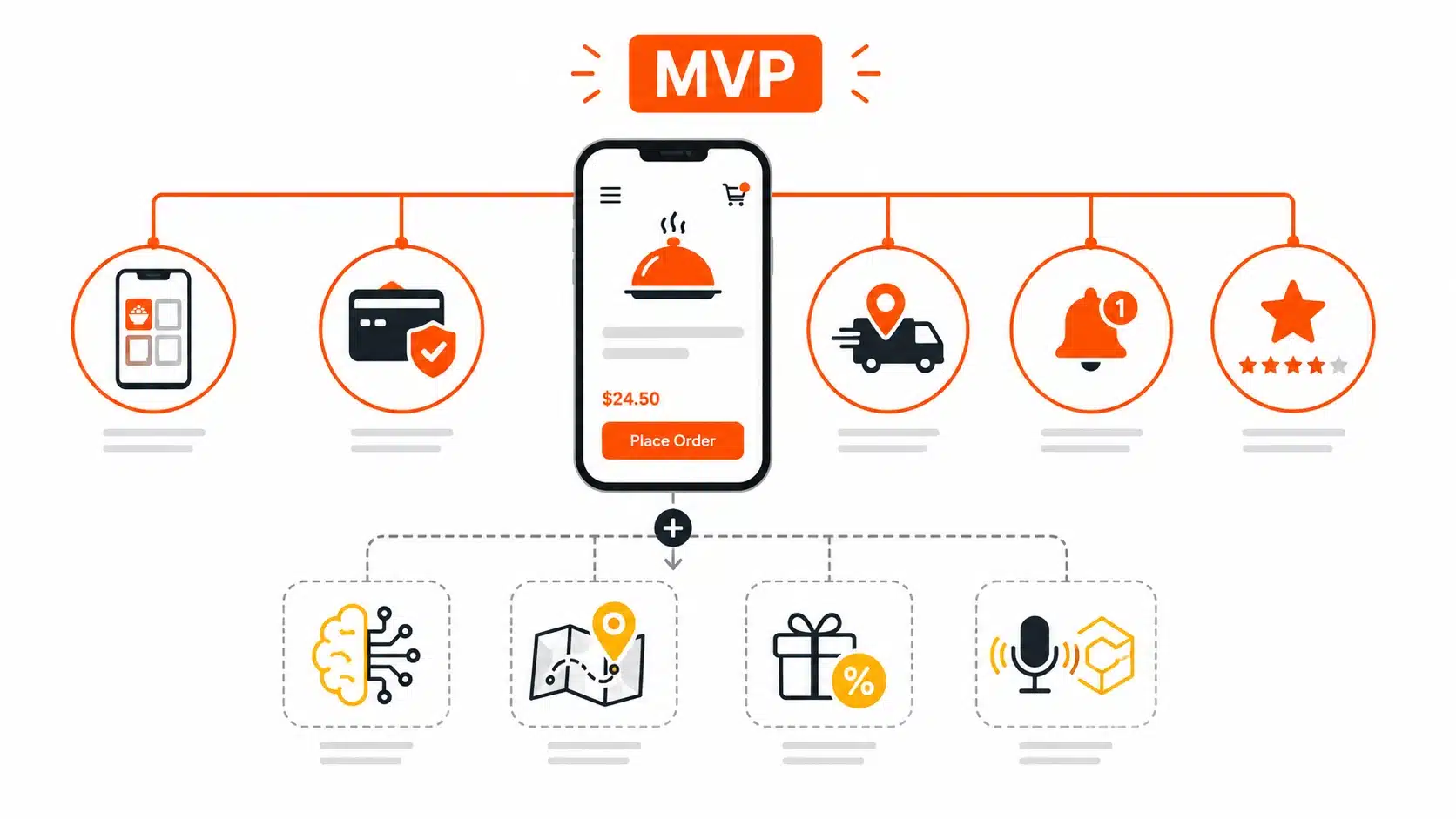
Core features your MVP cannot launch without:
- Simple, secure checkout: A streamlined cart and payment flow with at least one reliable gateway integration. Baymard Institute’s research on checkout usability found that the average cart abandonment rate sits at 70.22 percent across ecommerce, and a large share of that is directly tied to friction at checkout, so this is not a feature to shortcut.
- Restaurant and menu browsing: Search, filtering by cuisine or price, and clear menu presentation with item customization.
- Order tracking: Basic status updates from placed to delivered, even if live GPS comes in a later phase.
- Push notifications: Order confirmations, status changes, and promotional alerts that keep users engaged between orders.
- Ratings and reviews: A simple star-rating system builds trust faster than almost any other feature on the list.
Advanced features that can wait for version two:
- AI-powered recommendations: Personalized suggestions based on order history, typically adding $15,000 to $40,000 depending on the sophistication of the model.
- Live GPS tracking with driver location: A meaningful upgrade over basic status updates, but one that adds real backend complexity around location pings and battery optimization.
- Loyalty and rewards programs: Effective at improving repeat order rates once you have enough volume to make a points system worthwhile.
- Voice ordering and AR menu previews: Genuinely differentiating in a crowded market, but rarely the reason a first-time user chooses your app over an established competitor.
Which Technology Decisions Quietly Drive Your Long-Term Bill?
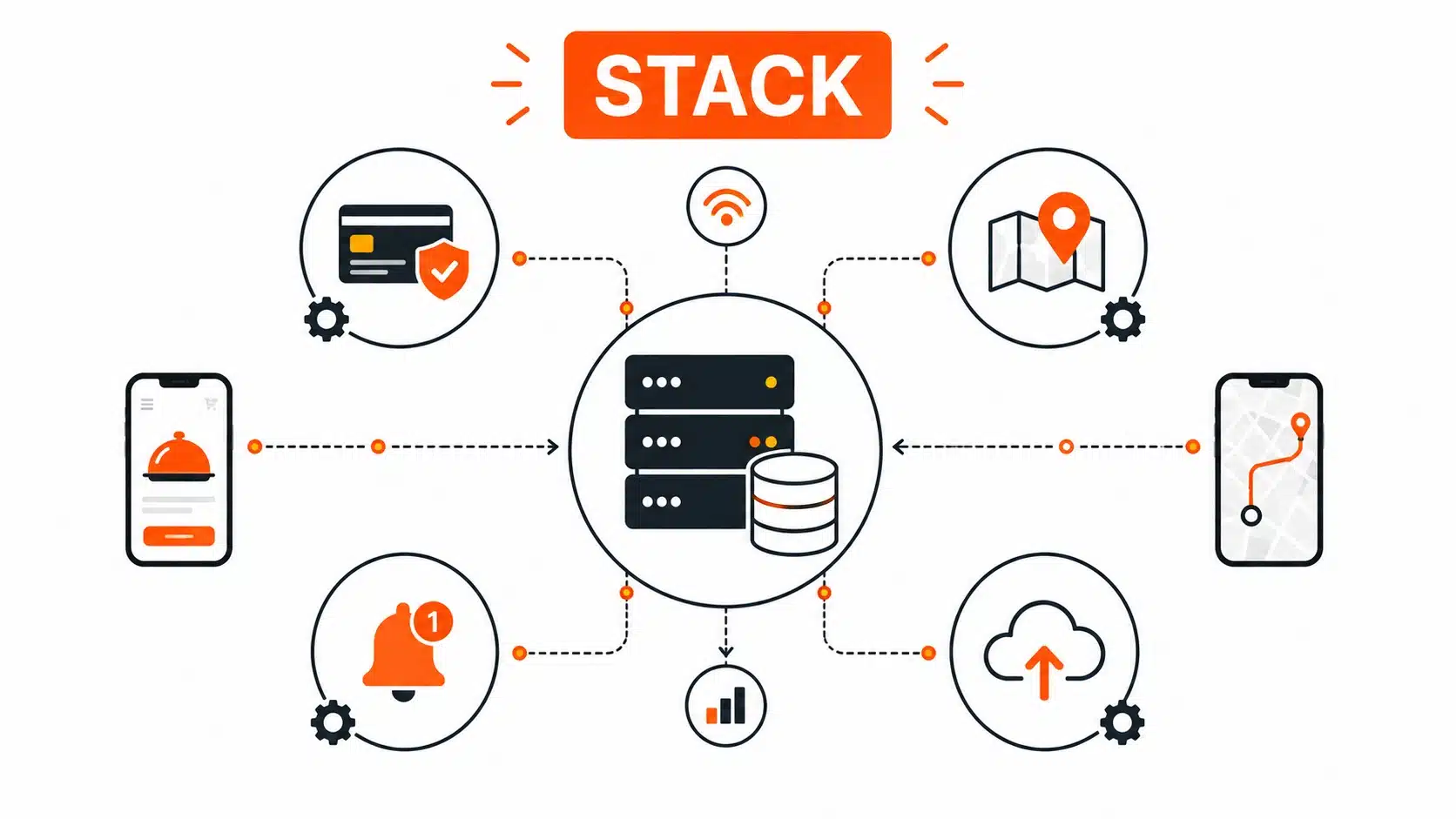
Feature lists get most of the attention in cost conversations, but the technology choices underneath those features often matter more once you look past launch day. A backend built for a single city behaves very differently, and costs very differently, than one built to survive a multi-city rollout two years from now.
Backend architecture: A simple monolithic backend is cheaper to build initially and works fine for an MVP in one market. Once you add multiple cities, surge pricing, or real-time inventory across restaurant partners, a microservices approach becomes worth the added upfront cost because it lets you scale individual components, like the dispatch engine or the payment service, independently rather than rebuilding the whole system under load.
Database and real-time infrastructure: Order status updates, live driver locations, and restaurant availability all need to reflect changes within seconds, not minutes. Real-time database solutions and WebSocket-based communication add development complexity but are non-negotiable once customers expect the same live-tracking experience they get from established platforms.
Third-party integrations you cannot avoid:
- Payment processing: Stripe, Braintree, or a regional equivalent, typically the single most important integration in the entire stack.
- Mapping and geolocation: Google Maps or Mapbox for route optimization, delivery time estimates, and driver navigation.
- SMS and push notification services: Twilio or Firebase Cloud Messaging for order updates and time-sensitive alerts.
- Cloud hosting: AWS, Google Cloud, or Azure, chosen based on your team’s existing expertise as much as any technical advantage between them.
Each of these integrations comes with both a setup cost and a recurring, usage-based fee that scales with your order volume, which is exactly why the “hidden costs” section later in this guide matters as much as the initial development quote. A platform that looks affordable at 500 orders a month can look very different at 50,000 if the underlying integrations were not chosen with growth in mind.
Native, Cross-Platform, or White-Label: Which Fits Your Budget?
Platform choice is one of the largest single levers on your final bill, and it is a decision worth making deliberately rather than defaulting to whatever your first developer recommends.
| Approach | Relative Cost | Best Fit |
| Native (iOS + Android separately) | Highest, often 40 – 60% more than cross-platform | Enterprise apps prioritizing performance and platform-specific features |
| Cross-Platform (React Native, Flutter) | Moderate, 30 – 45% savings vs. dual native | Most startups and mid-market apps balancing speed, cost, and quality |
| White-Label | Lowest upfront, $15,000 – $50,000 | Founders who need to launch fast and can accept limited customization |
For a deeper look at how the framework choice itself affects long-term maintenance and codebase decisions, our guide to cross-platform app development walks through the tradeoffs between React Native, Flutter, and native builds in more detail. For most food delivery startups building four separate apps, cross-platform frameworks are the practical default. Writing one codebase that runs on both iOS and Android cuts real development hours across every module, and that savings compounds because you are paying for it four times over across the customer, restaurant, driver, and admin experiences.
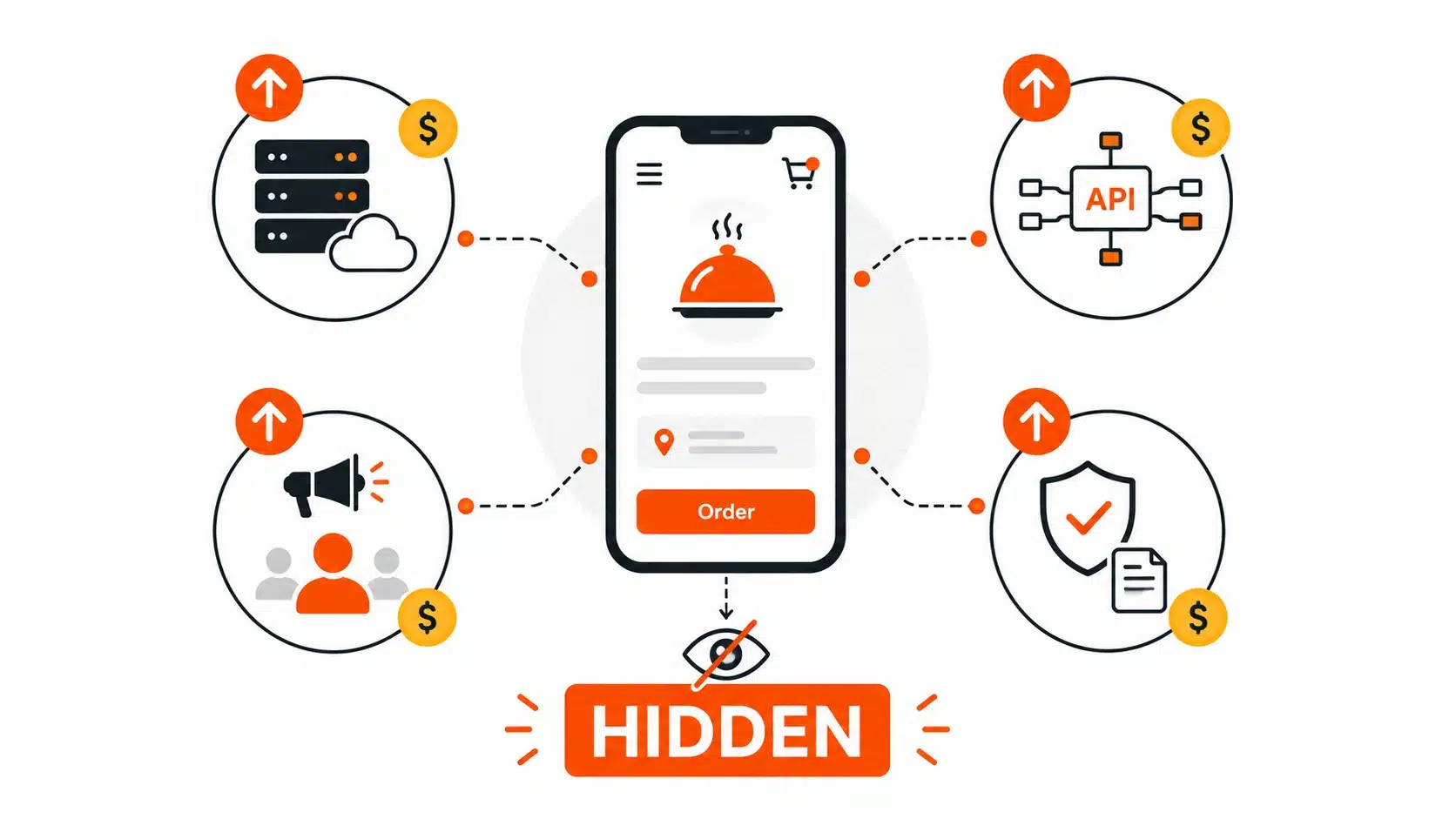
Development is only the first bill. The costs below are the ones that catch founders off guard because they rarely appear in an initial quote, and each comes with a practical way to plan around it.
Challenge: Ongoing hosting and infrastructure costs escalate with traffic. Cloud hosting starts cheap but grows quickly once you have real order volume, particularly during lunch and dinner rush windows when concurrent users spike. Monthly costs commonly run $500 to $5,000 for a growing platform, and enterprise-scale operations with high availability requirements can exceed $10,000 monthly.
Fix: Choose auto-scaling cloud infrastructure from day one rather than fixed server capacity, so you pay for demand rather than provisioning for a worst-case scenario that may never arrive.
Challenge: Third-party API and integration fees compound over time. Payment gateways, mapping services, and SMS providers often charge per transaction or per call once you exceed free tiers, and these costs scale directly with your order volume rather than staying fixed.
Fix: Model your per-order integration cost early and build it into your unit economics, not just your one-time development budget.
Challenge: Customer acquisition often costs more than the app itself. Building the platform is step one. Getting people to actually order through it is frequently the more expensive half of the equation, with acquisition costs in food delivery commonly running $15 to $25 per user.
Fix: Budget marketing as a separate line item from day one, ideally 50 to 100 percent of your development cost for the first serious push into a new market.
Challenge: Compliance and legal requirements vary by region and add up fast. PCI DSS compliance for payment data, food safety regulations, and gig worker classification rules differ by state and country, and getting them wrong is far more expensive than getting them right upfront.
Fix: Bring legal counsel in during the planning phase, not after a compliance issue forces a rebuild.
The apps that survive their first two years are rarely the ones with the most features at launch. They are the ones whose founders budgeted honestly for what happens after the app store submission, not just for what happens before it.
How Can You Keep Costs Under Control Without Cutting Corners?
Reducing your food delivery app development cost does not have to mean shipping a weaker product. These strategies target waste, not quality.
- Launch with a true MVP, not a feature-padded one. Instacart did not launch with AI recommendations. It launched with ordering and delivery, then earned the right to add sophistication once real users proved the core loop worked.
- Choose cross-platform frameworks over dual native builds. As covered above, this single decision routinely saves 30 to 45 percent across a multi-app platform.
- Sequence your four apps instead of building all at once. Launch customer and restaurant experiences first, then invest in a dedicated driver app once order volume justifies the automation.
- Use established APIs instead of custom-building commodity features. Payment processing, mapping, and SMS notifications are solved problems. Reserve your custom development budget for what actually differentiates your platform.
- Consider nearshore or offshore development for non-core work. Geographic cost differences are real, often cutting hourly rates by 30 to 70 percent, but pair this strategy with a partner who has genuine food delivery experience rather than a generalist team learning the domain on your dime.
How Do Food Delivery Apps Make Money?
Understanding your revenue model before development starts helps you prioritize the right features, since a subscription-driven app needs different infrastructure than a pure commission model.
| Revenue Model | How It Works | Typical Range |
| Commission per order | Platform takes a percentage of each order value from the restaurant | 15–30% per order |
| Delivery fees | Customers pay a flat or distance-based fee per delivery | $2–$8 per order |
| Subscription | Customers pay a recurring fee for free or discounted delivery | $8–$15 per month |
| In-app advertising | Restaurants pay for featured placement or promoted listings | $0.50–$2.00 per user monthly |
Most platforms blend two or three of these models rather than relying on a single stream. A commission-plus-delivery-fee structure remains the most common starting point because it requires no additional infrastructure beyond what a marketplace app already needs.
Final Thoughts
The real question behind food delivery app development cost was never “how much does an app cost.” It is “how much does it cost to build the version of this business that will still be standing in two years.” Those are different budgets, and conflating them is how founders end up either overbuilding a platform nobody has validated yet, or underbuilding one that cannot handle its own success once orders start coming in.
The path that consistently works is the boring one: define your business model clearly, launch the smallest version that proves real demand, and reinvest based on what actual order data tells you rather than what a competitor’s feature list suggests you need. AI-driven dispatch and personalized recommendations are genuinely valuable, but they are optimizations on top of a working core, not substitutes for one.
If you are scoping a food delivery app and want a realistic view of cost, timeline, and architecture before you commit budget, Simpalm’s experienced mobile app developers have built on-demand and marketplace platforms across healthcare, logistics, and retail, and can walk through what a build specific to your market and business model would actually take. Reach out for a free consultation and a straight answer on scope before you start writing requirements.
Frequently Asked Questions
Q1. How much does it really cost to build a food delivery app in 2026?
Most serious builds land somewhere between $70,000 and $150,000 for a mid-market platform with real-time tracking, multiple payment options, and a dedicated driver app. A lean single-restaurant MVP can start as low as $40,000, while an enterprise platform with AI-driven dispatch, multi-city support, and deep POS integrations can exceed $350,000. The right number for your project depends far more on your business model and feature scope than on any generic industry average.
Q2. How long does it take to build a food delivery app from start to launch?
An MVP with core ordering and delivery functionality typically takes three to four months. A mid-market platform with real-time tracking, a dedicated driver app, and multiple payment gateways usually requires five to eight months. Enterprise builds with AI features, multi-region support, and heavy compliance requirements can take nine to eighteen months, depending largely on how many third-party integrations and custom workflows are involved.
Q3. Should I build a custom app or use a white-label solution?
A white-label solution makes sense if speed to market matters more than differentiation and you are comfortable with limited customization and no data ownership. A custom build makes more sense if you plan to compete on unique features, need full control over your data and architecture, or expect to scale into a business model the white-label provider was not built to support. Many founders start white-label to validate demand quickly and migrate to a custom build once product-market fit is clear.
Q4. What is the biggest mistake founders make when budgeting for a food delivery app?
The most common mistake is treating the development quote as the total cost. Hosting, third-party API fees, customer acquisition, and compliance routinely add 25 to 40 percent to the first-year investment beyond the initial build. Founders who budget only for development consistently run out of runway during the growth phase, right when marketing and infrastructure costs start climbing alongside order volume.
Q5. Do I need to build all four apps (customer, restaurant, driver, admin) at once?
No, and most successful platforms do not. A common and cost-effective sequence is launching the customer app and restaurant panel first, managing delivery manually or through a lightweight dispatch process, then building the dedicated driver app once order volume justifies the automation. The admin dashboard typically needs to exist from the start in some form, even a simple one, since you need visibility into orders and users from day one.
Q6. How much should I budget for ongoing costs after launch?
Plan for annual maintenance and hosting costs of roughly 15 to 25 percent of your original development investment, plus a separate marketing budget that often matches or exceeds your development spend during the first serious push into a new market. Customer acquisition costs in food delivery commonly run $15 to $25 per user, so reaching a viable order volume in even a single metropolitan area can require a marketing investment comparable to the app build itself.