
 Design
 App Development
 Web Engineering
 AI Services
 Cloud
Cloud Staffing
 Startups
 Health / Fitness
 Education
 Social
 Nonprofit
 Fintech
 Construction
 Logistics
 Government
 Travel/Hospitality
 HR Software
 About Simpalm
 Our News
 Client Testimonials
 Careers
 Our Blog
 Awards
 Resources
 Information
Key Takeaways
- Most plumbing websites convert below 2 percent, which means 98 out of every 100 visitors leave without calling or booking a service.
- Real photos and dedicated service area pages are two of the single biggest levers for lifting conversion rates on a plumbing website.
- Trust signals such as reviews, licenses, and guarantees matter enormously, since most customers verify credibility online before picking up the phone.
- Page speed has a direct, measurable effect on bounce rate. Every additional second of mobile load time pushes more visitors away before they ever see your services.
________________________________________________________________________________________
Imagine a homeowner staring at a burst pipe at 11 pm, water spreading across the kitchen floor. They are not browsing calmly. They are stress-Googling “emergency plumber near me” on their phone, and they will call whichever website answers their questions fastest and feels the most trustworthy. Most plumbing websites are built like they are selling pottery, with slow loading times, generic stock photos, and a single homepage trying to serve every visitor regardless of what they actually need. That approach fails the exact moment it matters most, when a stressed customer is actively deciding between you and the next search result.
This guide breaks down why most plumbing websites underperform, the seven elements that actually convert panic-searching homeowners into booked jobs, how to design for both emergency and scheduled service visitors, the trust signals that move the needle, local SEO fundamentals, mobile performance, realistic 2026 pricing across every build path, common mistakes that quietly kill conversions, and how to keep improving your site after launch.
Why Most Plumber Websites Fail to Convert
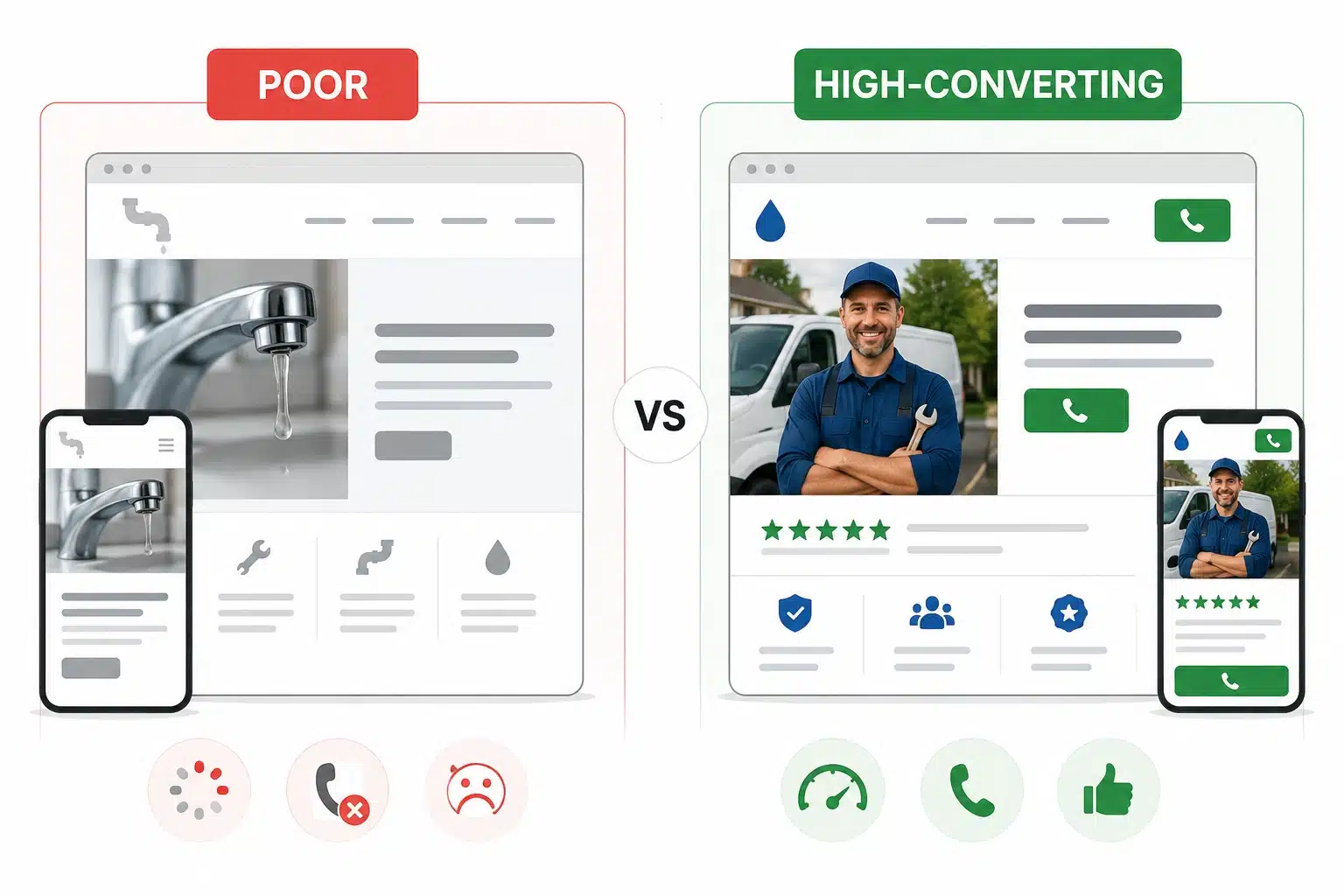
Most plumbing websites convert below 2 percent, meaning 98 out of every 100 visitors leave without contacting the business. That is not a small gap. It is the difference between a website that generates steady new business and one that quietly drains marketing spend every single day.
The core problem is usually not that the website looks bad. Many underperforming sites are visually polished, professionally designed, and still fail to generate calls. Here are some of the real issues:
- The real issue is that they are built like a digital brochure instead of a lead-generating system. A brochure tells people about your services. A converting website removes every possible reason a stressed, urgent visitor might hesitate before calling.
- An emergency visitor searching for a burst pipe at midnight wants a phone number they can tap immediately and reassurance that someone will actually answer
- A visitor researching a bathroom remodel or planning a water heater replacement wants pricing information, examples of past work, and time to compare options
- A single homepage trying to serve both of these visitors at once will underperform for each of them, since neither one gets the specific experience they actually came looking for.
The gap between a decent-looking website and one that consistently generates revenue keeps growing. As more plumbing businesses invest in better websites, customer expectations rise. A site that converted well two years ago may now be losing leads to a competitor with a faster, more user-focused experience.
| Pro tip: Before redesigning anything, pull your current site’s conversion rate and bounce rate from analytics. You cannot know whether a redesign actually worked without a clear baseline to compare against. |
The 7 Elements Every High-Converting Plumber Website Needs
Conversion-focused plumbing websites share a consistent set of elements, regardless of the specific design or build platform behind them.
Real photos and service area pages tend to produce the biggest individual lift, but each element below plays a distinct role in moving a visitor toward calling or booking.
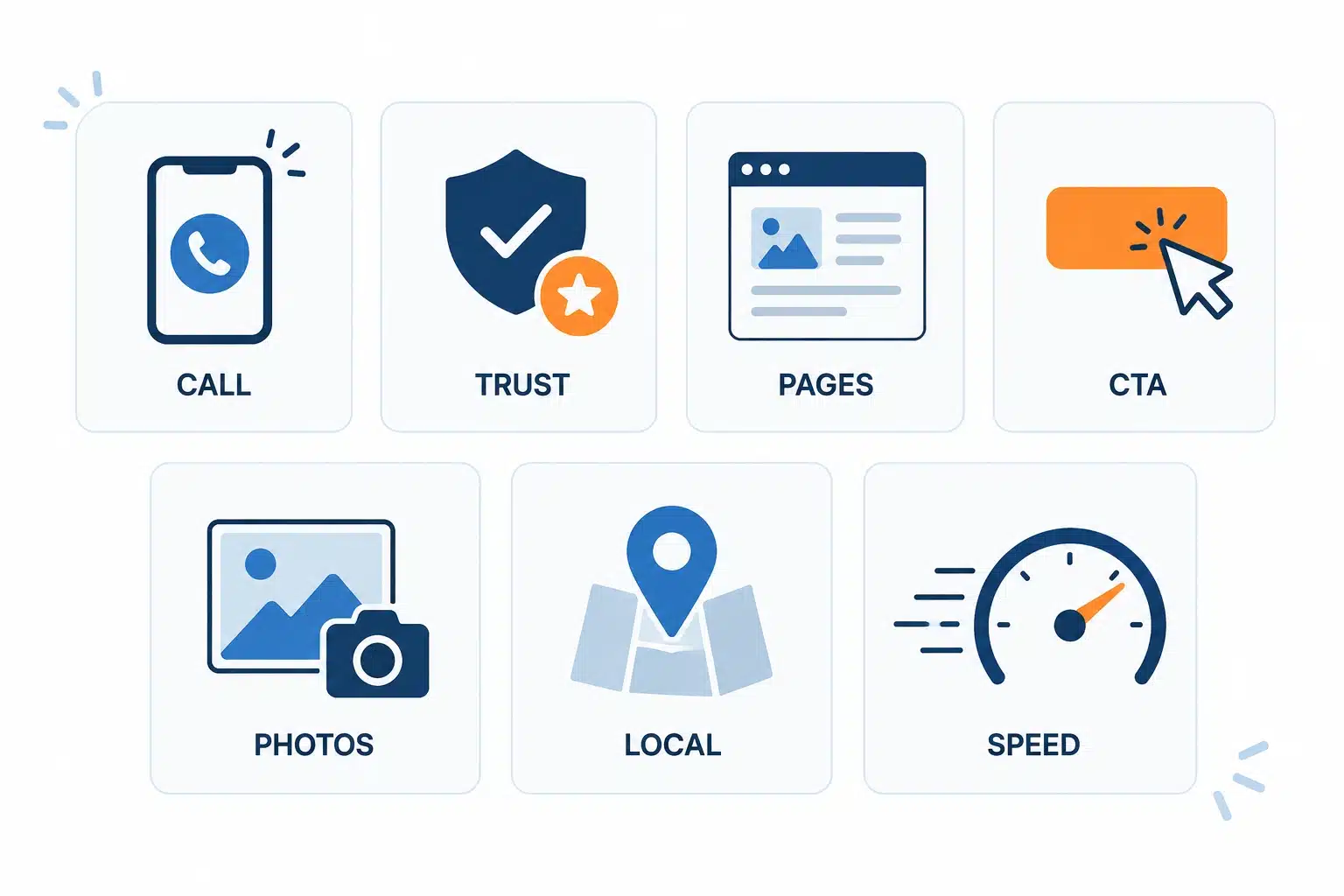
- A sticky, tap-to-call phone number: The phone number needs to be visible and tappable from the very first second a visitor lands on the page, and it should stay visible as they scroll. For a homeowner dealing with an active leak, hunting for a contact button is a dealbreaker.
- An above-the-fold trust stack: Licenses, insurance information, years in business, and review ratings need to be visible without scrolling. Trust signals placed below the fold arrive too late for a visitor who is already deciding whether to leave.
- Service-specific landing pages: A homepage cannot serve every search intent well. Someone searching “water heater replacement cost” and someone searching “emergency plumber 24 hours” are looking for completely different information, and each deserves its own page built around that specific need.
- Multiple types of calls to action: Offering a phone number, a contact form, and a booking widget together, rather than relying on just one, appeals to different comfort levels and urgency levels. Sites using at least three distinct CTA types tend to see meaningfully higher overall conversion rates.
- Real photos, not stock images: Photos of your actual team, trucks, and completed jobs build far more trust than generic stock photography, and visitors can often tell the difference instantly.
- Service area pages: Dedicated pages for each city or neighborhood you serve help your site rank for local searches and reassure visitors that you actually work in their area. This is one of the most consistent differences between plumbing sites that generate steady local leads and those that do not.
- Fast mobile load speed: Most plumbing searches happen on a phone, often while the visitor is standing in their kitchen looking at a problem in real time. A slow-loading site loses these visitors before the page even finishes rendering.
Also Read: Responsive Web Design Best Practices
| Pro tip: If you can only fix two things this quarter, prioritize real photos and service area pages first. Audits of underperforming plumbing sites consistently point to these two as the highest-leverage individual fixes. |
Trust Signals That Actually Move the Needle
Trust is not a nice-to-have on a plumbing website. It is often the deciding factor between a visitor who calls and one who leaves for a competitor. Consider adding the following trust signals to your plumber website.
- Ratings and Reviews: Research on plumbing website conversion consistently finds that a large majority of customers check online reviews before choosing a plumber. Displaying aggregate ratings prominently, and featuring a handful of detailed testimonials that address common concerns like pricing or punctuality, gives hesitant visitors the reassurance they need.
- Third-party verification: from platforms like Google or Yelp carries significantly more weight than testimonials curated and hosted only on your own site, since visitors know you are unlikely to publish a bad review yourself.
- Missing credentials: and limited social proof are consistently cited as a primary reason visitors leave a plumbing website without making contact. Licenses, insurance details, and years of experience should be stated clearly, not buried in an About page few visitors ever reach.
- Pricing transparency: also plays a bigger role in trust than most plumbers expect. Many business owners avoid publishing pricing out of fear it will scare customers away, but the opposite tends to be true. Even general price ranges reduce friction and signal that you have nothing to hide, which builds confidence before a visitor ever picks up the phone.
- Location specific pages: one for each city or neighborhood you actively serve, are one of the strongest levers for ranking in local search results. Rather than trying to rank a single generic page for every location, dedicated pages let each one target the specific searches happening in that area.
- Your Google Business Profile: needs to stay accurate and active, since it often appears before your website does in local search results and directly influences whether someone clicks through at all. Keeping your hours, service categories, and photos updated signals to both search engines and visitors that the business is active and reliable. Responding to reviews, both positive and negative, on your Google Business Profile also reinforces the trust signals your website is already working to build.
- Consistent business information: across your website, Google Business Profile, and other directories reinforces trust with both search engines and visitors. Mismatched phone numbers, addresses, or business hours across different platforms can quietly hurt your local rankings and confuse potential customers at the exact moment they are deciding whether to call.
- Mobile-first design:is not optional here either. The overwhelming majority of plumbing searches now happen on smartphones, and search engines factor mobile experience into how they rank local business websites.
- DIY website builders offer the lowest upfront cost and fastest launch time, but they often come with limited local SEO flexibility and generic templates that make trust-building harder. This path suits plumbers just starting with a very limited budget.
- WordPress with plumbing-specific themes remains a popular middle ground, offering strong SEO flexibility, a wide range of plumbing-focused themes, and plugins for booking, reviews, and call tracking. This path requires more setup time than a DIY builder but gives significantly more control over conversion elements.
- Custom-built websites offer the most control over performance, design, and conversion optimization, and they typically deliver the strongest results for established plumbing businesses ready to invest seriously in their online presence. A well-executed custom build can meaningfully lift form-fill leads and reduce bounce rate within the first few months.
- Relying on one homepage for every search intent: A single homepage cannot serve someone searching for an emergency repair and someone comparing installation pricing equally well. Sites structured this way typically cap out at a low conversion rate no matter what other fixes are made.
- Offering only one way to make contact: Some visitors want to call, others prefer a form, and some want to book directly through a widget. Offering only a phone number, or only a contact form, filters out visitors who would have converted through a different method.
- Hiding pricing entirely: Visitors who cannot find even a general price range often leave to compare with a competitor who is more transparent, even if your actual pricing is competitive.
- Ignoring page speed until it becomes a visible problem: Slow load times quietly suppress conversion rates long before most business owners notice, since the visitors affected simply leave without ever registering a complaint.
- Treating the website as finished after launch: A site that never gets tested or refined tends to lose ground quietly over time, even without any obvious problem appearing. Competitors continue improving their own sites, search algorithms continue changing, and a static, unmaintained website slowly falls behind without any single dramatic failure to point to.
- They design around the two very different visitor types, emergency and scheduled, rather than forcing everyone through the same homepage.
- They treat trust signals, real photos, and page speed as core requirements from launch, not improvements to add later.
- They keep testing and refining after launch instead of treating the website as a one-time project.
Local SEO Fundamentals for Plumbers
A beautifully designed plumbing website means little if it never shows up when someone searches for a plumber nearby. Local SEO and conversion-focused design need to work together, not as separate projects handled by different teams.
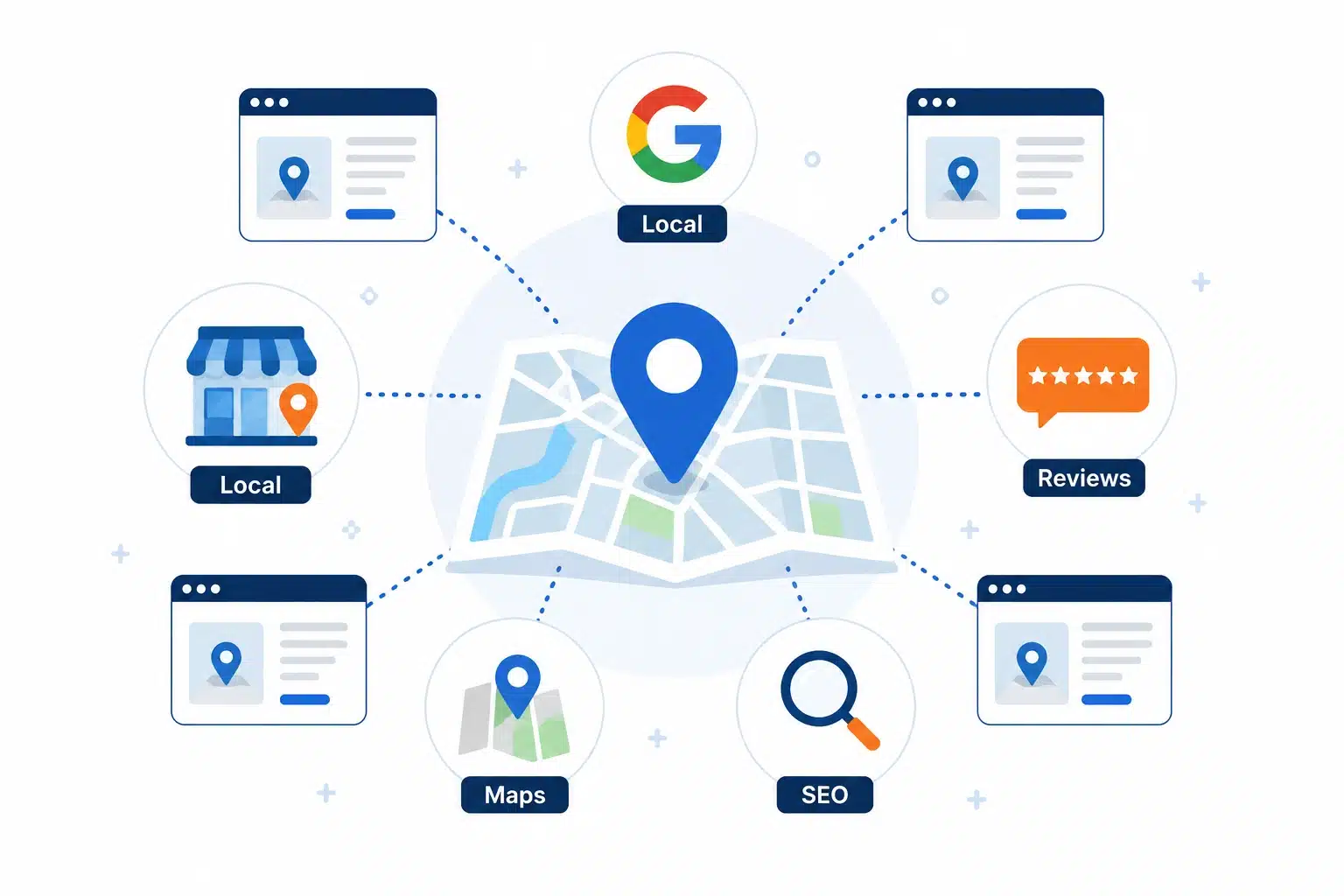
The Crucial Four Local SEO Fundamentals to Focus on
Mobile Performance and Page Speed
Speed is not just a technical detail. It has a direct, measurable relationship with whether a visitor stays on your site long enough to consider calling.
When load time increases from one second to three seconds, bounce rate rises significantly, and many plumbing websites today load somewhere between four and eight seconds on mobile, well past the point where visitors start leaving. For a visitor dealing with an urgent problem, a slow-loading site does not just create mild annoyance. It actively pushes them toward the next search result.
Image optimization, minimal use of heavy plugins, and reliable hosting all contribute to faster load times. SSL security is also no longer optional, both because it protects visitor data and because search engines and browsers flag unsecured sites in ways that damage trust instantly.
Pro tip: Test your site’s mobile load speed using a free tool like Google PageSpeed Insights before making any other design changes. Speed issues often explain a conversion problem that looks, at first glance, like a design or content issue.
Conversion Element Impact Overview
| Element | Primary Impact | Common Mistake |
| Sticky tap-to-call number | Reduces friction for emergency visitors | Buried below the fold or in a menu |
| Real photos of team and jobs | Builds immediate trust | Using generic stock photography |
| Service area pages | Improves local search ranking | One generic page for all locations |
| Mobile page speed | Reduces bounce rate directly | Heavy plugins and unoptimized images |
Build Options and Realistic 2026 Pricing
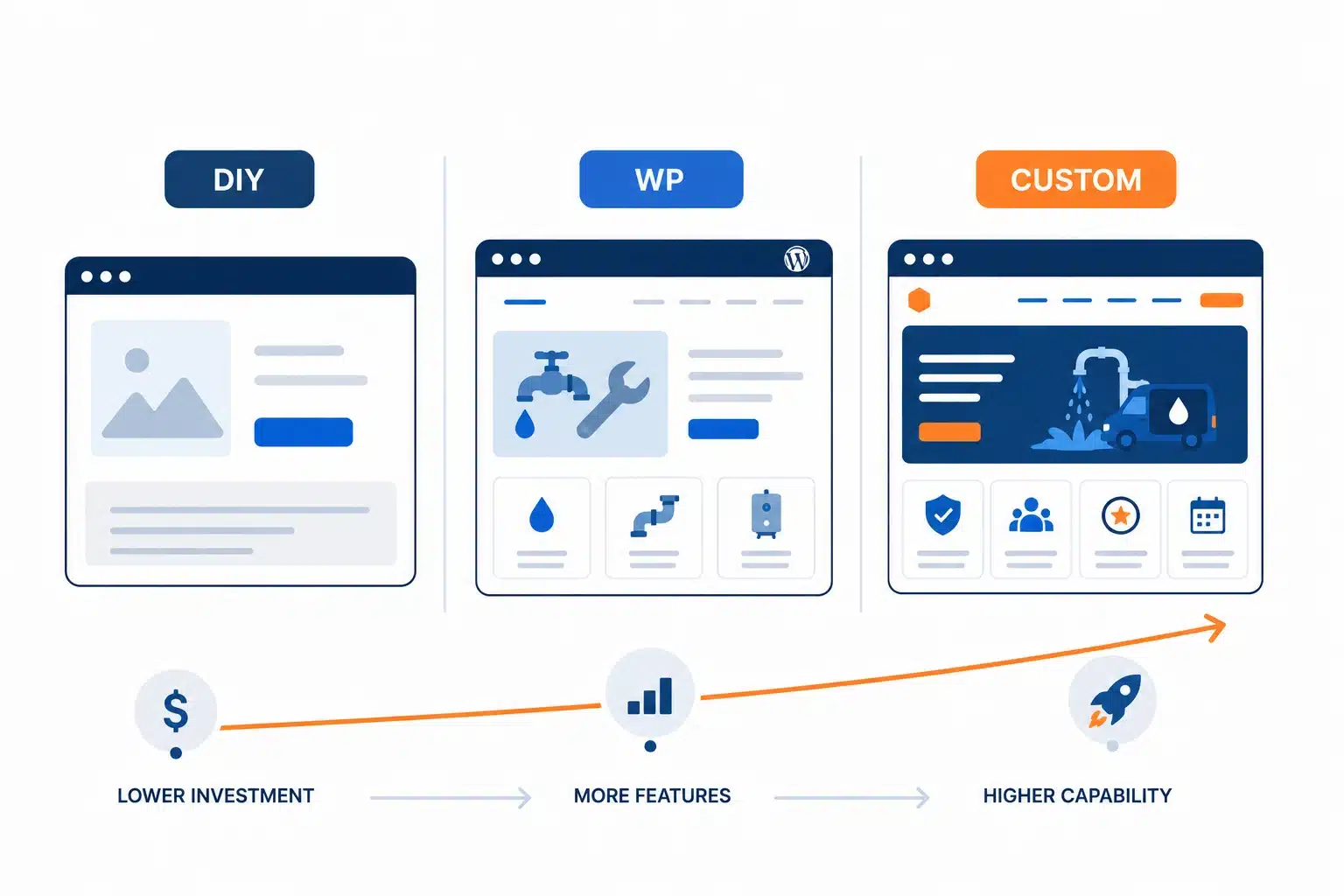
Plumbers have several realistic paths to building a converting website, and the right choice depends on budget, timeline, and how much ongoing optimization you plan to invest in.
| Build Path | Typical Cost Range | Best For |
| DIY website builder | $500 to $3,000 | New businesses with a very limited budget |
| WordPress with plumbing theme | $3,000 to $10,000 | Established plumbers wanting strong SEO control |
| Custom-built website | $10,000 to $20,000+ | Growing businesses investing in long-term lead generation |
What Drives Cost Up
The number of service area pages you need built out is one of the biggest cost drivers, since each page requires unique, locally relevant content rather than a copy-paste template. Integrated booking widgets, live review feeds, and call tracking systems also add development time compared to a simpler static site.
Where to Optimize Without Cutting Corners
Starting with a WordPress build using a proven plumbing theme, rather than a fully custom site, can deliver most of the same conversion benefits at a lower cost for businesses not yet ready for a larger investment. Prioritizing real photography and service area pages over advanced animations or unnecessary design flourishes keeps spending focused on what actually drives calls.
Common Mistakes That Kill Conversions
A few recurring mistakes show up again and again across underperforming plumbing websites, and most of them are fixable without a full rebuild.
Who Do You Need on Your Team?
Building a plumbing website that actually converts requires more than a general web designer, even though many businesses start there.
A designer with service business experience understands the urgency-driven behavior of plumbing customers, which differs significantly from designing for a retail or hospitality brand. A local SEO specialist is essential for building out service area pages correctly and ensuring your Google Business Profile and website work together, not in isolation. A copywriter familiar with trust-building language helps translate credentials and guarantees into copy that actually reassures a stressed visitor rather than reading like generic marketing text. If you plan to run ongoing conversion testing, someone with basic analytics literacy should be involved from the start, since improvements compound significantly more when they are measured rather than guessed at.
Smaller plumbing businesses do not need every one of these roles as a dedicated hire, but skipping local SEO expertise or trust-focused copywriting almost always leaves real conversion potential on the table.
Related Post: SEO Checklist For New Websites in 2026
Post-Launch Testing and Ongoing Optimization
A website is not a one-time project that gets finished and forgotten. Businesses that treat their site as a living asset, tested and refined over time, consistently outperform those that launch once and walk away.
A one-time build with no ongoing performance monitoring is a depreciating asset. Search algorithms change, competitor sites improve, and visitor expectations around speed and design continue to rise. A site with continuous conversion testing and SEO refinement compounds in value instead of slowly losing ground.
Before hiring anyone for an ongoing relationship, it is worth asking whether they offer real conversion testing and SEO refinement after launch, or simply hand over a finished site and disappear. A beautiful, fast, well-optimized plumbing website means little if nobody is tracking whether it is actually generating calls over time.
Tracking a few key metrics on an ongoing basis- conversion rate, bounce rate, and which service area pages are driving the most local traffic- gives you a clear picture of where to focus the next round of improvements rather than guessing.
Conclusion
Plumber website design in 2026 comes down to removing friction for a visitor who is often stressed, in a hurry, and comparing you against a competitor in real time. The businesses that convert best share a few clear traits.
Choosing the right build path, prioritizing the elements that actually move conversion, and committing to ongoing optimization will determine whether your website becomes your hardest-working employee, answering questions and booking jobs around the clock, or a digital brochure that quietly fails at the one thing that matters.
If you are ready to move from planning to building, working with an experienced web design company that understands local SEO, trust-focused design, and conversion optimization for service businesses can save significant time compared to learning these lessons through trial and error.
Frequently Asked Questions
Q1. Why does my plumbing website get traffic but not many calls?
This usually points to a trust or friction problem rather than a traffic problem. Missing credentials, slow load times, buried contact information, or a single homepage trying to serve every type of visitor are the most common reasons traffic fails to convert into calls. Reviewing your bounce rate alongside your actual conversion rate often reveals which specific issue is costing you the most leads.
Q2. What is the single biggest fix for a low-converting plumbing website?
Real photography and dedicated service area pages consistently show the largest individual impact across plumbing website audits. Real photos build immediate trust, while service area pages improve both local search ranking and visitor confidence that you actually serve their area.
Q3. Should I show pricing on my plumbing website?
Yes, at least in general ranges. Many plumbers avoid this out of fear it will scare customers away, but transparency tends to build trust and reduce friction instead. Even a rough price range for common services gives visitors enough information to feel comfortable reaching out.
Q4. How important is page speed for a plumbing website?
Extremely important; bounce rate rises sharply as load time increases, and many plumbing websites currently load well past the point where visitors start leaving. Since most plumbing searches happen on mobile, often from someone dealing with an active problem, a slow site loses visitors before they ever see your services.
Q5. Do I need separate pages for each service and each city I serve?
Yes, if you want to rank well in local search and effectively convert visitors with different needs. A single homepage cannot serve someone searching for an emergency repair and someone researching a bathroom remodel equally well, and generic city-wide pages tend to rank worse than pages built specifically around each service area.