 Design
 App Development
 Web Engineering
 AI Services
 Cloud
 Staffing
 Startups
 Health / Fitness
 Education
 Social
 Nonprofit
 Fintech
 Construction
 Logistics
 Government
 Travel/Hospitality
 HR Software
 About Simpalm
 Our News
 Client Testimonials
 Careers
 Our Blog
 Awards
 Resources
 Information
Key Takeaways
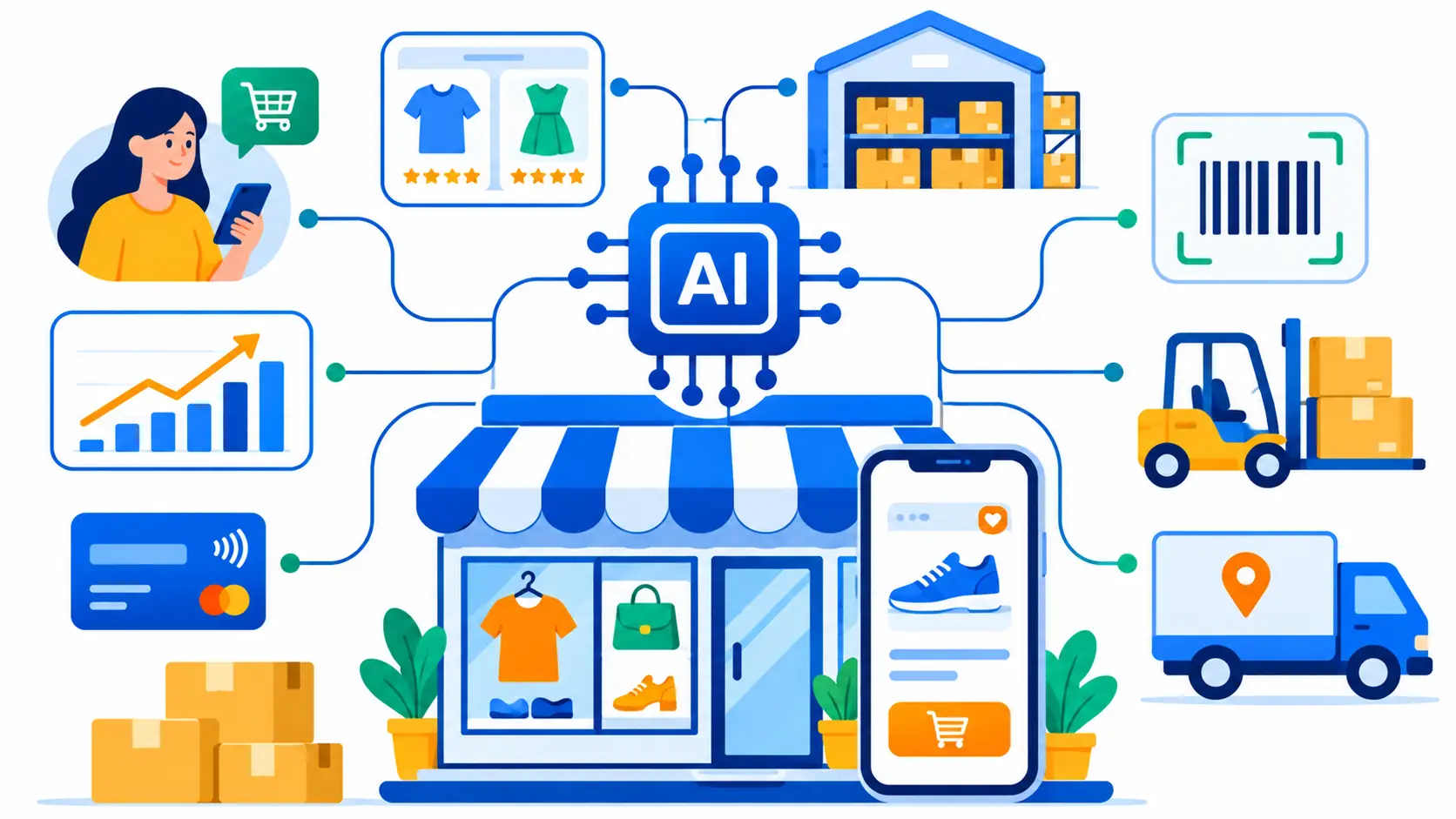
- AI in retail combines machine learning, computer vision, language processing, and generative AI to predict demand, personalize shopping, and automate store and supply chain decisions.
- Use of AI in personalization, conversational search, demand forecasting, and pricing tends to deliver the clearest returns in the retail industry because they connect directly to conversion, inventory, and margin.
- Set baselines and KPIs before integrating AI into your retail business, then separate impact delivered by AI over a time period to measure the clearest results.
_________________________________________________________________________________________
Retailers make hundreds of decisions every day, from choosing which products to stock and how to price them to deciding which products shoppers see and when to replenish inventory. When these decisions rely on outdated data or manual processes, retailers risk missed sales, excess inventory, and lower profit margins.
Artificial intelligence (AI) is changing how retailers make these decisions. By analyzing sales patterns, predicting demand, personalizing product recommendations, and automating routine tasks, AI helps retailers respond to customer needs and manage operations more efficiently. The opportunity is significant. McKinsey estimates that generative AI could create $240 billion to $390 billion in economic value for the retail industry.
However, adopting AI is about more than adding new technology. Retailers need to identify the right use cases, choose between ready-made and custom solutions, address data and integration challenges, and measure whether their investments deliver results.
This guide explores how AI is transforming the retail industry, from customer-facing applications such as personalized shopping and conversational search to operational uses such as demand forecasting, dynamic pricing, and supply chain optimization. It also explains the benefits, implementation challenges, and practical steps retailers can take to adopt AI and measure its business impact.
The Core Technologies Behind Retail AI
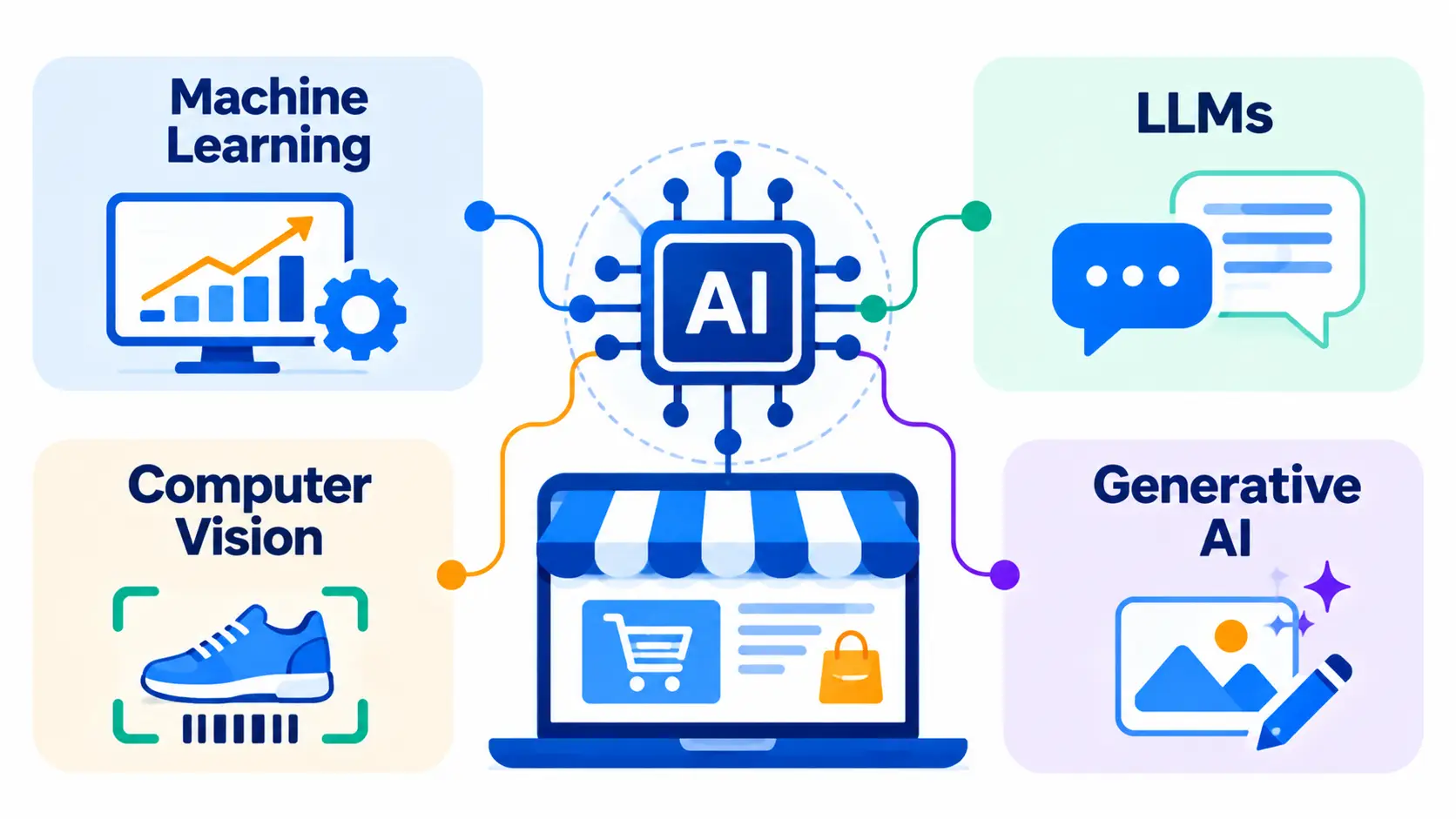
AI in the retail industry learns from data to predict, personalize, automate, and decide across the shopper journey and store operations. In practice, four technologies do most of the work:
- Machine learning: Finds patterns in sales, browsing, and inventory data to power forecasts, recommendations, and pricing models.
- LLMs: Understand customer intent and generate human-like responses to power AI shopping assistants, personalized recommendations, product descriptions, and customer support.
- Computer vision: Interprets images and video, which enables visual search, virtual try-on, shelf monitoring, and loss prevention.
These layers rarely work alone. A modern shopping assistant, for example, pairs a conversational model with a recommendation engine and live catalog data, so it can understand a vague request, retrieve matching products, and explain why they fit. That combination is what most AI solutions for retail look like once they reach production.
How Retailers Use AI to Enhance the Shopping Experience
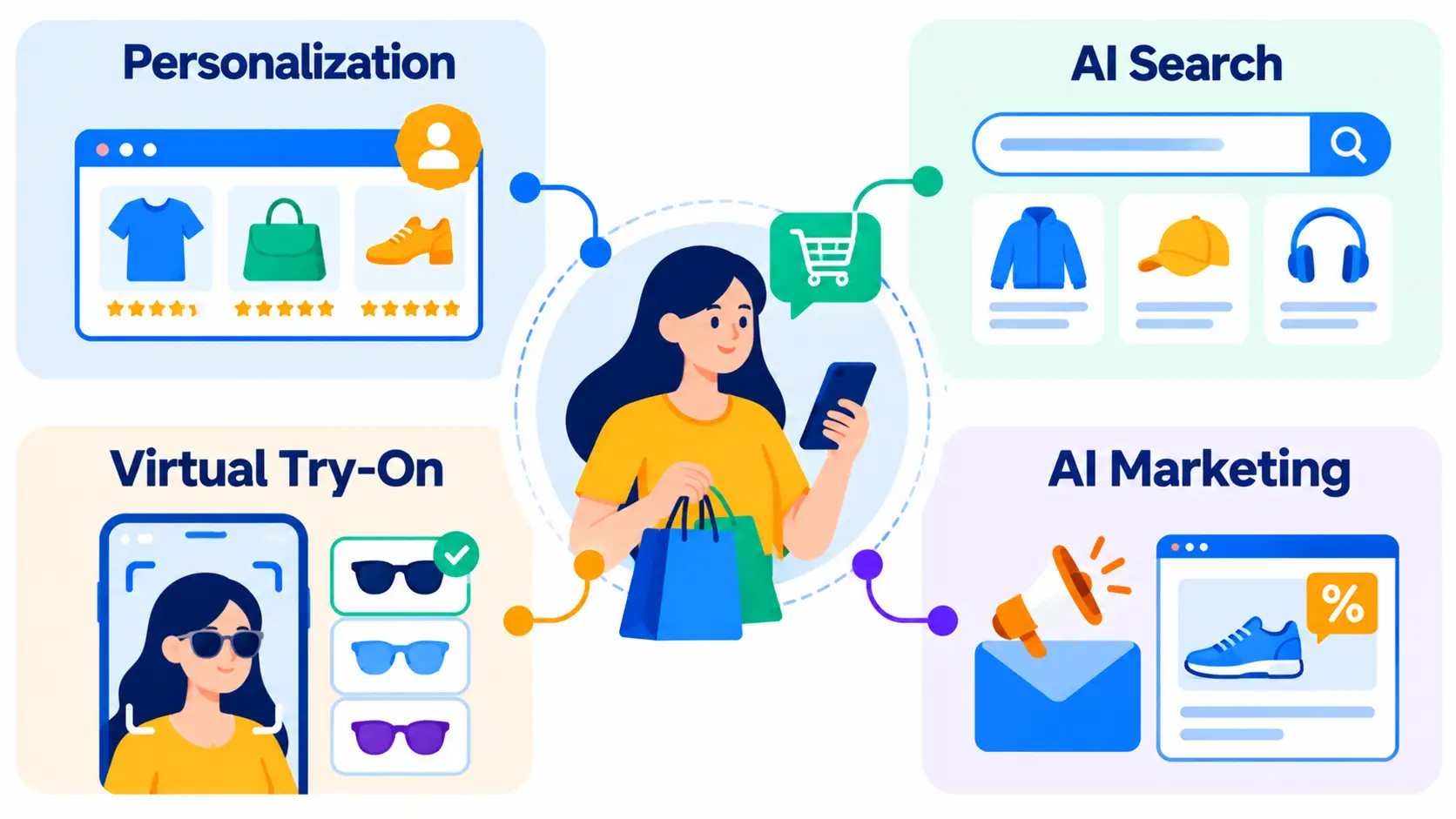
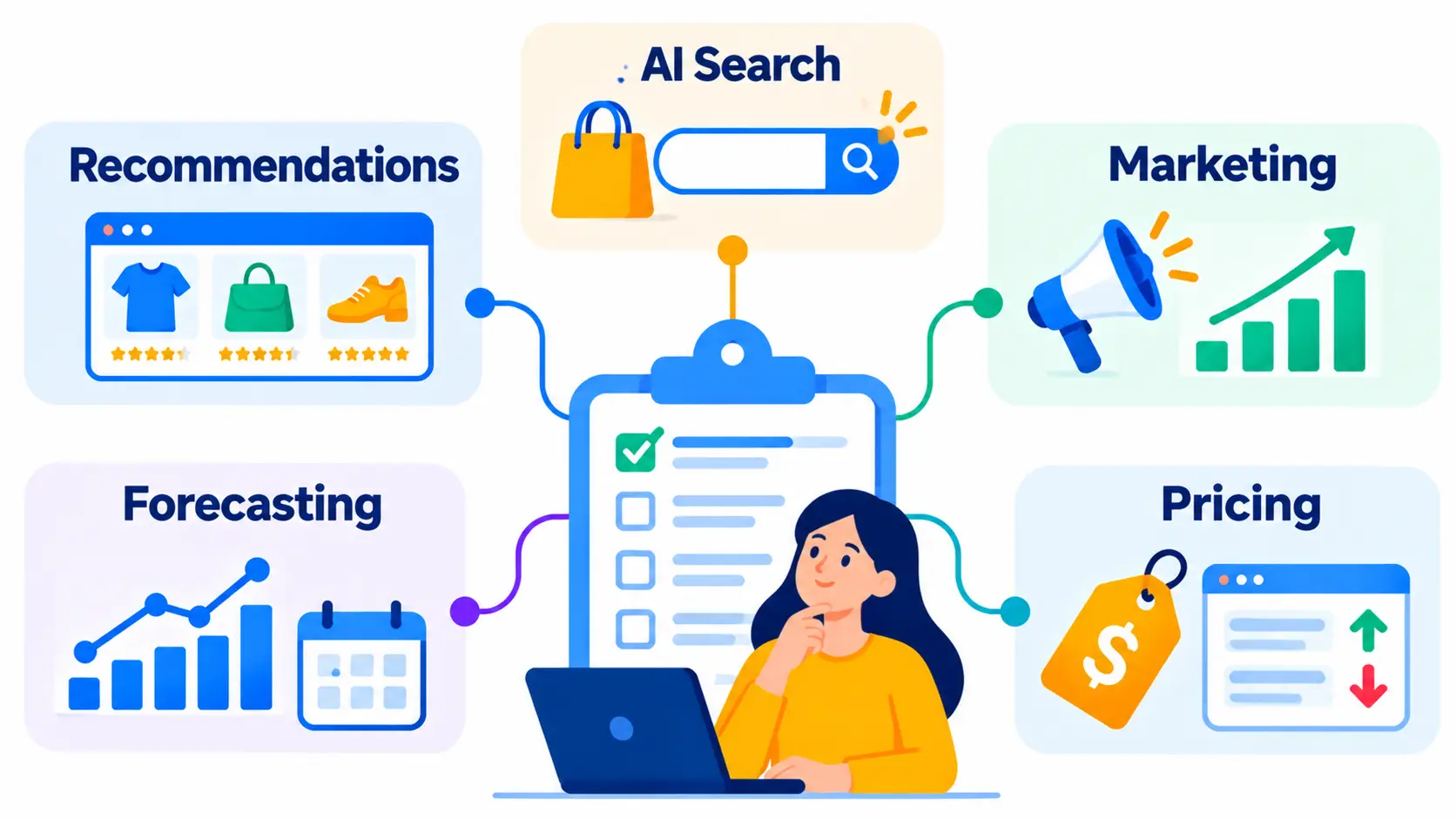
Retailers use AI to make shopping more relevant, convenient, and personalized. It helps customers discover products through tailored recommendations, find answers using conversational search, preview products virtually, and receive more relevant marketing messages. The following use cases show how AI supports shoppers from product discovery to the final purchase decision.
Personalization and Product Recommendations
Personalization is the most mature AI use case in retail because the data behind it, such as purchase history, browsing behavior, and loyalty activity, already exists in most businesses. Models use that data to decide which products, offers, and messages each shopper sees, which tends to lift conversion and basket size.
- How it works: Recommendation engines rank products by predicted relevance for each person and each moment, across the website, app, email, and in-store screens.
- Real example: Starbucks uses its Deep Brew platform to suggest items based on factors such as order history, time of day, weather, and local store inventory.
- Why it matters: Relevance reduces the effort shoppers spend searching, which makes each visit shorter, more satisfying, and more likely to end in a purchase. It also gives retailers a way to promote high-margin items to the people most likely to want them.
Conversational Assistants and AI Search
Finding the right product becomes tricky when shoppers describe a need instead of a product, such as “a waterproof jacket for a rainy hiking trip.” Intent-based search and shopping assistants interpret that request, ask clarifying questions, and return matched products.
- What it improves: Product discovery, answer speed, and conversion for shoppers who arrive unsure of what to buy.
- Real example: Amazon’s Rufus reached more than 300 million customers in 2025, and Amazon attributes nearly $12 billion in incremental annualized sales to it. That figure reflects Amazon’s own attribution method, but it shows how much demand exists for conversational shopping.
Visual Search and Virtual Try-On
Advance features like visual search and virtual try-on use AI to help shoppers evaluate products before making a purchase. Visual search lets customers find similar items by uploading a photo, while virtual try-on uses computer vision and augmented reality to preview products such as makeup, clothing, and accessories. These features make product discovery easier and help shoppers feel more confident about their choices.
- What it improves: Confidence at the point of purchase, which supports lower return rates.
- Real example: Sephora’s Virtual Artist lets customers try on makeup in the app or in-store, and the company has reported more than 8.5 million visits and 200 million shades tried. Amazon says tens of millions of customers use Amazon Lens each month for camera-based product search.
AI in Retail Marketing
AI helps retailers create marketing content faster and deliver more relevant campaigns to different customer segments. Generative AI supports content creation, while machine learning analyzes customer behavior to help retailers determine which messages to send, which audiences to target, and when to reach them.
- Content generation: Product descriptions, email copy, and campaign imagery can be drafted in minutes and then reviewed by people.
- Segmentation and optimization: Models group shoppers by behavior and price sensitivity, then adjust timing, channel, and creative based on results.
- Real example: Zalando told Reuters that generative AI cut the time needed to produce campaign imagery from six to eight weeks to three or four days and reduced costs by 90 percent. Around 70 percent of its editorial campaign images were AI-generated in late 2024.
How AI Improves Retail Operations and Efficiency
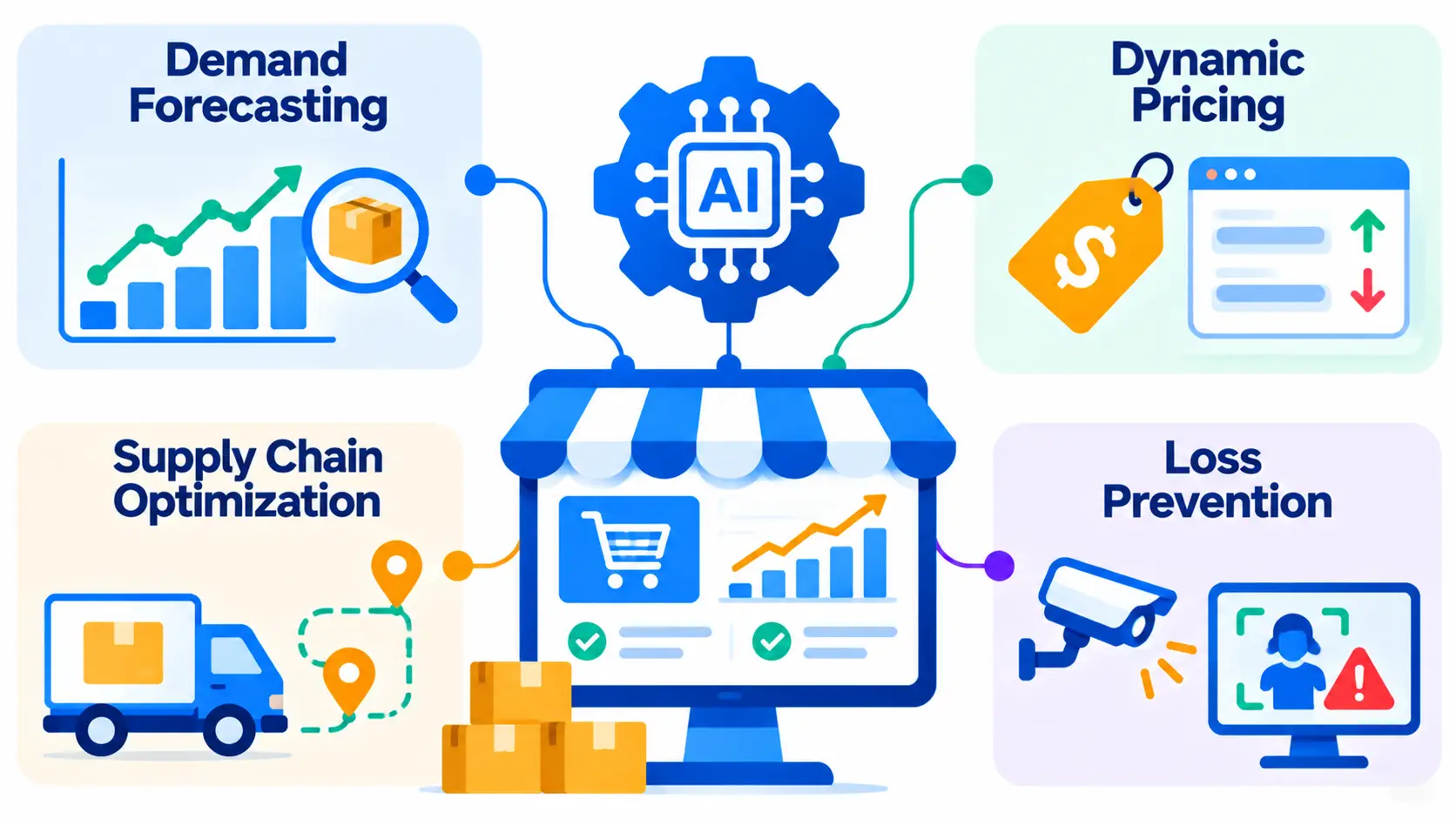
Beyond the shopping experience, AI helps retailers make better operational decisions and manage costs. Retailers use predictive models to plan inventory, pricing algorithms to manage markdowns, and AI-powered tools to improve delivery planning and detect store-level issues. These applications focus on the processes behind each sale, helping retailers reduce waste, protect profit margins, and keep products available where customers need them.
Demand Forecasting and Inventory Management
Forecasting models combine past sales, promotions, weather, local events, and trends to predict what each store or fulfillment center will need. Better forecasts mean fewer stockouts, less overstock, and less capital tied up in slow-moving inventory. They also help buyers plan further ahead, which improves negotiating position with suppliers and shortens the lag between a demand signal and a stocked shelf.
Dynamic Pricing and Promotions
Pricing models weigh demand, competitor prices, and stock levels to recommend prices, markdowns, and promotions. Used well, they clear aging inventory and protect margin. Used carelessly, they erode trust, and lawmakers in the United States have already proposed limits on algorithmic and individualized pricing, so transparency matters.
Supply Chain and Delivery Routing
AI helps rebalance stock between locations, choose the right fulfillment point for each order, and plan delivery routes. The result is faster, lower-cost fulfillment, especially when demand shifts unexpectedly. Shoppers see the benefit as accurate delivery promises and fewer cancelled orders, while retailers see lower shipping cost per order and less stranded inventory.
Loss Prevention and Store Operations
Computer vision and analytics flag shelf gaps, pricing errors, and suspicious patterns, while assistant tools help associates find answers faster. The stakes are high. Appriss Retail estimated that shrink cost retailers $90 billion in 2025, and 73 percent of it was preventable.
Taken together, these four use cases form a loop. Forecasts inform pricing, pricing shapes promotions, promotions change demand, and store data feeds the next forecast. Retailers that connect them see compounding gains, while those that run each in isolation capture only a fraction of the value. The table below summarizes each use case alongside a documented example from a large retailer.
| Use case | What AI does | Real-world example |
| Demand forecasting and inventory | Predicts store-level demand from sales history, weather, and events to guide replenishment | Walmart built a machine learning forecasting platform that launched first in its meat and produce departments across US stores |
| Dynamic pricing and promotions | Recommends prices and markdowns based on demand, competition, and stock | Walmart is rolling out digital shelf labels across its roughly 4,600 US stores so prices can change within minutes, and says store prices stay consistent regardless of demand or time of day |
| Supply chain and delivery routing | Adjusts replenishment schedules and product flow when demand surges | Walmart uses AI forecasting tools to adjust replenishment and the flow of goods when demand depletes inventory faster than projected |
| Loss prevention and store operations | Detects out-of-stocks, misplaced items, and pricing errors with cameras and robots | BJ’s Wholesale Club is deploying Simbe’s Tally shelf-scanning robots across all of its stores |
Which AI Use Case Should You Start With?
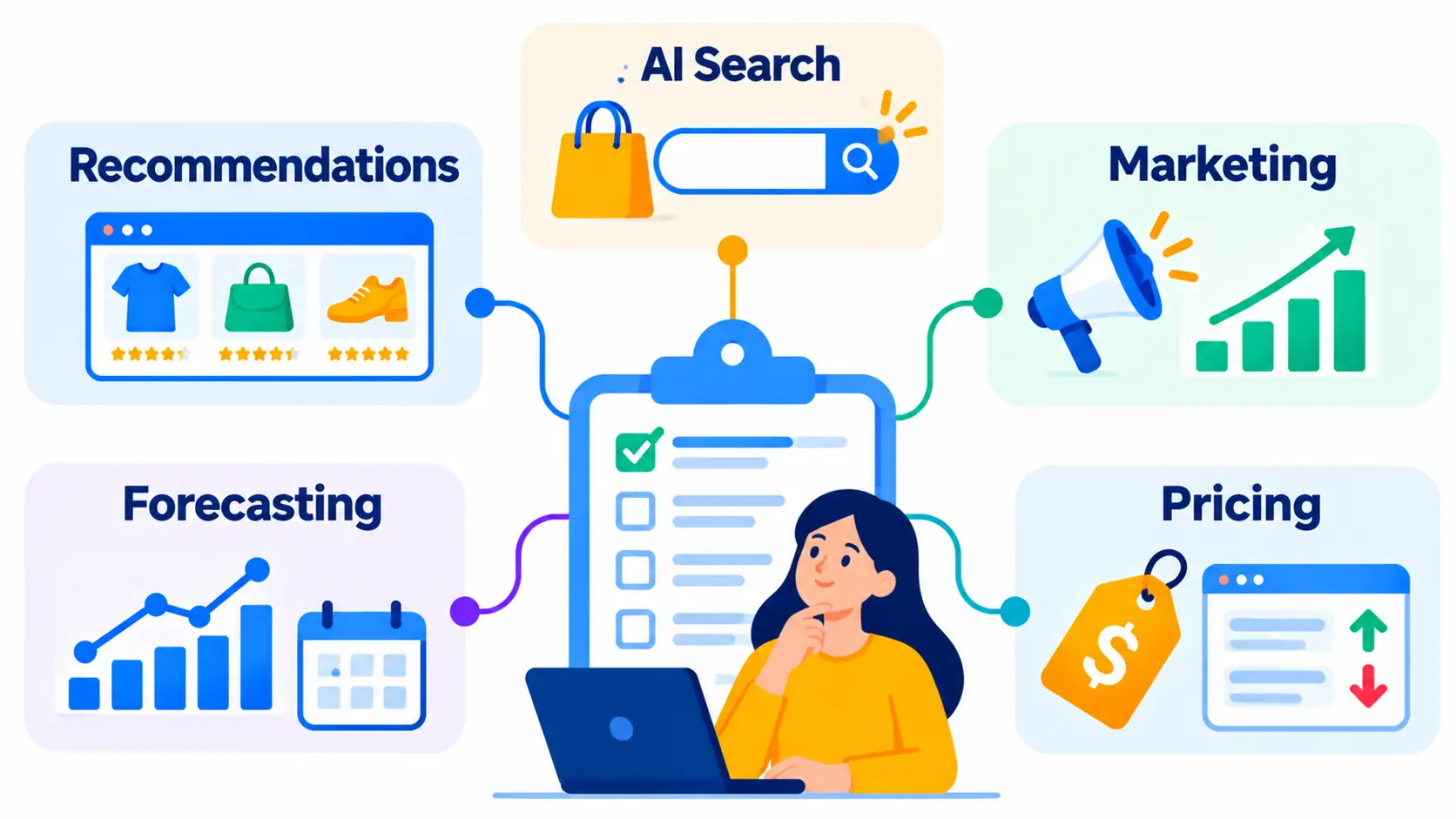
A simple framework keeps the decision grounded. Score each candidate on business impact (how directly it affects revenue, margin, or cost), data readiness (whether the data you need is clean, accessible, and current), and integration effort (how many systems the project touches). The best first project usually combines high impact with modest effort, even if it is not the most exciting idea on the list.
| Use case | Business impact | Integration effort | Data requirements |
| Product recommendations | High | Low to medium | Purchase and browsing history |
| AI search and shopping assistant | High | Medium | Clean, current product catalog |
| Marketing content generation | Medium | Low | Brand guidelines and product data |
| Demand forecasting | High | Medium to high | Sales, inventory, and promotion history |
| Dynamic pricing and markdowns | High | High | Pricing, competitor, and stock data |
| Shelf monitoring and loss prevention | Medium | High | Camera or robot data and store systems |
Sequencing matters as much as selection. A recommendation engine or an AI search upgrade can go live in weeks and produce measurable conversion data quickly. That early evidence builds internal confidence, funds the next project, and exposes data problems while the stakes are still low. Quick wins include recommendations and marketing content, which rely on data most retailers already hold. Forecasting, pricing, and in-store vision are longer-term investments that pay off at scale but demand deeper integration. Small and mid-sized retailers should begin with AI features built into the commerce, email, or point-of-sale tools they already use, choose one KPI to improve, and delay custom models until their data volume justifies the cost.
Why Retailers Should Invest in Integrating AI Features
McKinsey estimates that generative AI could unlock $240 billion to $390 billion in economic value for retailers, equivalent to a margin gain of 1.2 to 1.9 percentage points.
The case for acting now rests on four pressures that are all building at once:
- Margin and cost pressure: Labor, logistics, and inventory costs keep climbing, and AI-driven forecasting and automation attack all three.
- Shopper expectations: Customers expect relevant results, fast answers, and personal offers, and they notice when a retailer falls short.
- Underused data: Most retailers already own years of transaction, loyalty, and inventory data that rarely informs daily decisions.
- Early momentum: Assistants like Rufus show that shoppers will adopt AI when it makes buying easier, and early movers build the data and experience that late movers must catch up on.
Waiting carries its own cost. Every season without AI-informed forecasting means another round of avoidable markdowns, and every quarter without personalization leaves relevant offers unsent. The main benefits of AI in retail follow directly from these pressures: higher conversion, larger baskets, leaner inventory, lower cost to serve, and fewer losses to returns and shrink.
Common AI Retail Pitfalls and How to Fix Them
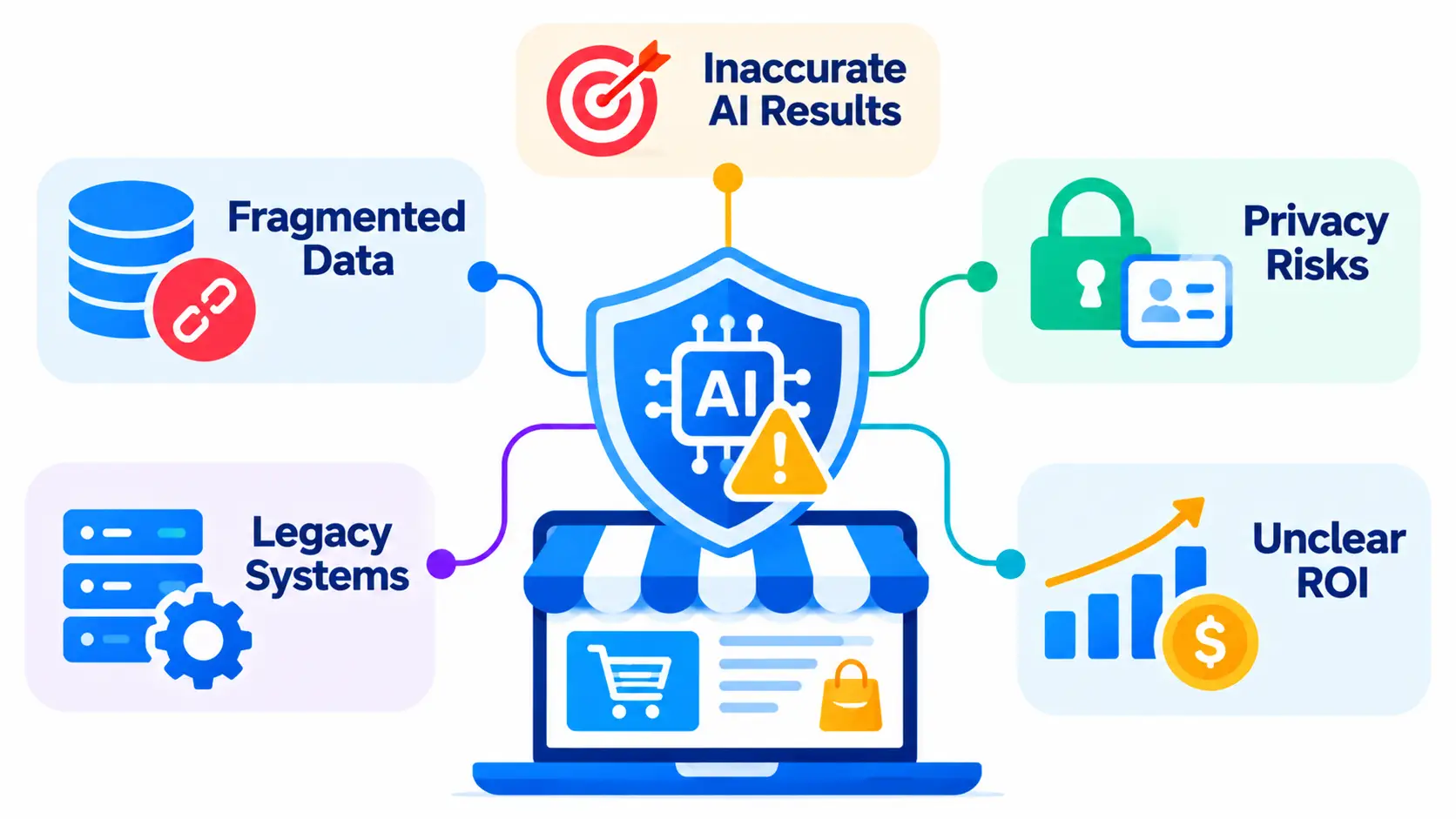
Most failed retail AI projects stall for predictable reasons. None of them are exotic, and each one has a practical fix that a well-run team can apply before problems reach shoppers.
- Challenge – Fragmented data across systems. Online, in-store, and supply chain data often sit in separate tools, so models see only part of the picture.
Fix – Unify data sources into a single customer and product view before scaling AI. - Challenge – Inaccurate AI answers about products or stock. An assistant that recommends an item that is sold out damages trust quickly.
Fix – Ground assistants in live catalog and inventory data, and test answers against real shopper questions before launch. - Challenge – Privacy and consent risks. Personalization depends on personal data, and regulators and shoppers both expect careful handling.
Fix – Build consent and governance into personalization from the start. Retailers that process payments can borrow proven controls from fintech, where AI is already used for fraud detection and payment risk. - Challenge – Legacy POS and ERP integration. Older systems were not built to share data in real time.
Fix – Phase integrations, use APIs to connect new tools to existing systems, and avoid ripping out core platforms all at once. - Challenge – Unclear returns on investment. Projects launched without success metrics are hard to defend at budget time.
Fix – Define KPIs and baselines before launch so every pilot has a measurable goal.
How to Measure the ROI of AI Implementation in Retail Businesses
Measurement starts before launch. Record baseline figures for the KPI each use case is meant to move, then compare against a control group or a comparable period so seasonality and promotions do not get credited to the model.
| Use case | Primary KPIs |
| Recommendations and personalization | Conversion rate, average order value |
| Demand forecasting | Forecast accuracy, stockout rate, overstock levels |
| Pricing and markdowns | Markdown rate, gross margin |
| Assistants and support | Cost to serve, resolution rate |
| Visual search and try-on | Return rate, conversion rate |
Choose a small set of KPIs per project rather than a long dashboard, because a clear before-and-after comparison persuades finance leaders more than a dozen loosely connected charts. Review results on a fixed schedule, such as monthly, and decide in advance what outcome would justify expanding, adjusting, or stopping the project. Results also fade if models are left alone. Customer behavior, catalogs, and prices change constantly, so plan for monitoring, retraining, and ongoing support from day one. Simpalm’s overview of AI for app maintenance and support shows how predictive monitoring keeps software healthy after launch.
Final Thoughts
AI is transforming retail by helping businesses personalize shopping experiences, forecast demand, optimize pricing, and streamline store operations. As these use cases show, the greatest value comes when retailers connect AI initiatives to specific business goals rather than adopting technology without a clear purpose.
Retailers should start by identifying a high-impact problem, setting measurable KPIs, and choosing an AI solution that fits their data, systems, and budget. This approach helps them evaluate results before expanding to more complex applications, including agentic commerce.
If you want to use AI to improve product recommendations, automate retail operations, or build an AI-powered shopping assistant, Simpalm’s advanced AI services can help you define the right use case and develop a solution around your business requirements.
Frequently Asked Questions
Q1. How is AI used in retail?
Ans. AI is used on both sides of the business. Shopper-facing applications include personalized recommendations, conversational assistants, visual search, virtual try-on, and marketing content generation. Behind the scenes, AI forecasts demand, recommends prices and markdowns, plans fulfillment and delivery, and monitors stores for stock gaps and shrink. Most retailers begin with one or two of these and expand as their data and confidence grow.
Q2. What are the main benefits of AI in retail?
Ans. The core benefits are higher conversion and larger baskets from better personalization, leaner inventory from sharper forecasts, faster and cheaper marketing production, lower service costs through automation, and reduced losses from returns and shrink. The strongest results appear when a retailer ties each AI project to a specific KPI instead of treating AI as a general upgrade.
Q3. Can small retailers use AI?
Ans. Yes. Small retailers can start with AI features built into the e-commerce, email, and point-of-sale platforms they already pay for, including product recommendations, automated product descriptions, and basic demand forecasts. The key is to pick one problem, such as cart abandonment or stockouts, and measure the outcome. Custom development usually makes sense only after those simpler tools have proven their value.
Q4. How much does it cost to implement AI in a retail business?
Ans. Cost depends on scope, data readiness, and the build approach. Packaged tools generally cost the least upfront and are billed as subscriptions, while custom solutions require development, integration, and ongoing maintenance budgets. Hidden costs often include data cleanup, connecting legacy systems, staff training, and model monitoring. A scoped pilot with clear KPIs is the best way to estimate real costs before committing to a larger rollout.
Q5. What are the risks of AI in retail?
Ans. The main risks are inaccurate outputs, such as assistants quoting wrong prices or stock levels, along with privacy and consent violations, biased recommendations, and shopper backlash against opaque pricing. Integration failures and unclear ROI are also common. Governance, human review of important decisions, grounding AI in live data, and transparent communication with shoppers reduce most of these risks.
Q6. How is generative AI different from traditional retail AI?
Ans. Traditional retail AI, mostly machine learning, analyzes structured data to predict outcomes such as demand, churn, or the next best offer. Generative AI creates new content, including product copy, images, and natural conversation. The two work best together. A forecasting model decides what to promote, and a generative model writes the campaign, answers shopper questions, and explains recommendations in plain language.