
 Design
 App Development
 Web Engineering
 AI Services
 Cloud
Cloud Staffing
 Startups
 Health / Fitness
 Education
 Social
 Nonprofit
 Fintech
 Construction
 Logistics
 Government
 Travel/Hospitality
 HR Software
 About Simpalm
 Our News
 Client Testimonials
 Careers
 Our Blog
 Awards
 Resources
 Information
Key Takeaways
- AI accelerates MVP development by generating UI, code, architecture, and test cases from natural language prompts.
- Founders/CTOs can validate ideas faster using AI-driven market research, competitor analysis, and personal insights.
- AI is ideal for simple MVPs but struggles with complex logic, scalability, security, and long-term architecture, which require intervention from human intelligence.
- Cost of building varies based on complexity, integrations, backend code, platform choice, and the need for custom AI models.
- The strongest MVP combines AI speed with human engineering expertise to ensure stable and scalable systems.
_________________________________________________________________________________________
There is a dramatic shift in building a Minimal Viable Product (MVP) in recent times. What used to take months and needed a huge team to turn an idea into a usable product can now be done in days. The reason for this shift is the rapid adoption of AI in software engineering. Today, founders can use AI in every step of product development with faster, cheaper, and more accessible technology. According to a GitHub survey, the generative AI wave in software development continues to grow. Survey data indicates that a strong majority (59-88% of respondents across all markets) reported that their companies are either “actively encouraging” or “allowing” the use of these tools.
But here is the nuance that often gets overlooked.
AI makes it possible and easy to build an MVP, but it does not guarantee a foolproof MVP. AI can accelerate execution, but it lags behind when it comes to strategic decision-making, product-market fit, and validation. This is where you tend to lose money, miss deadlines, and run into scalability issues. AI can build the product, but it will not tell you whether the architecture will survive real-world usage.
In this blog, we will explore how AI is redefining MVP development — what it builds, where it struggles, and when founders can rely on AI vs. when they need engineering support.
What is AI MVP Development?
AI MVP development is the process of building a minimum viable product using AI as the core foundation of the development workflow. You describe what you want in plain English, and the AI system generates the architecture, writes the code, creates the UI, tests the product, and helps deploy it. Instead of manually building every component, you supervise, refine, and validate what the AI tool produces. In fact, 70% of developers see an advantage in AI coding tools and cite better code quality, faster completion time, and quicker incident resolution as some of the top anticipated benefits.
This approach is different from the traditional MVP development process, which requires product managers to define requirements, designers to create wireframes, developers to write code, QA engineers to test features, and DevOps engineers to deploy and maintain the application.
AI MVP development changes this model. Instead of humans doing the heavy lifting, AI handles the repetitive and time-consuming tasks, and the entire effort can be completed in days or weeks depending on the size of the MVP. This shift makes the process faster, cheaper, and more accessible, especially for early-stage founders who don’t have a large engineering team.
Who is Using AI to Build MVPs?
- Founders
- Idea Innovators
- CTO/CIO
- Digital Product Leaders
- Software Engineering Heads
The AI Stack That Helps You Build Faster
A big reason founders are leaning towards AI is the rise in the number of tools that automate the development process and make it faster. You can simply input your ideas into these platforms as natural language prompts, and the tools will turn your ideas into working software.
All AI platforms can be categorized into two groups:
1. AI App Builders
These are tools that use artificial intelligence to help you build an app faster, even if you do not have strong coding skills. Using a prompt-to-build approach, even a non-technical person can describe what they want — the app’s screens, features, and flow — and the AI generates the code and basic app structure. You can handle ideation, wireframes, user flow, frontend and backend coding, and deployment.
Examples:
- Lovable — Autonomous code generation for web apps.
- Replit — Mobile and web apps.
- FlutterFlow — Cross-platform code export.
- Bolt.new — Prompt-to-app speed.
- Bubble — Used for web applications.
- Base44 — Used for rapid prototyping.
- v0 by Vercel — App builder for React and Next.js.
2. AI Coding Assistants / Code Editors
AI coding assistants can be used for MVP development; however, these platforms should be used by an expert developer. These are software tools that use LLMs to write, review, debug, and refactor code. There are two categories: one that suggests the next line of code, and another that acts as a fully autonomous software engineer, completing the development lifecycle with minimal human intervention. AI coding assistants should not be used by non-technical people.
Examples:
- Claude Code — Autonomous coding and debugging.
- Cursor — AI-assisted coding and editing.
- GitHub Copilot — Code suggestion and generation.
- OpenAI Codex — Autonomous software development.
- Devin — End-to-end software engineering.
- Tabnine — AI-powered code completion.
8 Advantages of AI for MVP Development
Building an MVP today is no longer about juggling multiple teams, long timelines, and endless iterations. Using AI, founders get a faster, simpler, and more confident way to move from idea to working product. It reduces guesswork and helps you build a first version without stretching your budget.
01. Faster Build, Fewer Delays
Turns ideas into products without waiting for long development cycles.
02. Better User Experience
AI studies user behavior to suggest clean flows, simple screens, and features people enjoy using.
03. Smarter Decisions
Provides quick insights from data, trends, and user feedback so you can choose the right features with confidence.
04. Lower Development Risk
AI helps you test ideas early, spot issues sooner, and avoid building redundant features.
05. Reduced Cost
You can build more with fewer resources, keeping your MVP budget tight and manageable.
06. Mature Infrastructure
Since AI tools are stable and production-ready, you can build MVPs without complex setup.
07. Stronger Investor Confidence
A working MVP gives investors real proof instead of just a pitch deck, strengthening capital discussions.
08. Faster Market Entry
AI lets you launch early, learn from real users, and stay ahead before the market gets saturated.
How to Build an MVP Using AI
Building an MVP is not just about writing code — it’s a sequence of decisions, validations, and iterations. AI now plays an important role in each of these stages, helping founders move fast without losing clarity.
Below is a breakdown of the steps AI supports in the MVP development journey, from initial discovery to post-launch improvements.
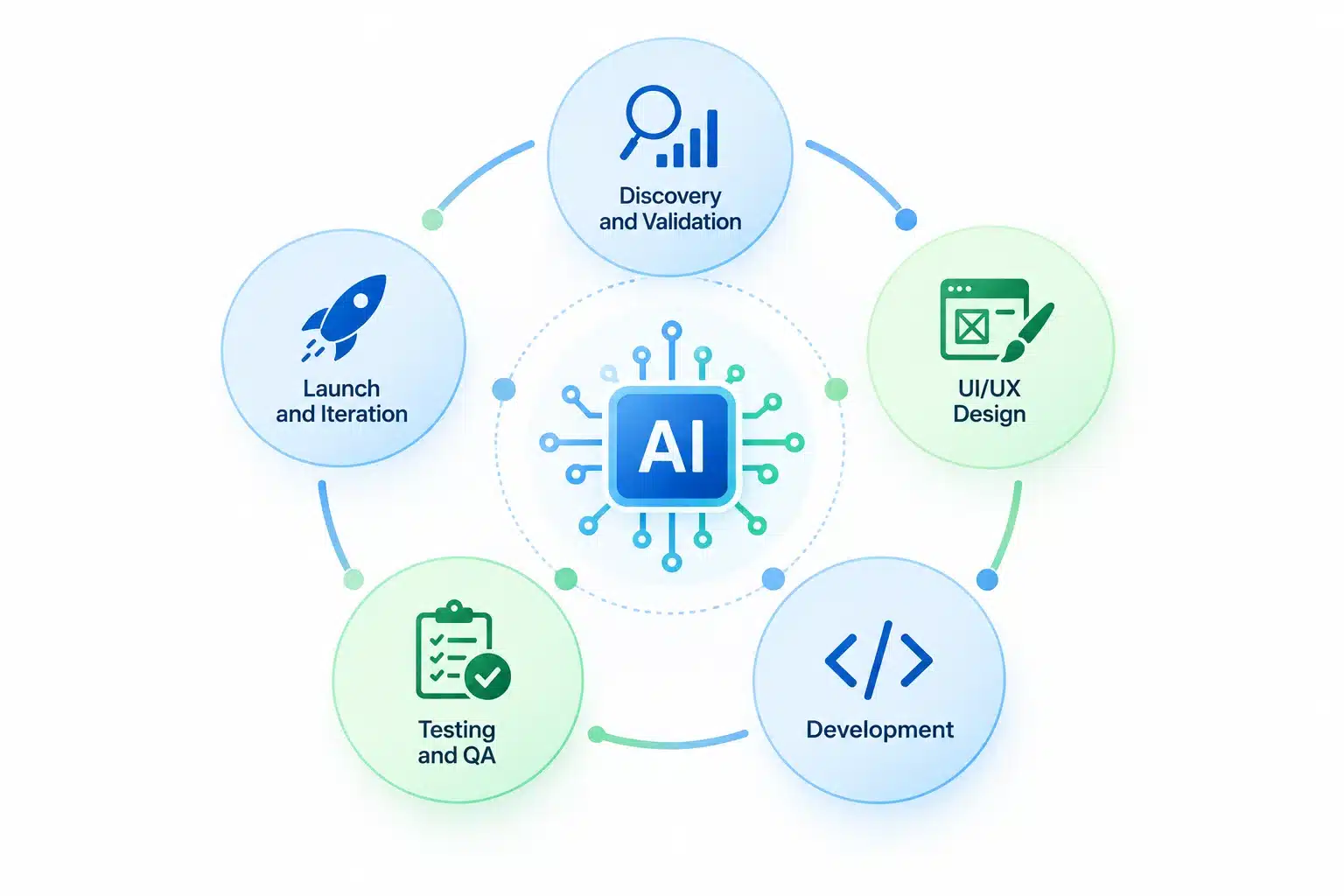
1. Discovery and Validation
Instant Customer Insights — Analyze reviews, forums, social media conversations, and industry reports to surface what users are struggling with.
Market and Competitor Analysis — Summarize market trends, highlight emerging opportunities, and compare competitors to understand market fit and saturation levels.
Persona Analysis and Demand Signals — Create realistic user personas based on customer behavior and demographic data. Identify demand signals from search trends, recurring complaints, or gaps in existing products.
Early Risk Identification — AI can flag potential risks before any code is written, including unclear value proposition, weak differentiation, or technical complexity — preventing founders from investing in ideas that won’t hold up.
2. UI/UX Design
Quick Wireframe Generation — Once you describe the screen, AI generates multiple wireframe options instantly. Platforms like Uizard and UX Pilot specialize in wireframes and UX flows.
User Flow Creation — AI maps out how users navigate the product — what they see first, where they click next, and how they complete tasks — helping founders visualize the experience early.
Design Variations — Instead of one direction, AI generates multiple designs, helping teams compare layouts and pick the best one.
Faster Iteration Cycles — AI acts as a creative partner, suggesting improvements and flagging usability issues. According to Worldmetrics, AI reduces UX design iteration time by 35% on average, from 8 weeks to 5.2 weeks.
3. Development
Frontend and Backend Code Generation — Platforms like Replit, Base44, Bolt.new, and Cursor generate working code from simple instructions.
Database and API Setup — Design database schemas, define relationships, and build APIs with minimal manual effort. For a deeper look, explore our guide on how to build an API.
Authentication and Integrations — Common flows like login, password reset, or third-party integrations can be generated automatically.
Smarter Debugging — AI identifies bugs and suggests fixes, reducing time spent on troubleshooting.
Reduced Boilerplate Work — Tasks that once took days, like setting up project structure, now take minutes, freeing teams to focus on strategy and logic.
4. Testing and QA
Automated Test Case Generation — AI writes test cases for every feature, ensuring solid coverage even on tight timelines.
Early Bug Detection — Catching issues early helps founders avoid costly fixes later.
Edge Case Simulation — AI tests scenarios humans often overlook, like unusual inputs or unexpected system behavior.
Continuous Testing — AI enables regression testing to ensure existing functionality keeps working as intended.
5. Launch and Iteration
User Behavior Analysis — AI tracks how users interact with the product — where they click, where they drop off — giving founders a clear picture of what’s working.
Feedback Summarization — Summarizes feedback from emails, reviews, and support chats, highlighting what needs immediate attention.
Data-Driven Improvement — AI recommends features to remove and features to improve.
Faster Iterations — Instead of waiting weeks to analyze data, founders can make informed decisions within hours and push updates faster.
Also read: Software Development for Startups: A Complete Guide for 2026
What Impacts the Cost of Building an MVP with AI?
Artificial intelligence makes MVP building faster and more affordable, but that doesn’t necessarily make the product cheap. Final cost depends on the complexity of what you’re building. In reality, AI is best understood as a powerful accelerator, not a replacement for skilled engineering.
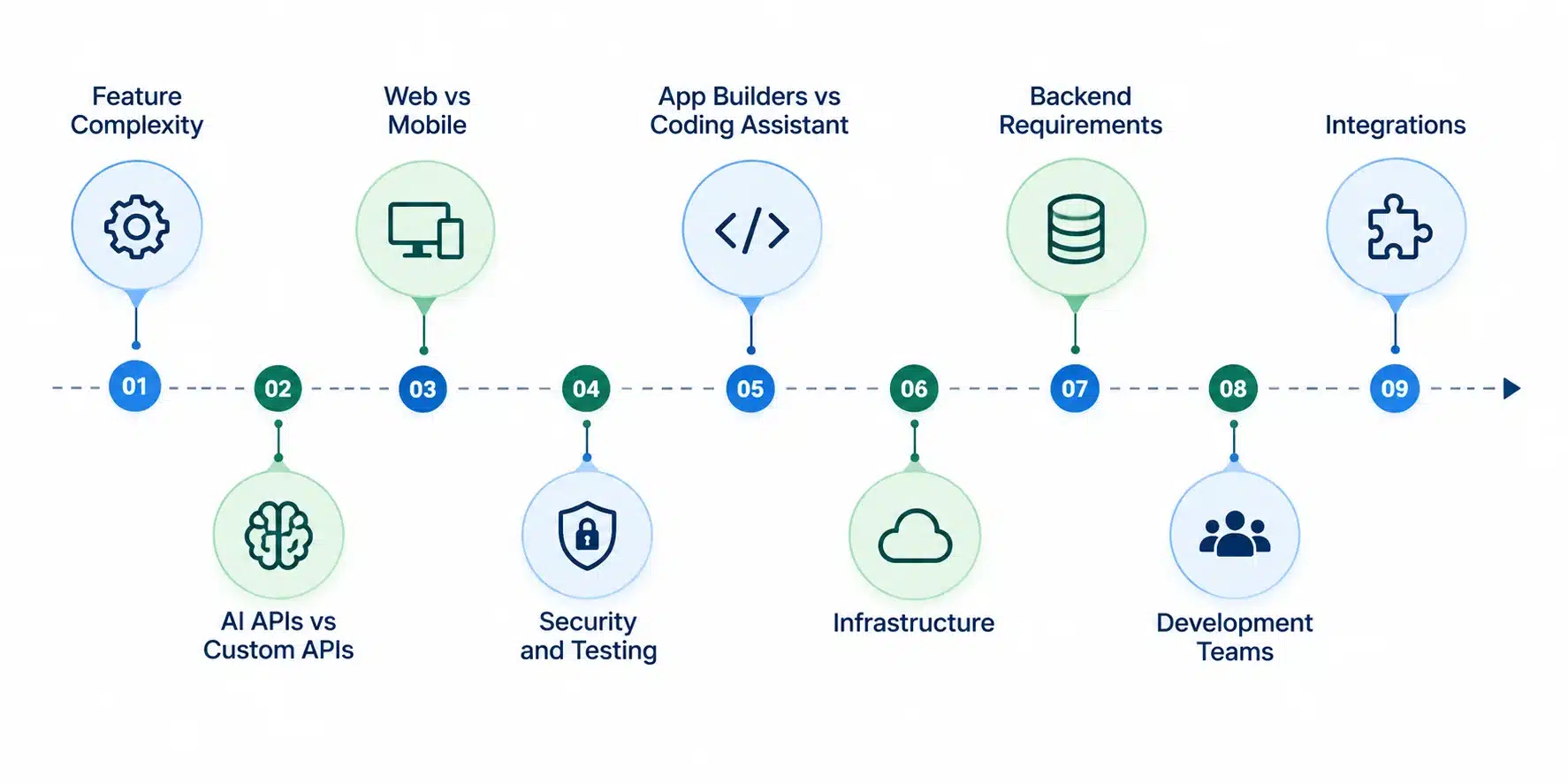
Feature Complexity — Simple features like logins, profiles, and dashboards can be generated quickly by AI. Anything that doesn’t follow a predictable pattern needs developers to refine the output and clean up the architecture.
Web vs. Mobile — Web apps are cheapest and fastest to build. Mobile apps need platform-specific UI, device testing, and extra engineering effort, which increases both timeline and budget.
App Builders vs. Coding Assistants — AI app builders like Replit or Base44 charge a monthly fee, keeping costs lower. AI coding assistants like Claude, Copilot, or Cursor charge by token and still require development skills, which can raise costs.
Backend Requirements — Real-time updates, heavy data processing, or complex data relationships make the backend more expensive. AI can scaffold the structure, but custom backend logic still needs human engineering.
Integrations — Every integration — payments, analytics, CRM tools, third-party APIs — adds testing, configuration, and troubleshooting overhead.
AI APIs vs. Custom APIs — Ready-made AI APIs like OpenAI or Anthropic are fast, affordable, and well-suited for MVPs. Custom APIs and fine-tuned models trained on proprietary data cost more.
Security and Testing — MVPs in healthcare, finance, or enterprise contexts need strong security and deep testing protocols. AI can automate test cases, but compliance still requires human oversight.
Infrastructure — AI-heavy apps need more compute power, especially with large models or large datasets, which raises hosting and infrastructure costs.
Development Teams — AI reduces the need for large teams, but humans are still needed to make key decisions, build solid architecture, and scale the product properly.
How Far Can You Go Without a Development Team?
AI has made it surprisingly simple for founders to build an MVP on their own — writing code, generating UI, and stitching features together — without hiring a full engineering team. However, not every product fits a DIY approach. Some MVPs need an expert engineering team to make the foundation solid and scalable.
| Suitable for DIY Development Using AI Tools | When You Need an Agency |
| Apps with basic screens and straightforward flows | Multi-step processes, advanced logic, and complex integrations |
| A handful of core functionalities | Apps needing device-level features like camera, GPS, or offline mode |
| One or two external services like payments and integrations | Multiple third-party tools that must work together smoothly |
| Quick prototypes to test concepts and gather feedback | Real-time updates, heavy data processing, intricate database design |
| Fast, low-code or no-code builds | Finance, healthcare, and enterprise apps handling sensitive data |
| Products with small or medium user base | Products supporting a growing user base or large data volumes |
Also read: How to Choose a Mobile App Development Partner?
AI can speed up MVP development in many ways, but founders and CTOs face several challenges once the product grows beyond a simple version. On average, only 41% of generative AI prototypes reach production.
Understanding the following eight challenges early on can help you build a better strategy and avoid costly fixes later.
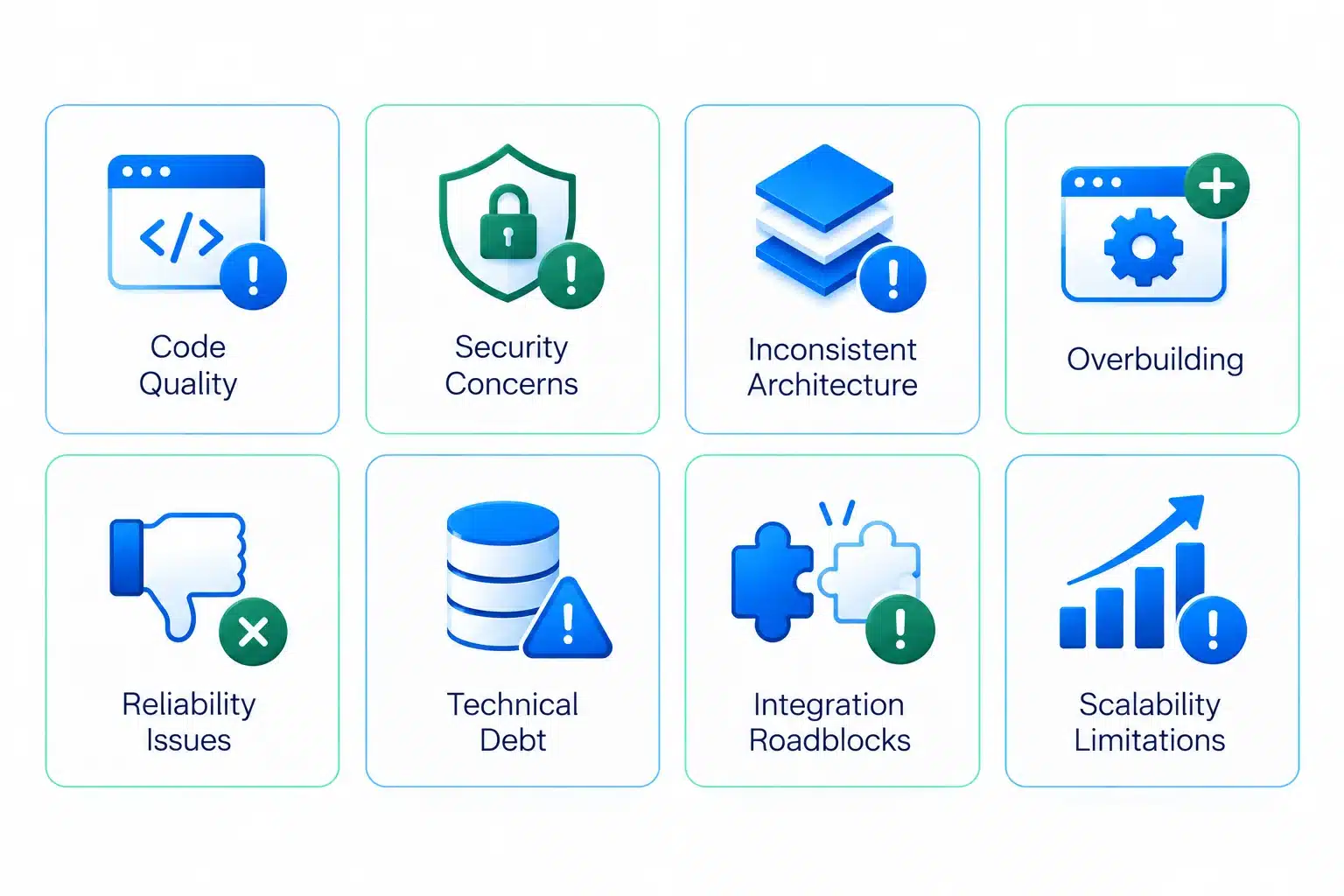
1. Code Quality — AI-generated code isn’t always clean and can become hard to maintain over time, requiring reorganization or rewrites.
2. Security Concerns — AI tools can’t enforce strong security practices automatically; payment and personal data handling need thorough review.
3. Inconsistent Architecture — AI-generated foundations may work initially but often struggle to scale long term.
4. Overbuilding — It’s easy to keep adding features to an AI-generated app, which complicates the product and slows down validation.
5. Reliability Issues — AI-generated workflows need thorough testing, since inconsistent outputs can hurt user trust.
6. Technical Debt — Quick fixes pile up into long-term problems that cost time and money to clean up later.
7. Integration Roadblocks — AI can connect APIs quickly, but proper error handling and testing still require careful attention.
8. Scalability Limitations — Prototypes built fast with AI still need strong engineering and infrastructure planning to scale to thousands of users.
Also read: Web Development Challenges and How to Solve Them?
AI + Human Expertise: How Simpalm Makes the Difference
The best MVPs today are built using a mix of AI speed and human expertise. AI helps you move fast; humans make sure the product is stable, scalable, and ready for real users. That’s exactly where Simpalm steps in.
At Simpalm, we’ve helped founders and CTOs with MVP development services for decades — long before AI tools existed. Now we combine that experience with modern AI capabilities to deliver the best of both worlds.
Our experts use AI to accelerate the early stages — generating UI, writing boilerplate code, creating test cases, and helping validate ideas quickly. But we don’t stop there. Our team strengthens the architecture, refines the code, and ensures the product is scalable and secure.
We blend AI with practical, hands-on development. AI speeds up the early build while our designers, developers, and QA engineers ensure the product works for real users — turning an AI-generated starting point into a reliable, long-term MVP.
If you’re already building an app with AI tools and feel stuck due to messy code, unstable architecture, or unreliable outputs, our experts can help. We’ll take what you’ve built, stabilize it, improve it, and help you move forward with confidence.
The Bottom Line
AI has changed the way founders build MVPs. They can validate ideas faster, build prototypes without large teams, and iterate quickly based on user feedback. Small, simple MVPs can be built using AI tools alone.
But when your product grows in complexity, or needs to scale, experienced engineering support becomes necessary. The smartest approach is to use AI to learn and build faster, and rely on human oversight to scale and succeed.
Frequently Asked Questions
Q1. What is AI-powered MVP development, and how is it different from traditional MVP building?
AI MVP development uses AI tools to generate architecture, write code, design UI, test features, and help deploy the product using natural-language instructions. Unlike traditional development — which requires product managers, designers, developers, QA, and DevOps — AI handles most repetitive tasks, making the process faster and more affordable.
Q2. Which parts of the MVP development process does AI handle effectively?
AI accelerates execution across the entire workflow, from discovery to iteration. It supports ideation, market research, competitor analysis, feature planning, wireframing, code generation, debugging, test case creation, and post-launch analytics.
Q3. What types of features can AI build for an MVP?
AI can generate standard features like login, profiles, dashboards, search, filters, payments, notifications, admin panels, and integrations. It can also build AI-powered features such as chatbots, recommendation engines, natural-language search, content generation, document analysis, and personalization.
Q4. What factors influence the cost of building an MVP using AI?
Cost depends on feature complexity, platform (web vs. mobile), backend requirements, number of integrations, use of AI APIs vs. custom models, security needs, infrastructure load, and the level of human engineering required to refine and scale the product.
Q5. How quickly can founders launch an MVP using AI tools?
A small, well-defined web-based MVP can be built in 2–4 weeks using AI. Timelines increase for mobile apps, complex workflows, multiple integrations, custom AI models, or products requiring heavy testing and scalability planning.
Q6. What are the hidden challenges of AI-built MVPs?
AI-generated MVPs often face issues like inconsistent architecture, messy code, weak security, reliability problems, technical debt, integration errors, and scalability limitations. Human engineering is required to stabilize, optimize, and scale the product for real-world usage.