
 Design
 App Development
 Web Engineering
 AI Services
 Cloud
Cloud Staffing
 Startups
 Health / Fitness
 Education
 Social
 Nonprofit
 Fintech
 Construction
 Logistics
 Government
 Travel/Hospitality
 HR Software
 About Simpalm
 Our News
 Client Testimonials
 Careers
 Our Blog
 Awards
 Resources
 Information
Do you have a great startup idea, but aren’t sure of how to build a high-performance software product for it?
Well, a lot of tech startups often fail because they lack adequate knowledge of software development methods. The startups that lag behind on a proper approach will eventually exceed the planned budget, delay the launch, and fail to meet the user requirements.
If you are a startup founder with a brilliant idea that you believe can be the next big thing in the tech industry, prioritizing software development is paramount for you. Building high-performance software will ensure you stand strong amidst the competition and position your brand as a leading player in the industry.
To help you in your startup journey, this article will guide you with the key attributes of software development for startups and steps on how you can approach it. Read along till the end and gather everything that’s important for you to bring your startup idea to life!
How is Software Development for Startups Different from that of Large Companies?
All the large-scale and established companies have the liberty to spend a lot of money and months of time in planning their software development project. Moreover, such organizations can also survive any potential delays, considering they generate enough revenue already.
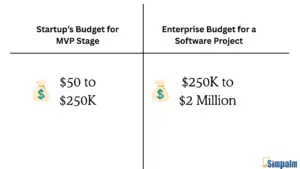
- A large-sized company or established enterprise can have a spending power in the range of $250,000 to more than $2 million for a software development project.
- However, that’s not the case with startups, as they are limited on budget, time, and options for their project! Startups’ budget in the USA for software development is mostly $50K-$250K in the MVP development stage or bootstrapped stage.
- Startups want to first build the MVP, launch it, and then spend more once they receive some traction.
Startup software development is different from the usual approach taken for projects of larger companies, mostly because of a few reasons, which include:
1. Limited Budget: Most startup founders don’t have a big budget or team to start their business. They mostly bootstrap, or rely on angel investment or preseed money to launch the startups. Therefore, they look for cost-effective ways to build software. The idea for startups is always to start small, learn fast, and continue to improve.
2. Need for Entering the Market Faster: Startups thrive on unique ideas, and it would only benefit them if those ideas hit the market fast and enable users to try and leave their feedback. Therefore, speed matters a lot when software development for startups is concerned.
|
3. Product Pivoting: Startups also need a unique development approach, mostly because there’s always a possibility for change in plans, pivot in ideas, and change in market trends, which might require your software to quickly adapt to such instances.
|
4. Adherence to User Feedback: Unlike the mid-scale and large-scale businesses that hold great amounts of experience, startups must pay utmost attention to their customer feedback while building a software product. However, doing that will require you to make constant changes based on audience-specific insights, which is why startups need a unique development approach.
5. Startups outsource more than enterprises: Data shows that 98% of startups outsource software development projects, whereas enterprises only outsource 30-38% of their software development projects. Enterprises only outsource when they don’t have the capability or if the project is short-term.
|
Best Methodologies Adopted for Startup Software Development
When developing software for startups, choosing the right methodology becomes paramount. It is because the method of approach you choose will affect the cost, flexibility, and speed of development. However, there’s no one methodology that suits all startup software projects.
Different startups require varying approaches, and here is a list of them all for you to understand and make the right pick:
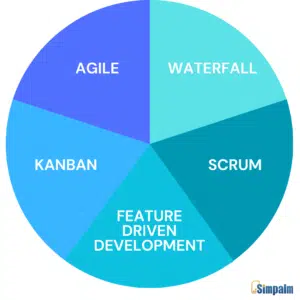
1. Agile
Agile software development methodology is the approach where you will be creating, testing, and improving one section or sprint at a time. When developing software for startups, agile methodology helps your team respond to users’ feedback faster and make quick changes as required. Thus, the overall development lifecycle is sped up while ensuring that the end product stays relevant to the target audience.
Key Highlights:
-
-
- Supports faster iterations and deployments.
- Provides you with ease of adapting to the changing requirements.
- Fosters strong collaboration between stakeholders and developers.
-
2. Waterfall
It is a linear and sequential project management methodology, executed with distinct phases and rigid progression. There are five stages in the waterfall software development approach, which include requirements, design, implementation, verification, and maintenance, all cascading downward in a sequence. For startups, this approach offers a clear structure, simplified management, and predictable costs.
Key Highlights:
-
-
- Supports detailed planning for accurate time and cost estimation.
- Step-by-step process ensuring defined milestones and easy tracking of progress.
- Encourages detailed recordkeeping for future audits or funding.
-
3. Kanban
It is a visual software development approach for startups, where tasks are highlighted on boards to ensure you can keep a tab on the progress and entire lifecycle. Startups adopt kanban methodology for software development projects as it encourages transparent workflow and detection of potential bottlenecks at the early stages.
Key Highlights:
-
-
- Track project progress in a unified admin dashboard.
- Limits work overload with a clear depiction of ongoing tasks.
- Supports continuous improvement & productivity.
-
4. Scrum
Scrum is similar to the agile methodology, but is focused on organizing software development projects into shorter sprints of 2 to 4 weeks. The approach with scrum methodology demands developers to finish one sprint and review it before planning to start with the next. As far as software development for startups is concerned, Scrum methodology ensures the team is aware of what needs to be done, while staying flexible for new ideas.
Key Highlights:
-
-
- Defines the roles and responsibilities clearly within a team.
- Easy to track the incremental progress of a project.
- Supports quick pivoting upon change of priorities.
-
5. Feature Driven Development (FDD)
FDD, as the name suggests, is an agile approach that drives the developers’ focus on developing functionalities. This method of approach might not be suitable if you are building an MVP. However, you can consider it if you already have a documented list of certain features that you would like to implement into a working product.
Key Highlights:
-
-
- Supports detailed upfront designing and modeling.
- Enables scheduled feature deliveries.
- Practices a feature-centric development approach.
-
Is Building an MVP Right for Startup Software Development?
As a startup founder, you might face a dilemma: whether to launch an MVP first or directly jump into deploying a full-scale build. Well, the ultimate decision depends on your business goals, available resources, and risk-bearing capacity.
- Evidence proves that MVP makes more sense for a startup, as it will be the leanest version of your working product.
- An MVP will be launched with only the must-have features, capable of attracting early users or beta testers for validating your business idea.
- You can also consider launching an MVP as a startup founder to get the attention of potential investors without spending all your capital upfront.
The idea of lean MVP development is for startups to focus on doing more with fewer resources and removing the unwanted steps. For startups using lean methodology, founders are requested to spend the resources wisely and also validate the ideas quickly through user feedback. This way, potential adjustments can be made faster.
MVP always works for startups, mostly because:
- It enables you to launch a lighter version of your software quickly and gain feedback from real users.
- As a startup, you can only build the essential features first, while keeping the funds and expenses manageable.
- It helps you showcase your working idea to the customers and investors.
Startup Software Development: In-House vs. Outsourcing
Both in-house as well as outsourcing approaches for startup software development come with their pros and cons. Here is a table that will highlight the potential differences between them:
| In-House Development | Outsourcing Software Development | |
| Control | You will have complete control over your team, daily work culture, and the project operations. | Outsourcing software development for startups limits the overall control, but provides more flexibility. |
| Speed of Development | As a startup, hiring an in-house team will take a lot of time, which might eventually delay the product launch. | Startups can quickly start with the project as experts are available on demand, and can start with the development process right away. |
| Cost of Development | Leads to extensive ongoing expenses, including salaries, employee benefits, and workplace infrastructure. | It is a cost-efficient approach for software development, especially for startups. |
| Expertise | General professionals might lack diversification of skills, limiting the sophistication in software development. | Hire specialists across all domains of software development, including MVP development, customization, scaling, post-launch maintenance, etc. |
| Scope of Scalability | With consistent business growth, quick scaling with an in-house team will be difficult. For instance, hiring more employees will take time. | With the outsourcing of software development projects, startups can easily scale their teams based on business growth demands. |
| Potential Risks | Startups will have to bear the risk of employee turnover and potential knowledge gaps. | Proper project management is required to tackle the potential risk of communication issues with the outsourced team. |
Why Outsourcing Software Development Makes More Sense for Startups?
Not all startups plan on seeking in-house software development, considering the high ongoing expenses, limited talent pool, lack of expertise, and other such constraints in the approach. However, most founders realize that outsourcing startup software development services isn’t just about saving on business capital, but also about building smarter.
Some of the reasons why startups outsource their software development needs include:
1. Validating the Idea Early:
If you want to build just an MVP version of your software, outsourcing the project to a startup software development company can make the process cheaper and faster. Most MVP development experts are specialists in turning raw ideas into testable products.
2. Specialized Skills:
Upon outsourcing, you will be partnering with a team that holds niche-driven expertise and skills in developing high-performance software, backed with advanced AI, analytics, and other such capabilities.
3. Limited Budget:
Building a complete in-house team for your software project can be expensive, especially when your business is in the startup phase. Therefore, partnering with established experts will help you build high-quality software, but within your limited budget and resources.
4. Long-Term Support:
Outsourcing your startup software development project is not just about building your product faster and achieving quick results. Some startup software development companies also offer post-launch support services, ensuring long-term reliability and scalability.
Important Technical & Legal Considerations to Follow While Outsourcing Startup Software Development
Here are a few of the technical and legal considerations that you must adhere to while outsourcing your software development project:
- Make sure to have an NDA and a Confidentiality agreement in place.
- Make sure to have control of the Source code
- Make sure to have ownership of the cloud backend and hosting environments
- Ensure data security and compliance, including access controls, data encryption, etc.
- Seek the implementation of Two-Factor Authentication for protecting your intellectual property and sensitive data.
What are the Different Phases of Startup Software Development?
Turning a raw startup idea into a working digital product requires a sophisticated, structured, and clear process. Experts use multiple phases or segments to utilize the available resources efficiently and reduce the overall cost in the process. Most new founders intend to collaborate with a startup software development company to seamlessly execute all the involved stages, which include:
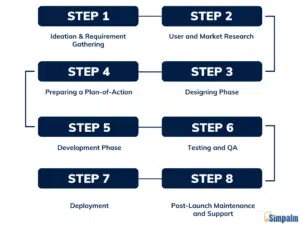
1. Ideation and Requirement Gathering
The first step of the process is understanding what your startup product is about and what purpose it will serve. Your job as a startup founder at this stage is to express the core features of your product, its scope, and user needs. Consider this as the foundation stage to further steps in the process.
2. User and Market Research
As startup founders, you must reach out to your targeted users and determine the pain points they are experiencing. Following that, you can prepare a list of features or services that they expect in a niche software that you will be building for your business. Not just that, but you must also do a competitor analysis to understand the strengths & weaknesses of your product, and optimize the same accordingly.
3. Preparing a Plan-of-Action
The next stage is preparing a blueprint of your project with all the requirements, expectations, and customization requests in brief. In this phase, the team will prepare a plan of action for bringing your startup idea to life. Experts will also be evaluating the technologies, deciding the timelines, and checking the availability of resources for the project. This way, it will help the team prevent wasting of efforts once the project commences.
4. Designing Phase
The UI/UX design experts will then take over the startup software development project and will add visual aesthetics to the plan. In the process, visual mockups, wireframes, and user flow guides will be built, ensuring an intuitive and engaging design. A well-crafted software design is crucial for the project to seamlessly undergo the development and testing phases.
5. Development Phase
This is the stage where your startup idea will finally take shape. The startup software developers will write code, integrate functionalities, build custom features, and ensure security compliance. All the experts working in the team will foster clear communication and planning throughout this stage, guaranteeing quality development.
6. Testing and QA
Once the product is ready, it will then be tested for functionality, usability, and performance. A strong and robust QA process is crucial for startups to feel confident about their products and be sure of their trustworthiness and reliability once launched. In case any issues are found during the testing phase, they will be fixed prior to the launch.
7. Deployment
Your startup product will now be deployed into the production environment and will reach the targeted users in the market. The startup software development company you hire will assist you in carefully executing the deployment process, ensuring a smooth launch with minimal downtime.
8. Post-Launch Maintenance and Support
Even beyond the launch, the team you hire must also help you with post-launch maintenance and support services. It is an important ongoing stage, as it will help you launch updates, fix bugs, and enhance features in the long run for keeping your software up & running in the competitive market. Continuous maintenance of your software wi ensure it grows alongside the users’ ever-changing demands and preferences.
Typical Budgets for Software Development Project:
| Small | Mid-Sized | Large | |
| Estimated Cost | $15K-$30K | $30K-$100K | $100K-$150K |
| Discovery and Design (20%) | $3K-$6K | $6K-$20K | $20K-$30K |
| Development (75%) | $11K-$22K | $22K-$75K | $75K-$110K |
| Testing | $750-$1.5K | $1.5K-$5K | $5K-$7.5K |
| 1st Year Support and Maintenance (10% of the initial cost) | $1.5K-$3K | $3K-$10K | $10K-$15K |
Make Use of AI for Reducing the Cost of Software Development
AI today is a powerful ally that can help you dramatically reduce your overall software development costs. At the same time, you won’t have to compromise on the quality, speed, and usability of the final product. Some of the ways AI can help reduce the cost of startup software development are:
- Make use of tools like UXpilot for creating mockups and wireframes of your software. You just have to specify your requirements to these tools, and they can create an optimal wireframe for you, faster than a human designer.
- Startup founders can create a functional prototype using platforms like Replite, Base44, and Lovable to show their functions. Please keep in mind that if you are not a developer, you can not build a functional and deployable application using these platforms; you can only build a prototype. You still need expert developers to build production applications, even when you want to use these AI coding platforms.
- Use of AI code generation tools such as Claude Code, Gemini, Lovable, and other such tools for generating code snippets of your software. Please take note that using these tools won’t entirely replace the need for software developers. Instead, it will help professionals reduce the overall time and cost of software development by 20-30%.
- There are various AI testing tools, such as Katalon, BrowserStack, Mabl, and others, that can be used for creating automated test cases and validating the performance, security, usability, and other aspects of your software.
Let Simpalm Pave the Path for Your Startup Software Development Needs!
Simpalm, being the leading startup software development company, offers a comprehensive suite of services to help budding entrepreneurs build efficient digital products to enter their target markets faster. From product discovery and UI/UX design to MVP development and post-launch support, we will be assisting you at all stages of startup software development.
We assign dedicated experts for building startup mobile apps, web apps, and websites, depending on what your business project demands. Simpalm works for startups across different industries, including FinTech, fitness, e-commerce, logistics, emerging technology, non-profits, and more, offering technology-backed software solutions.
So, if you have a booming business idea that you think is ready to enter the competitive market, our startup software development services can give you a good kickstart. Reach out to us today, and let’s schedule your consultation call right away!