
 Design
 App Development
 Web Engineering
 AI Services
 Cloud
Cloud Staffing
 Startups
 Health / Fitness
 Education
 Social
 Nonprofit
 Fintech
 Construction
 Logistics
 Government
 Travel/Hospitality
 HR Software
 About Simpalm
 Our News
 Client Testimonials
 Careers
 Our Blog
 Awards
 Resources
 Information
Key Takeaways
- AI adoption in Fintech is growing due to increasing data volumes, tighter regulations and rising customer demands for speed and personalization.
- Intelligent systems now power major functions across digital banking, payments, lending, trading, wealth management, and insurance.
- Major AI use cases transforming digital finance include fraud detection, credit scoring, underwriting, trading intelligence, compliance, insurance and more.
- Successful AI implementation requires clear objectives, strong data foundations, compliance alignment, pilot testing and continuous monitoring.
- Companies that prioritize foundational requirements, structured approach and work with a reliable partner gain a lasting competitive edge.
_________________________________________________________________________________________
Fintech has always moved fast and AI adoption has accelerated rapidly over the past few years. In fact, industry reports show a substantial increase in spending on AI in Fintech. In 2026, the banking sector’s estimated level of AI investment reached 53.14 billion U.S. dollars, growing at a compound annual growth rate of 30 percent and on track to exceed 90 billion U.S. dollars by 2028. Artificial intelligence solutions have been integrated in banking, payments, lending and wealth management. With the rapid surge in financial data volumes, AI has become an important tool for boosting business.
This rapid shift has been propagated by three factors – data volume, regulatory pressure and changing customer expectations. Fintech companies process large volumes of customer data including transactions, interactions and documents, far more than human teams can analyze or deduce patterns. Compliance requirements are becoming stricter and companies are adopting automated monitoring. Finally, customer expectations are at a record high with the rising demand for personalized recommendations, instant support and seamless onboarding. In such a scenario, a hassle-free process gives a competitive edge to fintech companies.
This article breaks down AI in Fintech in a business-friendly way. We will explore the major use cases, problems that AI solves, followed by applications across the different fintech segments like digital banking, payments, lending, wealth management, and insurance. Finally, we will walk through a stepwise guide of how fintech companies can implement AI in a responsible manner.
What is AI in Fintech?
Artificial intelligence in Fintech is the use of smart algorithms to analyze data, learn from patterns and make decisions faster than traditional systems. Instead of relying on fixed rules and manual reviews, AI helps financial companies understand customer behavior, detect risks, automate complex tasks and deliver personalized experiences.
AI shows up in many forms in the financial services industry:
| Types | What it Does |
| Machine Learning (ML) | Learn financial patterns and user behaviors that can be used by LLMs for predictions. |
| AI/LLMs | Understand the context, real time financial data, and generate a personalized output. Also, predict risk and fraud. |
| Natural Language Processing (NLP) | Interprets human language data such as news, social media and voice for sentiment analysis and train chatbots |
| Computer Vision | Extracts insights from images through techniques like facial recognition, object detection to verify documents and claims assessment |
| Robotic Process Automation (RPA) | Uses software robots to automate repetitive, rule-based tasks |
5 Practical Benefits of Bringing AI into Fintech
AI is becoming a practical benefit for fintech companies, as it solves the everyday problems that slow teams down and frustrate customers. By early 2026, 40 percent of financial institutions reported that AI had increased their overall profitability. With the right implementation, AI can make financial products feel faster, safer and personalized.
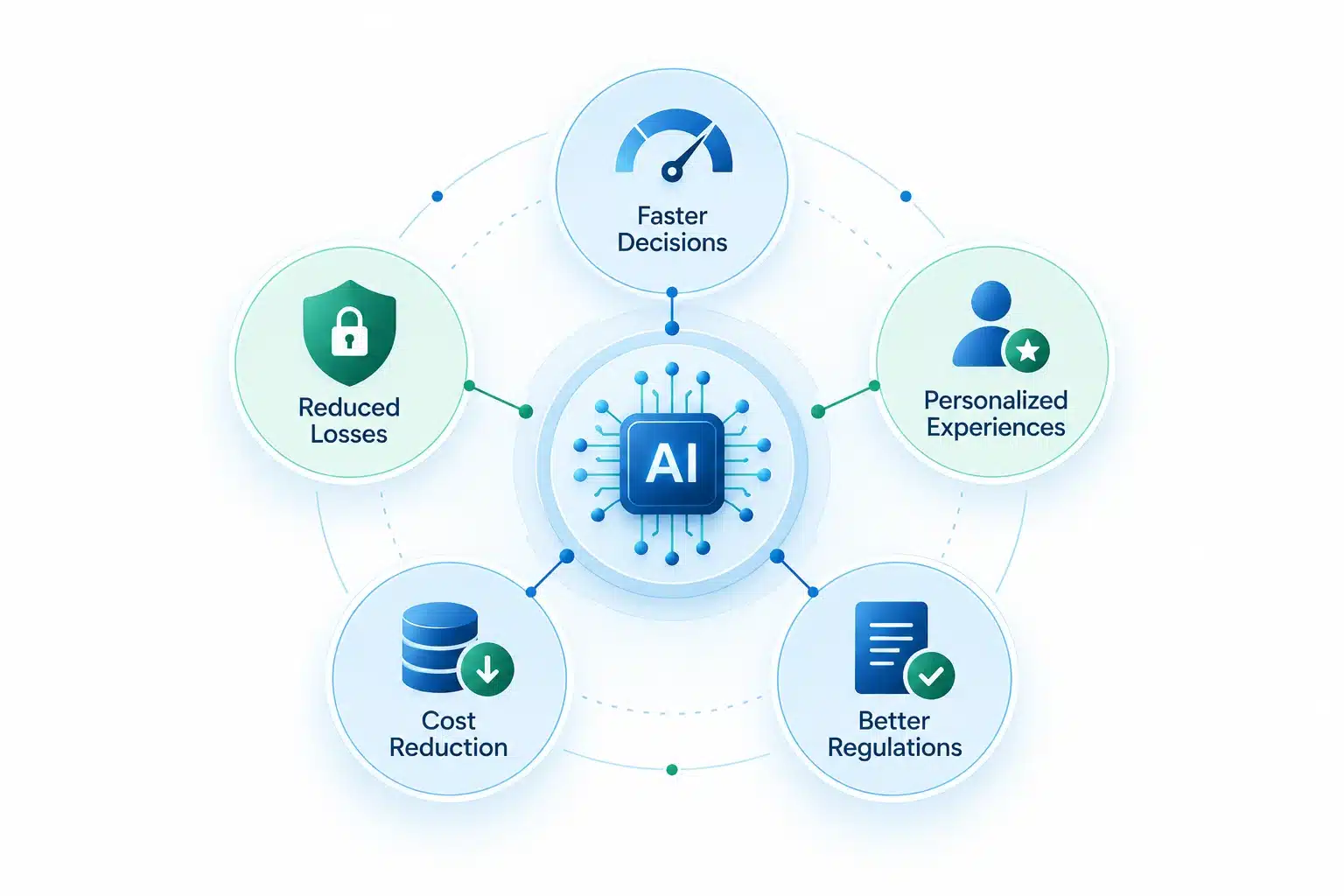
Here are some tangible benefits:
- Faster Decision-Making and Processing Time – Speed is non-negotiable in fintech. Customers do not want to wait for long hours for a loan decision or sit through long verification steps. AI cuts these delays automatically and provides a smoother experience for users and efficient workflow for teams. These capabilities create a smooth and more responsive experience for customers and a more efficient operational flow for teams.
- Reduced Losses and Operational Risk – Fraud patterns change constantly and static rule-based systems struggle to keep up. Artificial intelligence provides an adaptive approach by continuously learning from new data and identifying signals that suggest suspicious activity. This proactive approach reduces financial losses, minimizes operational disruptions and strengthens the overall security framework of the organization.
- Improved Customer Experience and Personalization – Modern customers expect financial services tailored to their needs. AI enables this level of personalization by analyzing individual behavior, preferences and financial patterns. This approach helps customers feel more valued, and informed, improving overall experience and deepening relationships with the brand.
- Cost Reduction Through Automation – A significant part of financial operations include repetitive, time-consuming tasks. AI and intelligent automation reduces the burden of these activities by handling them consistently and accurately. This combination lowers operational costs and allows teams to redirect their initiatives towards greater business value.
- Better Regulatory Compliance and Audit Trails – Financial services has extensive and evolving compliance requirements. Using AI, organizations can stay aligned to these expectations by ensuring consistent monitoring of activities. The outcome is stronger regulatory adherence, reducing the likelihood of penalties or compliance gaps.
Also read: AI-Powered Personal Finance App Development: A Complete Guide
Key Use Cases and Applications of AI in Fintech
AI has become the main decision-making layer that helps financial companies understand customers better, detect risks earlier and operate with greater efficiency. 52% of financial industry respondents are piloting or are at more advanced deployment stages with Agentic AI. Given below are the most important use cases and real applications built around them giving a complete picture of how AI is transforming digital finance.
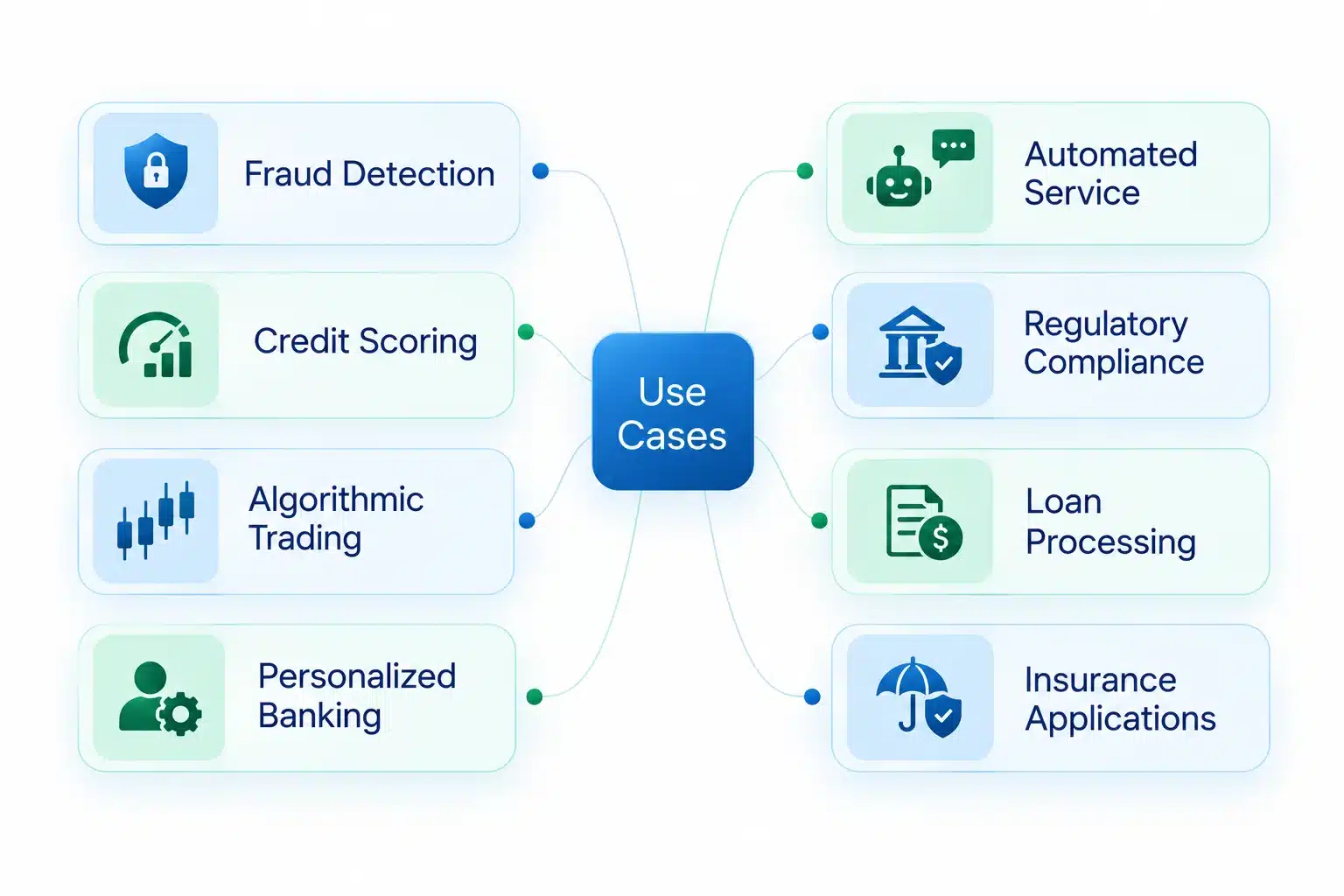
Use Case 1 – Fraud Detection and Prevention
Fraud is one of the fast evolving threats of fintech. Traditional rule-based systems can only capture the known threats but fraudsters invent new ones. AI helps fintech companies stay ahead by analyzing real-time behavior and subtle anomalies that normal humans would miss.
Real-time Transaction Monitoring – AI models evaluate every transaction as they happen, checking dozens of signals like location, device, spending history, merchant type and velocity of transactions. This helps to determine whether something is suspicious and allows fintech platforms to intervene immediately and not when the damage is already done.
Anomaly Detection Models – These models are trained on normal behavior of customers. If behavior deviates like sudden high-value purchases or unusual login times, the system flags it. Unlike static rules, anomaly detection changes continuously with evolving customer behavior.
Behavioral Biometrics – Artificial intelligence can analyze how a user types, swipes or navigates an app. This acts as a powerful layer of identity verification as these patterns are hard to fake. Behavioral biometrics can detect a mismatch even if a fraudster logs in with the correct password or OTP.
Applications:
- Digital banking apps send instant fraud alerts to customers when something looks unusual. This helps block suspicious transactions beforehand.
- Payment processors score transactions to approve safe transactions instantly while declining high-risk transactions.
- Wallet apps trigger step up authentication when AI detects unusual behavior during login or payment. The wallet app asks for extra verification like biometrics or OTP to ensure that the user is genuine.
- BNPL platforms prevent account takeovers with AI tracking login patterns, device changes and spending behavior to spot signs of account takeover. The system immediately triggers protective action like locking the account or requesting identity confirmation.
Use Case 2 – Credit Scoring and Risk Assessment
This is the area where AI creates the biggest impact. Traditional scoring models rely heavily on financial history which is limited and eliminates thousands of potential borrowers. AI analyzes the behavioral and transactional data making credit decisions more accurate and inclusive.
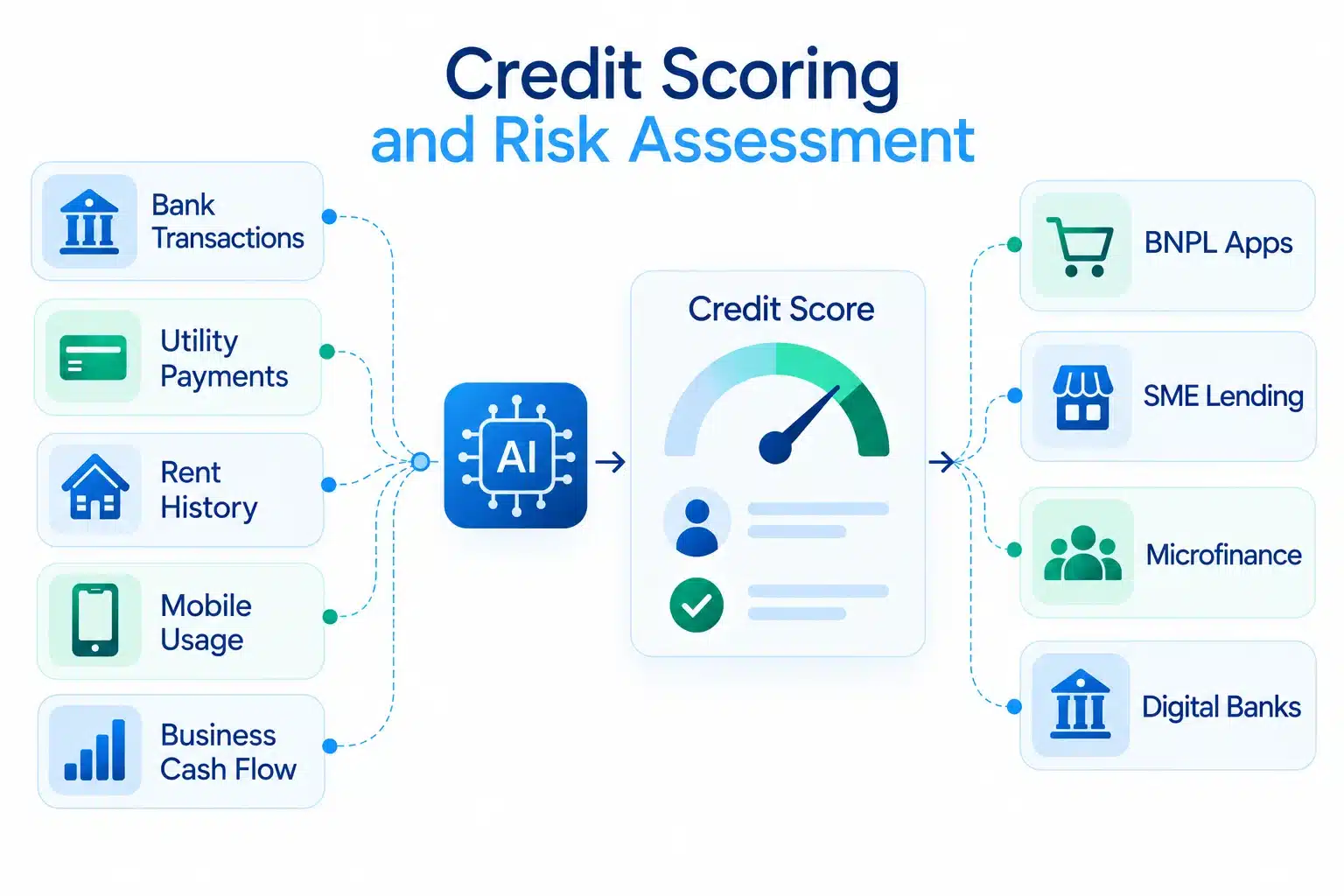
Alternate Data Scoring – Artificial intelligence expands credit scoring beyond traditional bureau scores. It can analyze bank transactions, utility payments, rent history, mobile usage and business cash flow. Using these insights, lenders can assess customers who have thin or no credit files, giving them access to financial products that were previously denied.
Real-Time Risk Models – Static risk scores remain unchanged for months, while AI integration helps to update the risk profile continuously. If a borrower’s financial behavior improves or deteriorates, the model adjusts instantly. This helps lenders respond quickly to emerging risks and take precise decisions.
Applications:
- BNPL apps assess first-time borrowers by analyzing spending patterns and repayment behavior to extend credit limits.
- SME lending platforms evaluate business health using cash flow invoices, and transaction trends to determine creditworthiness.
- Microfinance customers can score thin file customers using alternate data to offer fair loan decisions.
- Digital banks offer instant credit lines by calculating risks in real-time within the app.
Use Case 3 – Algorithmic and High Frequency Trading
Trading environments move at extreme speed. With AI, they can process massive volumes of data for smarter and faster decisions which are key considerations while planning trading app development.
Predictive Market Analytics – AI models study historical price movements, volatility patterns, macroeconomic indicators and market signals to forecast potential outcomes. This helps traders anticipate market risks and optimize their strategies accordingly.
Sentiment-Driven Trading Signals – AI can read and analyze news articles, analyst reports, social media posts and customer sentiment. Intelligent systems can detect changing sentiments and adjust trading signals accordingly. Quick insights help traders to react faster and take optimum measures.
Applications:
- Robo advisors adjust portfolios automatically based on market conditions and customer risk profiles.
- High frequency trading systems react to micro-shifts by executing trades within milliseconds.
- Wealth platforms provide AI-assisted insights, summarizing market trends and highlighting risks and opportunities.
Use Case 4 – Personalized Banking and Robo Advisory
Customer expectations are rising and they expect their financial services app to feel personal and intuitive. Artificial intelligence assists financial companies deliver tailored experiences to their customers.
Financial Planning Tools – AI-powered financial planning tools analyze customer incomes, spending habits, saving patterns and financial goals to provide personalized guidance. It can also suggest budgets, saving plans, investment strategies and financial milestones based on customer data.
Personalized Product Recommendations – Intelligent tools identify the financial products that best match a customer’s unique needs. These products can be credit cards, loans, investment plans and insurance options that are truly helpful for them.
Applications:
- Neo banks offer personalized saving nudges based on spending behavior and monthly cash flow.
- Wealth apps recommend investment strategies aligned with user goals and risk tolerance.
- Digital banks suggest relevant financial products by analyzing customer behavior and financial patterns.
Use Case 5 – Customer Service Automation
Customer support is the most important touchpoint in Fintech. AI makes customer services faster, reliable and available 24/7. Instead of waiting in queues or navigating complex menus, customers can get instant assistance powered by intelligent systems.
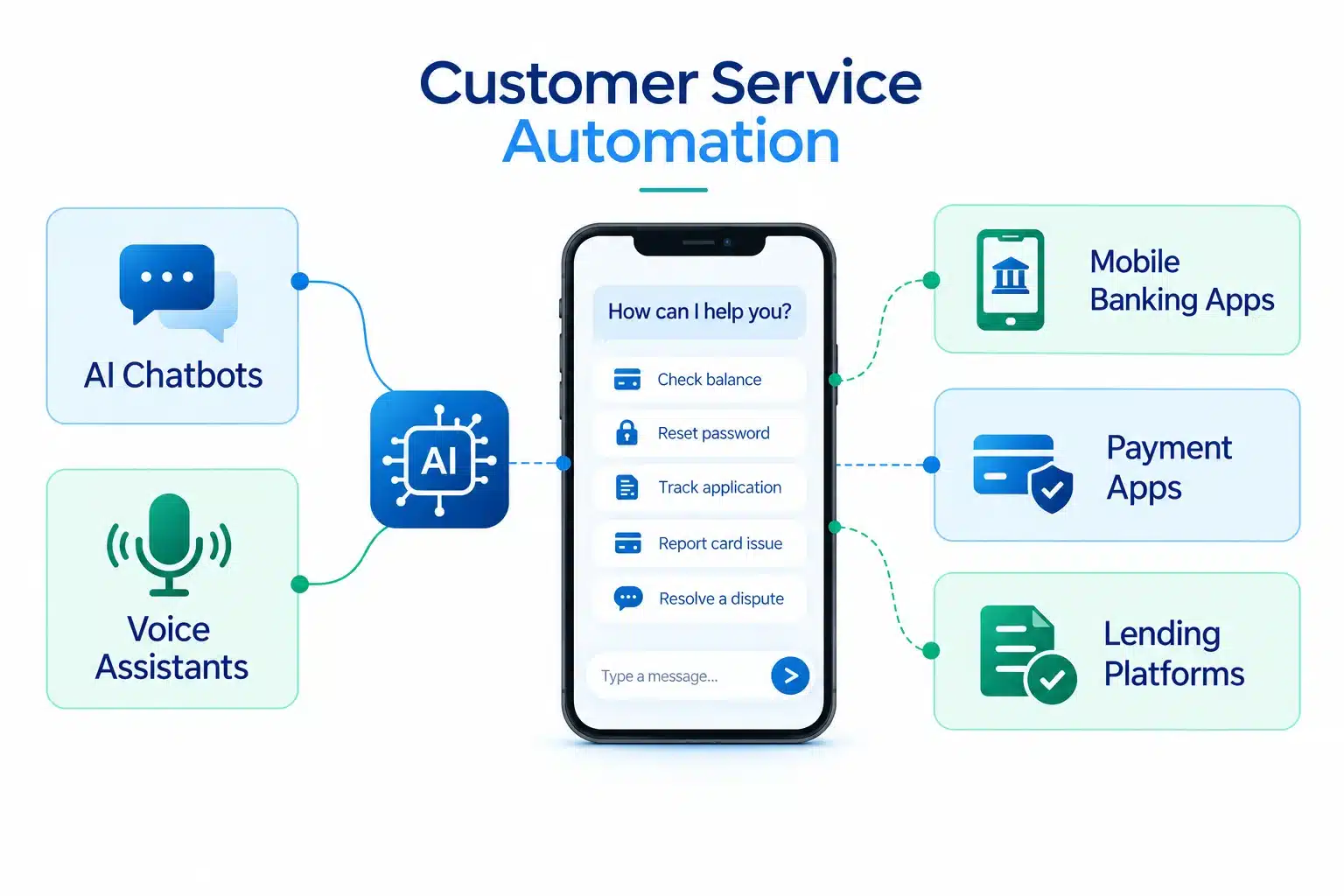
AI Chatbots and Virtual Assistants – AI driven chatbots can understand customer queries and respond immediately. They manage routine tasks like balance checks, password reset, status updates, card issues, and basic troubleshooting. This proactive service and less reliance on human intervention reduce waiting times and improve customer experience.
Voice-Based Banking Assistants – Customers can interact with financial apps in natural language. AI interprets spoken commands to perform tasks like checking balances, transferring money or retrieving account information. This makes banking accessible for users who are not comfortable in navigating mobile interfaces.
Applications:
- Mobile banking apps provide conversational support to resolve common issues instantly reducing dependency on call centres.
- Payment apps offer dispute resolution by guiding users through automated steps to review and challenge transactions.
- Lending platforms assist applicants by explaining eligibility criteria, required documents and next steps in a simple, conversational flow.
Use Case 6 – Regulatory Compliance and AML (Anti money laundering)
Compliance is one of the most demanding areas of fintech as companies need to monitor transactions and maintain documentation while keeping pace with the evolving global standards. AI simplifies this by automating checks, monitoring transactions and reducing human error.
Automated KYC/AML Checks – AI verifies identity documents, extracts relevant information and compares customer data against regulatory databases. It also matches ID photos using facial recognition tools. This ensures quick and compliant onboarding reducing manual workload for compliance teams.
Continuous Transaction Auditing – Intelligent systems monitor every transaction in real-time looking for patterns associated with money laundering, fraud or suspicious activity. It also identifies anomalies early and alerts compliance teams before issues escalate. This proactive approach strengthens regulatory adherence and reduces risk.
Applications:
- Digital onboarding flows ensure quick identity verification using AI-driven documents and facial checks.
- AML dashboards flags suspicious clutters of transactions that indicate illegal activity or unusual patterns.
- Audit-ready reports are generated automatically, ensuring accurate documentation and reducing manual reporting errors.
Use Case 7 – Underwriting and Loan Processing
Underwriting includes heavy manual work like reviewing documents, verifying income, and assessing risk. AI streamlines these processes making loan decisions faster, accurate and consistent.
Automated Document Analysis – Artificial intelligence reads and interprets financial statements, tax returns, income proof and business records. It extracts key information, checks for inconsistencies and organizes information. This reduces human error and speeds up the evaluation process.
Faster Approval Cycles – With automated data extraction and real-time risk scoring, AI makes approval timelines faster. The advantage is that low risk borrowers are approved immediately while complex cases are routed to human agents. The overall gain is improved customer experience and operational efficiency.
Applications:
- Consumer lending apps offer instant approvals for low-risk borrowers based on AI-powered risk scoring.
- SME lending platforms analyze business documents to support faster and accurate underwriting decisions.
- Mortgage systems automate income and asset verification reducing manual review time.
Use Case 8 – Insurance Applications
AI is redefining the insurance industry by improving accuracy, speeding up claims, and enabling more personalized pricing. Insurers can operate efficiently and provide a hassle-free experience for users.
Automating Claims Processing – AI classifies claims, validates documents and checks for inconsistencies or fraudulent claims. It also extracts information from photos or scanned documents. This automation reduces processing time, ensures consistent decisions and boosts legitimate claims processing.
Underwriting and Pricing – Intelligent systems evaluate risk factors like medical history, driving behavior, lifestyle patterns and demographic data. These variables are analyzed more precisely than traditional methods helping insurers make more accurate underwriting decisions.
Applications:
- Health insurance apps automate claims to reduce manual reviews and deliver faster payouts.
- Motor insurance platforms analyze accident photos to estimate the damage and detect potential fraud.
- Life insurance companies use AI for risk scoring and offer personalized pricing based on individual risk profiles.
While fraud detection (57%), credit risk and underwriting (54%), and AML/CFT and KYC (52%) are the most widely adopted use cases, firms reporting AI adoption in less prevalent areas such as treasury, insurance risk, claims management and climate risk reported higher profitability outcomes.
Step by Step Approach of Implementing AI in Fintech
AI implementation in Fintech is not a technical project but a strategic shift as you are redesigning how decisions are made, risks are managed and how customers perceive your product.
Here is a stepwise breakdown of the process:
01. Define Business Objectives and Use Cases
The first step is getting absolute clarity on what you want to achieve. Instead of starting with models or tools, start by identifying the real business problem that needs to be solved. Is it the rising fraud losses, slow underwriting cycles, poor personalization or heavy compliance workloads?
Once the pain points are clear, you can translate them into specific AI use cases like fraud scoring, credit risk modeling, automated KYC, Chatbots, document extraction or portfolio recommendations. This upfront clarity ensures that the team focuses on solving meaningful problems rather than just chasing trends.
02. Assess Data Readiness and Infrastructure
Strong AI is powered by strong data and so the next step is evaluating whether your organization has the right data foundation. This means checking if your data is clean, complete, properly labeled, securely stored and accessible through reliable pipelines. You can also assess whether your infrastructure – cloud platforms, data lakes, APIs and integration layers can support model training and deployment.
Cleaning the data and building the right infrastructure often takes longer than building the right model itself. This groundwork ensures that the model works reliably and delivers accurate results once it goes live.
03. Ensure Regulatory and Compliance Alignment
Fintech operates under strict regulatory oversight so AI systems must be built keeping compliance in mind. This means that ensuring automated decisions, especially in lending, fraud or risk management are traceable and maintains audit trails for every automated decision. It must also follow KYC/AML guidelines strictly.
Compliance also includes protecting customer data under privacy laws, checking models for bias or unfair outcomes and involving compliance teams earlier in the design process than after deployment. Embedding compliance early in the lifecycle prevents future roadblocks and builds trust both with customers and regulators.
04. Pilot, Test and Measure ROI
Before deploying AI in Fintech solutions, you must run a controlled pilot to validate whether the system is working as expected. A strong pilot tests the model on real data and measures improvements in speed, accuracy, fraud reduction, manual workload, customer satisfaction and operational efficiency.
You can also uncover edge cases, refine the model and identify any operational challenges that may appear during full-scale deployment. Most importantly, pilots provide concrete numbers on ROI, efficiency gain and risk reduction that help justify investment and build confidence across the organization.
05. Scale and Continuously Monitor Models
Once the pilot succeeds, you scale AI across your workflows. But that is not the end of the story. AI models need continuous monitoring to stay accurate, fair and aligned with business goals. This involves tracking performance metrics, detecting model drift when customer behavior or market conditions change, retraining models with new data, and expanding AI to additional use cases or departments.
With growing users, the infrastructure must also evolve to support higher volumes and more complex operations. Scaling AI means embedding it deeply into financial workflows like payment gateways, lending platforms, customer apps and compliance tools while continuously improving and adapting the models over time.
Also Read: How AI is Transforming App Maintenance and Support
Challenges and Risks to Consider for AI Adoption
AI adoption in Fintech comes with its own set of hurdles that can slow down progress if not addressed early. From safeguarding sensitive financial data to navigating evolving regulations, these challenges need to be addressed with thoughtful planning. For understanding the common fintech industry challenges, explore our fintech challenges and solutions guide.
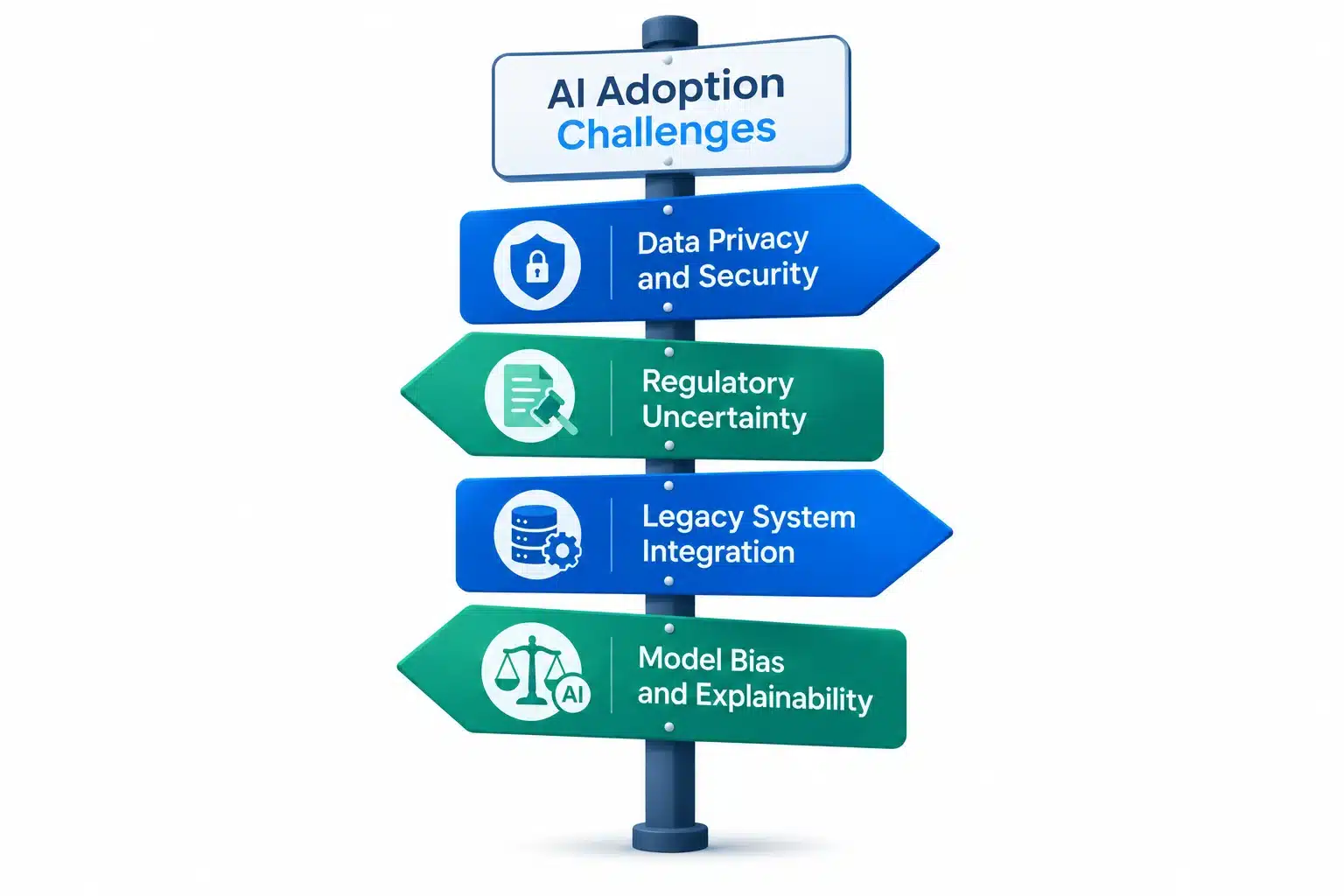
Data Privacy and Security
- Fintech deals with extremely sensitive information including customer documents, bank details, and transaction histories. Introducing AI poses risks as many systems touch this data and it increases the attack surface.
- AI models can themselves leak information if not properly secured especially when trained on customer data.
- Strong encryption, secure pipelines, anonymization, and strict access controls are essential to prevent breaches and maintain customer trust.
Regulatory Uncertainty
- AI in finance is still evolving, and regulators across different regions are continuously updating guidelines for automated decision-making.
- Fintech companies must interpret ambiguous rules, especially around lending, fraud detection, and identity verification.
- Constant alignment with legal teams and regulators is required to avoid compliance violations and ensure AI systems remain audit-ready.
Legacy System Integration
- Many fintech companies still rely on older core banking systems or fragmented infrastructure that were never designed to support AI.
- Integrating modern AI tools into these systems can be slow and complex, often requiring re-engineering, API development, or data migration.
- A phased modernization approach, upgrading key components while gradually introducing AI, helps reduce disruption and implementation risk.
Model Bias and Explainability
- AI models learn from historical data, which often contains hidden biases. If not corrected, these biases can lead to unfair outcomes, like rejecting credit applications from certain groups or flagging legitimate transactions as fraud.
- Explainability is critical, especially in regulated areas like lending and risk. Companies must be able to clearly justify why an AI model made a particular decision.
- Regular bias checks, transparent logic, and human oversight help maintain fairness and trust.
Fintech companies face several hurdles while adopting AI as discussed above. These challenges can slow them down, if not handled properly. Partnering with a strong AI solutions implementation partner like Simpalm helps to overcome these obstacles by bringing deep technical expertise, proven security practices and industry-specific knowledge. We clean and structure data, modernize infrastructure and build secure pipelines that safeguard sensitive financial information. Our trained developers design and deploy AI models that are explainable, fair and aligned with regulatory expectations. Post launch, we stay with you for continuous monitoring and optimization to keep your AI models reliable and achieve real ROI.
Bottom Line
AI is no longer optional for Fintech companies as it is the foundation for faster decisions, smarter risk management and personalized customer experiences. The companies that adopt AI have to invest in strong data foundations, responsible innovations and compliant practices. However many fintech companies rush to implement AI without addressing the core challenges like data privacy, regulatory compliance, model bias and legacy system limitations.
This creates fragile systems that fail to work under real world conditions and do not deliver the intended impact. Without the right groundwork AI becomes difficult to maintain and scale, leading to stalled projects and missed opportunities. Fintech companies that take a structured approach supported by strong technical partners, are the ones that turn AI into a competitive advantage.
Frequently Asked Questions
Q1. Why is everyone in fintech suddenly talking about AI?
The Fintech industry is drowning in data, regulations are getting tighter, and customers want everything now. Traditional systems simply can’t keep up. Smarter tools like AI help companies analyze information faster, automate complex tasks, and deliver the kind of smooth, personalized experience people expect from modern financial apps.
Q2. How does AI actually help reduce fraud?
Fraudsters change their tricks constantly, and old rule-based systems only catch what they already know. AI models watch how users behave in real time, how they spend, where they log in from, even how they swipe or type. When something feels unnatural, the system flags it instantly. This helps stop suspicious activity before it becomes a loss.
Q3. Can AI really improve lending decisions?
Absolutely. Instead of relying only on credit bureau scores, lenders can look at things like bank transactions, rent payments, utility bills, or business cash flow. This gives a fuller picture of someone’s financial behavior, especially for first-time borrowers or thin-file customers. It also updates risk profiles continuously, so lenders can react quickly if someone’s financial situation changes.
Q4. What makes AI adoption challenging for fintech companies?
The biggest hurdles are protecting sensitive customer data, keeping up with evolving regulations, dealing with legacy systems, and making sure automated decisions are fair and explainable. If companies ignore these issues, they often end up with unreliable systems, compliance headaches, or projects that never make it past the pilot stage.
Q5. How do fintech companies make sure their AI systems stay compliant?
They include compliance into the process from day one. That means keeping audit trails, ensuring decisions can be explained, protecting customer data under privacy laws, and regularly checking models for bias. When product, engineering, and compliance teams work together early, systems stay trustworthy and regulator-friendly.
Q6. Why does working with an AI development partner make such a big difference?
A good partner solves the problems most fintech teams struggle with. They help clean and structure data, modernize outdated systems, build secure pipelines, and create models that are fair, explainable, and compliant. They also stay involved after launch with monitoring, retraining, and optimizing, so the system keeps performing well as customer behavior and regulations evolve.
Q7. Which AI technologies are used in Fintech?
The most commonly used AI technologies in Fintech are Machine Learning, Natural Language Processing, generative AI, predictive analytics and AI agents.