
 Design
 App Development
 Web Engineering
 AI Services
 Cloud
Cloud Staffing
 Startups
 Health / Fitness
 Education
 Social
 Nonprofit
 Fintech
 Construction
 Logistics
 Government
 Travel/Hospitality
 HR Software
 About Simpalm
 Our News
 Client Testimonials
 Careers
 Our Blog
 Awards
 Resources
 Information
The modern-day IT infrastructure is now thriving on cloud computing environments and has so far transformed the way businesses store, manage, and process data. This technological revolution has helped organizations save their expensive investments on maintaining the on-premise infrastructure and associated hardware & software.
Cloud computing is now an affordable and easy-to-manage solution, offering both on-demand servers as well as third-party managed platforms to meet your operational needs. However, irrespective of whether you need better operational efficiency, cost optimization, or scalability, it is important to assess the different cloud environments and decide on what would work best for your organization.
In this article, you will get a clear understanding of the different types of cloud environments and how each one of them contributes to improving your business operations.
Types of Cloud Environments
You must know that a cloud environment represents how your specific organizational resources, like servers, networking, software, or storage, are deployed, consumed, and managed. You can deploy cloud environments for your business operations either on-premise, off-premise, or combining both of these aspects.
To give you a better perspective on how different cloud environment types assist you in business operations, here is a brief elaboration on each of them:
1. Public Cloud Environment
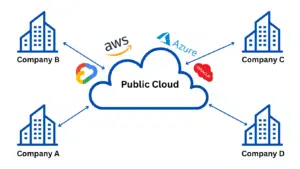
As the name suggests, a public cloud environment is a dedicated infrastructure where resources are shared across multiple organizations. In addition to that, a public cloud is managed by a third-party service provider.
All the resources, such as storage, networking, and servers, are under the ownership and operational capacity of the public cloud provider. Users have the liberty to access those resources on demand across the internet.
Businesses often use public cloud environments for hosting or scaling their existing applications, storing data, or leveraging additional cloud services.
For instance, a new business might prefer public cloud for hosting a website, back-end services, databases, or operational processes. Beyond that, startups also use cloud-based tools to analyze large data sets.
Some of the common examples of public cloud environments are:
- Amazon Web Services (AWS)
- Google Cloud
- Microsoft Azure
- Oracle Cloud
- iCloud
With several positives, there are some downsides to public cloud as well. As the public cloud resources are shared with multiple users, there is some risk for data loss or security breaches. Moreover, downtime and outage issues might be common, mostly due to shared resources or network congestion.
2. Private Cloud Environment
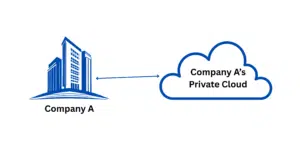
As a solution to the shortcomings, a private cloud environment brings in an infrastructure dedicated to only one individual or organization. The best part is that private cloud environments are hosted either on-premise or in a third-party data center.
When implementing a private cloud computing environment, your organization will have complete control over its infrastructure, security, and hardware. Your team can seamlessly access the private cloud environment through a specific network or VPN.
For instance, a financial institution can use a private cloud environment for storing or processing the customer credentials or records. Every organization using a private cloud will have robust control over the entire infrastructure and the associated servers.
Some of the popular private cloud providers include:
- IBM Cloud Private
- Oracle Cloud at Customer (C@C)
- Amazon Virtual Private Cloud (VPC)
- Azure VMware / Azure Dedicated Host
Only the authorized personnel will have access to the stored data, which eventually encourages organizations to comply with certain security mandates such as HIPAA regulations.
The only downside to using a private cloud environment is its expensive setup and maintenance than public and other types of cloud development environments. Therefore, a private cloud is mostly not feasible for startups with a limited budget.
3. Hybrid Cloud Environment
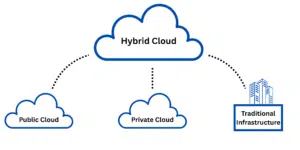
The best of both worlds, a hybrid cloud environment, as the name suggests, is the combination of public and private clouds. Upon adopting this type, you will be able to manage both public and private clouds as one unified environment.
Your organization can benefit from the perks of both public and private clouds and fulfill the planned goals. Hybrid clouds offer you better control and flexibility as they pose a perfect balance of scalability, cost-effectiveness, and security.
For instance, if you have multiple applications or workloads in your organization, using a hybrid cloud computing infrastructure can help you choose the ideal environment for each of them. Team can also access them through VPN or private network.
Some of the common hybrid cloud services by top companies in the industry are:
- AWS Outposts
- Azure Stack / Azure Arc
- Google Anthos
- IBM Cloud Paks / Red Hat OpenShift
- Oracle Dedicated Region Cloud@Customer
Alongside the positives, hybrid clouds also have certain downsides, including the cost and complexity of managing them. You might have to use additional tools to effectively channelize the perks of hybrid cloud environments.
4. Multi-Cloud Environment
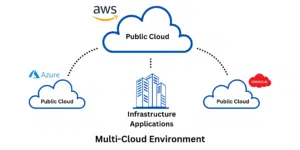
A dedicated multi-cloud environment uses two or more cloud services, linked to different providers, such as Google Cloud, Azure, or AWS. When using multi-cloud, you can rely on varying cloud providers to support your different applications or workloads. This way, your business can leverage the strengths of each cloud environment, specific to the business needs, demands, and goals.
Just like a hybrid cloud, a multi-cloud environment also frees you from the limitations of a single provider. You will have the liberty to assess the performance, security, or cost requirements of every business application or workload, and choose an ideal cloud provider for the same.
Multi-cloud computing does offer enhanced flexibility, cost-effectiveness, and control over public or private cloud environments. However, managing it might require complex controls and proper integrations.
Best Practices to Implement Upon Choosing Different Types of Cloud Environments
No matter what type of cloud environment you opt for your business success, the key to success depends on your thoughtful planning and strict governance. Therefore, to help you pick the right option from the different types of cloud environments, here are some best practices for you to count on:
1. Clearly Define Your Business Objectives
Determine your KPIs (Key Performance Indicators), alongside the compliance requirements for establishing a cloud computing environment. Beyond that, determine if you need optimal data control, scalability, cost-effectiveness, or specialized cloud services, prior to choosing your specific environment.
2. Execute a Comprehensive Workload Analysis
You must then analyze your workflows to determine which among them are suited for public, hybrid, private, or multi-cloud environments. This way, you can decide whether your operational workloads can be satisfied with just a public or private cloud or need services from multiple providers.
3. Lay the Roadmap for Security & Compliance
Specify the compliance regulations in brief, and make sure that the cloud environment you choose meets them. Beyond that, you can also implement multi-layer security, such as access controls, intrusion detection, and encryption, to better utilize the cloud computing environments.
4. Integrate a Management & Monitoring System
You can use cloud-specific monitoring tools for tracking the overall usage, associated costs, and performance across varying environments. Beyond that, you can also centralize the telemetry and logging data for convenient troubleshooting as well as optimization.
5. Continuous Optimization
Seek continuous iteration and optimization of your cloud environment, as adopting it is supposed to be an ongoing process. You can continually review the costs involved and the performance output to determine if the environment is adding more business value. In case of any shortcomings, you can always fine-tune your implementation strategy.
Conclusion
Choosing the ultimate one from the different types of cloud environments will depend on aligning your technical needs with the strategic goals of your business. Public, private, hybrid, and multi-cloud environments have their own set of advantages, making them ideal for different use cases.
In case you are having trouble deciding on which cloud environment would suit your business operations the best, Simpalm is here to help! We will not just help you decide, but will also support you with comprehensive cloud development solutions.
To know more about cloud environments and cloud backend development practices, specific to your business operations or growth, reach out to our team at Simpalm!