
 Design
 App Development
 Web Engineering
 AI Services
 Cloud
Cloud Staffing
 Startups
 Health / Fitness
 Education
 Social
 Nonprofit
 Fintech
 Construction
 Logistics
 Government
 Travel/Hospitality
 HR Software
 About Simpalm
 Our News
 Client Testimonials
 Careers
 Our Blog
 Awards
 Resources
 Information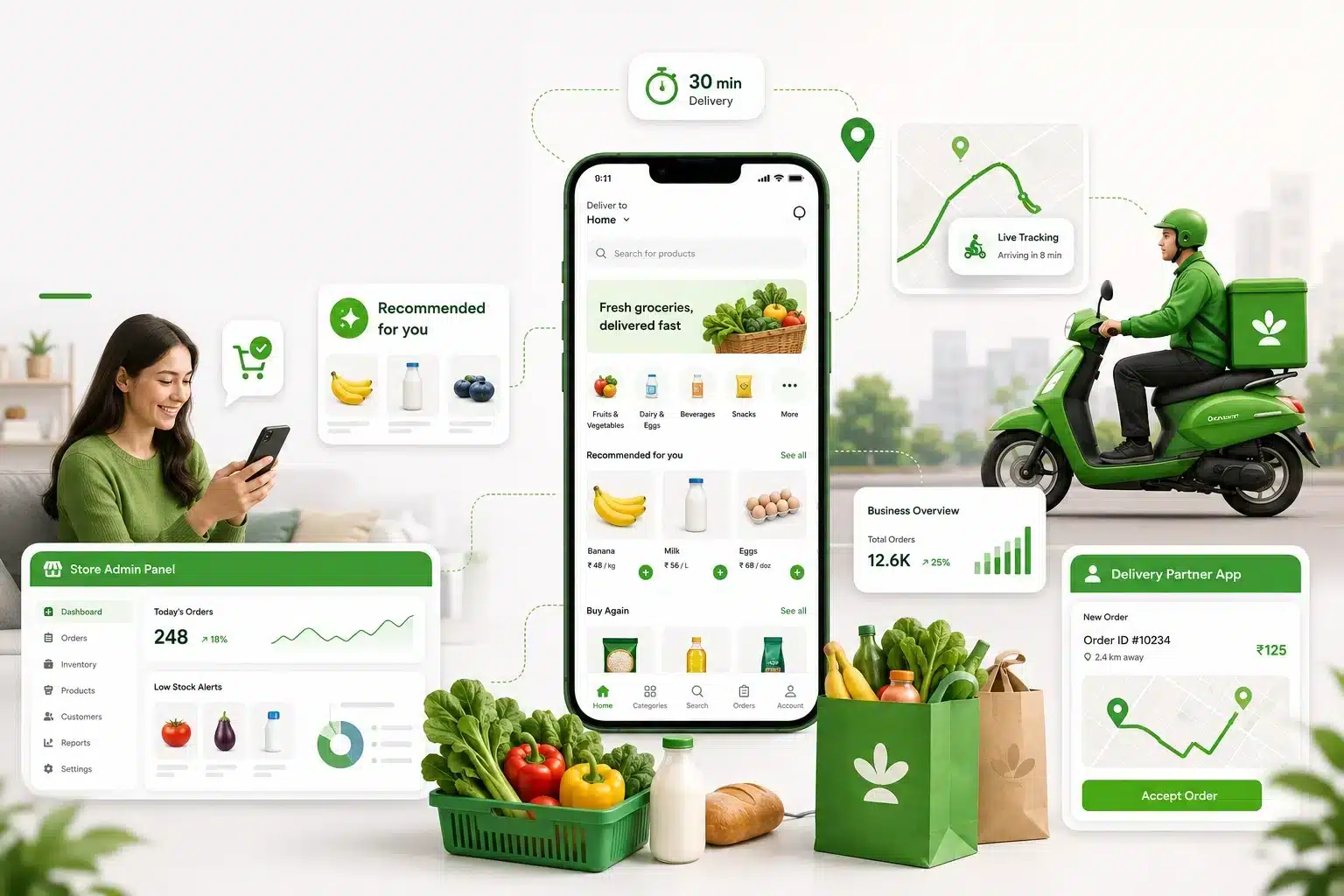
Key Takeaways
- The global online grocery delivery market is projected to reach $786.8 billion by 2030, growing at a CAGR of 25.3%, making it one of the fastest-growing segments in consumer tech.
- More nuclear families are driving the trend of grocery delivery due to lack of time.
- A grocery delivery app is not a single-module application. It is a system of three interconnected panels: a customer app, a store admin dashboard, and a delivery partner app. Each panel has its own distinct UX logic and feature set.
- Business model selection is the single most consequential decision before development begins. Inventory-based, marketplace, hyperlocal, and subscription models each carry different cost structures, margin profiles, and scaling trajectories.
- AI-powered features such as personalized recommendations, dynamic pricing, and demand forecasting are no longer differentiators. They are fast becoming the baseline expectation for competitive grocery platforms in 2026.
________________________________________________________________________________________
Online grocery shopping has evolved from a convenience feature into a core consumer expectation. The global online grocery market is projected to reach USD 992.35 billion by 2033, driven by changing buying habits, smartphone adoption, and demand for faster delivery experiences.
Consumers today expect groceries to arrive within minutes, browse real-time inventory before purchasing, track orders live, and reorder household essentials with just a few taps. For retailers, supermarkets, and startups, meeting these expectations is no longer optional but a new baseline that the market has drawn.
This shift has created a significant opportunity for grocery delivery app development. The success of such apps depends on choosing the right business model, features, technology stack, and operational strategy from the start. Common grocery delivery app models include:
- Marketplace platforms such as Instacart and DoorDash, which connect customers with multiple grocery retailers.
- Dedicated grocery store apps such as the Walmart app are built for a single retailer’s customers.
- Quick-commerce platforms such as Gopuff focus on ultra-fast delivery and convenience purchases.
This complete guide to grocery delivery app development covers everything founders, product teams, and business owners need to know. We have covered market opportunity, business model selection, preferred features, tech stack, development cost, and post-launch strategy.
What is Grocery Delivery App Development?
Grocery delivery app development is the end-to-end process of designing, engineering, and deploying a digital platform that enables customers to browse, order, and receive groceries at their doorstep, eliminating the need to visit a physical store.
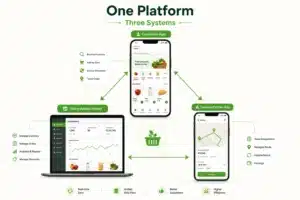
It is important to clarify what this actually means at a structural level, because the term is often misunderstood as a single-panel mobile app. In practice, a complete grocery delivery platform is a system of three deeply integrated modules:
- Customer App
- Store Admin Panel
- Delivery Partner App
Each module has its own distinct UX logic, performance requirements, and feature priorities. The quality of the connections between these three modules, i.e., how fast they sync, how reliably data flows between them, is what separates a professional grocery platform from a basic ordering app.
Must-Have Features of a Grocery Delivery App
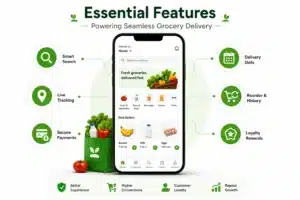
Every feature in a grocery app must solve a specific, measurable problem for one of your three user types. Below are the non-negotiable features for a production-ready platform, organized by the panel they serve.
Customer-Facing Features
-
- Smart Product Search and Filtering: Customers need to find products by name, category, brand, dietary attribute (organic, gluten-free, vegan), price range, and availability. Poor search is the fastest path to cart abandonment.
Example: A customer types “low-sodium canned tomatoes” and receives filtered results sorted by price and brand, not a generic search page requiring five additional manual filters.
- Real-Time Order Tracking with Live Map: Once an order is placed, customers expect a live map showing the delivery agent’s location, the estimated arrival time, and automated status updates at each stage. This is now a baseline expectation, not a differentiator.
- Multiple Secure Payment Options: Support for credit/debit cards, digital wallets (Apple Pay, Google Pay), UPI (for South Asian markets), net banking, and cash on delivery where applicable. Payment friction at checkout is the single highest-impact conversion killer in any e-commerce flow.
- Scheduled Delivery Slots: Customers should be able to choose a delivery window that fits their schedule, same-day, next-day, or a specific two-hour window rather than accepting whatever the system assigns. This feature directly reduces missed deliveries and failed order attempts.
- Smart Reorder and Purchase History: Grocery shopping is highly repetitive. A one-tap reorder of last week’s cart, combined with personalized product recommendations based on purchase history, meaningfully increases average order frequency.
- Loyalty Points and In-App Promotions: A points system where customers earn rewards on each order, combined with personalized discount offers, drives repeat purchase behavior and directly increases customer lifetime value.
Store Admin Panel Features
- Real-Time Inventory Management: Stock levels must update automatically with every order. Manual inventory updates at any scale create oversell conditions, customer complaints, and operational chaos. Automated low-stock alerts and supplier reorder triggers are closely adjacent features that significantly reduce management overhead.
- Centralized Order Management Dashboard: A live command center showing incoming orders by status (pending, preparing, dispatched, delivered), average preparation time, and daily revenue, all updating in real time.
- Promotions and Pricing Controls: The ability to create time-limited discounts, flash sales, category-level promotions, and bundle offers without requiring developer involvement. Marketing agility at the store level drives revenue in ways that static pricing cannot.
- Analytics and Business Reports: Sales performance by product, category, and time period; customer retention metrics; average basket value; and delivery performance data are all accessible in exportable reports.
Delivery Partner App Features
- Optimized Route Navigation: Integrated map routing that calculates the fastest delivery path, accounting for traffic, multiple stops, and time windows. Manual routing at any delivery volume is operationally unsustainable.
- In-App Order Communication: The ability for delivery agents to contact customers directly through the app (call or message) when there is a delivery issue without exposing either party’s personal phone number.
- Earnings Dashboard and Payment Tracking: Delivery partners need transparent visibility into their completed deliveries, earnings per order, bonuses, and pending payments. Opacity around earnings is the fastest way to lose your delivery fleet.
AI-Powered Features Redefining Grocery Apps in 2026
The feature set above gets your platform to competitive parity. What separates a market-leading grocery app from a functional but average one is the intelligent layer built on top of that foundation.
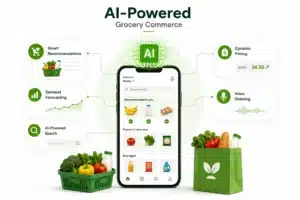
- Personalized Product Recommendations: Machine learning models analyze each customer’s purchase history, browsing behavior, time-of-day patterns, and household size signals to proactively surface relevant products on the home feed and at checkout. Platforms implementing personalization see measurable increases in average basket size within 60 days of deployment.
- Dynamic Pricing and Demand Forecasting: AI-driven pricing adjusts product prices and delivery fees based on real-time demand signals, time of day, competitor pricing, and inventory levels. On the supply side, demand forecasting helps buyers optimize purchase orders and minimize perishable waste, one of the highest-cost operational problems in grocery retail.
- AI-Powered Inventory Management: Rather than reacting to stockouts after they happen, AI systems predict demand by SKU based on historical sales patterns, seasonal trends, weather signals, and local events. This moves inventory management from reactive to proactive and directly reduces both out-of-stock incidents and overstocking costs.
- Chatbot Support and Voice-Based Ordering: An AI chatbot handling common customer queries such as order status, refund requests, and product substitutions reduces support ticket volume significantly and extends customer service coverage to 24/7 without proportional staffing costs. Voice ordering, particularly for repeat purchases, is an emerging channel gaining traction in smart speaker and hands-free shopping contexts.
- Smart Search with Natural Language Processing: NLP-powered search understands queries like “something for pasta dinner tonight under $20” and returns contextually relevant product combinations rather than a keyword-matched list. This reduces time-to-cart for browsing customers and increases conversion.
| Build Prioritization Note: Personalized recommendations and AI-powered inventory management deliver the highest return relative to implementation effort and should be considered for version 1 if budget allows. Dynamic pricing and voice ordering belong in version-2 after you have sufficient behavioral data and a validated user base. |
Grocery Delivery Market: Size, Growth, and the Opportunity Window
The grocery delivery market is not in a speculative growth phase. It is in active, measurable expansion driven by three structural forces that are unlikely to reverse. First, let’s have a look at the market stats.
Key Market Numbers:
| Metric | Figure |
| Global market size (2030 projection) | $786.8 billion |
| CAGR (2023–2030) | 25.3% |
| Consumers who have ordered groceries online at least once | 63% |
| Share of grocery buyers preferring app-based reorders | 48% |
| Growth in same-day delivery demand (since 2021) | 3.1x |
*Source: Grocery Delivery – Worldwide Stats by Statista
Here is what is driving that trajectory:
Mobile-first consumer behavior: Smartphone penetration in urban markets has made app-based commerce the default shopping channel for the under-40 demographic. Grocery is simply the last major retail category catching up.
Speed expectations ratcheting upward: Amazon Fresh and Blinkit have set one-hour delivery as the experiential benchmark. Consumers who have experienced this speed do not return to next-day alternatives.
Data ownership becoming a strategic asset: Grocery retailers operating on third-party marketplaces lose access to their own customer purchase data. Custom-built platforms solve this problem entirely, giving businesses behavioral data that directly improves inventory decisions, promotions, and retention.
Hyperlocal market still fragmented: Outside major metropolitan centers, the hyperlocal grocery delivery space remains significantly underserved. Businesses that move early in mid-tier cities and suburban markets are capturing loyal customer bases without competing against enterprise platforms on their strongest ground.
Recommended Tech Stack for Best-Performing Grocery Delivery App Development
Technology choices made at the start of development compound in both directions: good architecture decisions accelerate everything that follows, while poor ones become increasingly expensive to correct under production load.
| Layer | Recommended Technology | Purpose |
| Mobile Frontend | React Native / Flutter | Cross-platform iOS and Android from a single codebase |
| Web Frontend | Next.js (React) | SEO-optimized product pages and admin dashboard |
| Backend | Node.js / Python (Django) | API server, business logic, authentication |
| Primary Database | PostgreSQL | Transactional data orders, users, payments, inventory |
| Cache Layer | Redis | Inventory locking, session management, fast reads |
| Real-Time Engine | WebSockets / Firebase | Live order tracking, delivery status sync |
| Cloud Infrastructure | AWS / GCP | Auto-scaling, CDN, managed databases |
| Payments | Stripe / Razorpay | Global and India-specific payment processing |
| Maps & Routing | Google Maps API / MapBox | Delivery tracking and route optimization |
| Push Notifications | Firebase Cloud Messaging | Order updates across iOS and Android |
| Media & Storage | AWS S3 + CloudFront | Product images, receipts, and promotional assets |
Platform Choice: React Native and Flutter both allow a single codebase to power iOS and Android simultaneously. For a grocery app where the development budget is a real constraint, this cross-platform approach typically reduces mobile development costs by 30 to 40% compared to building native apps for each platform independently.
Step-by-Step Process to Build a Grocery Delivery App
Building a production-quality grocery delivery app is a multi-phase process. The teams that rush through the early stages to reach development faster consistently encounter the most expensive rework later.
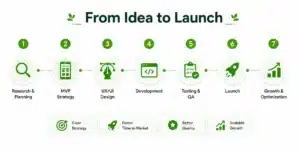
Step 1: Market Research and Niche Definition
Identify your target geography, customer segment, and positioning before committing to a feature scope. Are you targeting urban professionals who want 30-minute delivery? Or suburban families who want scheduled weekly grocery deliveries? The answer shapes every product decision that follows. Document your research in a Market Requirements Document (MRD) before moving forward.
Step 2: Business Model and MVP Scope
Select your business model based on the framework outlined earlier. Then define your MVP: the smallest version of the product that delivers real value to real users and generates data you can act on. Separate non-negotiable MVP features from v2 enhancements explicitly and document the boundary clearly to prevent scope creep.
Step 3: UX Wireframing and User Flow Design
Build low-fidelity wireframes for all three panels: customer, admin, and delivery partner, covering every core flow, including product search and checkout, order management, delivery assignment and tracking. Validate these flows with real potential users before investing in visual design.
Step 4: UI Design and Component System
Develop a complete design system with defined typography, color variables, spacing, and interaction patterns. Consistency across all screens is not an aesthetic preference. It directly impacts perceived quality and user trust, both of which affect conversion and retention.
Step 5: Frontend and Backend Development
Build in parallel where possible, with clear API contracts defined early so frontend and backend teams can progress without blocking each other. The inventory management system and real-time order tracking require particular architectural attention as these are the components that fail most visibly under production load.
Step 6: Third-Party API Integrations
Integrate payment gateways, mapping services, push notification systems, SMS providers, and any relevant ERP or POS systems. Each integration should have proper error handling, retry logic, and fallback behavior defined from the start, not added reactively when something breaks in production.
Step 7: QA Testing and Load Testing
Test functional flows, edge cases, payment failure scenarios, and offline behavior. Also, conduct load testing that simulates the peak concurrent user conditions your platform will face during high-demand promotional periods, holiday seasons, and flash sales. Such rigorous testing allows us to identify scaling issues before they happen in production.
Step 8: App Store Submission and Launch
Prepare App Store and Google Play submissions with keyword-optimized descriptions and high-quality screenshots. Account for the standard 1 to 3-day review window in your go-live timeline. A rejected submission on launch day is an avoidable crisis.
Step 9: Post-Launch Monitoring and Iteration
Track crash rates, order completion rates, cart abandonment points, and customer support ticket patterns in the first 30 days. This data is the most valuable input for your first patch release and your v2 feature prioritization decisions.
How Much Does it Cost to Develop a Grocery Delivery App and Factors That Influence Cost
Development cost is the question every founder asks first and most often underestimates. The following ranges reflect estimates for teams building at professional quality standards.
| App Tier | Scope | Estimated Cost | Timeline |
| Basic MVP | Core customer app + basic admin panel, single platform | $5,000–$15,000 | 2–3 months |
| Mid-Level App | Full feature set, iOS + Android + web, all 3 panels | $13,000–$45,000 | 3–5 months |
| Enterprise Platform | AI features, multi-vendor, advanced analytics, integrations | $40,000–$80,000+ | 5–9 months |
Key Factors That Affect Development Cost
Feature scope and complexity: Real-time order tracking, AI-powered recommendations, and dynamic pricing each add development hours significantly. Every feature in scope is a direct cost input.
Platform coverage: A web-only platform costs considerably less than a cross-platform iOS + Android + web product. Cross-platform frameworks (React Native, Flutter) reduce this gap but do not eliminate it.
Team geography: Development teams in North America or Western Europe typically charge $100–$180/hour. Teams in Eastern Europe charge $40–$80/hour. Teams in South Asia charge $20–$50/hour.
Third-party integration complexity: A platform integrating with an existing POS system, ERP, or multiple payment gateways requires significantly more backend development effort than a greenfield build.
Hidden Costs Businesses Consistently Underestimate
Beyond the initial build, the total cost of owning a grocery delivery app includes:
- Cloud infrastructure: $800–$2,500/year for a mid-scale platform depending on active users and order volume
- Third-party API fees: Google Maps API, payment gateway transaction fees, and push notification services add recurring per-request costs that scale with usage
- Ongoing maintenance: Security patches, OS compatibility updates, and bug fixes typically require 3–5% of the original development cost annually
- App Store fees: Apple charges $99/year for the iOS Developer Program; Google charges a one-time $25 registration fee
Planning for these recurring costs from the outset is not optional. It is the difference between a financially sustainable product and one that creates operational stress within 12 months of launch.
How to Monetize Your Grocery Delivery App For Optimized Profit Margins
Selecting the right monetization model is as important as selecting the right tech stack, because it directly determines unit economics, sales motion, and which features to prioritize.
| Model | How It Works | Best For | Key Risk |
| Delivery Fees | Fixed or distance-based fee per order | All models | Abandoned carts at checkout |
| Surge Pricing | Higher fees during peak demand windows | High-demand urban markets | Customer perception backlash |
| Vendor Commission | 5–20% fee on each order from marketplace vendors | Aggregator model | Vendor churn if margins are tight |
| Subscription Membership | Monthly fee for free delivery and exclusive offers | Repeat-purchase customer base | Requires strong existing loyalty |
| Featured Listings | Vendors pay for prominent placement in search results | Marketplace model | Relevance degradation if overused |
| In-App Advertising | Brand promotions within the browse and search experience | Scale platforms | User experience trade-offs |
The most durable monetization structure for a new grocery delivery app combines a delivery-fee model at launch, which requires no minimum order volume to generate revenue, with a subscription membership layer introduced once a loyal repeat-purchase customer base has been established.
These two models compound naturally: subscription members convert to free delivery expectations, while continued delivery fee revenue from non-subscribers funds the growth required to acquire more members.
Data Security and Compliance Considerations While Building Grocery Delivery App
A grocery delivery app collects sensitive data at scale: names, addresses, payment card information, and behavioral purchase data for every user. The legal and reputational consequences of handling that data incorrectly are significant.
GDPR and Regional Data Privacy Laws: If your platform serves users in the European Union, GDPR compliance is a legal requirement, not a best practice. This includes obtaining explicit consent for data collection, providing users with the ability to request data deletion, and maintaining clear privacy policies in plain language. CCPA applies similar obligations in California. Platforms targeting India should align with the Digital Personal Data Protection Act (DPDPA), which became enforceable in 2024.
PCI-DSS Compliance for Payments: Any platform that processes credit card transactions must meet Payment Card Industry Data Security Standard requirements. The practical implication: use a certified payment gateway (Stripe, Razorpay, PayU) rather than attempting to build card processing infrastructure independently. This shifts the compliance burden to the gateway and significantly reduces your exposure.
User Data Security Best Practices: Encrypt all personally identifiable information (PII) at rest and in transit. Implement role-based access control so that delivery partners, store admins, and platform administrators each access only the data their role requires. Conduct penetration testing before launch and on a regular schedule afterward.
App Security Testing Checklist Before Launch
- SQL injection and XSS vulnerability scan
- Payment flow penetration testing
- API authentication and authorization audit
- Sensitive data exposure review
- Load testing for rate-limiting and DDoS resilience
| Note: Compliance requirements vary meaningfully by geography. Before launching in any new market, a legal review specific to that jurisdiction is a worthwhile investment. |
Common Challenges in Grocery Delivery App Development
Every grocery delivery app development project encounters the same set of predictable problems.
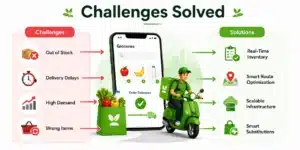
The teams that navigate them most efficiently have planned their architecture with these scenarios in mind from the start.
Real-Time Inventory Synchronization
When a product sells out while a customer still has it in their cart, the resulting experience can be frustrating. Receiving an order confirmation only to get a cancellation notice shortly afterward is one of the quickest ways to erode trust in an e-commerce brand.
Solution: Implement soft inventory reservation at add-to-cart with a 15-minute hold timer and hard deduction at payment confirmation. Real-time sync between the admin panel and customer-facing catalog must update in under 500ms.
Last-Mile Delivery Logistics
Optimizing delivery routing across multiple concurrent orders, accounting for traffic, delivery slot windows, and agent availability, is computationally complex. Manual assignment at any meaningful order volume creates delays and cost inefficiencies.
Solution: Automated order assignment algorithms based on proximity, agent availability, and slot window. Google Maps Platform’s Route Optimization API handles multi-stop routing reliably at scale without requiring proprietary algorithm development.
Handling Perishables and Substitution Logic
When a customer orders fresh produce that is no longer in stock, the next step becomes critical. Whether the system automatically cancels the item, suggests a substitute, or places the order on hold pending customer approval can have a major impact on satisfaction at one of the most sensitive moments in the purchasing journey.
Solution: Build an explicit substitution preference flow into the checkout experience where customers select their substitution policy (accept recommended alternative, contact me, or cancel item) before the order is placed. This removes ambiguity from the fulfillment step entirely.
Cultural Catalog Localization and Product Discovery
Many grocery platforms are designed around mainstream U.S. retail catalogs, which creates a friction point for customers shopping for culturally specific ingredients. A shopper looking for Indian, Chinese, Korean, Middle Eastern, or Hispanic groceries may search using native product names, regional spellings, or culturally familiar categories that do not exist in a standard grocery taxonomy. Even when products are available, poor categorization and search relevance can make them difficult to find, creating the perception that the platform does not serve that community’s needs.
Solution: Design the product catalog with support for multilingual product metadata, alternative product names, and culturally relevant category structures from the outset. Search functionality should recognize common regional terms, transliterations, and synonyms (for example, “coriander” and “cilantro,” or “atta” and “whole wheat flour”). For marketplaces serving diverse communities, localized merchandising and curated cultural grocery collections can significantly improve product discovery and customer retention.
Scaling for Peak Demand
Promotional events, holiday periods, and flash sales create order volume spikes that can be 5 to 10x normal traffic. Infrastructure that handles average load without planning for peak load will fail exactly when reliability matters most.
Solution: Cloud auto-scaling configured with defined triggers, Redis-based caching for high-read data like product catalogs and pricing, and load testing specifically designed around your peak demand scenarios before they occur in production.
Post-Launch Maintenance and Growth Strategy for Your Grocery Delivery App
Launch is the beginning of the product’s life, not the end of the project. The decisions made in the first 60 to 90 days post-launch have a disproportionate impact on the trajectory of the first 12 months.
KPIs to Track from Day One
- Order completion rate (target: 95%+)
- Average delivery time vs. promised delivery time
- Cart abandonment rate by checkout step
- Customer reorder rate at 30 and 60 days
- App crash rate and ANR (Application Not Responding) rate
- Average basket value and its trend over time
Regular Feature Updates and OS Compatibility: Apple and Google both release major OS updates annually. Apps that are not updated for compatibility within 60–90 days of a major OS release begin experiencing user-reported issues that translate into App Store rating drops. Schedule a dedicated compatibility review cycle for every major OS release.
Customer Feedback Loops: A structured in-app feedback prompt triggered after every fifth order generates a continuous data stream on product quality, delivery experience, and feature requests. A qualitative review text, processed at scale, identifies the pattern-level issues that individual tickets obscure.
Scaling Infrastructure Proactively: Review infrastructure capacity quarterly against growth projections rather than waiting for performance degradation signals. It is significantly less expensive to right-size infrastructure ahead of a growth inflection than to emergency-scale during one.
Want to Build the App? Here’s How to Choose the Right Grocery App Development Company
The development partner you choose influences not just the quality of the initial build but the technical debt you inherit, the architectural decisions you will live with for years, and the speed at which you can iterate after launch.
Key Qualities to Look For
- Demonstrated experience building multi-panel delivery platforms (not just e-commerce stores)
- A portfolio that includes real-time features: order tracking, live inventory sync, and delivery management
- A structured discovery process before quoting: companies that quote without understanding your requirements are pricing a generic product, not a specific product as per your dedicated business needs
- Transparent communication on timeline, technical risks, and post-launch support terms
Red Flags to Avoid
- Fixed-price quotes delivered within 24 hours of initial contact without a discovery phase
- No references from clients who have launched and scaled a similar product
- Unwillingness to provide access to the codebase or a code review before engagement
- Scope that excludes QA testing, load testing, or app store submission support
Questions to Ask Before Signing
- What is your process for handling scope changes during development?
- Who owns the IP and source code upon project completion?
- What post-launch support do you provide, and at what cost?
- Can you share the architecture you would propose for the inventory sync and real-time tracking components?
- What is the testing protocol before handing over a build for review?
Conclusion
Building a successful grocery delivery app in 2026 is a fundamentally different challenge than it was three years ago. Consumer expectations around delivery speed, product accuracy, and app quality are higher. The competitive landscape, from enterprise platforms to well-funded regional players, is now more established. And the cost of a poor post-order experience propagates faster through ratings and social feedback than it ever did before.
The founders and product teams who succeed in this market consistently share three characteristics:
- They choose a clearly defined market segment and build deeply for that audience rather than attempting to serve everyone from day one.
- They treat their MVP launch as the beginning of a data collection process, not a finished product release.
- They invest seriously in three specific areas from the start: real-time infrastructure reliability, mobile UX quality, and post-launch analytics instrumentation.
The complexity of modern grocery delivery platforms also reinforces the importance of experienced technical leadership during the build phase. Many founders choose to work with specialized app development partners to accelerate decision-making around architecture, scalability, and user experience, allowing internal teams to stay focused on customer acquisition, operations, and growth.
Frequently Asked Questions
Q1. What Is the First Step in Building a Grocery Delivery App?
Start by defining your target customers, business model, and must-have features. Then validate demand, create an MVP roadmap, and partner with an experienced grocery app development team. Focus on launching quickly with core features such as product browsing, ordering, payments, inventory management, and delivery tracking. Add advanced functionality after gathering real customer feedback.
Q1. How Much Does It Cost to Develop a Grocery Delivery App in 2026?
Grocery delivery app development typically costs between $15,000 and $120,000+, depending on feature scope, platform coverage (iOS, Android, web), and team geography. A basic MVP covering core ordering and delivery features costs significantly less than a full-scale multi-vendor platform with AI-powered recommendations and advanced analytics.
Q2. What features does a grocery delivery app need?
A production-ready grocery delivery app requires smart product search, real-time order tracking, multi-payment support, scheduled delivery slots, inventory management, an order management dashboard for store admins, and a delivery partner app with route navigation. In 2026, AI-powered personalization and automated inventory forecasting are increasingly expected by competitive platforms.
Q3. How long does it take to develop a grocery delivery app?
Development timelines generally range from 2 to 9 months. A focused MVP typically takes 2 to 3 months; a full-feature cross-platform app with all three panels requires 3 to 5 months; an enterprise-grade platform with AI features and third-party integrations often takes 5 to 9 months or more.
Q4. What is the best business model for a grocery delivery app?
There is no universally best model. Inventory-based models offer higher margins but require significant capital. Marketplace models scale faster with less upfront investment. Hyperlocal models excel at delivery speed in dense urban areas. Most successful platforms at scale combine a primary model with a subscription membership layer to create recurring revenue alongside transaction-based income.
Q5. What tech stack should a grocery delivery app use?
A scalable grocery delivery app typically uses React Native or Flutter for cross-platform mobile development, Next.js for web interfaces, Node.js or Django for backend services, PostgreSQL for transactional data, Redis for caching and inventory locking, and AWS or GCP for cloud infrastructure. Real-time delivery tracking requires WebSockets or Firebase Realtime Database.
Q6. Should I build a custom grocery app or use an off-the-shelf platform?
Off-the-shelf solutions work for businesses with standard requirements and limited customization needs. A custom build becomes the stronger choice when data ownership, branded customer experience, workflow customization, multi-vendor management, or long-term scalability are business priorities. Grocery businesses running recurring operations or targeting a specific niche consistently benefit more from a purpose-built platform.