 Design
 App Development
 Web Engineering
 AI Services
 Cloud
Cloud Staffing
 Startups
 Health / Fitness
 Education
 Social
 Nonprofit
 Fintech
 Construction
 Logistics
 Government
 Travel/Hospitality
 HR Software
 About Simpalm
 Our News
 Client Testimonials
 Careers
 Our Blog
 Awards
 Resources
 Information
Key Takeaways
- Subscription success is driven by retention, not downloads. The biggest winners design onboarding, pricing, and value delivery to keep users renewing month after month.
- Your pricing model shapes your product from day one. Choosing between freemium, hard paywalls, tiered plans, or hybrid monetization affects user acquisition, conversions, and long-term revenue.
- Reliable billing and App Store compliance are business-critical. Payment recovery, entitlement management, and platform policy compliance prevent avoidable churn and costly app review delays.
- AI is becoming a competitive advantage for subscription apps. Personalized experiences, churn prediction, and dynamic paywalls help maximize subscriber lifetime value while improving retention.
________________________________________________________________________________________
A one-time purchase app makes money once. A subscription app makes money every month, for as long as the user sees value in staying. That difference explains why nearly every major consumer app, from Spotify to Duolingo to Calm, has moved to some form of recurring revenue, and why founders building something new almost always ask the same question early on: should this be a subscription?
The global subscription economy reached $492.34 billion in 2024 and is projected to hit $1.51 trillion by 2033, growing at a rate 3.4 times faster than S&P 500 companies over the last 12 years. Specifically for mobile, global subscription revenue hit $79.5 billion in 2025, with iOS accounting for 73% of that total.
The opportunity is real, but so is the risk.
The median subscription app grew monthly recurring revenue just 5.3% year-on-year in 2025, while top-decile apps grew more than 306% and the bottom decile contracted sharply. Subscription apps do not fail quietly in the middle. They either compound or they collapse, and the difference usually traces back to decisions made during development, not marketing decisions made after launch.
This guide walks through what actually goes into building a subscription-based app that lands in the winning half of that gap: the business model choices, the features that reduce churn instead of causing it, the technical architecture behind reliable billing, App Store and Play Store compliance requirements, realistic development costs, and the mistakes that quietly sink otherwise promising apps.
What is a Subscription-Based App?
A subscription-based app charges users a recurring fee, typically weekly, monthly, or annually, in exchange for ongoing access to content, features, or a service. This is fundamentally different from a one-time purchase app, where the user pays once and owns the app permanently, and different again from an ad-supported free app, where revenue comes from advertisers rather than users directly.
The subscription model works because it aligns revenue with ongoing value delivery. A streaming app has to keep adding content to justify renewal. A fitness app has to keep users seeing results. A productivity tool has to keep saving people time. This is also what makes subscription apps harder to build well than they look. The app is not done at launch. It has to keep earning its renewal every single billing cycle, which means retention, not just acquisition, becomes the core design problem from day one.
The Subscription Economy in 2026: Why This Model Keeps Winning
The scale of the shift toward subscriptions is no longer a trend; it is the default architecture for digital revenue. The subscription economy market will grow from $623.61 billion in 2025 to $738.82 billion in 2026 at a compound annual growth rate of 18.5%, driven by increasing adoption of digital services, growing internet penetration, smartphone usage, and rising preference for flexible payment models.
On the consumer spending side, the numbers are striking. The average American spends $219 per month on subscriptions across 8.2 active services, while estimating they spend only $86, a 2.5x perception gap. Gen Z leads spending at $377 per month, followed by Millennials at $276 per month, showing that younger, mobile-first users are the most comfortable paying recurring fees, provided the value is clear.
Growth is not evenly distributed, however. The top 25% of subscription apps grew monthly recurring revenue by 80% or more year-on-year, while the bottom 25% saw MRR shrink by more than 33%, a widening gap that reflects a winner-take-most dynamic rather than a rising tide lifting every app. Monthly new subscription app launches increased from roughly 2,000 in January 2022 to more than 14,700 by January 2026, meaning competition for subscriber attention has grown far faster than the market itself. Getting the pricing model, onboarding, and retention mechanics right at the architecture stage is no longer optional. It is the difference between landing in the growing top quartile or the shrinking bottom one.
Subscription Pricing Models: Which One Fits Your App
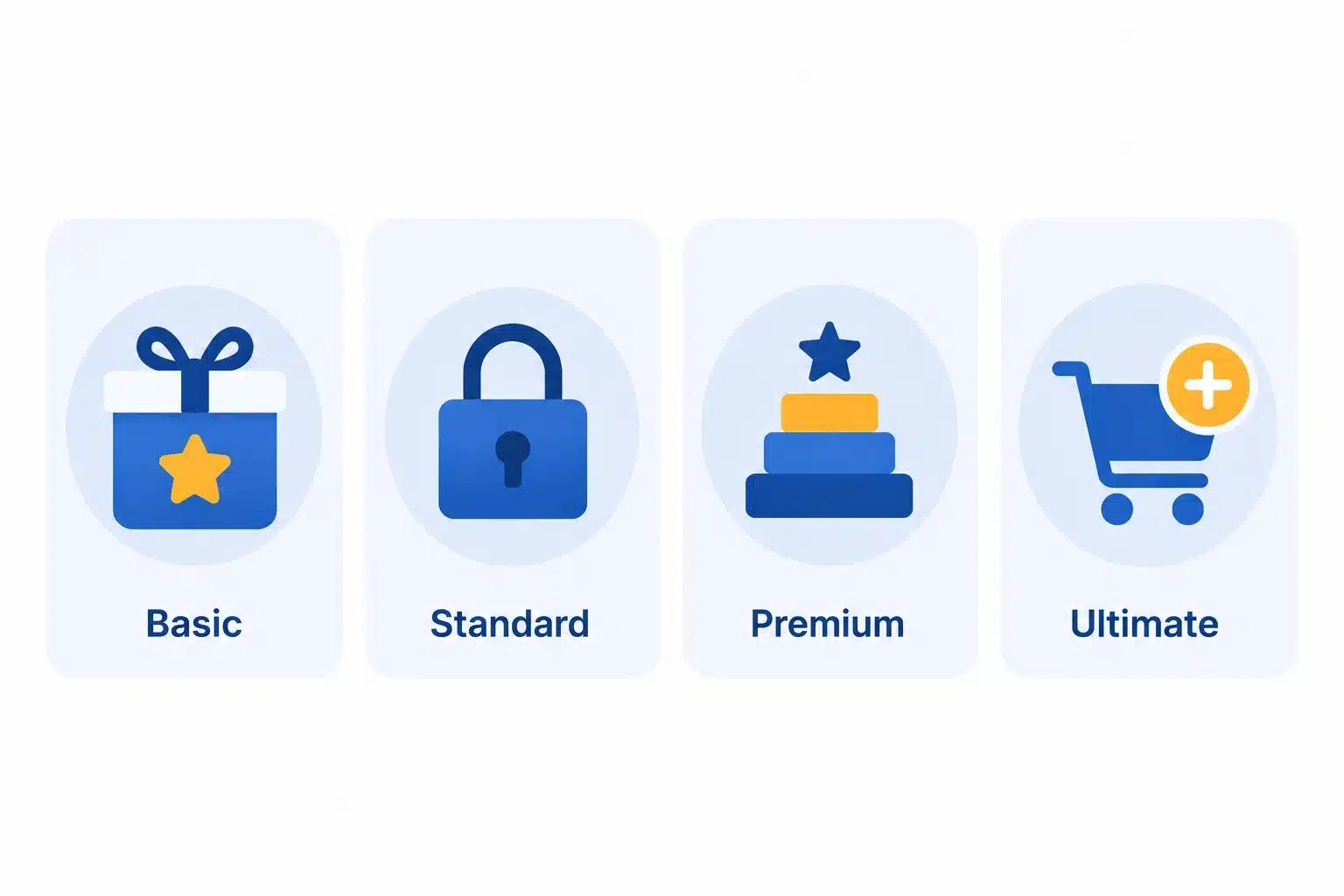
Choosing a pricing model is one of the first and most consequential decisions in subscription app development, since it shapes the paywall design, onboarding flow, and backend billing logic from the start. Here is how the major models compare.
| Model | How It Works | Best For | Key Tradeoff |
| Freemium | Free core features with premium features locked behind a paywall | Apps with a broad audience and a clear “aha moment” achievable for free | Lower conversion rates but larger top-of-funnel user base |
| Hard Paywall | Full access requires payment upfront, often after a short trial | Apps with strong brand trust or a very specific, high-value use case | Higher revenue per install but a smaller total user base |
| Tiered Subscription | Multiple pricing levels unlock increasing feature sets | Apps serving distinct user segments with different needs, like casual vs. power users | More complex billing logic and entitlement management |
| Hybrid (Subscription + Consumables) | Recurring fee plus optional one-time purchases | Gaming and social apps where users want both ongoing access and occasional extras | Requires more sophisticated backend to track two revenue streams cleanly |
The data supports being deliberate about this choice rather than defaulting to freemium out of habit. Hard paywall apps generate roughly nine times more day-14 revenue per install than low-priced freemium apps, with a median of $2.32 versus $0.27. At the same time, hard paywalls convert five times better than freemium models at the 35-day trial-to-paid conversion benchmark, according to recent industry analysis. Freemium still has a place for apps that need broad distribution to build network effects, but for many utility and content apps, a short free trial followed by a hard paywall now outperforms open-ended freemium access.
About 35% of apps now blend subscriptions with consumables or lifetime purchase options, with gaming at 61.7% and social apps at 39.4% leading that shift toward hybrid monetization, so hybrid models are increasingly the norm rather than the exception in those categories.
Must-Have Features for a Subscription App
Beyond the core product experience, a few features consistently separate subscription apps that retain users from ones that leak them.
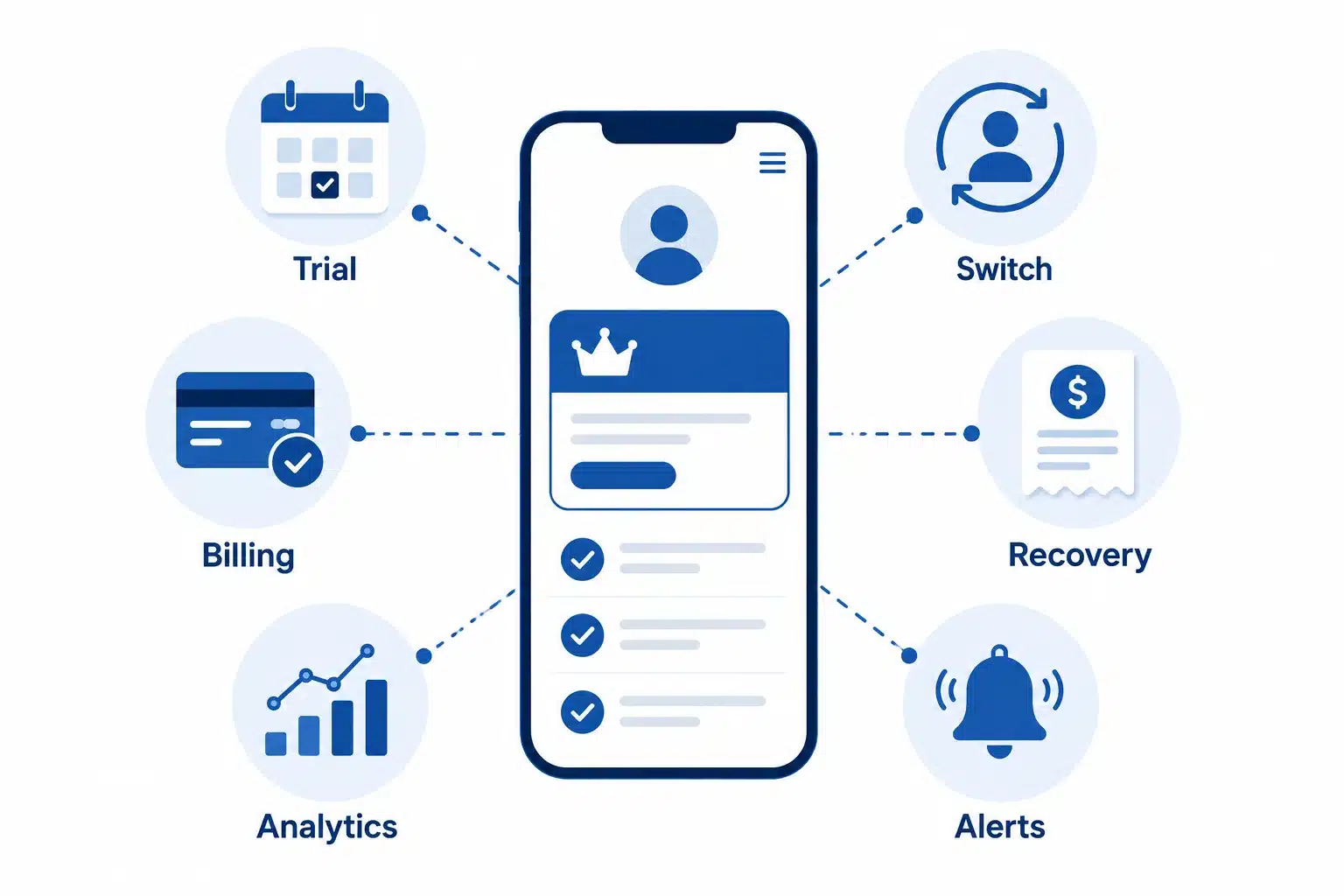
- Frictionless Onboarding to a First Value Moment: The single highest-leverage feature in any subscription app is getting a new user to experience real value before asking them to commit financially. This might mean a short guided setup, a sample of premium content, or a quick win tied to the app’s core promise.
- Free Trial with Clear Expiration Messaging: Free trials boost customer lifetime value by 64% in the US and 58% in Europe, while improving 90-day retention from 23% to 42% by filtering for users who are genuinely committed rather than just curious. Trials work best when users are reminded clearly, but not aggressively, before the trial converts to a paid subscription.
- In-App Subscription Management: Users need a simple way to upgrade, downgrade, pause, or cancel without leaving the app or contacting support. Both Apple and Google require this to be reasonably accessible, and apps that hide cancellation paths tend to accumulate negative reviews and support tickets rather than retained subscribers.
- Payment Recovery and Dunning Logic: A meaningful share of churn is involuntary, caused by expired cards or failed charges rather than a genuine decision to leave. Automated retry logic and card update prompts recover a significant portion of this revenue that would otherwise be lost silently.
- Usage Analytics Tied to Subscription Events: Tracking activation, trial conversion, renewal, and cancellation as distinct events, rather than just generic app usage, is what allows a team to actually diagnose why churn is happening instead of guessing.
- Flexible Plan Switching: Letting users move between monthly and annual plans, or between tiers, without canceling and resubscribing reduces unnecessary churn events and keeps the entitlement system cleaner on the backend.
- Push Notifications Tied to Behavior, Not a Fixed Schedule: Retention messaging performs far better when it responds to actual user behavior, like a lapsed session or an abandoned trial, rather than firing on a generic weekly schedule regardless of what the user has done.
App Store and Play Store Billing Compliance
Subscription apps face a layer of platform compliance that one-time-purchase apps mostly avoid, and getting this wrong can delay launch or trigger app store rejection.
- In-App Purchase Requirements: Both Apple and Google require subscriptions for digital content and features to go through their respective in-app purchase systems, which take a revenue share on transactions, typically starting around 30 percent and often dropping to 15 percent after a subscriber’s first year or for smaller developers.
- Clear Subscription Terms Disclosure: Both platforms require the app to clearly state the subscription price, billing frequency, and what happens when a free trial ends, displayed before the user commits, not buried in settings afterward.
- Easy Cancellation Access: Apple requires a direct path to cancel a subscription from within account settings or a deep link to the platform’s subscription management screen. Google has similar requirements through the Play Store’s subscription center. Apps that make cancellation deliberately difficult risk both user complaints and platform policy violations.
- Grace Periods and Billing Retry Windows: Both platforms offer built-in grace periods and billing retry mechanisms for failed payments, and a well-built subscription app should integrate with these rather than immediately revoking access on the first failed charge, since many failures resolve automatically within a few days.
- Family Sharing and Plan Restoration: Apps need to correctly handle subscription restoration when a user reinstalls the app or switches devices, and should account for family sharing plans where platforms support them, to avoid users losing access to something they already paid for.
Retention and Churn: The Real Battle of Subscription Apps
Acquisition gets an app installed. Retention is what makes a subscription app profitable, and it is where most of the meaningful product and engineering decisions actually live.
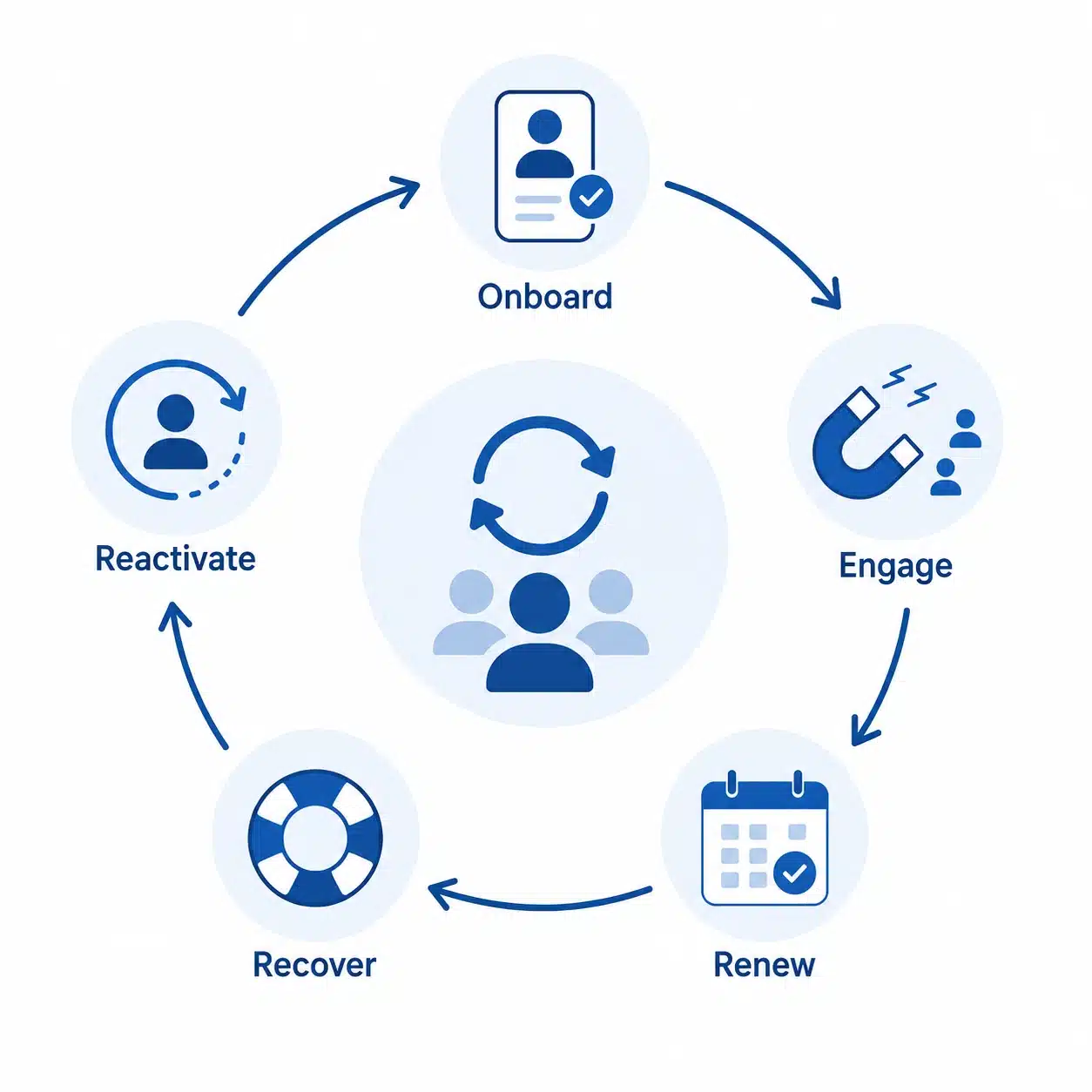
Churn falls into two broad categories, and they require different solutions. Voluntary churn happens when a user actively decides the app is no longer worth the price, which is a product and value problem to solve through better onboarding, clearer value delivery, and honest pricing. Involuntary churn happens when a payment fails due to an expired card, insufficient funds, or a bank decline, and this is a technical problem solved through retry logic, card update prompts, and grace periods.
About 77% of consumers maintained the same number of subscription services in 2026, which suggests that once a subscription earns a place in someone’s routine, it tends to stay there, making the first few weeks of the relationship disproportionately important. This is also why HelloFresh reported over 70% churn in the US market in the food delivery and meal kit category specifically, a reminder that even strong brands in high-friction categories face structurally higher churn than digital content or software subscriptions.
Building retention into the architecture from the start, rather than bolting it on after launch, means instrumenting every subscription lifecycle event (trial start, trial conversion, renewal, cancellation, and reactivation) from day one, so the team can actually see where users are dropping off instead of relying on aggregate revenue numbers that hide the real story.
AI and Personalization in Subscription Apps
Artificial intelligence has become one of the clearest ways to differentiate a subscription app, both in the experience it delivers and in how efficiently it retains subscribers.
- Personalized Content and Recommendations: Generative AI is transforming subscription products through hyper-personalization, customer retention, and repeated revenue models by processing user interaction, purchase history, and browsing behavior to fulfill personalization demands in real time. A widely cited example is that Spotify updated its app in December 2024 to use large language models to generate personalized, contextually relevant recommendations with friend-like explanations for music, podcast, and audiobook suggestions.
- Churn Prediction Models: AI models trained on usage patterns can flag subscribers likely to cancel before they actually do, giving the product team a window to intervene with targeted messaging, a discount offer, or a feature nudge.
- Dynamic Paywall Optimization: Machine learning can test and adjust which plan is presented as the default option, which trial length converts best for a given user segment, and how pricing is framed, without requiring a full manual A/B test cycle for every change.
- AI Feature Gating: For apps that use AI capabilities as part of the premium offering itself, such as AI-generated content or AI coaching, the cost to serve a marginal subscriber is no longer near-zero when using large language models, which is why many AI-powered apps now offer less generous free tiers and shorter trials to protect unit economics as they scale.
Technology Stack for Subscription App Development
The right technology choices for a subscription app center less on the frontend framework and more on getting the billing, entitlement, and data layers right, since these are the systems that directly touch revenue.
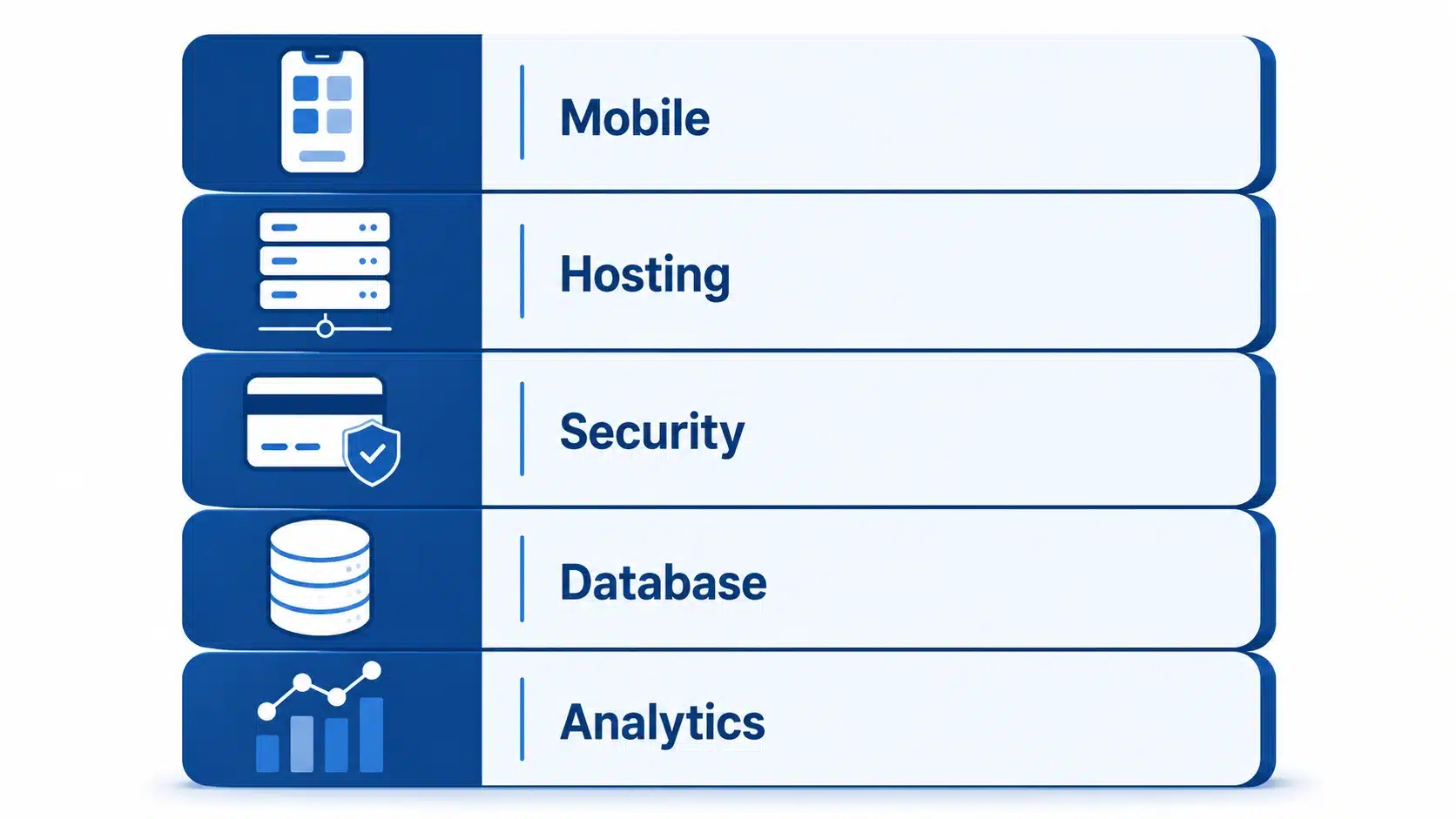
Here is how the stack typically breaks down by layer, along with why each choice matters specifically for a subscription-based build.
| Layer | Common Technologies | Why It Matters for Subscriptions |
| Frontend | React Native or Flutter for most apps; native Swift or Kotlin when deep App Store or Play Store subscription APIs are needed | Cross-platform frameworks speed up time to market without sacrificing the polish subscription users expect |
| Backend | Node.js, Django, or Ruby on Rails | Handles core app logic alongside the subscription billing and entitlement layer |
| Billing and Entitlement | RevenueCat, Adjust’s subscription tooling, or custom-built receipt validation | Manages cross-platform billing complexity, trial logic, and entitlement state without building this from scratch |
| Database | PostgreSQL or MongoDB with a separate entitlement schema | Keeps billing state and feature access cleanly separated, so a payment failure or plan change updates access correctly without a full app update |
| Cloud Infrastructure | AWS, Azure, or Google Cloud | Handles scaling as the subscriber base grows |
| Analytics | Dedicated pipeline instrumented around subscription lifecycle events | Lets the team diagnose churn and retention issues by tracking trial starts, conversions, and cancellations, not just generic app opens |
Step-by-Step Subscription App Development Process
- Business Model and Pricing Strategy: Before any design work starts, the team defines the pricing model, trial length, and plan tiers based on the target audience and comparable apps in the category.
- UX Design for Onboarding and Paywall: Wireframes focus heavily on the path from first open to first value moment to paywall presentation, since this sequence determines trial-to-paid conversion more than almost any other design decision.
- UI Design: Visual design builds out the full experience, with particular attention to how the paywall, plan comparison, and trial messaging are presented clearly and honestly.
- Frontend and Backend Development: Parallel development of the app itself and the backend services handling user accounts, content or feature delivery, and subscription state.
- Billing and Entitlement Integration: Integration with Apple’s StoreKit, Google Play Billing, and any third-party subscription management platform, along with building the entitlement logic that ties billing state to feature access.
- Analytics and Lifecycle Event Instrumentation: Setting up tracking for every subscription lifecycle event, from trial start through renewal and cancellation, so the team has real data to work with post-launch.
- QA Across Billing Edge Cases: Testing needs to cover failed payments, subscription restoration after reinstall, plan upgrades and downgrades, and trial expiration, not just the happy path of a successful subscription purchase.
- App Store Submission: Preparing the app for review, with particular attention to subscription terms disclosure and cancellation accessibility, since these are common causes of app store rejection for subscription apps specifically.
- Post-Launch Optimization: Once live, the real work of subscription apps begins: watching trial conversion rates, testing paywall variations, and refining onboarding based on where users actually drop off.
How Much Does Subscription App Development Cost?
Subscription app development cost depends heavily on the complexity of the billing and entitlement system, the number of pricing tiers, and whether AI-powered personalization is part of the build.
| Tier | Estimated Cost | What’s Included |
| Basic | $20,000 to $50,000 | Single pricing tier, core app features, App Store and Play Store billing integration, basic analytics |
| Mid-Tier | $50,000 to $150,000 | Multiple pricing tiers, free trial logic, third-party subscription platform integration, churn and retention analytics, plan switching |
| Enterprise | $150,000 and up | AI-powered personalization or churn prediction, hybrid subscription and consumable monetization, multi-region compliance, advanced dunning and payment recovery systems |
Common Mistakes That Sink Subscription Apps
- Launching Without a Clear Value Moment: If a user cannot immediately understand what they are paying for within the first session, no amount of paywall optimization will fix the underlying retention problem. The fix: Design onboarding around getting users to a genuine “aha moment” before ever presenting the paywall, even in a hard paywall model.
- Treating the Paywall as an Afterthought: Bolting a generic subscription screen onto a finished app rarely converts as well as designing the paywall alongside the core product experience from the start. The fix: Treat paywall design, trial length, and plan presentation as core product decisions, tested and iterated the same way any other feature would be.
- Ignoring Involuntary Churn: Many teams focus entirely on why users choose to cancel while ignoring the significant share of churn caused by simple payment failures. The fix: Build automated payment retry logic and card update prompts from the start, rather than treating this as a post-launch improvement.
- Overcomplicating the Pricing Model Too Early: Launching with five pricing tiers before understanding how users actually behave adds engineering complexity without necessarily adding revenue. The fix: Start with one or two clear tiers, gather real usage and conversion data, and expand the pricing structure once there is evidence to support it.
- Underestimating App Store Review Requirements: Subscription apps face more scrutiny during app store review than simpler apps, particularly around cancellation accessibility and trial disclosure. The fix: Build compliance requirements into the initial design rather than discovering them during a rejected app store submission.
How to Choose the Right Development Partner
Look for a team that has built subscription billing and entitlement systems before, not just general mobile apps. Subscription logic, particularly around trial handling, plan switching, and payment recovery, has enough edge cases that inexperienced teams consistently underestimate both the cost and the timeline.
Ask how they approach retention, not just acquisition. A partner who treats the paywall and onboarding flow as core product design decisions, rather than an afterthought bolted on near launch, is far more likely to deliver an app that actually retains subscribers past the first billing cycle.
Review their experience with App Store and Play Store compliance specifically for subscriptions. A team that has navigated subscription-specific review requirements before will avoid costly rejection cycles that a team without that experience often runs into during their first submission.
This is exactly the kind of project Simpalm has built repeatedly for clients across content, wellness, education, and SaaS categories. If you are weighing whether your product idea fits a subscription model, or you already know it does and need a team that can build the billing architecture, retention analytics, and AI personalization right the first time, Simpalm is a strong next step. Our team has hands-on experience with the exact technical decisions this guide covers, from entitlement systems to App Store compliance to churn-reducing onboarding design, and we approach every subscription build with retention as a first-class design requirement, not an afterthought.
Final Thoughts
A subscription app is not a feature you add to a finished product. It is a business model that shapes onboarding, pricing, backend architecture, and even how the roadmap gets prioritized after launch. The market is growing fast, but the gap between top- and bottom-performing apps is growing faster, which means the businesses that win are the ones that treat retention, billing reliability, and compliance as core engineering priorities from the very first sprint, not problems to solve after the app is already live. Get those fundamentals right, and a subscription app becomes one of the most durable, compounding revenue models a business can build. Get them wrong, and even a genuinely good product can quietly bleed subscribers every single month.
If you’re ready to move from planning to building, Simpalm can help turn this guide into a working roadmap for your specific app, and then into a live product built to retain the subscribers you work hard to acquire.
Frequently Asked Questions
Q1. How long does it take to build a subscription-based app?
A basic subscription app with a single pricing tier and standard billing integration typically takes three to five months to build. A mid-tier app with multiple pricing plans, free trial logic, and retention analytics usually takes six to nine months, while an enterprise build with AI-powered personalization and hybrid monetization can take ten months or longer depending on integration complexity.
Q2. Which is better for a new app: a freemium or a hard paywall?
It depends on the category and audience. Hard paywalls tend to generate significantly higher revenue per install and convert trial users to paid subscribers at a notably higher rate, making them a strong choice for apps with a clear, specific value proposition. Freemium still works well for apps that need a large user base to build network effects or rely on word-of-mouth growth before monetizing, since it lowers the barrier to that initial adoption.
Q3. What causes most subscription app churn?
Churn splits into voluntary churn, where users actively decide the app is not worth the price anymore, and involuntary churn, caused by failed payments from expired cards or bank declines. Voluntary churn is typically a product and value problem addressed through better onboarding and clearer ongoing value, while involuntary churn is a technical problem solved through automated payment retry logic and proactive card update prompts.
Q4. Do subscription apps have to use Apple and Google’s in-app purchase systems?
For digital content and features consumed within the app, yes, both platforms generally require subscriptions to go through their respective in-app purchase systems, which take a revenue share on transactions. This share often decreases after a subscriber’s first year or for smaller developers under certain program terms, so it is worth checking current platform policies during planning rather than assuming a flat rate applies indefinitely.
Q5. How important is AI in a subscription app today?
AI has moved from a differentiator to a near-baseline expectation in categories like content, wellness, and productivity apps, primarily through personalized recommendations and churn-prediction models that flag at-risk subscribers before they cancel. That said, AI features that rely on large language models also carry real per-user serving costs, so they need to be scoped carefully against the pricing model rather than added purely for competitive parity.
Q6. What is the biggest technical risk in subscription app development?
The billing and entitlement layer is consistently the most underestimated part of subscription app development, since it has to correctly handle trial expiration, failed payments, plan switching, subscription restoration after reinstall, and platform-specific edge cases across both iOS and Android. Teams without direct experience building this layer before tend to significantly underestimate both the engineering time and the QA effort it requires.