 Design
 App Development
 Web Engineering
 AI Services
 Cloud
Cloud Staffing
 Startups
 Health / Fitness
 Education
 Social
 Nonprofit
 Fintech
 Construction
 Logistics
 Government
 Travel/Hospitality
 HR Software
 About Simpalm
 Our News
 Client Testimonials
 Careers
 Our Blog
 Awards
 Resources
 Information
Key Takeaways
- COPPA just had its first major update since 2013. The FTC’s amended rule took effect on June 23, 2025, and the compliance deadline of April 22, 2026, has already passed. If your app collects data from children under 13 and you have not reviewed your compliance posture against the new rule, you are already behind.
- Personal information now includes biometric identifiers and government-issued IDs. Voiceprints, face scans, and fingerprint data collected from a child now trigger the same consent obligations as a name or email address.
- Bundled consent is no longer compliant. Parents must give separate, specific consent for core app functionality versus third-party data sharing for advertising or AI training.
- The FTC has already issued multimillion-dollar settlements in 2025 against Disney, Cognosphere, and Apitor Technology, and enforcement officials have publicly stated that children’s privacy remains a top priority for 2026.
- COPPA compliance built into your architecture from day one costs a fraction of what retrofitting it costs after launch, and it is the only approach that survives an FTC inquiry.
________________________________________________________________________________________
Building an app or website that children might use is no longer just a design and engineering problem. It is a compliance problem first, and a product problem second. The Children’s Online Privacy Protection Act (COPPA) has governed how companies collect and handle children’s data since 2000, but for over a decade, the rule itself barely changed while technology, advertising, and AI moved far ahead of it.
That gap closed in 2025. The Federal Trade Commission finalized the first substantial amendments to the COPPA Rule since 2013, and as of April 22, 2026, every operator covered by the law is expected to be in full compliance. If your product roadmap includes anything that a child under 13 could plausibly use, whether that is a learning app, a game, a family utility, or a general audience platform with a younger-than-expected user base, this guide walks through what the law actually requires today and how to build it into your app or website rather than bolting it on afterward.
What is COPPA, and Who Does it Actually Apply To
COPPA stands for the Children’s Online Privacy Protection Act. It applies to operators of commercial websites, mobile apps, and online services that are directed to children under 13, or that have actual knowledge they are collecting personal information from children under 13, regardless of whether the app was designed for kids in the first place.
Many founders assume COPPA only applies to apps built for children. That is not always true. A general audience app can also fall under COPPA if a significant portion of its users are under 13, based on evidence such as reviews, support requests, or usage data. The updated rule makes this clearer by expanding the factors the FTC considers when deciding whether an app is “directed to children.” These now include marketing materials, user reviews, and the age profile of users on similar apps.
Under the amended rule, operators must cover:
- Post a clear, accurate privacy notice describing what children’s data is collected and why it is collected.
- Provide direct notice to parents and obtain verifiable parental consent before collecting personal information from a child, with separate consent required for non-essential uses like advertising or AI training.
- Let parents review, request deletion of, and stop further collection of their child’s data.
- Maintain reasonable security procedures and a documented, time-bound data retention policy.
- Avoid conditioning a child’s participation in an activity on providing more data than is reasonably necessary.
Penalties are no longer a rounding error. Civil penalties can now reach up to $53,088 per violation, and the FTC counts each affected user as a separate violation in some enforcement actions, which is how settlements have climbed into the tens of millions of dollars.
What Changed Recently: The 2025 COPPA Amendments
A lot of COPPA content still circulating online was written for the 2013 version of the rule. The 2025 amendments are not a minor refresh. They rewrite several core definitions and introduce obligations that did not exist before.
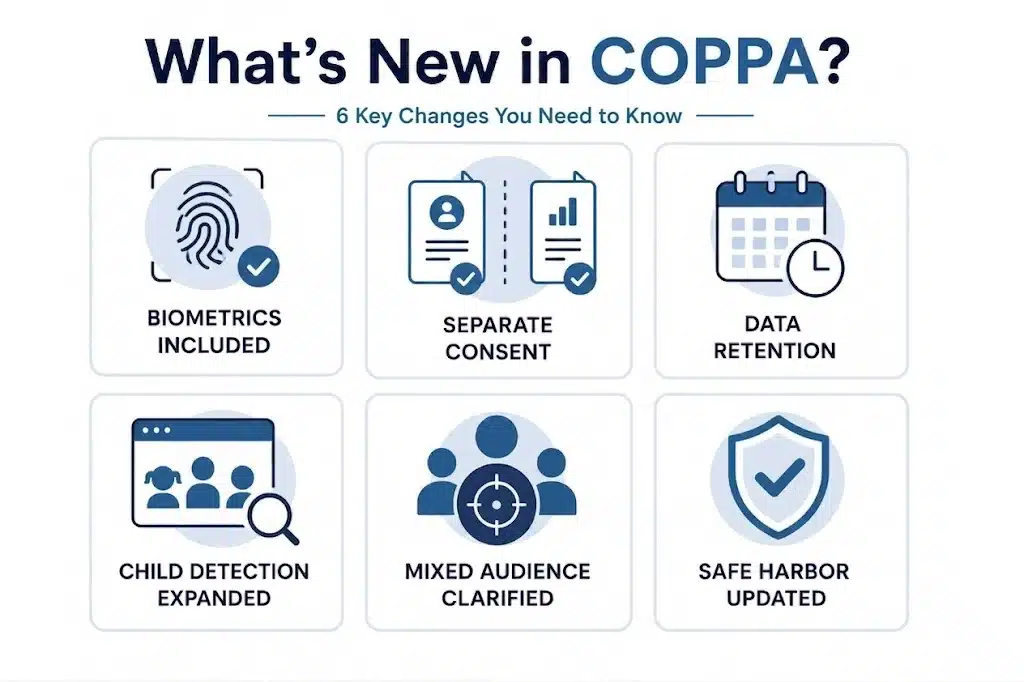
Here’s an overview of what changed after the 2025 amendment rule:
| Area | Pre-2025 Rule | 2025 Amended Rule |
| Personal information | Names, addresses, photos, persistent identifiers, geolocation | Adds biometric identifiers (fingerprints, voiceprints, facial templates, iris scans) and government-issued IDs |
| Consent for third-party sharing | Single consent often covered all data uses | Separate, specific opt-in consent required for disclosures tied to advertising, monetary consideration, or AI model training |
| Data retention | No explicit time limit, “as long as necessary” was loosely interpreted | Operators must publish a written retention policy with specific purposes, business need, and a deletion timeline. Indefinite retention is prohibited |
| “Directed to children” test | Based on subject matter, visual design, and content | Adds marketing materials, user and third-party reviews, and age data from comparable apps as evidence |
| Mixed audience services | Referenced informally, not formally defined | Now has a standalone legal definition clarifying how general-audience platforms with some child users should treat that subset |
| Safe Harbor programs | Limited public reporting | Must publicly disclose member lists and report disciplinary actions to the FTC |
The practical effect of COPPA for development teams is significant. If your app uses voice commands, face filters, fingerprint login, or any biometric-adjacent feature, and children might use it, that feature now collects personal information under COPPA, full stop. If you have a single “I agree” checkbox covering your terms, your analytics SDK, and your ad network, that consent mechanism is no longer compliant on its own.
You can read the full text of the amended rule directly from the Federal Register if your legal team wants the source document rather than a summary.
What Counts as Personal Information Now
Before you can design a compliant data flow, your team needs a shared, current definition of what counts as personal information under COPPA. This list expanded meaningfully in 2025, and several items on it are easy to miss during a technical spec review.
| Category | Examples | Commonly Missed By Dev Teams |
| Direct identifiers | Full name, home address, phone number, email | Rarely missed |
| Online identifiers | Persistent device IDs, advertising IDs, cookies that track across sessions | Often missed when using default analytics SDK settings |
| Biometric identifiers | Voiceprints, facial templates, fingerprints, iris and retina patterns, gait patterns | Frequently missed in apps with voice assistants or AR filters |
| Government identifiers | Social Security numbers, passport numbers, state ID numbers | Rare outside fintech or identity-verification flows |
| Media containing a child | Photos, videos, or audio recordings that include a child’s image or voice | Often missed in social or content-sharing features |
| Geolocation | Precise location sufficient to identify street and city | Frequently missed when location is collected “for performance” rather than for a feature |
| Combined data | Any of the above combined with another identifier collected from the child | Often missed in personalization engines that quietly stitch together multiple data points |
A useful working rule for your engineering team: if a data point, on its own or combined with another, could be used to single out or contact a specific child, treat it as personal information under COPPA until your legal counsel says otherwise.
Step-by-Step: Building COPPA Compliance into Your App
Knowing the legal requirements does not tell your engineering team how to actually build the product. Compliance has to live in your architecture, not just your privacy policy.
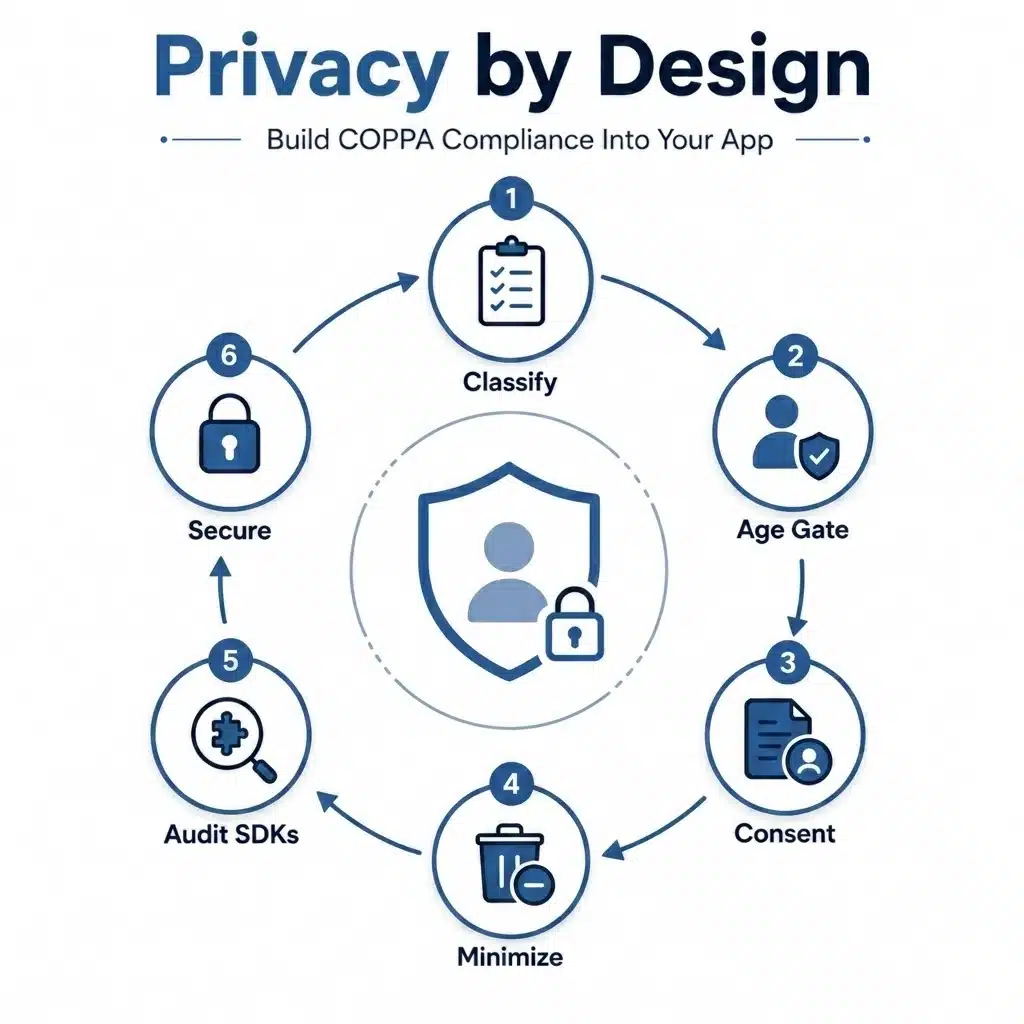
Here’s a step-by-step process to build COPPA compliance into your app by design:
Step 1: Decide Your Audience Classification Before You Write a Single Line of Code
Your app falls into one of three categories: child-directed, mixed audience, or general audience with no actual knowledge of child users. This classification determines almost every downstream technical decision, so it has to be made deliberately, not discovered after launch through a support ticket or a viral TikTok.
If there is any realistic chance your app appeals to or is used by children under 13, document the reasoning behind your classification now. The 2025 amendments mean the FTC can look at your marketing materials, app store reviews, and even the age distribution of users on comparable apps when deciding how to classify you, regardless of how you classified yourself.
Step 2: Architect Age Verification and Age-Gating From the Start
Age gates exist to create a reasonable barrier, not a perfect one. Apple’s guidelines describe acceptable parental gate patterns, such as asking a user to hold a button for a set duration or solve a simple math problem before accessing account-linking or commerce features. These are not security measures. They are friction mechanisms designed to prevent a young child from clicking through a feature meant for an adult.
For apps that genuinely need to confirm a user’s age rather than just slow down a child, the 2025 amendments formally recognize newer verification methods, including knowledge-based authentication and government ID verification, in addition to the long-standing methods like credit card verification, signed consent forms, and toll-free verification calls. Choose a method proportionate to your risk level. A meditation app for general audiences needs a lighter touch than a platform that processes payments or facilitates direct messaging.
Step 3: Build a Granular, Layered Consent Architecture
This is the single biggest technical shift under the 2025 amendments. A unified consent screen that bundles core functionality, analytics, advertising, and AI training into one checkbox is no longer defensible. Your consent flow needs to be separated:
- Consent for core app functionality that is integral to the service
- Consent for analytics and behavioral data collection
- Consent for advertising-related data sharing with third parties
- Consent for using a child’s data to train or develop AI models
Parents must be able to approve the first and decline the rest without losing access to the core product. This is a database schema decision as much as it is a UI decision. Your permissions system needs to track consent at the feature level, not just at the account level, and your code needs to check those flags before any data leaves the device or gets passed to a third-party SDK.
Step 4: Practice Data Minimization at the Schema Level
The cleanest way to reduce your compliance burden is to simply not collect data you do not need. Before your team writes a single data model, ask whether each field is required to deliver the core experience. A spelling app needs a username and progress data. It does not need a birthdate, a phone number, or a precise location unless that data serves a feature the user cannot get otherwise.
Build this discipline into your code review process, not just your initial design phase. Feature creep adds new data fields constantly, and each one is a new point of COPPA exposure if a child could be the one providing it.
Step 5: Audit Every Third-Party SDK Before It Ships
Under COPPA, you are liable for what your vendors do with children’s data, not just what your own code does. Analytics SDKs, ad networks, crash reporting tools, and even some authentication providers can collect device identifiers or behavioral data by default, often without the development team realizing it.
The FTC’s September 2025 settlement with Apitor Technology is a useful cautionary example here. The company’s app embedded a third-party SDK that collected personal information from children without the proper notice and consent in place, and Apitor was held responsible for that SDK’s behavior even though it did not write the SDK’s code itself. Before integrating any third-party tool, confirm in writing what data it collects, whether it has a COPPA-compliant configuration, and whether it disables advertising IDs and cross-app tracking for child users.
Step 6: Write and Implement a Real Data Retention Policy
The 2025 amendments require a written retention policy that specifies why each category of children’s data is collected, the business need for keeping it, and a concrete timeline for deletion. Indefinite retention is no longer legally defensible, even if it was common practice before.
This needs to be implemented as an actual deletion job in your backend, not just a paragraph in your privacy policy. Build automated data lifecycle management into your infrastructure from the start, including soft-delete and hard-delete schedules tied to the purposes you documented.
Step 7: Build Security as a First-Class Requirement, Not a Launch Checklist Item
Encryption at rest and in transit, role-based access control, and detailed audit logging for any access to children’s data are baseline expectations now, not advanced practice. If your app shares any architecture or backend infrastructure with a general audience product, segment the children’s data environment so that a vulnerability elsewhere in your stack does not expose it.
App Store and Google Play Requirements for 2026
Both major app store platforms layer their own requirements on top of COPPA, and getting this wrong can delay your launch even if your legal compliance is otherwise solid.
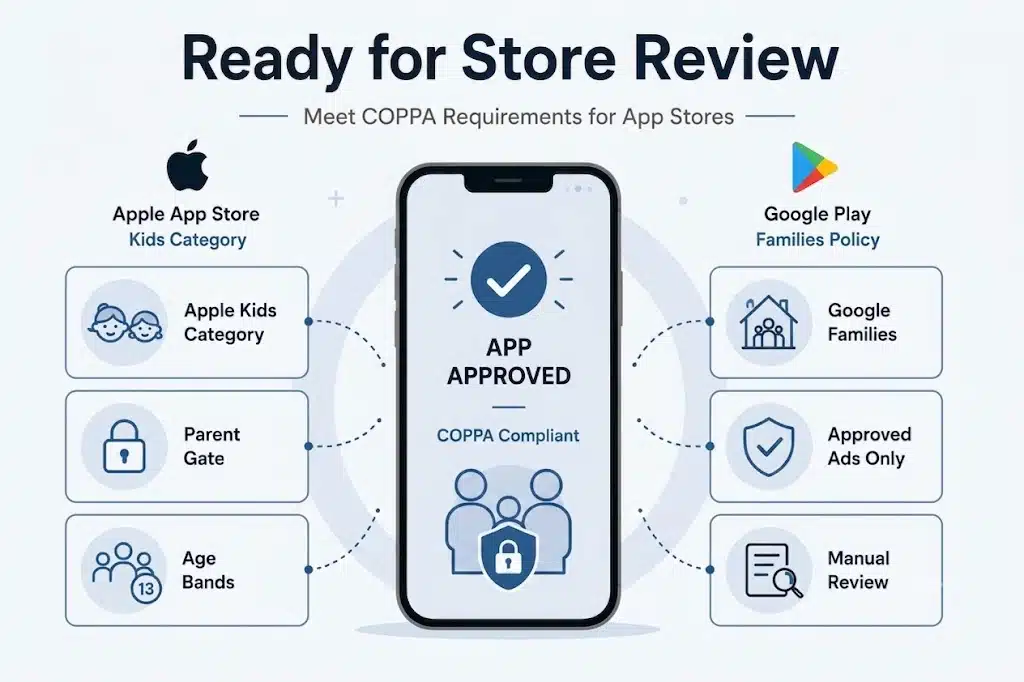
Apple requires apps in the Kids category to avoid behavioral advertising, limit contextual ads to age-appropriate content, and implement a parental gate before any feature that involves commerce or external links. Apps must also be classified into one of three sub-age bands: ages 5 and under, 6 to 8, and 9 to 11, and each band has different expectations around content and interaction design.
Google Play applies similar restrictions to apps in its Designed for Families program, with particular attention to ad SDK behavior. Google’s Families Ads Program requires participating ad networks to certify that they will not collect data for behavioral targeting from child-directed apps. If your app uses an ad network that is not on Google’s certified list, expect a rejection during review.
Both platforms have increased manual review scrutiny on kids’ and family apps since the 2025 FTC amendments took effect, so build extra review time into your launch timeline rather than assuming a same-week approval.
What Non-Compliance Actually Costs: 2025’s Enforcement Record
COPPA enforcement used to feel theoretical to a lot of founders. It stopped being theoretical in 2025. Here are a few examples to understand how much penalties these companies faced:
| Company | Settlement | What Went Wrong |
| Cognosphere (Genshin Impact developer) | $20 million | Collected personal data from children without parental notice or consent, and failed to act after becoming aware that specific users were children |
| Disney | $10 million | Allowed children’s data to be collected from child-directed YouTube videos without notifying parents or obtaining consent |
| Apitor Technology | Settlement with the required compliance program | A third-party SDK embedded in its app collected children’s personal information without proper notice and consent |
What connects these cases is not malicious intent. It is a gap between what the legal team believed was happening and what the product actually did in production, often because of a third-party vendor, a default SDK setting, or a feature that quietly expanded the scope of data collection after launch. The FTC has been explicit that 2026 enforcement will remain a priority, which means now is the wrong time to treat any of this as a someday problem.
How Much Does it Cost to Build a COPPA Compliant App?
Compliance cost depends heavily on whether you build it in from day one or retrofit it later. Retrofitting is consistently more expensive because consent architecture and data minimization decisions touch your database schema, your API design, and your third-party integrations all at once.
| App Tier | What You Get | Estimated Cost | Timeline |
| Basic MVP | Core features, age gating, single-purpose consent flow, minimal data collection | $35,000 – $60,000 | 3–5 months |
| Mid-Tier | Full feature set, layered consent architecture, third-party SDK auditing, and written retention policy | $70,000 – $160,000 | 5–9 months |
| Enterprise-Grade Platform | Full compliance program, Safe Harbor certification readiness, multi-jurisdiction support (GDPR, UK AADC), advanced security architecture | $180,000+ | 9–18 months |
What Drives Cost Up
Legal review is not a one-time cost. Your privacy policy, consent flows, and data retention documentation should go through counsel before launch and again any time you add a feature that touches children’s data.
Third-party vendor vetting takes real engineering time. Auditing analytics, ad, and authentication SDKs for COPPA-compliant configurations, and sometimes replacing vendors that cannot offer one, adds weeks to a build that founders rarely budget for upfront.
Safe Harbor certification, while optional, is worth considering for any product where trust signals matter to your distribution channel, such as school districts or enterprise partners. Programs like kidSAFE typically run $2,000 to $5,000 annually depending on company size, and the audit process itself adds lead time.
Where You Can Optimize Without Cutting Corners
Use consent management platforms rather than building custom consent infrastructure from scratch. Choose ad networks and analytics vendors that already ship COPPA-compliant configurations rather than negotiating custom data handling agreements with general-purpose vendors. Start with a single platform, either iOS or Android, before expanding, so your compliance architecture gets validated once before you multiply your surface area.
COPPA Versus Other Children’s Privacy Laws
If your distribution plan includes markets outside the United States, COPPA is the floor, not the whole picture.
| Law | Jurisdiction | Age Threshold | Key Difference From COPPA |
| COPPA | United States | Under 13 | Federal law, FTC-enforced, focused specifically on data collection and parental consent |
| UK Age Appropriate Design Code | United Kingdom | Under 18 | Broader design-level obligations, covers default privacy settings and “nudge” techniques, not just data collection |
| California Age-Appropriate Design Code | California, US | Under 18 | State-level law with design and default-setting requirements layered on top of COPPA’s data rules |
| GDPR Article 8 | European Union | Under 16 (member states may lower to 13) | Requires parental consent for data processing, broader scope than COPPA’s specific PII categories |
Building for a single jurisdiction first and expanding deliberately is almost always cheaper than trying to satisfy every regime simultaneously from day one. Pick your primary market, build a compliant foundation, and treat each additional jurisdiction as a discrete, scoped expansion rather than retrofitting your entire architecture each time.
Common Mistakes That Trigger FTC Scrutiny
A handful of patterns show up again and again in COPPA enforcement actions:
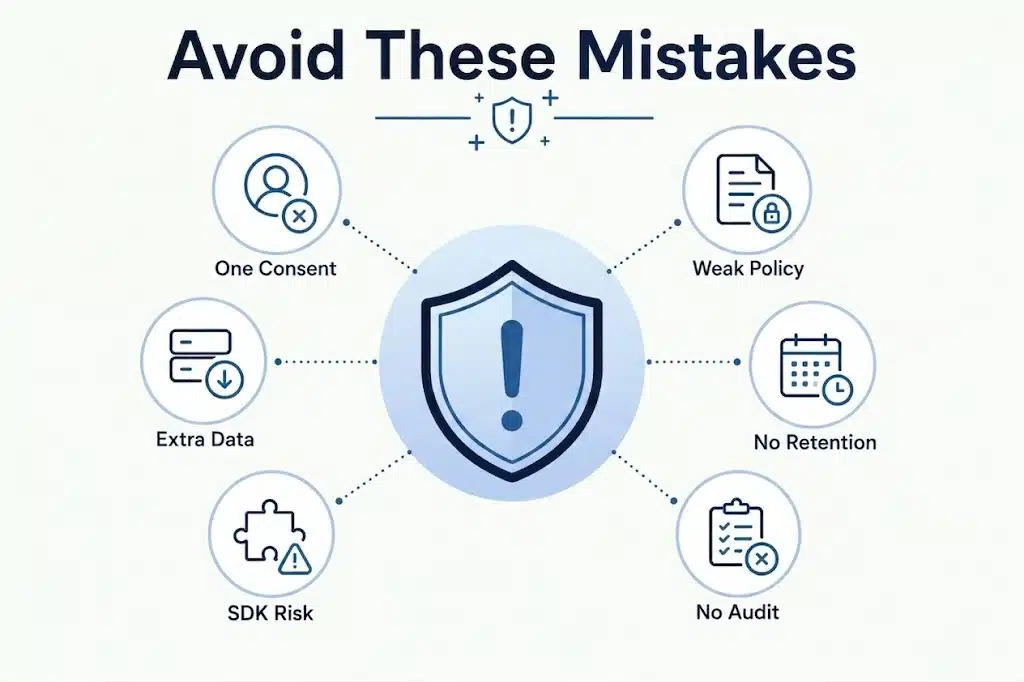
Treating consent as a one-time checkbox rather than a layered, feature-specific system is the most common technical mistake. The second most common is failing to audit third-party SDKs before shipping, which is exactly what triggered the Apitor settlement. Collecting more data than the feature requires, often because a default SDK setting was never changed, is a close third.
On the policy side, the most common mistake is writing a privacy policy that describes what the legal team intended the app to do rather than what the app actually does in production. The FTC treats discrepancies between stated practices and actual data flows as a serious violation, not a technicality.
Simpalm Approach Towards COPPA Compliant Development
Building for children’s privacy is not a feature you add near launch. It has to shape your data model, your vendor selection, your consent architecture, and your QA process from the very first sprint. At Simpalm, compliance planning happens during discovery, alongside feature scoping, not after the build is already underway.
If you are building or maintaining an app or web platform that children might use, make sure the team behind it understands the 2025 COPPA amendments in technical depth, not just at a policy level. The difference between a privacy policy that reads well and an architecture that actually enforces it is where most COPPA violations originate.
Conclusion
COPPA stopped being a static checklist in 2025. The rules changed, the deadline has passed, and the FTC is actively enforcing the new requirements through multimillion-dollar settlements. Apps that treat compliance as architecture, not paperwork, are the ones that survive scrutiny. That means layered consent, audited third-party SDKs, real data minimization, and a retention policy that actually deletes data on schedule.
Building this in from day one costs far less than retrofitting it after launch, and it earns the kind of trust that gets your app approved by app stores, trusted by parents, and overlooked by regulators for the right reasons.
Frequently Asked Questions
Q1. Does COPPA apply to my app if it is not designed for children?
Ans. Yes, if you have actual knowledge that children under 13 are using your app and providing personal information, COPPA applies regardless of your original target audience. The 2025 amendments expanded the evidence the FTC can use to determine this, including user reviews, marketing materials, and the age composition of users on comparable apps. If there is a reasonable chance children make up a meaningful share of your user base, treat your app as covered and build accordingly.
Q2. What is the deadline for COPPA compliance in 2026?
Ans. The amended COPPA Rule became effective on June 23, 2025, and operators had until April 22, 2026 to come into full compliance with most provisions. That date has already passed, which means any app or website covered by the rule should already reflect these requirements rather than treating them as upcoming.
Q3. Do biometric features like face filters or voice assistants trigger COPPA obligations?
Ans. Yes. The 2025 amendments expanded the definition of personal information to explicitly include biometric identifiers such as voiceprints, facial templates, fingerprints, and iris patterns. If your app collects any of these from a child, even through a feature that feels unrelated to data collection, such as an AR filter or a voice command shortcut, verifiable parental consent is required before that data is collected.
Q4. Can I use a single consent screen for all the data my app collects from children?
Ans. No. The 2025 amendments require separate, specific parental consent for disclosures tied to advertising, monetary consideration, or AI model training, distinct from consent for the app’s core functionality. A bundled “I agree to everything” checkbox no longer satisfies this requirement, which means your consent architecture needs to support feature-level permissions rather than a single account-level flag.
Q5. Is COPPA Safe Harbor certification required?
Ans. No, Safe Harbor certification is optional. It is a self-regulatory program, such as kidSAFE or PRIVO, that audits your compliance practices and gives you a recognized seal of approval. It is not legally required, but it can be a meaningful trust signal for distribution channels like school districts, enterprise partners, or parent communities that specifically look for it.
Q6. What happens if my third-party SDK violates COPPA without my knowledge?
Ans. You remain liable. The FTC’s 2025 settlement with Apitor Technology confirmed that operators are responsible for the data collection practices of embedded third-party SDKs, even when the operator did not write that code directly. This is why auditing every analytics, advertising, and authentication vendor before integration, and confirming their COPPA-compliant configuration in writing, is a required step rather than an optional one.
Q7. Does COPPA apply to websites, or only mobile apps?
Ans. COPPA applies equally to websites and online services, not just mobile apps. Any commercial website directed to children under 13, or any general-audience website with actual knowledge it is collecting personal information from children, falls under the same requirements covered in this guide, including consent architecture, data minimization, and retention policy obligations.