
 Design
 App Development
 Web Engineering
 AI Services
 Cloud
Cloud Staffing
 Startups
 Health / Fitness
 Education
 Social
 Nonprofit
 Fintech
 Construction
 Logistics
 Government
 Travel/Hospitality
 HR Software
 About Simpalm
 Our News
 Client Testimonials
 Careers
 Our Blog
 Awards
 Resources
 Information
Key Takeaways
- Patient adoption determines success. Even the most compliant CCM platform fails if patients do not continue using it.
- Build around the patient, not just compliance. Simple UX, care coordination, and seamless communication drive better engagement and outcomes.
- Compliance and interoperability are essential from day one. HIPAA, CMS, EHR integration, and security should be built into the platform, not added later.
- Long-term value comes from continuous care. Remote monitoring, AI, and proactive care help reduce hospitalizations, improve outcomes, and support value-based care.
________________________________________________________________________________________
Managing a chronic condition is an everyday responsibility, not something limited to occasional doctor visits. People living with diabetes, heart disease, COPD, and other chronic illnesses need continuous support between appointments, making effective care coordination essential.
Chronic Care Management (CCM) programs were created to meet this need, but many CCM platforms still prioritize billing and compliance over the patient experience. As a result, they satisfy technical requirements yet struggle with long-term patient engagement.
This guide explores how to build a CCM app that balances compliance, technology, and usability, with one goal in mind: creating a platform patients will actually keep using.
Understanding Chronic Care Management, From the Patient’s Side
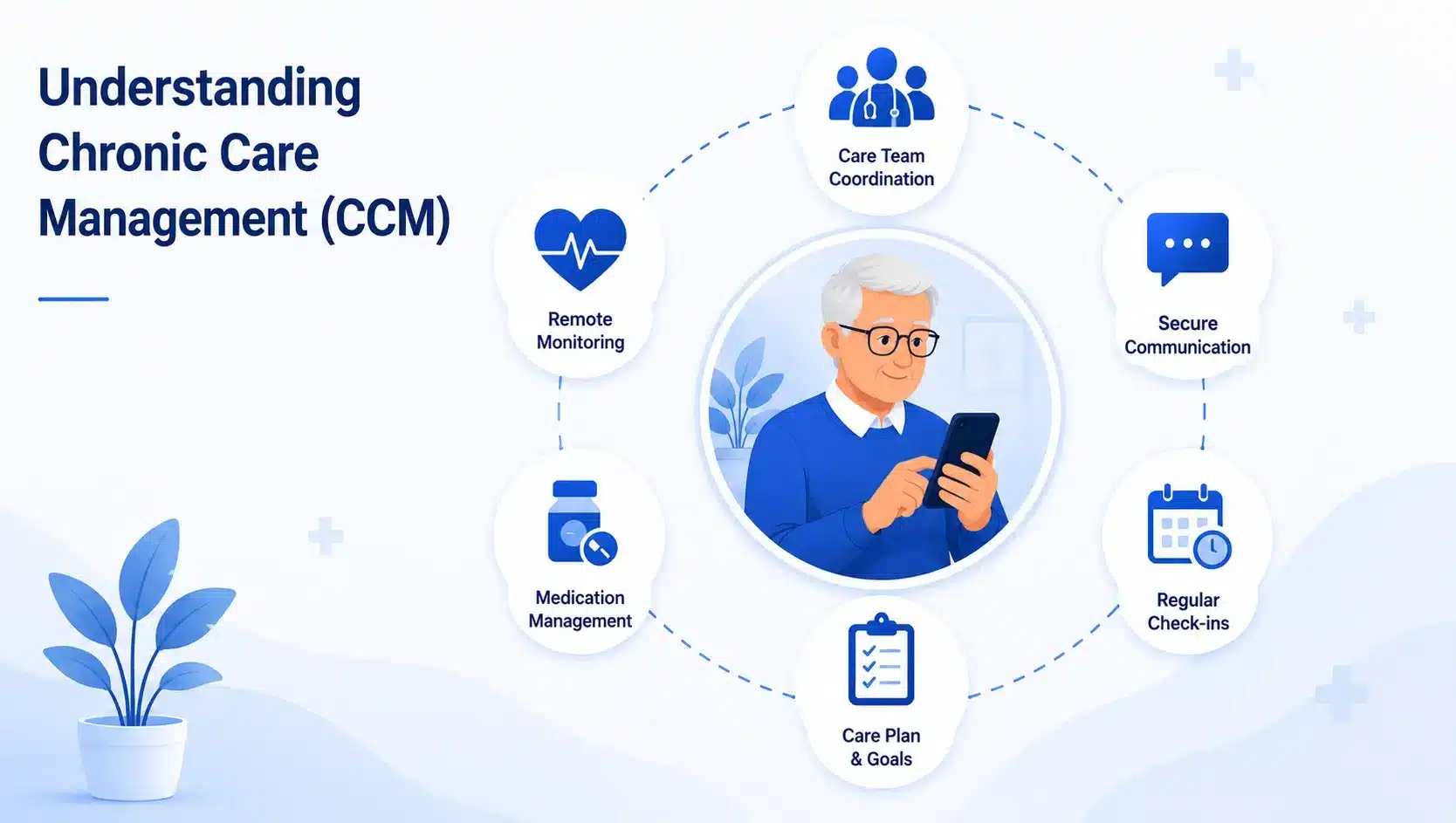
Chronic Care Management, often shortened to CCM, is a Medicare-supported model of care for patients with two or more chronic conditions. In practice, it means a care team stays connected with a patient between visits, monitors their condition, helps manage medications, and coordinates care across providers. For the patient, CCM is supposed to lighten the load. It is supposed to mean fewer surprises, fewer gaps in communication, and a care team that notices a problem before it becomes an emergency.
That promise only holds if the supporting software respects how much patients are already carrying. Someone managing a chronic illness is often juggling multiple medications, multiple specialists, and a long list of instructions that change depending on how they feel that day. Software that adds friction to that experience, through complicated logins, confusing dashboards, or one more notification to dismiss, works against the very goal CCM was designed to achieve.
Why CCM Matters for People Living With Chronic Conditions
The case for CCM software becomes obvious once you consider how differently chronic conditions behave compared to acute ones. A broken bone has a clear beginning and end. Diabetes, hypertension, and arthritis do not. They require continuous attention, and continuous attention requires tools that work in the background of daily life rather than demanding a person’s full focus.
This is where remote monitoring and proactive outreach earn their value. A patient whose blood pressure trends upward over several weeks benefits far more from a care team catching that pattern early than from a sudden hospital visit after the trend goes unnoticed. CCM software is the mechanism that makes that kind of early catch possible, but only if patients are willing to keep using it long enough for the pattern to show up.
Medical Conditions Where CCM Software Makes the Biggest Difference
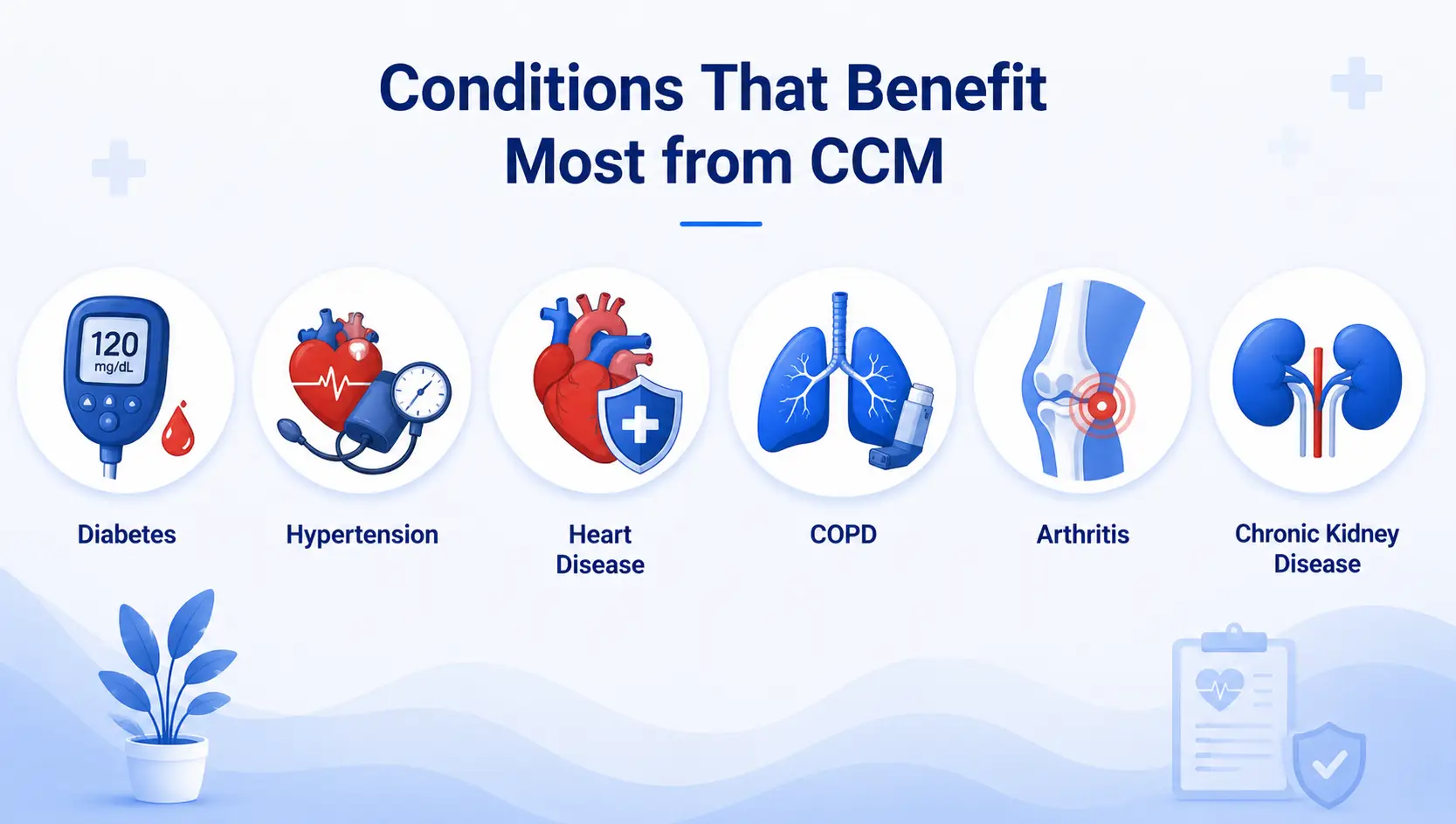
Some conditions place a heavier daily burden on patients than others, and the software built for them should reflect that.
- Diabetes management involves frequent monitoring and a real risk of fatigue from constant tracking.
- Hypertension is often called a silent condition because it produces no symptoms, which makes it easy for patients to deprioritize, even though it carries serious long-term risk.
- Heart disease comes with a different kind of weight, where every symptom can feel like a potential emergency, and good software should reduce anxiety rather than amplify it.
- COPD requires attentive tracking of breathing patterns and flare-ups that can change quickly.
- Arthritis presents a different challenge entirely, since pain levels vary day to day and a rigid tracking system rarely captures that variability well.
- Chronic kidney disease depends heavily on lab results and requires tight coordination between primary care and specialists, which makes communication tools especially important.
Each of these conditions asks something different of the patient, and CCM software earns its place by adapting to those differences rather than treating every chronic illness the same way.
What CMS Requirements Mean for the Patient Experience
CMS reimbursement guidelines shape much of how CCM programs are structured, including monthly time requirements for care coordination and documentation standards that providers must follow. These requirements matter to the business side of a CCM program, but they also have a direct effect on patients. When a program meets CMS requirements properly, it usually means a patient receives a documented care plan, regular check-ins, and a clearer line of communication with their care team. Compliance, in this sense, is not just a regulatory hurdle. It is one of the mechanisms that keeps the patient experience consistent.
What is Chronic Care Management App?
A Chronic Care Management (CCM) app is a digital platform that helps healthcare providers coordinate, monitor, and document care for patients with chronic conditions between in-person visits. It connects patients with their care teams, centralizes health data, and supports personalized care plans while meeting CMS documentation and billing requirements.
A typical CCM platform includes:
- Patient mobile app
- Care team portal for physicians, nurses, and care coordinators
- Administrative web dashboard for patient management, reporting, and billing
The patient is at the center of the platform. Physicians, care coordinators, and healthcare organizations use CCM software to monitor patient health, improve care coordination, and manage chronic conditions more effectively outside the clinic.
Essential Features of Chronic Care Management Software
The effectiveness of a chronic care management program depends heavily on the features built into the software that supports it. Some features are designed to help patients stay engaged with their care on a daily basis, while others help providers coordinate treatment, manage documentation, and operate CCM programs more efficiently. Together, these capabilities create the foundation for better long-term care management.
Patient-Facing Features
The features a patient interacts with directly deserve the most careful design attention, because they determine whether the software gets used at all.
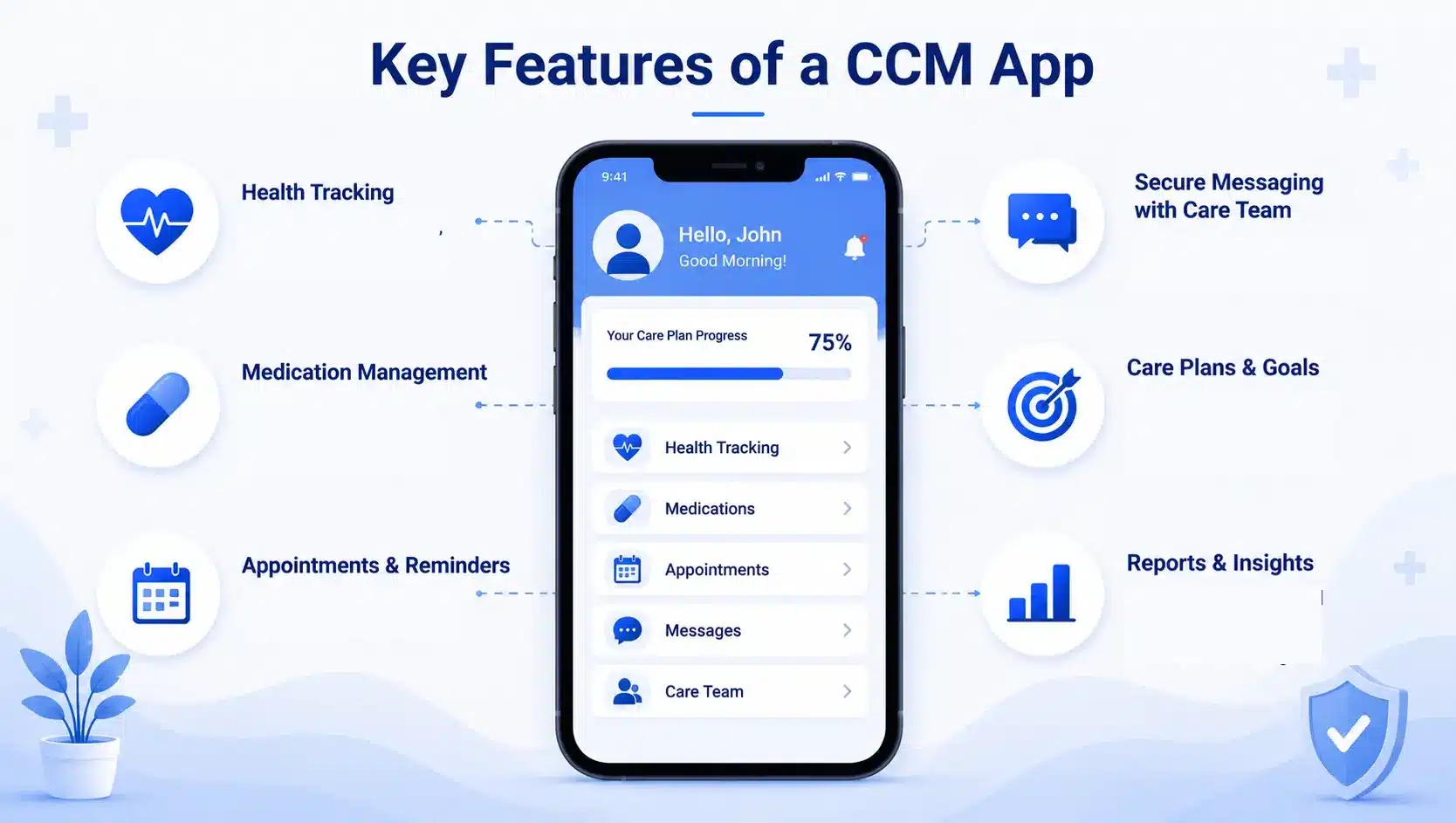
- Onboarding should be simple enough that a patient can complete it without help, since a confusing first experience often ends the relationship before it begins.
- Personalized care plans need to be written in plain language, with clear next steps rather than clinical jargon.
- Secure messaging gives patients a low-pressure way to reach their care team for non-urgent concerns, while video consultations support more involved conversations without requiring an in-person visit.
- Medication reminders should be clear and specific, telling a patient exactly what to take and when, rather than relying on vague prompts.
- Symptom and vital tracking needs to feel like a quick, natural part of someone’s day rather than an additional chore layered on top of an already demanding routine.
- A patient portal and mobile access tie all of this together, giving patients one consistent place to manage their care.
- Alerts and notifications deserve particular care in how they are designed, since a poorly tuned alert system creates anxiety rather than reassurance, while a well-tuned one builds trust over time.
Care Team and Back-Office Features
Behind the patient experience sits a layer of functionality built for the care team and the organization running the program.
- EHR integration keeps clinical data synchronized and gives providers a complete view of a patient’s history without duplicate entry.
- Remote patient monitoring integration connects wearables and medical devices so vital signs flow directly into the platform.
- Care team collaboration tools let nurses, coordinators, and physicians share updates and avoid duplicated outreach.
- Task and workflow automation reduces the administrative burden that comes with managing a large CCM patient population.
- Billing and CCM time tracking ensure that the minutes spent on care coordination are properly documented for reimbursement.
- Analytics and reporting dashboards give organizations the visibility they need to manage population health and demonstrate program effectiveness over time.
Types of Chronic Care Management App Solutions
Organizations approach CCM software in a few different ways, and the right choice depends on existing infrastructure and program goals. Here’s an overview of various types of chronic care management apps with their primary use case –
- Standalone CCM platforms operate independently and are often the fastest path to launching a program.
- EHR-integrated CCM solutions build directly into a provider’s existing electronic health record system, reducing duplicate data entry at the cost of a more involved integration process.
- Remote patient monitoring platforms focus specifically on device data and vital sign tracking, often working alongside a broader CCM system.
- Telehealth-enabled CCM systems combine virtual visits with ongoing care coordination.
- Enterprise population health management solutions sit at the top of this range, supporting large scale programs across entire patient populations with advanced analytics and risk stratification.
Chronic Care Management Software Development Process
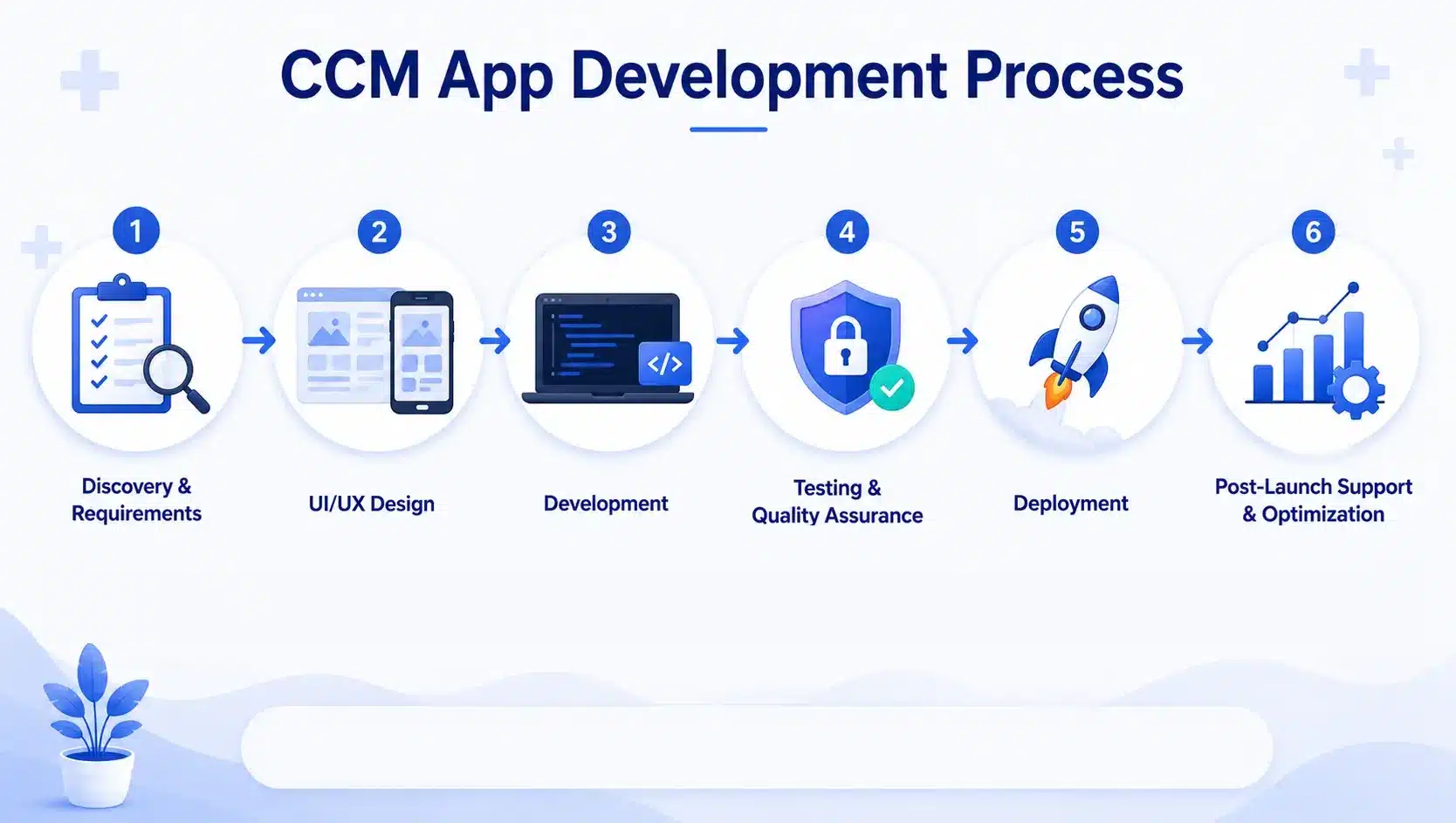
Building CCM software well starts with requirements gathered from both clinical staff and, just as importantly, from patients themselves. Skipping the patient research step is one of the most common reasons platforms underperform after launch.
Developing chronic care management software is a multi-stage process that extends well beyond writing code. Each phase influences how effectively the platform supports patients, providers, and compliance requirements after launch. The table below breaks down the key stages of CCM software development and the primary focus of each step.
| Development Stage | Primary Focus |
| Requirements Gathering & Research | Collect requirements from clinicians, care coordinators, administrators, and patients to understand workflows, pain points, and engagement needs. |
| Regulatory & Compliance Planning | Define HIPAA, CMS, security, privacy, and data governance requirements before development begins. |
| UI/UX Design | Create intuitive patient and provider experiences with a strong focus on accessibility, usability, and long-term engagement. |
| Technology Stack Selection | Choose the frontend, backend, database, cloud infrastructure, and security architecture that best support the platform’s goals. |
| Core CCM Software Development | Build essential features such as care plans, medication management, messaging, monitoring, scheduling, and reporting. |
| EHR & Third-Party Integrations | Connect electronic health records, remote monitoring devices, payer systems, and other healthcare applications. |
| Testing & Quality Assurance | Validate functionality, security, performance, compliance, and real-world usability through comprehensive testing. |
| Deployment & User Training | Launch the platform and train patients, providers, and care teams to ensure successful adoption. |
| Maintenance & Continuous Optimization | Monitor performance, release updates, improve workflows, address regulatory changes, and enhance patient engagement over time. |
Regulatory and compliance planning needs to happen early, since retrofitting HIPAA and CMS requirements into an already built system is far more costly than designing around them from the start.
UI and UX design should be approached with patients as the primary audience, even though providers and care teams will also use the platform extensively. Choosing the right technology stack and developing the core CCM modules follows standard software development practices, but every decision should be weighed against how it affects the patient experience. Integration with EHRs and third-party healthcare systems comes next, followed by thorough testing that goes beyond security and performance to include real-world usability testing with actual patients.
Deployment and training matter for both staff and patients. A platform that is technically ready but poorly introduced to its users will struggle regardless of how well it was built. Ongoing maintenance and optimization round out the process, since patient needs and clinical guidelines both shift over time, and the software needs to shift with them.
Technology Stack for CCM Software Development
Choosing the right technology stack is about more than selecting popular frameworks and tools. Every technology decision affects the platform’s security, performance, scalability, and ability to integrate with the broader healthcare ecosystem. The table below outlines the core technology layers commonly used in chronic care management software development and their role within the platform.
| Technology Layer | Common Technologies | Purpose |
| Frontend (Web) | React, Angular | Build responsive web interfaces for providers, care coordinators, and administrators. |
| Frontend (Mobile) | Flutter, React Native | Create cross-platform patient-facing mobile apps for iOS and Android. |
| Backend Development | Python, Node.js, .NET, Java | Handle business logic, APIs, authentication, data processing, and integrations. |
| Database | PostgreSQL, MySQL, MongoDB | Store patient records, care plans, communication logs, and health data. |
| Cloud Infrastructure | AWS, Microsoft Azure, Google Cloud | Provide secure, scalable hosting, storage, backups, and compliance-ready infrastructure. |
| Healthcare Interoperability | HL7, FHIR, SMART on FHIR | Enable data exchange between CCM software, EHRs, medical devices, and healthcare systems. |
| Security & Compliance | Encryption, IAM, Audit Logging, Access Controls | Protect patient data and support HIPAA and other healthcare compliance requirements. |
Compliance and Security: The Foundation of Patient Trust
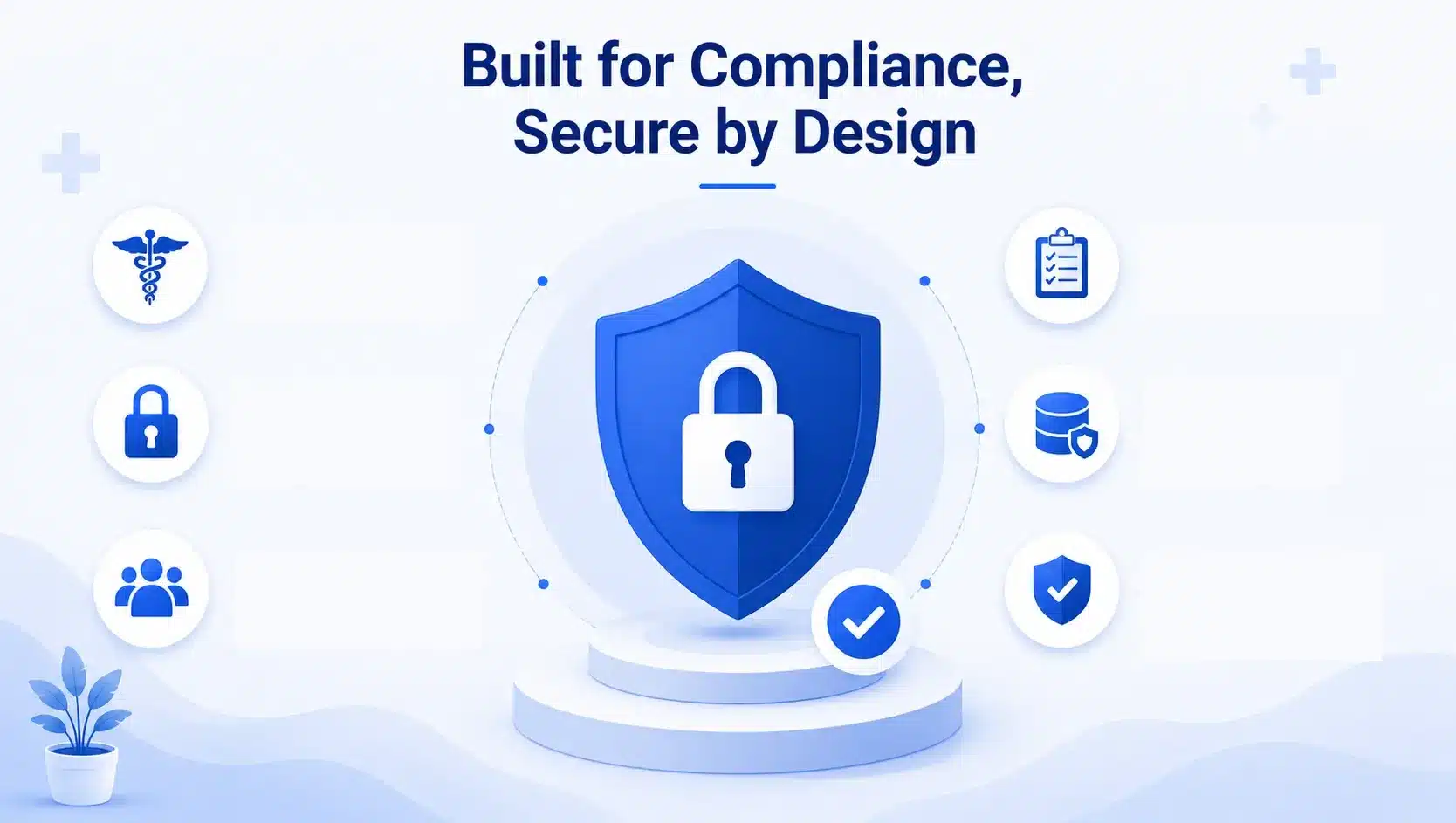
Compliance and security are not just regulatory requirements; they are fundamental to patient trust. Healthcare organizations must protect sensitive health information while meeting strict legal and industry standards. The following components form the foundation of a secure and compliant CCM platform:
- HIPAA Compliance: Ensures patient health information is collected, stored, and shared according to federal privacy and security requirements.
- HITECH Act Requirements: Strengthens healthcare data security and establishes breach notification obligations.
- Data Encryption – Protects sensitive information both in transit and at rest.
- Role-Based Access Controls (RBAC): Restricts access to patient data based on user roles and responsibilities.
- Audit Logs & Activity Monitoring: Tracks user activity and helps identify unauthorized access or suspicious behavior.
- Secure Patient Communication: Protects messaging, file sharing, and virtual interactions between patients and care teams.
- Data Backup & Disaster Recovery: Ensures critical health data can be restored quickly in the event of system failures or cyber incidents.
- Third-Party Vendor Compliance: Verifies that integrated services, platforms, and vendors meet healthcare security and compliance standards.
How Much Does CCM Software Cost, and Who Pays for It?
The cost of developing chronic care management software depends on factors such as feature complexity, regulatory requirements, integrations, user roles, and platform scope. While exact budgets vary from project to project, most CCM solutions fall into one of the categories outlined below.
| Solution Type | Estimated Development Cost | Typical Scope |
| Basic CCM MVP | $40,000 – $80,000 | Core care management features, patient portal, messaging, basic reporting, and limited integrations. |
| Mid-Level CCM Platform | $80,000 – $150,000 | Advanced care coordination, remote monitoring, workflow automation, analytics, and multiple integrations. |
| Enterprise CCM Solution | $150,000 – $300,000+ | Population health management, extensive interoperability, advanced reporting, multi-location support, and enterprise-grade scalability. |
As discussed earlier, patients are rarely the ones covering these costs directly.
Most funding comes from healthcare organizations, payers, or through CMS reimbursement for the care coordination services the software supports. Understanding this funding reality early in a project shapes everything from pricing strategy to which features get prioritized for the initial build.
Ongoing maintenance and compliance costs should also be planned for from the outset, since healthcare software requires continuous updates to stay aligned with evolving regulations and security standards.
Tackling Challenges While Designing CCM Software Patients Will Actually Use
Building chronic care management software is not simply a matter of translating clinical workflows into a digital product. The real challenge is creating a platform that patients are willing to engage with consistently over months or even years. Many CCM initiatives struggle not because the underlying care model is flawed, but because adoption, trust, and long-term engagement are harder problems to solve than feature development alone.
Why Clinically Sound Features Still Get Abandoned
It is entirely possible to build CCM software that checks every clinical and regulatory box and still watch patients stop using it within a month. This happens because clinical soundness and patient adoption are two different problems, and solving one does not automatically solve the other.
A feature can be medically appropriate and still feel burdensome, confusing, or irrelevant to the person it was designed for. Closing that gap requires treating patient adoption as its own design challenge, with its own research and its own success metrics.
The Value Proposition Problem: Who Pays and Why It Matters to Adoption
One of the persistent challenges in this space is that patients themselves are rarely the ones paying for these tools. Most people do not think of chronic disease management as something worth a direct subscription fee, which means the financial responsibility usually falls on providers or payers.
If a health system or payer is charging the bill, the software needs to demonstrate clear value to them in the form of measurable outcomes, while still earning genuine, voluntary use from the patient. A platform that satisfies the payer but frustrates the patient will eventually fail both audiences, because low patient engagement erodes the very outcomes the payer was hoping to fund.
Building an Evidence-Based Case for Patient Outcomes
The strongest CCM platforms are built on evidence, not assumption. Programs that can point to documented improvements in outcomes, supported by structured evaluation rather than anecdote, are far more likely to gain long term support from healthcare organizations and clinicians who recommend them to patients.
This means development teams should be thinking about evaluation frameworks from the earliest stages of a project, not adding measurement as an afterthought once the platform is already live. A clear evidence trail also gives sales and partnership teams something concrete to point to when convincing a health system to adopt the platform in the first place.
Designing Around Patient Preferences, Not Just Clinical Guidelines
Clinical guidelines tell you what a patient should be doing. They rarely tell you how a patient actually wants to be reminded, communicated with, or monitored. The most effective CCM software incorporates patient preferences directly into its design process through user research, feedback loops, and iterative testing with real patients rather than internal assumptions about what patients want.
A care plan built purely from clinical best practice, without regard for how a specific patient prefers to receive information, will often go unused even if it is medically correct.
Trust, Privacy, and Why Patients Hesitate to Use Health Apps
Patients have legitimate concerns about how their health data is stored, shared, and used, and those concerns are a significant barrier to adoption across the entire category of digital health tools. Addressing this requires more than a privacy policy buried in the terms of service.
It requires visible, understandable communication about how data is protected, who can see it, and what choices a patient has over their own information. A platform that takes this seriously, and communicates it clearly within the product itself, earns a level of trust that translates directly into sustained use.
Avoiding “Just One More App to Manage” Fatigue
Patients managing multiple chronic conditions are often already juggling several apps, devices, and portals from different providers. Every new platform introduced into that mix carries a real cost in attention and patience.
The most successful chronic care management apps account for this by integrating with existing tools rather than demanding that patients abandon everything else, and by keeping their own interface lean enough that it does not become one more burden in an already crowded digital health life.
Benefits of Chronic Care Management Software, Starting With the Patient
The value of chronic care management software extends far beyond replacing spreadsheets or digitizing patient records. When implemented effectively, it helps patients stay connected to their care teams, improves adherence to treatment plans, and gives providers better visibility into a patient’s health between visits. While the specific benefits vary depending on the user, the impact is typically felt on both sides of the care relationship. Let’s start with the benefits patients experience first.
Fewer Gaps Between Appointments
The traditional model of healthcare leaves long stretches of silence between visits, and chronic conditions do not pause during those gaps. Well-designed CCM software closes that silence by giving patients a consistent way to reach their care team and giving care teams a consistent way to check in, without waiting for a scheduled appointment to catch a problem.
Less Mental Load for Tracking Symptoms and Medications
Patients managing multiple conditions often carry an enormous mental burden just keeping track of what medication to take, when, and in what dose. Good CCM software absorbs some of that load through reminders, simplified tracking, and care plans that are written in language a patient can actually follow, rather than clinical shorthand meant for providers.
Faster Access to a Care Team When Something Feels Off
One of the most underrated benefits of CCM software is the reassurance it provides. A patient who notices something unusual about how they feel should not have to wait two weeks for the next scheduled appointment to ask about it. Secure messaging and structured check-ins give patients a direct line to their care team, which often prevents a minor concern from becoming a major one.
Better Visibility Into Personal Health Trends
When patients can see their own data over time, whether that is blood pressure readings, glucose levels, or symptom logs, they gain a clearer understanding of their own condition. This visibility tends to increase engagement because patients start to see the connection between their daily choices and the trends in their health, rather than experiencing their condition as something that happens to them without explanation.
Improved Patient Outcomes
All of the benefits above ultimately point toward the same outcome: better health results. Continuous monitoring and consistent communication catch problems earlier, support better medication adherence, and give care teams the information they need to adjust treatment plans before a condition worsens.
Reduced Hospital Readmissions
Early detection of warning signs, supported by remote monitoring and regular check-ins, directly reduces the likelihood of a preventable hospital readmission. This is one of the clearest financial and clinical arguments for CCM software, and it follows naturally from a platform that keeps patients engaged between visits.
Benefits for Care Teams: Coordination, Documentation, and Reimbursement
None of this works without a strong foundation on the provider side. CCM software streamlines documentation so care teams are not spending more time on paperwork than on patient care. It also supports accurate time tracking and reporting required for CMS reimbursement, which keeps CCM programs financially sustainable for the organizations running them. A platform that serves patients well and a platform that serves the business well are not in conflict. The strongest CCM software does both at once.
What Makes CCM Software Different From a General Health App?
A general wellness app might track steps or sleep for someone who is generally healthy. CCM software operates under a different set of expectations entirely. It has to integrate with clinical workflows, meet HIPAA and CMS documentation standards, and support a care team that is legally and financially accountable for the outcomes it produces. The stakes are higher, the compliance burden is heavier, and the design has to account for patients who may be older, less comfortable with technology, or managing more than one condition at once.
Future Trends in Chronic Care Management Software
Chronic care management software continues to evolve as healthcare organizations look for better ways to improve patient outcomes, increase efficiency, and support value-based care models. The following trends are shaping the next generation of CCM platforms:
Artificial Intelligence (AI) for Care Coordination: AI in healthcare helps care teams identify high-risk patients, prioritize outreach, and allocate resources more effectively.
Predictive Analytics: Detects potential health issues earlier by analyzing patient data and identifying warning signs before conditions worsen.
Expanded Remote Patient Monitoring (RPM): Leverages connected devices and wearables to provide continuous visibility into patient health between visits.
AI-Assisted Personalized Care Plans: Creates more adaptive care plans that adjust based on patient behavior, health trends, and treatment progress.
Advanced Population Health Management: Gives healthcare organizations deeper insights into patient populations and chronic disease trends.
Value-Based Care Enablement: Supports healthcare models that reward improved outcomes, preventive care, and long-term patient engagement rather than service volume.
How to Choose the Right CCM Software Development Partner?
After defining the platform’s requirements, compliance strategy, and technology stack, the next step is selecting the right development partner. Chronic care management solutions require expertise that goes beyond general software engineering, making it important to evaluate providers with experience in delivering niche digital products in healthcare industry, regulatory compliance, and patient engagement. When comparing potential partners, look for proven success delivering custom healthcare app development services, strong HIPAA and security expertise, seamless EHR integration capabilities, and a track record of building patient-centered applications. It is also worth considering their ability to support long-term growth through ongoing maintenance, feature enhancements, and scalability planning. Since CCM platforms evolve alongside patient needs, clinical workflows, and healthcare regulations, choosing an experienced medical software development company can have a lasting impact on both adoption and outcomes.
Conclusion
Chronic Care Management software succeeds when patients actually use it, not simply when it passes a compliance audit or satisfies a feature checklist. Compliance, interoperability, and patient trust are the three pillars holding up everything else, and none of them can be treated as optional. As artificial intelligence and remote monitoring continue to mature, the organizations that benefit most will be the ones that built their platforms around the patient’s daily experience from the very beginning, rather than retrofitting that experience in after the fact.
For any healthcare organization considering an investment in CCM software, the question worth asking before any other is simple: will the person managing their chronic condition actually want to open this tomorrow?
If the answer is yes, the software stands a much better chance of delivering the outcomes, engagement, and long-term value that chronic care management programs are designed to achieve. Ultimately, the most successful CCM platforms are the ones that make better care feel easier for patients, providers, and the healthcare organizations supporting them.
Frequently Asked Questions
What is chronic care management software?
Chronic Care Management software is a digital platform that supports coordination, monitoring, and communication between patients with chronic conditions and their care teams, between in-person visits.
How is CCM software different from a regular health app for patients?
General health apps are typically designed for wellness tracking among healthy users. CCM software integrates with clinical workflows, meets HIPAA and CMS documentation standards, and supports a care team that is accountable for patient outcomes.
What features should CCM software include for patients to actually use it?
Simple onboarding, plain language care plans, secure messaging, medication reminders, and a tracking experience that feels manageable rather than burdensome are essential for sustained patient use.
How much does chronic care management software cost?
Costs range from roughly $40,000 for a basic MVP to $180,000 or more for an enterprise-grade platform, depending on complexity, integrations, and compliance requirements.
Is CCM software required to be HIPAA compliant?
Yes. Any software handling protected health information must meet HIPAA requirements, along with related obligations under the HITECH Act.
Why don’t more patients pay for chronic disease apps directly?
Most patients do not view chronic disease management as a service worth a direct subscription fee, which is why funding for CCM software typically comes from healthcare organizations, payers, or CMS reimbursement.
How does CCM software integrate with EHR systems?
Integration typically relies on healthcare interoperability standards such as HL7 and FHIR, allowing patient data to sync between the CCM platform and existing electronic health records.
What’s the difference between CCM and RPM software?
CCM software focuses on broader care coordination and communication, while RPM software focuses specifically on collecting and transmitting vital sign and device data. Many platforms combine both.
Can AI be used in chronic care management software?
Yes. AI is increasingly used for risk prioritization, predictive analytics, and personalized care plan recommendations within CCM platforms.
How long does it take to develop a CCM platform?
Timelines vary by scope, but a basic MVP can often be developed in a few months, while enterprise-grade platforms with extensive integrations may take a year or longer.