
 Design
 App Development
 Web Engineering
 AI Services
 Cloud
Cloud Staffing
 Startups
 Health / Fitness
 Education
 Social
 Nonprofit
 Fintech
 Construction
 Logistics
 Government
 Travel/Hospitality
 HR Software
 About Simpalm
 Our News
 Client Testimonials
 Careers
 Our Blog
 Awards
 Resources
 Information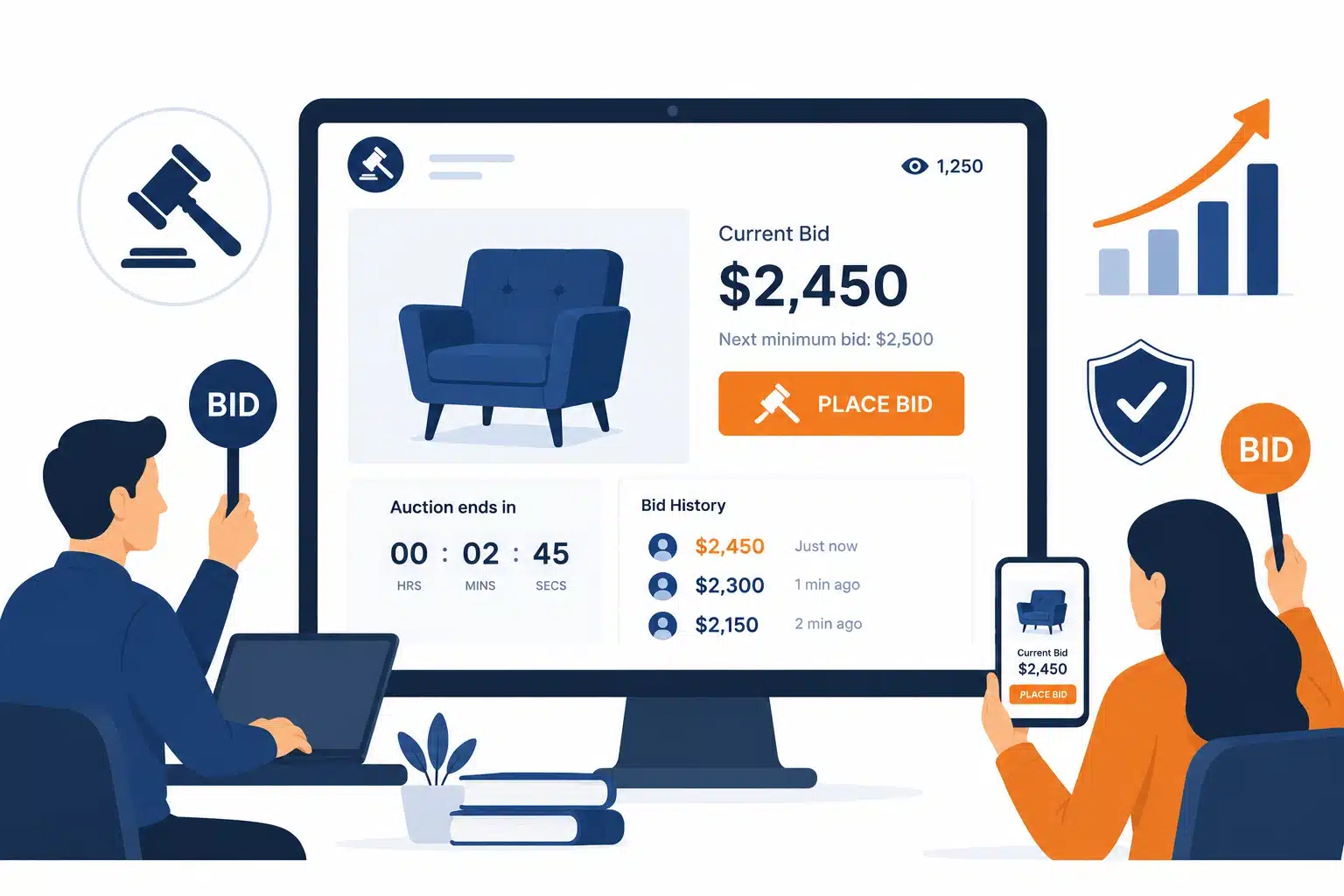
Key Takeaways
- An auction platform is far more complex than eCommerce. Real-time bidding, fraud prevention, payment holds, escrow, and dispute management require specialized architecture from day one.
- Trust and fairness determine long-term success. Identity verification, transparent bidding, anti-sniping logic, and AI-powered fraud detection are essential to building user confidence.
- Choosing the right auction model and niche matters more than building a generic marketplace. Vertical-specific features, compliance needs, and user expectations shape the platform’s growth potential.
- Scalable infrastructure is a competitive advantage. Real-time systems, event streaming, auto-scaling, and load testing ensure the platform performs reliably during high-traffic bidding events.
________________________________________________________________________________________
Auctions used to mean a room, a gavel, and a crowd. Today they mean a phone screen, a countdown timer, and a bid button that thousands of people are watching at once. From fine art and classic cars to industrial surplus, real estate, and everyday secondhand goods, the auction model has moved almost entirely online, and it shows no sign of slowing down.
For businesses, this shift is an opportunity. A well-built auction platform does not just replicate a physical sale online. It creates a new kind of marketplace, one where price discovery happens in real time, where buyers compete against each other instead of just comparing listings, and where sellers can extract more value than a fixed-price listing would ever get them.
But building an auction platform is not the same as building a typical e-commerce store. Real-time bidding, fraud prevention, payment holds, and dispute resolution all add layers of complexity that a standard shopping cart never has to deal with. This guide breaks down what actually goes into building an auction platform in 2026, including the features, the technology, the cost, and the mistakes that sink most first attempts.
Let’s start with the basics.
What is an Auction Platform?
An auction platform is a digital marketplace where the price of an item is determined by competitive bidding rather than a fixed listing price. Buyers place bids against each other, and the platform enforces the rules of who wins, when the sale closes, and how payment and delivery happen afterward.
Not all auctions work the same way. For example, a livestream art auction has almost nothing in common technically with a reverse auction for freight contracts. Your architecture needs to be chosen deliberately, not defaulted into. The auction model you choose shapes almost every other decision in development, from your database design to your fraud controls.
Here are some of the most common auction models that you shall know before building an auction platform:

English Auction (Ascending Bid): The most familiar format. Bidding starts low and rises until no one is willing to bid higher. This is the model eBay popularized and the one most people picture when they hear “online auction.”
Dutch Auction (Descending Bid): The price starts high and drops at set intervals until a buyer accepts it. Common in flower markets, bulk commodity sales, and some IPO pricing models.
Sealed-Bid Auction: Buyers submit one confidential bid without seeing what others have offered. The highest bid wins, but nobody knows how close the competition was. Common in government contracts, real estate, and business asset sales.
Reverse Auction: Sellers compete to offer the lowest price to a single buyer. This model dominates B2B procurement, freight bidding, and vendor sourcing platforms.
Penny Auction: Each bid raises the price by a small fixed amount, and bidders pay a fee just to place a bid. Controversial due to how easily it can feel exploitative, but still used by a handful of platforms.
Timed Auction: Bidding stays open for a set window, often days, letting bidders return and adjust their strategy rather than compete in a single live session.
Now, let’s have a look at various auction platforms that you can approach during the development process.
Types of Auction Platforms You Can Build
Before writing a single feature spec, decide which category you’re building for. This decision drives your compliance obligations, your payment architecture, and your entire feature roadmap.
Consumer-to-Consumer (C2C) Marketplaces: General auction platforms where individuals buy and sell to each other, similar in spirit to eBay. High volume, low average transaction value, and heavy reliance on trust and reputation systems.
B2B Procurement and Reverse Auction Platforms: Built for businesses sourcing goods and services, where suppliers bid down against each other. These platforms prioritize negotiation history, contract management, and integration with existing ERP or procurement software over consumer-facing polish.
Real Estate Auction Platforms: Used for distressed property sales, foreclosures, and investor liquidation. These require deep integration with title companies, escrow services, and jurisdiction-specific disclosure requirements.
Vehicle Auction Platforms: Serve dealers and individual buyers for used cars, salvage vehicles, and fleet liquidation. Typically require VIN verification, inspection report integration, and dealer licensing checks.
Charity and Nonprofit Auction Platforms: Built for fundraising events, both live and silent. Prioritize donor management, tax receipt generation, and simple mobile bidding for a non-technical audience.
Niche and Collectible Auction Platforms: Serve specific verticals like art, wine, watches, sneakers, or trading cards. Success here depends more on authentication and provenance features than on raw bidding volume.
Market Size and the Business Case
The online auction and bidding software market has grown well past its early “eBay clone” era. Verified market research places the global online auction market above $18 billion in 2025, with steady annual growth projected through the early 2030s as more industries, from B2B procurement to real estate liquidation, shift to bid-based pricing models.
What’s driving growth in 2025–2026:
- B2B procurement teams are moving sourcing and vendor negotiation onto reverse auction platforms to cut costs transparently
- Real estate auctions, once a niche corner of the industry, are becoming a mainstream channel for distressed sales and investor liquidation
- Government and municipal surplus sales are moving from in-person events to fully digital bidding
- Niche collectibles, from sneakers to trading cards to rare whiskey, are creating entirely new auction verticals that general marketplaces do not serve well
- Livestreaming technology has made real-time video auctions viable for categories like art, vehicles, and estate sales
The opportunity is not just building “another eBay.” It’s building the right auction model for an underserved vertical, with the features and compliance that vertical actually needs.
Must-Have Core Features for a Modern Auction Platform
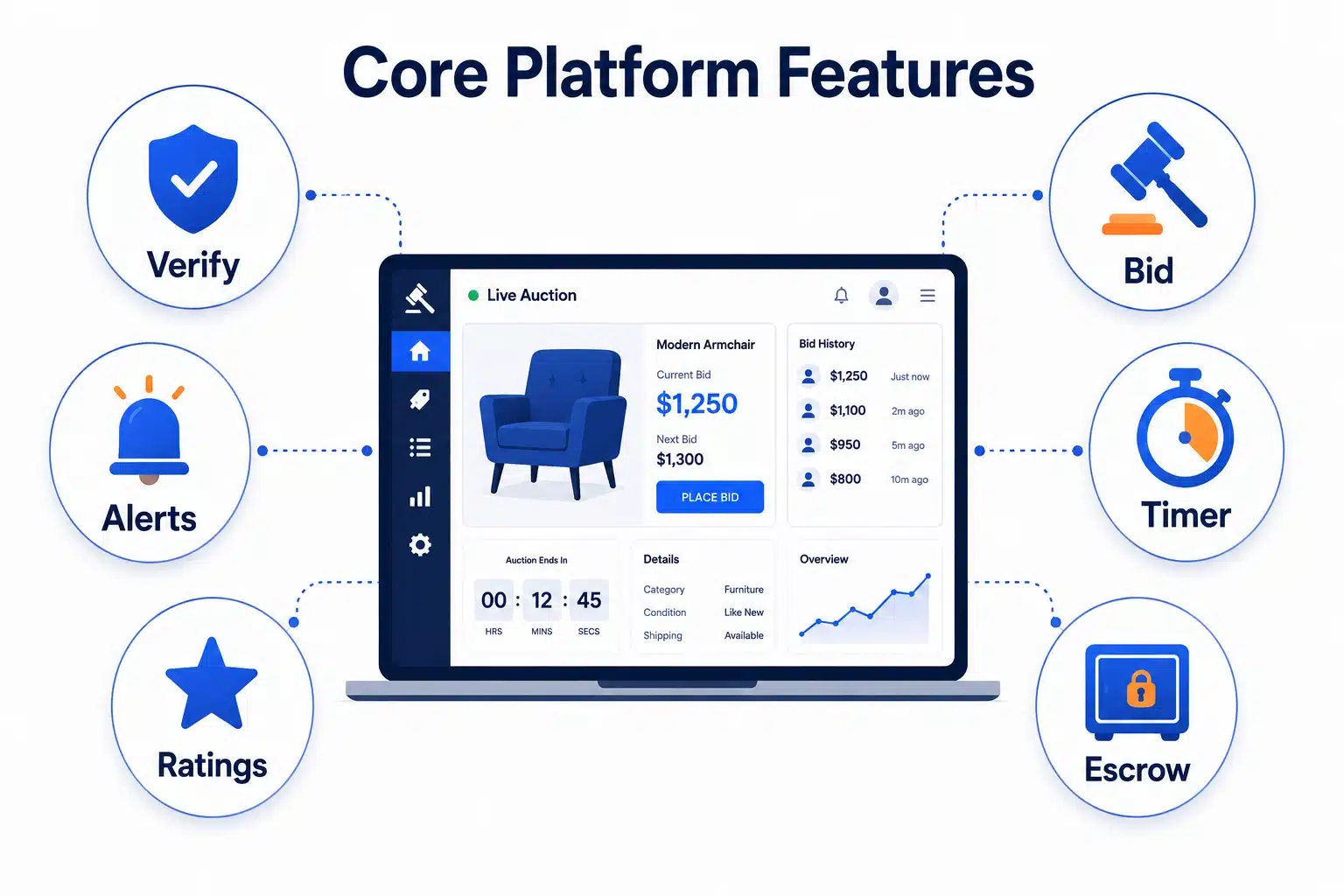
Whatever vertical you’re building for, a handful of features are non-negotiable.
- User Registration and Verification: Buyers and sellers need accounts with identity verification appropriate to the stakes involved. A $20 collectible auction needs light verification. A $2 million real estate auction needs full KYC and proof of funds.
- Listing Creation and Management: Sellers need to add items with descriptions, images, video, starting price, reserve price, and auction duration. For higher-value verticals, this extends to condition reports, authentication documents, and provenance history.
- Real-Time Bidding Engine: This is the technical core of the entire platform. It must handle simultaneous bids from potentially thousands of users, resolve tie conditions fairly, and update every connected client instantly.
- Countdown Timers with Anti-Sniping Logic: A hard countdown alone invites “sniping,” where bidders wait until the final second to bid, denying others a fair chance to respond. Most serious platforms extend the auction by a short window (commonly 1 to 5 minutes) whenever a bid lands close to the deadline.
- Bid History and Transparency Tools: Users need to see bid activity, whether that’s full transparency (English auctions) or appropriately withheld information (sealed-bid formats).
- Payment Processing and Holds: Winning bidders need a smooth checkout, but the platform also needs to place holds on funds for active bidders to prevent bids that can’t actually be paid.
- Escrow and Payout Management: Especially for high-value items, funds should sit in escrow until the buyer confirms receipt or an inspection period passes, protecting both sides of the transaction.
- Notifications and Alerts: Outbid alerts, closing reminders, and payment confirmations need to reach users instantly, typically through push notifications, SMS, and email in parallel.
- Dispute Resolution and Moderation Tools: Admins need the ability to review flagged listings, freeze suspicious accounts, cancel fraudulent bids, and mediate buyer-seller disputes.
- Search, Filtering, and Categorization: As catalog size grows, users need to filter by category, price range, closing time, and location to find relevant auctions quickly.
- Ratings and Reputation Systems: Trust between strangers is the foundation of any C2C auction platform. Buyer and seller ratings, transaction history, and verified badges all reduce fraud risk and increase conversion.
AI-Powered Features Redefining Auction Platforms in 2026
AI has moved from a nice-to-have to a genuine competitive differentiator in auction technology, and it’s an area most existing guides on this topic barely touch. Key AI-powered features include:
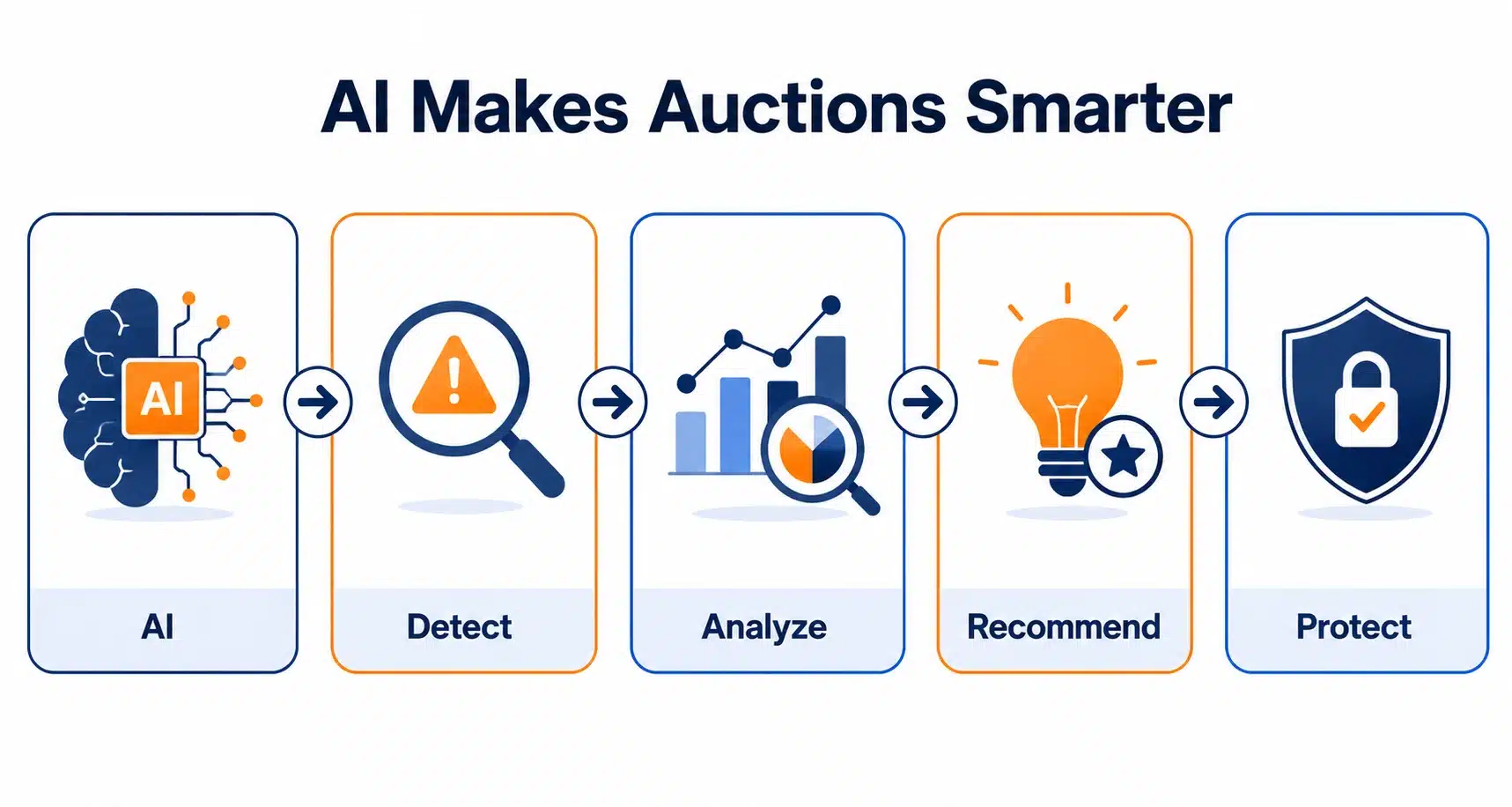
Shill Bidding and Fraud Detection: Machine learning models can flag suspicious bidding patterns in real time, such as a seller’s associated account bidding up their own listing, or a cluster of new accounts placing coordinated bids. This has traditionally been one of the hardest problems in auction platform integrity, and AI-based anomaly detection is now materially better at catching it than manual review ever was.
Dynamic Reserve Price Recommendations: AI can analyze historical sale data for similar items and suggest a realistic reserve price to sellers, reducing the number of auctions that close with no winning bid.
Smart Anti-Sniping Predictions: Beyond simple time extensions, some platforms now use predictive models to identify likely last-second bidding behavior and adjust extension windows dynamically based on bidder engagement patterns.
Personalized Auction Recommendations: Just as AI curates feeds and product suggestions elsewhere, it can surface auctions a specific buyer is statistically likely to bid on, based on past bidding history and browsing behavior.
Automated Content Moderation: Computer vision models can screen listing images for prohibited items, counterfeit indicators, or policy violations before a human moderator ever needs to look at them.
Conversational Bidding Assistants: Some platforms are experimenting with AI assistants that let users set a maximum bid and natural-language rules (“bid up to $500, but only if the reserve is already met”) and let the system execute automatically within those bounds.
Security and Anti-Fraud Architecture
Security in an auction platform is not just about protecting data. It’s about protecting the integrity of the bidding process itself, which is a layer most standard e-commerce security models don’t need to think about.
Shill Bidding Prevention: Beyond AI detection, platforms need structural safeguards: preventing sellers from bidding on their own listings, flagging IP address or device overlap between buyer and seller accounts, and setting bid velocity limits that trigger manual review.
Payment Tokenization: Card and bank details should never be stored in raw form. Tokenized payment credentials, combined with a pre-authorization hold on active bidders’ payment methods, ensure winning bids can actually be collected.
Escrow-Based Transaction Flow: For higher-value categories, funds should be held by a neutral third party until delivery is confirmed, protecting buyers from non-delivery and sellers from chargebacks.
Identity Verification Tiers: Not every user needs the same level of verification. A tiered KYC approach, light verification for low-value bidding and full identity checks for high-value transactions, balances friction against fraud risk appropriately.
Real-Time Risk Scoring: Every bid and transaction can be scored based on account age, device fingerprint, bidding velocity, and payment history, with high-risk actions triggering additional verification automatically.
Regulatory and Compliance Considerations
This is one of the most consistently underexplained topics in existing auction platform guides, and it is often the difference between a platform that scales and one that gets shut down.
Money Transmission and Escrow Licensing: If your platform holds buyer funds before releasing them to sellers, you may be classified as a money transmitter in certain jurisdictions, which triggers licensing requirements.
Consumer Protection Laws: Auctions are subject to distance-selling and consumer protection regulations that govern cancellation rights, dispute resolution, and disclosure obligations, and these vary significantly by region.
Auctioneer Licensing: Several jurisdictions require a licensed auctioneer to be involved in live auction formats, particularly for real estate and estate liquidation sales.
| Region | Key Regulation | Notes |
| US | State Auctioneer Licensing, FinCEN MSB rules | Requirements vary significantly by state; escrow handling may trigger money transmitter status |
| EU | Consumer Rights Directive, GDPR | Strong disclosure and cancellation rights apply to online sales |
| UK | Consumer Contracts Regulations, FCA (for payment handling) | Distance-selling rules apply; payment services may require FCA registration |
| India | Consumer Protection (E-Commerce) Rules | Platforms must disclose seller information and grievance mechanisms clearly |
Building Compliance Into Architecture From Day One: The smartest approach is choosing your escrow and payment partners with licensing already handled, structuring your database to support audit trails from launch, and getting legal review on your specific auction model and target market before writing your first feature spec, not after your first regulatory inquiry.
Technology Stack for Auction Platform Development
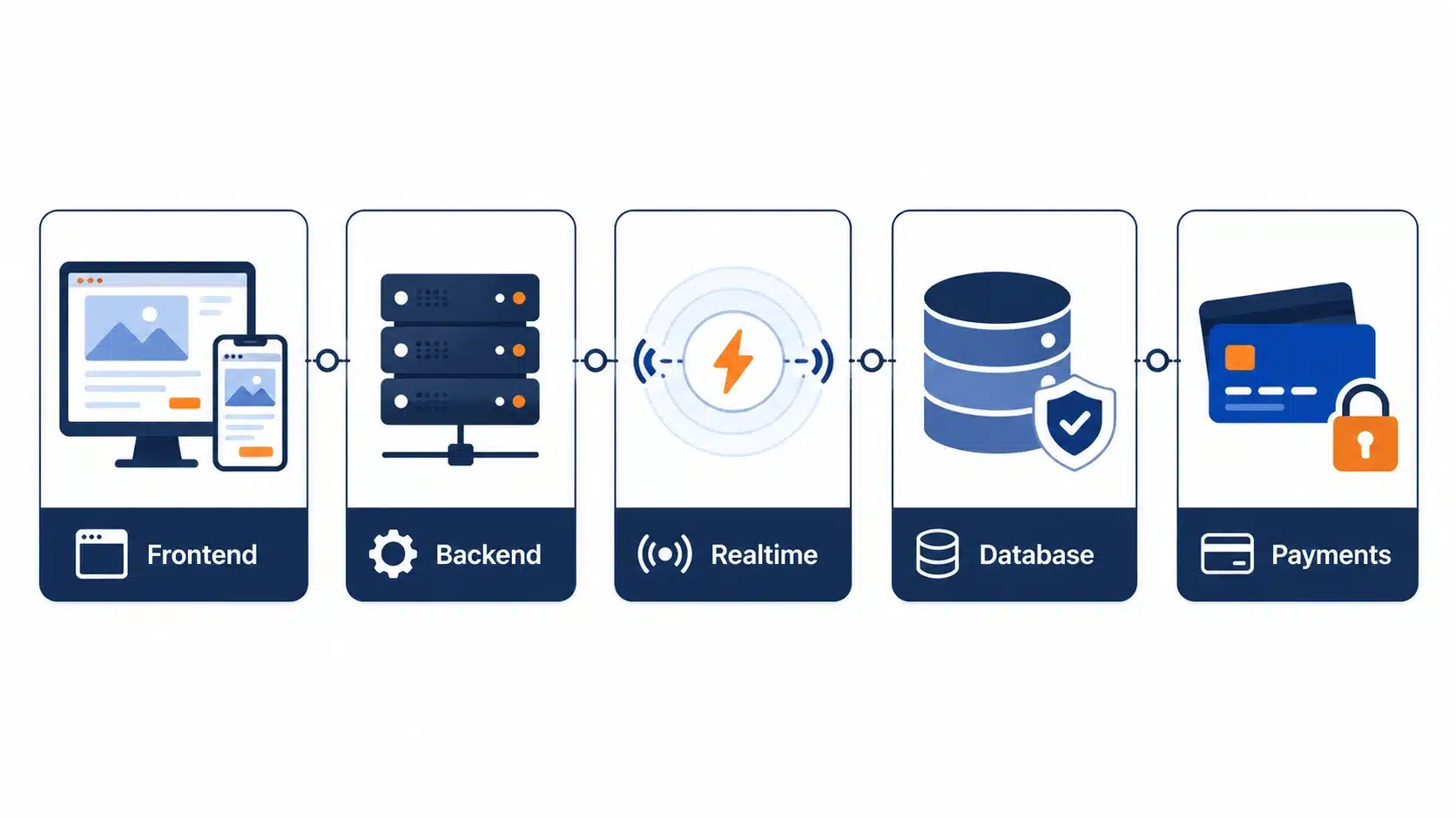
Here’s the recommended tech stack for each of the development layer:
| Development Layer | Technologies | Description |
| Mobile & Web Frontend | iOS: Swift / React Native, Android: Kotlin / React Native, Web: React.js / Next.js | Cross-platform frameworks reduce development time while supporting the real-time UI updates bidding requires |
| Real-Time Bidding Engine | WebSockets, Socket.io, Node.js | Handles live bid updates, countdown synchronization, and instant client notification across thousands of concurrent users |
| Backend & API Layer | Node.js / Python (Django, FastAPI), REST / GraphQL APIs, Microservices | Separates bidding logic, payments, and notifications into independently scalable services |
| Database & Caching | PostgreSQL, Redis, Elasticsearch | PostgreSQL for transactional data, Redis for real-time bid state, Elasticsearch for fast catalog search |
| Event Streaming | Apache Kafka / RabbitMQ | Manages high-volume bid events and ensures no bid is lost or processed out of order during traffic spikes |
| Payments & Escrow | Stripe / Braintree, Escrow.com APIs, ACH/wire integrations | Handles tokenized payments, holds, and third-party escrow for high-value transactions |
| Cloud & DevOps | AWS / Google Cloud, Kubernetes, Docker | Auto-scaling infrastructure to absorb traffic surges during high-profile auction closings |
| AI & Fraud Detection | TensorFlow / PyTorch, custom anomaly detection models | Powers shill bidding detection, risk scoring, and content moderation |
Step-by-Step Auction Platform Development Process
Step 1: Define Your Auction Model and Target Vertical
Decide whether you’re building an English, Dutch, sealed-bid, or reverse auction platform, and which industry vertical you’re serving. This single decision shapes everything downstream.
Step 2: Market and Competitor Research
Study existing platforms in your chosen vertical closely. Identify what they do well, where their user experience breaks down, and what complaints show up repeatedly in reviews and forums.
Step 3: MVP Scoping
Define the smallest version of the platform that can run a real auction end to end: listing, bidding, payment, and delivery confirmation. Resist the urge to build every feature before validating demand.
Step 4: UX Wireframing and Bidding Flow Design
Map every screen from account creation to bid placement to auction close. The bidding experience specifically needs to feel instant and trustworthy, since any lag or ambiguity during a live auction erodes user confidence fast.
Step 5: UI Design and Design System
Build a visual system that communicates urgency during active bidding without feeling manipulative. Countdown timers, bid confirmation states, and outbid alerts all need clear, consistent visual treatment.
Step 6: Core Backend and Bidding Engine Development
Build the real-time bidding engine first. This is the hardest technical component and the one every other feature depends on. Get concurrent bid handling and tie-resolution logic right before adding secondary features.
Step 7: Payment, Escrow, and Fraud System Integration
Connect your payment processor, escrow provider, and fraud detection models. Test extensively in sandbox mode, particularly for edge cases like simultaneous bids at the closing second.
Step 8: Security Audit and Load Testing
Simulate high-traffic bidding scenarios, since real auction platforms see enormous concurrent load in the final minutes of popular listings. Have an independent security firm test for shill bidding vulnerabilities and payment exploits before launch.
Step 9: Compliance Review
Get a legal review specific to your auction model, target regions, and escrow structure. This step is often skipped by smaller teams and is the single most common cause of post-launch shutdowns.
Step 10: Soft Launch and Iteration
Launch with a limited catalog and user base first. Monitor bidding behavior closely, fix bugs fast, and expand once the core experience is proven stable under real conditions.
How Much Does Auction Platform Development Cost?
| Platform Type | Estimated Cost |
| Basic MVP (Single Auction Type, Limited Catalog) | $25,000 – $60,000 |
| Mid-Level (Multiple Auction Types, Payment Escrow, Mobile App) | $60,000 – $150,000 |
| Enterprise (Real-Time Bidding at Scale, AI Fraud Detection, Multi-Region Compliance) | $150,000 – $500,000 |
Key factors that drive cost:
- Real-time bidding infrastructure is significantly more expensive to build correctly than standard e-commerce checkout flows
- Escrow and payment hold logic adds meaningful backend complexity compared to simple one-time checkout
- AI fraud detection and anomaly scoring require both development time and ongoing model training
- Multi-region compliance multiplies legal and technical overhead
- Live video auction capability, if included, adds substantial infrastructure cost for streaming at scale
How Businesses Monetize Auction Platforms
- Buyer’s Premium: A percentage fee added to the winning bid, charged to the buyer. This is the traditional auction house revenue model and remains the most common approach.
- Seller Listing Fees: A flat or tiered fee charged to sellers for listing an item, sometimes waived for high-value or high-volume sellers.
- Success Fees / Commission: A percentage of the final sale price charged to the seller once the auction closes successfully.
- Featured Listing Upgrades: Sellers pay extra for homepage placement, category highlighting, or extended listing duration.
- Subscription Tiers for Power Sellers: Recurring plans that offer reduced fees, advanced analytics, and priority support for frequent sellers.
- Payment Processing Margin: A small margin on payment processing fees, particularly relevant for platforms handling large transaction volumes.
Common Challenges in Auction Platform Development and How to Solve Them
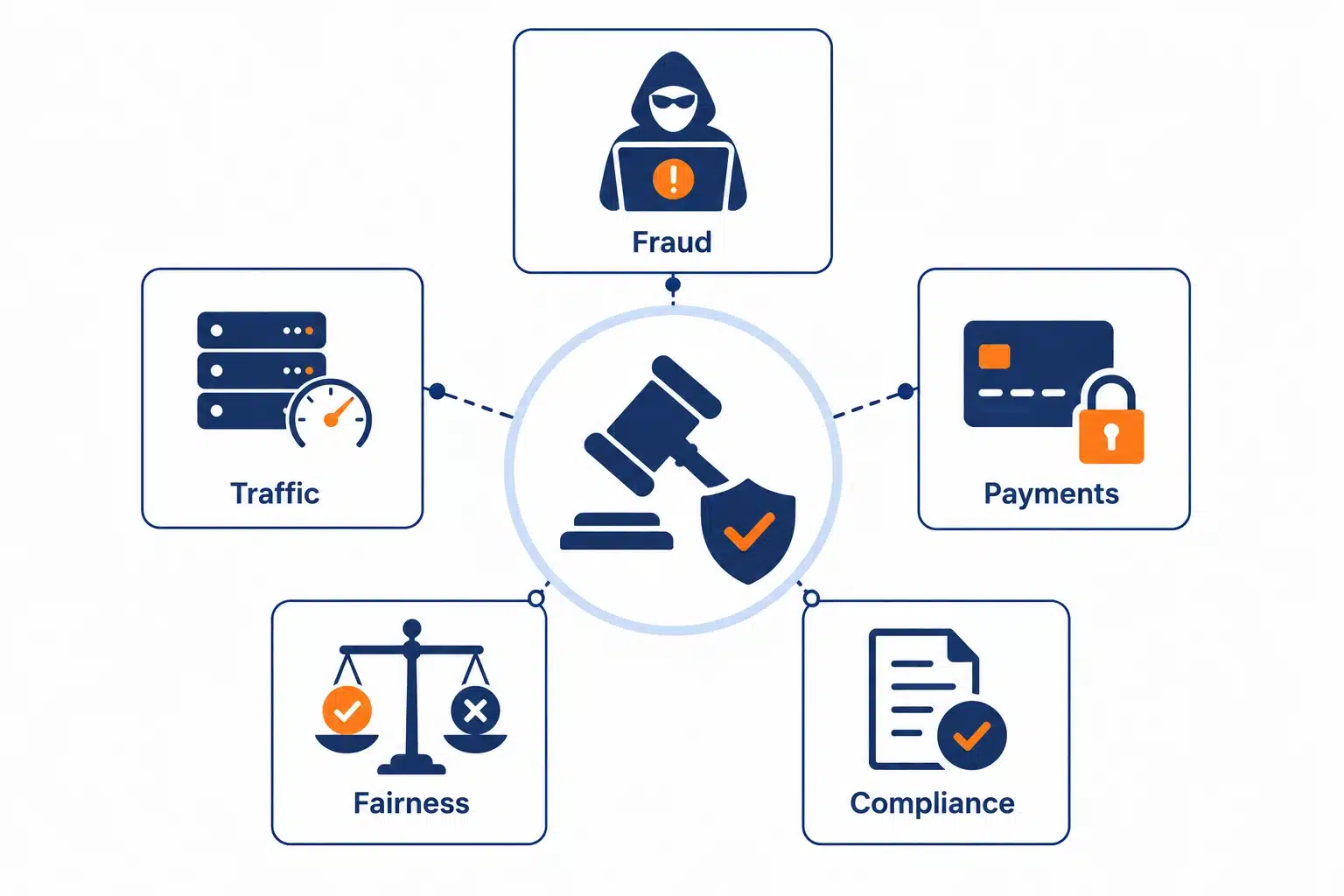
Handling Traffic Spikes at Auction Close: The final minutes of a popular auction generate a massive concurrent load spike. The fix: use auto-scaling infrastructure and event queuing (Kafka or RabbitMQ) specifically designed to absorb sudden bursts without dropping bids.
Preventing Shill Bidding: Sellers or their associates bidding on their own listings undermines trust in the entire platform. The fix: combine structural safeguards (blocking known associated accounts) with AI-based pattern detection that flags suspicious bidding behavior for review.
Ensuring Fair Tie Resolution: When two bids arrive at effectively the same instant, the system needs a clear, auditable rule for who wins. The fix: use server-side timestamping with microsecond precision and a documented, consistent tie-breaking policy communicated clearly to users.
Managing Non-Paying Winners: A winning bidder who doesn’t complete payment wastes the seller’s time and damages trust. The fix: require payment pre-authorization holds before allowing a bid, so funds are verified as available before the auction even closes.
Cross-Border Payment and Compliance Complexity: Different regions have different payment rails, currencies, and regulatory requirements. The fix: launch in one market first, get the compliance and payment flow right there, and expand deliberately rather than trying to support every region at once.
Post-Launch Growth Strategy
KPIs to track:
- Auction close rate (percentage of listings that end in a winning bid above reserve)
- Average number of bids per auction
- Bidder retention at 30 and 90 days
- Dispute and chargeback rate
- Average transaction value trend over time
Ongoing priorities after launch:
Keep refining fraud detection models as new manipulation patterns emerge. Continue expanding payment method support based on where your user base is actually located. Use post-auction surveys to understand why auctions close without a sale, and adjust reserve price guidance or category positioning accordingly.
How to Choose the Right Auction Platform Development Partner
Qualities to look for:
- Direct experience building real-time bidding systems, not just general e-commerce platforms
- A clear answer for how they handle payment holds, escrow, and fraud detection
- Familiarity with the regulatory landscape of your specific vertical and target market
- A track record of supporting platforms through post-launch scaling, not just initial delivery
What to avoid:
- Teams that treat an auction platform as “e-commerce with a timer”
- No mention of load testing for concurrent bidding scenarios
- Vague answers about compliance or escrow handling
- No prior portfolio work in real-time or marketplace systems
Final Thoughts
An auction platform is not a simplified marketplace. It’s a real-time transaction system where trust, speed, and fairness all have to hold up under pressure, often in the final sixty seconds before a listing closes. Getting the bidding engine right matters more than any single feature on the roadmap, and getting the compliance and fraud architecture right matters more than how the interface looks.
The businesses that succeed with auction platforms are the ones that pick a specific vertical, understand its regulatory and trust requirements deeply, and build a bidding experience that feels instant and fair every single time. Everything else, from AI-powered fraud detection to smart reserve pricing, is what separates a platform people use once from one they come back to for every future sale.
Frequently Asked Questions
Q1. How long does it take to build an auction platform?
A basic MVP with a single auction type typically takes 3 to 5 months. A full-featured platform with multiple auction formats, escrow integration, AI fraud detection, and mobile apps across platforms usually takes 8 to 14 months.
Q2. What is the minimum budget to build an auction platform?
A basic MVP starts around $25,000 to $30,000. Going significantly below that usually means skipping real-time infrastructure testing or fraud safeguards, which creates far bigger problems after launch.
Q3. Do I need a license to run an auction platform?
It depends on your model and market. If you hold buyer funds before releasing them to sellers, you may need money transmitter registration in certain jurisdictions. Live auctions involving real estate or estate liquidation often require a licensed auctioneer depending on the region.
Q4. What’s the difference between an English auction and a Dutch auction?
An English auction starts at a low price and rises as bidders compete, with the highest bid winning. A Dutch auction starts at a high price that drops over time until a buyer accepts the current price.
Q5. How do auction platforms prevent shill bidding?
Through a combination of structural safeguards, like blocking sellers from bidding on their own listings and flagging shared devices or IP addresses, and AI-based anomaly detection that identifies suspicious bidding patterns for manual review.
Q6. Can one platform support multiple auction types?
Yes. Many modern platforms support English, sealed-bid, and timed auction formats within a single system, though this adds meaningful complexity to the bidding engine and should be planned for from the architecture stage rather than added later.