
 Design
 App Development
 Web Engineering
 AI Services
 Cloud
Cloud Staffing
 Startups
 Health / Fitness
 Education
 Social
 Nonprofit
 Fintech
 Construction
 Logistics
 Government
 Travel/Hospitality
 HR Software
 About Simpalm
 Our News
 Client Testimonials
 Careers
 Our Blog
 Awards
 Resources
 Information
Maybe you spotted a gap in the market. Maybe you have an idea that Tinder and Bumble haven’t touched yet. Maybe you just looked at the numbers and thought, “People are spending real money on this.”
You’re not wrong on any count. The global online dating market crossed $10 billion in 2024, and it keeps growing. But here’s the thing nobody tells first-time builders: most dating apps fail. Not because the idea was bad. Because the execution was.
This guide walks you through everything. What makes a dating app actually work? What features do you need from day one? How to think about monetization. And what the development process really looks like from idea to launch.
Why Dating Apps Are a Unique Build
Dating apps look simple from the outside. A photo, a bio, a swipe. How hard can it be?
Answer: Pretty hard, actually.
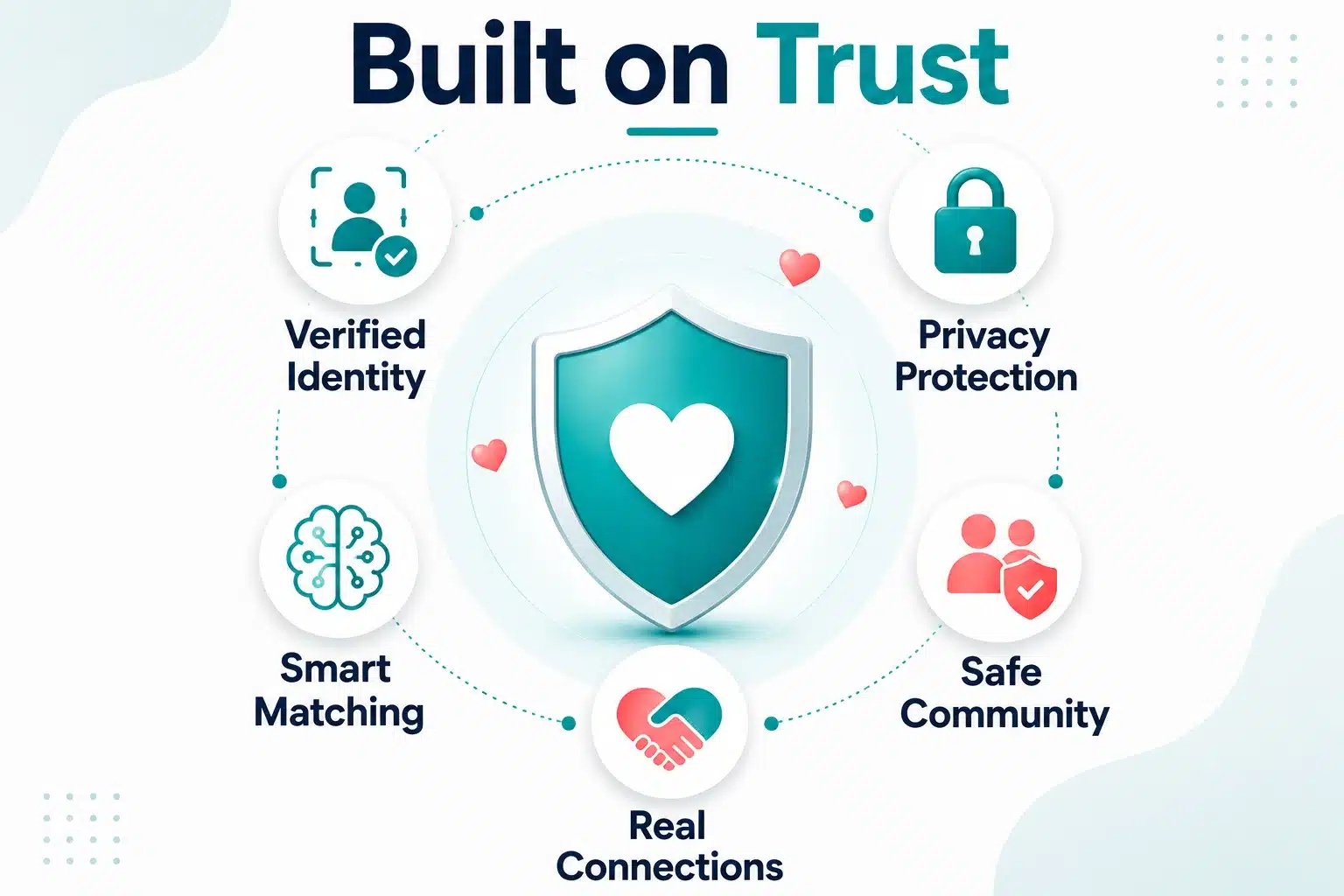
The reason is that dating apps are not just software. They are social platforms built around trust, vulnerability, and human emotion. Every design decision you make either helps people feel comfortable and confident or pushes them away.
On top of that, you’re dealing with:
- Real identity verification so users feel safe
- Matching logic that has to feel smart, not random
- Privacy at a level most apps never have to think about
- Retention mechanics that don’t feel manipulative
- Safety features to protect users from harassment and fraud
Get any of those wrong and users won’t complain. They’ll just leave.
That’s what makes dating app development both exciting and genuinely difficult. It rewards teams who think deeply about the user, not just the technology.
Types of Dating Apps You Can Build
Before you write a single line of code, you need to know what kind of app you’re building.
This shapes every decision that follows.
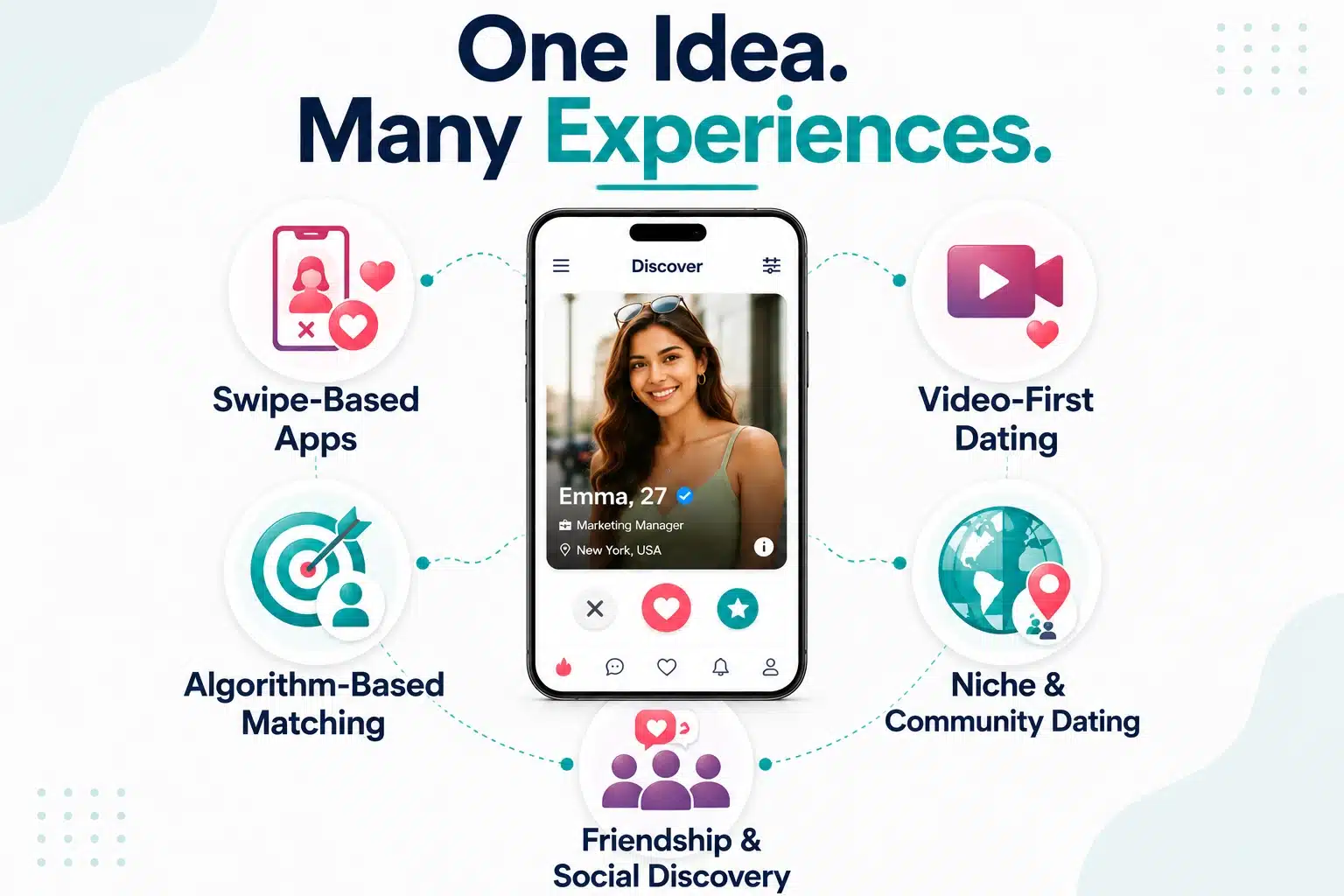
Swipe-Based Apps
The Tinder model. Users see one profile at a time and swipe right to like or left to pass. It’s fast, visual, and habit-forming. Great for broad audiences. The downside is that it can feel shallow, and many users experience burnout quickly.
Algorithm-Based Matching
Apps like Hinge or OkCupid use detailed questionnaires and behavioral data to surface compatible matches. Less about swiping, more about quality over quantity. These apps tend to attract users who are more serious about relationships.
Niche and Community Dating Apps
Some of the most successful new dating apps in recent years have been hyper-focused. Apps for specific religions, professions, age groups, lifestyles, or interests. The audience is smaller, but the engagement and retention rates are often significantly higher because users feel they truly belong.
Video-First Dating
A growing category where the first interaction happens through short video clips or live video rather than photos and text. Much harder to fake a persona when you’re on camera, which builds trust faster.
Friendship and Social Discovery
Not purely romantic. Apps that help people find friends, activity partners, or a community around shared interests. These have exploded post-pandemic and carry less social pressure than traditional dating.
Pro Tip: Before choosing your app type, spend two weeks using your top three competitors as a real user. Make notes on what frustrates you, what delights you, and what’s completely missing. Your best product ideas will come from lived experience, not market research reports.
Concierge Dating
A premium, high-touch approach where professional matchmakers, AI-assisted curation, or dedicated relationship experts handpick compatible matches instead of relying on endless swiping. Designed for busy professionals and users seeking meaningful, long-term relationships, these apps prioritize quality, privacy, and personalized matchmaking over volume.
Core Features To Integrate in a Dating App
This is the foundation. These are the features you cannot launch without. Cut corners here, and you’ll spend the next year fixing problems that should never have existed.
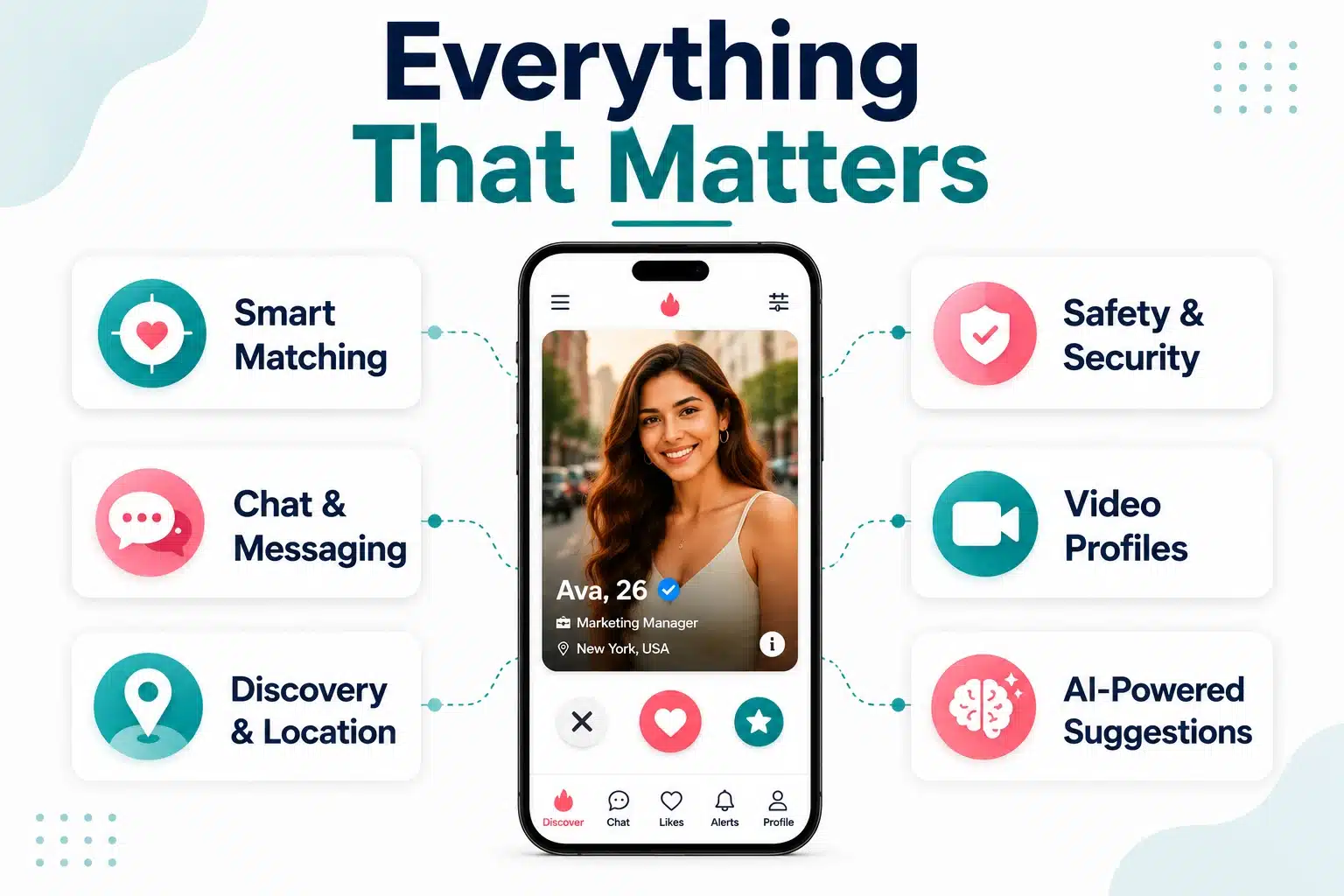
User Registration and Profile Setup
The sign-up flow sets the tone for everything. It needs to be fast enough that people don’t abandon it, but thorough enough to collect what the matching engine needs.
Most successful apps allow sign-up via phone number, email, or social login. Phone number tends to perform best because it creates a light layer of identity verification from the very start.
Profile setup should feel like a conversation, not a form. Ask one question at a time. Let users add photos easily. Give them prompts to fill out instead of staring at a blank bio field. The more complete the profile, the better the matches, so make completion feel rewarding.
The Matching System
This is the heart of your app. Everything else is decoration.
Your matching logic needs to balance several things at once:
- Proximity so that matches are actually reachable
- Preferences the user has stated (age, gender, interests)
- Behavioral signals like who they spend more time viewing
- Activity so active users see active users
The worst thing a dating app can do is show dead profiles or irrelevant matches. Users give you maybe three or four sessions before they decide if the app is worth keeping.
Chat and Messaging
Once two users match, they need a way to talk. The messaging experience needs to feel private, safe, and pleasant. Key things to get right:
- Message requests vs open chat (who can message first and when)
- Read receipts and typing indicators
- Media sharing (photos, GIFs, voice messages)
- Reporting and blocking directly from a conversation
Many apps now add icebreaker prompts and conversation starters inside the chat. These genuinely help, especially for users who feel anxious about making the first move.
Location and Discovery Settings
Users need control over how far they cast their net. Location-based discovery is standard, but give users the ability to adjust the radius, see matches from specific cities, or even browse globally.
Be upfront about how location data is used. Privacy-conscious users will check, and if your policy is vague, they’ll leave.
Safety and Reporting Tools
This is non-negotiable and, sadly, often underdeveloped.
Every profile needs an easy one-tap report button. You need a moderation system, either automated, human, or both, to review reports quickly. Photo verification helps confirm that profile pictures are real. A dedicated safety center or help page gives users somewhere to go if something goes wrong.
Apps that skip this pay a heavy price, both in user trust and in platform reputation.
Advanced Features To Integrate in Dating App Development
Once the foundation is solid, these are the features that make users choose your app over every other one on their phone.
Video Profiles and Live Features
Short video introductions give users a much richer sense of who someone is. They’re harder to fake, more engaging than static photos, and create a stronger first impression. Live video dating, where two matched users can video call directly through the app, removes the awkward transition to WhatsApp and keeps the experience contained.
Personality Tests and Compatibility Scoring
Deeper profile data leads to better matches. Apps that ask about attachment style, love languages, or values tend to attract users who are serious about finding real connections. Even a short personality quiz during onboarding can dramatically improve match quality and perceived app intelligence.
AI-Powered Suggestions
Modern dating apps use machine learning to get smarter over time. The more a user swipes, the better the algorithm understands their actual preferences versus their stated ones. AI can also help flag suspicious profiles, suggest conversation topics, or surface profiles a user might have missed.
Premium Discovery Boosts
Giving users the option to temporarily increase their profile visibility is one of the most reliable monetization tools in dating apps. Done well, it feels like a useful feature. Done badly, it feels like the app is holding your matches hostage.
Prompts, Games, and Icebreakers
The transition from matching to talking is where most apps lose users. Conversation prompts, shared games, or question-and-answer formats reduce the social pressure of that first message. Hinge built a significant portion of its brand identity around this exact problem.
Pro Tip: Build your “super like” or “priority match” feature only after your core matching engine is working well. Paid boosts only retain users if the organic experience is already good. If the app feels empty without paying, users will churn, not convert.
Monetization: How Dating Apps Make Money
Let’s talk about revenue. Dating apps have a few reliable models and a lot of ways to get this wrong.
| Model | How It Works | Best For |
| Freemium | Free core features, paid upgrades | Most dating apps |
| Subscription | Monthly or annual plan for full access | Serious relationship apps |
| Credits / Coins | Virtual currency for boosts and superlikes | Broad casual audiences |
Freemium
The most common model. The app is free to download and use at a basic level. Premium features like unlimited swipes, seeing who liked you, or profile boosts require payment.
The key to freemium is making the free tier genuinely useful while making the paid tier genuinely better, not artificially crippling the free experience to force upgrades.
Subscription
A flat monthly fee for full access. This model works well for apps targeting serious daters who are willing to invest in finding a partner. It tends to attract higher-quality users and produces more predictable revenue.
Credits and Virtual Currency
Users buy a pack of “coins” and spend them on specific actions. Popular in markets like Asia and with casual dating apps. The risk is that it can feel transactional in a context where users want to feel that connections are organic.
Other Revenue Streams
Many dating apps also earn through in-app advertising (usually in the free tier), gifting features where users can send virtual or physical gifts, or profile add-ons like background verification badges.
Dating Apps Development Process Step by Step
Building a dating app is a real project. It takes planning, iteration, and honest feedback.
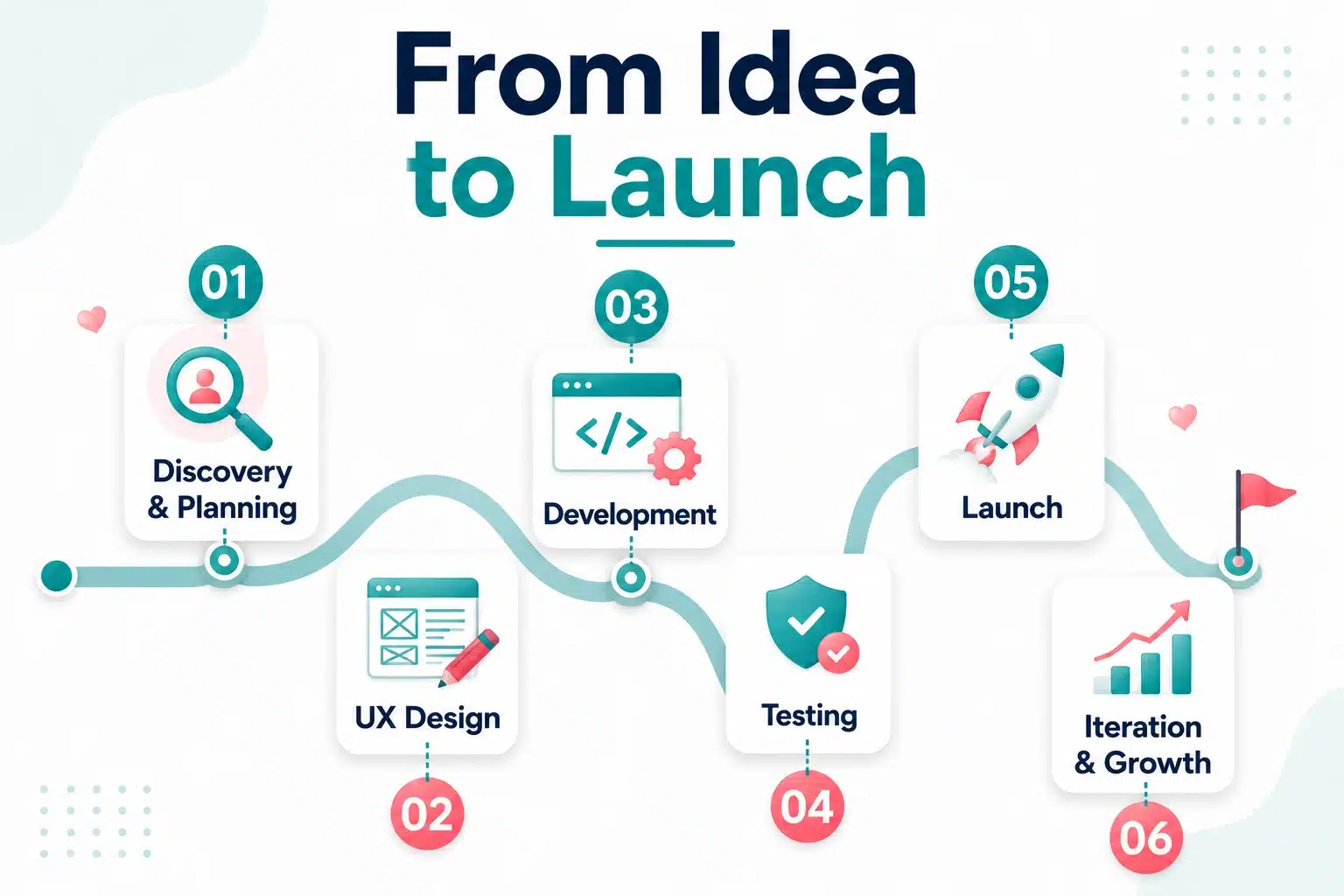
Here is how the process looks when done properly.
Step 1: User Research
Define your target audience, validate the market, analyze competitors, and prioritize the features your MVP truly needs. A strong discovery phase prevents costly changes later in development.
Step 2: Discovery and Planning
Before a developer writes a single line of code, spend serious time on discovery, mapping out every core feature, researching competitors, and making clear decisions about what the app is and what it is not.
Skipping discovery is one of the top reasons apps go over budget. You end up building the wrong thing, and fixing it costs twice as much.
Step 3: UX Design and Wireframes
Your UX designer creates the blueprint. Every screen. Every flow. Every interaction. This is where you figure out how users move through the app before you’ve spent anything on development.
Good wireframes also let you test ideas cheaply. Share them with real people, watch where they get confused, and fix the design before it becomes code.
Step 4: UI Design
Once the flow is approved, the visual design layer goes on top. Dating apps live and die by how they feel. Colors, typography, animation, empty states, and micro-interactions all contribute to whether the app feels premium and trustworthy or cheap and rushed.
Step 5: Backend Development
The backend is everything users never see. The database, the matching algorithm, the chat infrastructure, the notification system, the admin panel. It also needs to be built to scale, because if your app goes viral, you don’t want it to collapse under the traffic.
Step 6: Frontend and App Development
The client-side code connects the design to the backend. Most teams today build either native apps (separate iOS and Android codebases) or cross-platform apps using frameworks like React Native or Flutter. Each has real tradeoffs depending on your timeline, budget, and performance requirements.
Step 7: Testing
Quality assurance is not optional. Dating apps need to be tested for performance under load, security vulnerabilities, usability by real people, and compatibility across device types and operating systems. A bug in a dating app that exposes a user’s location or messages is not just a bad review. It’s a legal and ethical problem.
Step 8: Launch and Iteration
The first version of your app is not the final version. Launch, gather data, talk to real users, and improve fast. The teams that win in dating are the ones that ship, listen, and adapt.
Pro Tip: Plan a private beta with 100 to 200 real users before your public launch. This is the best way to find the problems your team is too close to notice. Give beta users a simple way to submit feedback inside the app and read every single response.
Tech Stack: What Goes Into a Dating App Development
You don’t need to choose every tool yourself, but understanding what goes into the build helps you ask better questions and evaluate vendors more honestly.
| Layer | Common Choices | What It Does |
| Mobile Frontend | React Native, Flutter, Swift, Kotlin | The app users see and interact with |
| Backend | Node.js, Python, Ruby on Rails | Server logic, data, matching engine |
| Database | PostgreSQL, MongoDB, Redis | Stores users, matches, messages |
| Real-Time Chat | Socket.io, Firebase, Twilio | Live messaging infrastructure |
Cloud and Infrastructure
AWS, Google Cloud, and Azure are all viable options for hosting a dating app. The important things are reliability, scalability, and the ability to handle location-based queries efficiently. Many teams use a combination of cloud services rather than a single provider.
Location Services
Geolocation is central to how dating apps work. Most teams use Google Maps API or Mapbox for location features, combined with spatial database queries to find nearby users efficiently.
Push Notifications
Timely notifications are a major driver of re-engagement. A match notification needs to arrive within seconds. Firebase Cloud Messaging and Apple Push Notification Service are the standard tools here.
Security and Privacy
End-to-end encryption for messages. Secure storage of personal data. GDPR compliance if you’re launching in Europe. These are not optional extras. They are infrastructure decisions that need to be made at the architecture stage, not added later.
Safety Features To Make Dating Apps More Secured
Safety deserves more than a bullet point. In dating apps, it is genuinely a product category on its own.
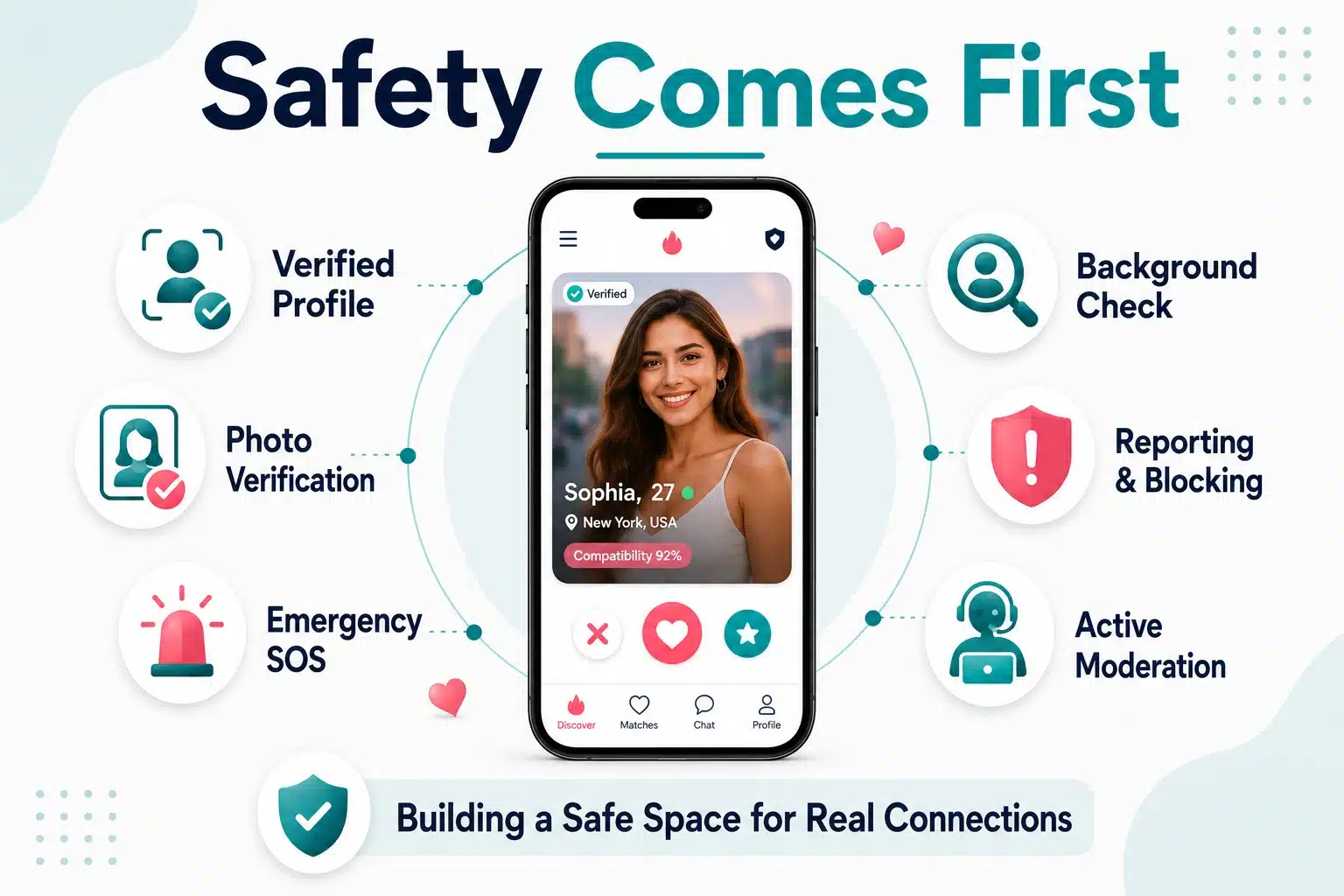
Photo Verification
Profile picture scams are one of the most common problems on dating apps. Users upload fake photos, and other users get tricked into conversations that go nowhere good. Photo verification asks users to take a real-time selfie in a specific pose and matches it to their profile photos. Even a basic version of this cuts down on fake accounts dramatically.
Background Check Integrations
A growing number of dating apps now offer optional background checks through third-party services. Users can voluntarily run a check on themselves and display a badge on their profile. It is not mandatory, but it adds a layer of trust that many users genuinely value, especially in markets where online dating safety is a bigger cultural concern.
In-App Safety Tips
A dedicated safety center with plain-language tips for safe first dates, how to spot scams, and how to report harassment is not just legally sensible. It signals that your company genuinely cares about its users. Apps that take an educational approach to safety tend to earn more loyal communities.
Emergency Features
Some apps have added a “date mode” where users can share their live location with a trusted friend when going on a first date. Others have SOS buttons that connect to local emergency services. These features are not mainstream yet, but they are increasingly expected in apps that want to be taken seriously.
Pro Tip: Create a trust and safety process from day one, even if it starts as one part-time person reviewing flagged reports. Having a human in the loop for moderation, especially for harassment reports, prevents the platform from developing a reputation problem that no marketing budget can fix later.
Dating App User Retention Tips
Getting users to download an app is hard. Getting them to come back is harder. Dating apps have a built-in churn problem: when users find what they are looking for, they leave. That is actually a success metric, but it means you always need fresh users flowing in.
Here is how smart dating apps handle retention.
Push Notifications Done Right
A notification that says “You have a new match!” brings people back. A notification that says “Don’t let your matches go cold!” feels pushy. The difference matters more than most teams realize.
Effective notifications are timely, relevant, and infrequent enough that users do not turn them off. More than two or three a day, and your uninstall rate will tell the story clearly.
Weekly Match Recaps
Some apps send a weekly summary of profiles the user might have missed or interactions that went quiet. Done with a light touch, this can re-engage users who have gotten busy. Done too aggressively, it feels like nagging.
Events and Community Features
Dating apps that layer community on top of matching tend to keep users longer. This could be virtual events, group chats around shared interests, or in-person meetup suggestions. Users who feel like the app is more than just a matching tool are much less likely to delete it.
Pro Tip: Track a metric called “meaningful conversations started” alongside your match count. A lot of matches with no conversations are a sign your matching engine is not working as well as your download numbers suggest. Fix the quality before you scale the quantity.
Common Mistakes That Might Hurt Success of Newly Launched Dating Apps
Knowing what not to do is just as useful as knowing what to do.
Launching without enough users. Dating apps need critical mass in a geography to feel alive. If your app has 200 users spread across a whole country, nobody finds a match, and everyone leaves. Nail one city first.
Ignoring safety early. Fake profiles, harassment, and scams destroy trust fast. Moderation needs to exist from day one, even if it’s manual at first.
Over-complicating the onboarding. Every extra step in sign-up loses a percentage of users. Cut anything that isn’t essential for matching.
Copying Tinder exactly. The swipe mechanic is not a strategy. Users already have Tinder. They need a reason to try your app instead.
Building for everyone. The most successful new dating apps are specific. They serve a clear audience with a clear point of view. Broad apps compete with billion-dollar incumbents on their home turf.
Treating monetization as an afterthought. Free apps need a business model. Figure out how you make money before you build, not after.
How Long Does It Take To Build a Dating App and How Much Does It Cost?
Honest answer: it depends heavily on scope, team location, and quality level.
A basic MVP with core matching, chat, and profiles from a mid-tier development team typically takes 4 to 6 months and costs between $30,000 and $100,000. A full-featured app with advanced matching, video, premium features, and a polished design from an experienced team is more likely to take 8 to 14 months and $200,000 or more.
The biggest mistakes people make with dating app budgets are underestimating backend complexity, skipping QA to save money, and not budgeting for post-launch iteration. The app you launch is version one. You need resources to build versions two and three.
What to Look for in a Development Partner
If you’re not building this yourself, choosing the right development team is probably the most important decision you’ll make.
Look for teams that have built social media apps before. Dating apps have unique challenges around real-time systems, location, and moderation that teams without this experience often underestimate.
Ask to see live apps they’ve built. Find out how they handle discovery. A team that wants to jump straight into development without a detailed planning phase is a team that will cost you more money later. You should also consider asking about the post-launch support. Building the app is half the job. Maintaining it, updating it, and scaling it is the other half.
Wrapping Up
Building a dating app is genuinely rewarding work when it’s done right. You’re creating something that could change real people’s lives, connect people who never would have met, and build a business in one of the most resilient consumer categories on earth.
But it takes serious thought, careful planning, and a team that knows what they’re doing.
If you’re at the stage where you’re thinking about who to build with, Simpalm is a leading mobile app development company that has helped founders and businesses build consumer apps across fintech, health, social, and beyond. They bring full-cycle expertise from strategy and design through development and launch, and they work with clients who want a real product, not just a deliverable.
The right partner makes a significant difference while building a successful dating app. Make sure to get a detailed quote before buying one.