
 Design
 App Development
 Web Engineering
 AI Services
 Cloud
Cloud Staffing
 Startups
 Health / Fitness
 Education
 Social
 Nonprofit
 Fintech
 Construction
 Logistics
 Government
 Travel/Hospitality
 HR Software
 About Simpalm
 Our News
 Client Testimonials
 Careers
 Our Blog
 Awards
 Resources
 Information
Key Takeaways
- eCommerce in 2026 focuses on customer experience, not just looks. Speed, trust, personalization and mobile-first design matter the most.
- New technologies like AI, AR/VR, voice commerce, headless architecture and PWAs are changing how people shop online.
- A strong eCommerce website needs proper planning, user‑centric design, smooth development, testing and continuous improvements.
- Customer understanding, trust indicators, fast checkout, clear visuals and personalization help an eCommerce site stand out.
________________________________________________________________________________________
eCommerce in 2026 is not just about aesthetics! With online storefronts dominating the market, it continues to expand rapidly,creating seamless, trustworthy experiences for customers. This means personalization, speed and easy accessibility are in the forefront. Shoppers are looking beyond mere product listings; they demand intuitive navigation, mobile responsive layouts and secure transactions.
At the same time, AI-driven capabilities in eCommerce, like hyper personalization, voice commands, headless commerce, AR/VR try-ons and social commerce are redefining how users interact with online stores. According to SQ magazine, the AI-enabled eCommerce market reached $8.65 billion in 2025 and continues to grow.
These developments indicate building a strong eCommerce design that balances usability, compliance and innovation. It is about building an online store that stands out, scales with business growth, integrates with advanced tools and delivers consistent experiences across devices and channels.
In this blog, we’ll cover eCommerce website design and development best practices in 2026 that helps businesses gain an edge and deliver long-term ROI.
What is eCommerce Website Development and Why is it Important?
eCommerce website development is the process of building online platforms that enables businesses to share their products or services directly to the customers using the internet. This involves designing the user interface, setting up secure payment gateways, integrating inventory and making navigation smooth across devices. Unlike a traditional website that primarily focuses on sharing information of products and services without direct transactions, an eCommerce website manages transactions and order fulfillment. It also implements dual tasks of protecting customer data and offering seamless experience at the same time.
Importance of an eCommerce Website
eCommerce development is more than building an online store- it’s about creating a platform that drives growth and generates ROI. A well developed eCommerce site helps businesses expand their reach, stay accessible 24/7 and make data-driven decisions.
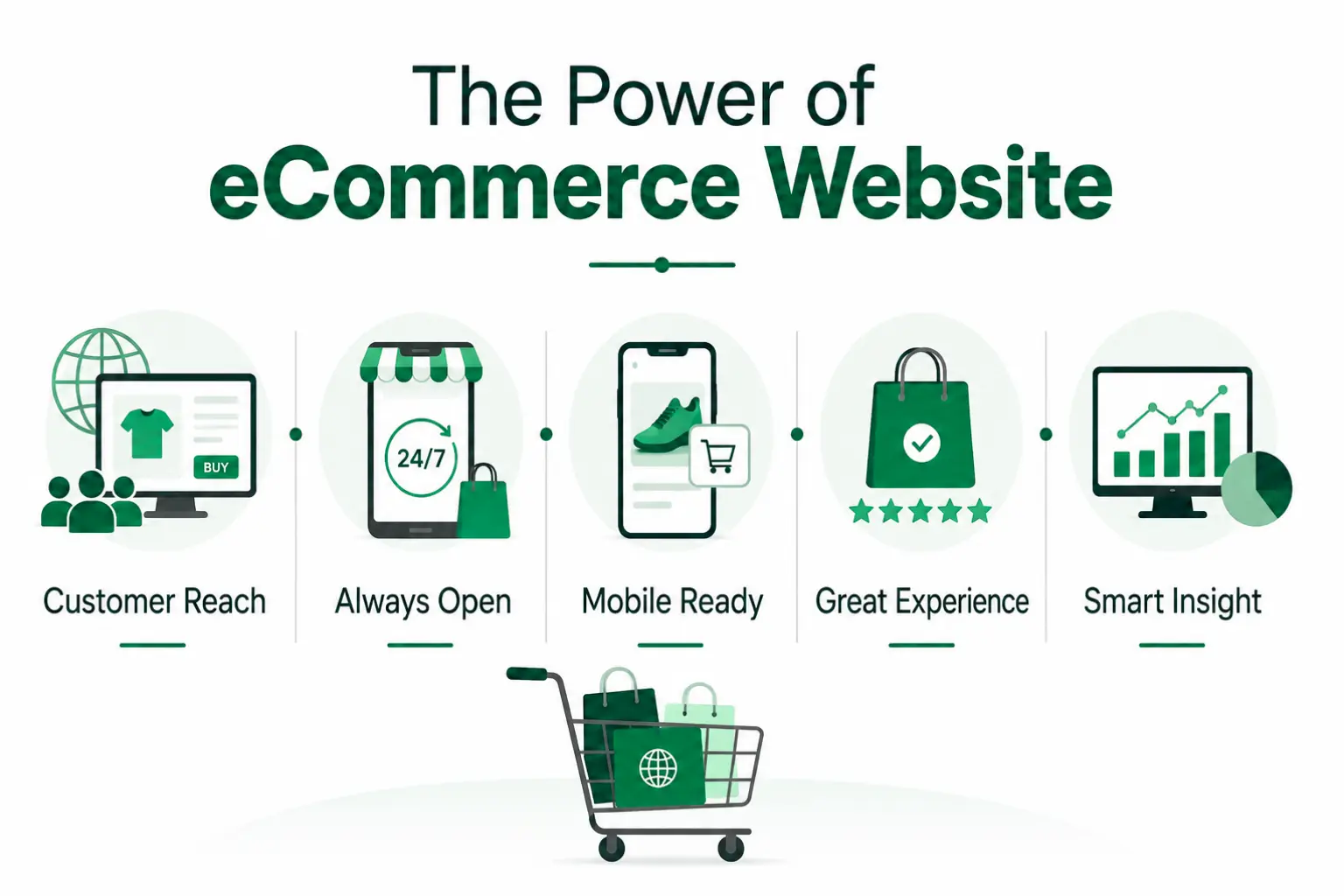
Here are the key reasons why it matters:
Reach more customers
An eCommerce website allows businesses to move beyond local markets and reach customers at the global level. For example- a fitness equipment brand in Austin, Texas can sell to customers in New York or LA without opening physical stores. This helps them expand their customer base and increase their revenue potential.
Stays open 24/7
Unlike brick and mortar stores that have a specific opening and closing time, an eCommerce store never brings down its shutters. This means customers can shop any time based on their convenience. For example- a skincare company in California can receive orders at 2 AM from customers in Florida ensuring that sales continue even beyond traditional shopping hours.
Support mobile shopping
With strong usage of mobile apps dominating the market, mobile shopping is the “new normal”. eCommerce websites must have mobile responsive design and accessibility. For example- a restaurant chain in Chicago must ensure that their site works seamlessly on smartphones so that customers can place orders while commuting or at work.
Unparalleled customer experience
A strong eCommerce site provides smooth navigation, fast loading and secure checkout-all of which drive trust. For example, a fashion retailer in New York can implement one-click checkout and personalized product recommendations reducing shopping roadblocks and fostering repeat purchases.
Make data-driven decisions
eCommerce platforms collect valuable customer information on customer behavior, preferences and shopping history. For example, a US based online electronic retailer can analyze browsing data to see which products are popular in different states. They can then adjust marketing campaigns and inventory accordingly. This allows smarter decisions that directly improve sales and customer satisfaction.
eCommerce Landscape in 2026
The eCommerce landscape in 2026 is defined by rapid global growth, mobile-first consumer behavior and innovations. Besides, emerging technologies like AI, AR/VR automation, voice commands and progressive web apps (PWA) are also reinventing ways customers interact with online marketplaces. Businesses that adapt to these strategies are best positioned to achieve higher conversions and thrive in the competitive landscape.
Here are some emerging technologies in eCommerce in 2026
AI-Powered Personalization
AI personalization uses advanced algorithms to tailor shopping experiences for each customer. It creates unique journeys by analyzing behavior, preferences and purchase history.
- Delivers product recommendations based on browsing and buying patterns.
- Adjusts promotions dynamically in real time.
- Personalizes homepage layouts and content for each visitor.
- Increases engagement, conversions, and customer loyalty.
Augmented Reality Shopping
AR shopping enhances eCommerce by letting customers visualize products in their own environment. It bridges the gap between online browsing and real-world decision-making.
- Integrates digital models into real‑world settings.
- Helps customers “try before they buy” virtually.
- Builds confidence in purchase decisions.
- Reduces product returns by minimizing uncertainty.
Headless Commerce Architecture
Headless commerce separates the frontend from the backend enabling flexibility and scalability. It allows businesses to deliver consistent experiences to their customers across multiple platforms.
- Uses APIs to connect presentation layers with commerce systems.
- Supports websites, apps, smart devices, and emerging technologies.
- Enables faster innovation and experimentation.
- Ensures agility in adapting to new consumer behaviors.
Sustainable and Ethical Commerce
Sustainability and ethics are central to commerce strategies in 2026. Consumers expect brands to behave responsibly in sourcing, packaging and operations.
- Reduces environmental impact through eco‑friendly practices.
- Promotes transparency in supply chains.
- Upholds fair labor and ethical standards
- Builds trust and strengthens brand reputation.
Best Practices for Creating an Effective eCommerce Website
A great eCommerce website is more than just displaying products online. It balances design, performance and usability to guide users through the buying journey, deliver seamless experiences and boost conversions. Customers in 2026 will stay loyal to a platform that is user-centric, technically robust and adaptable to evolving trends. From discovery to ongoing optimization, the best practices for creating an eCommerce website ensure that the site drives seamless experiences to customers and fosters sustainable growth.
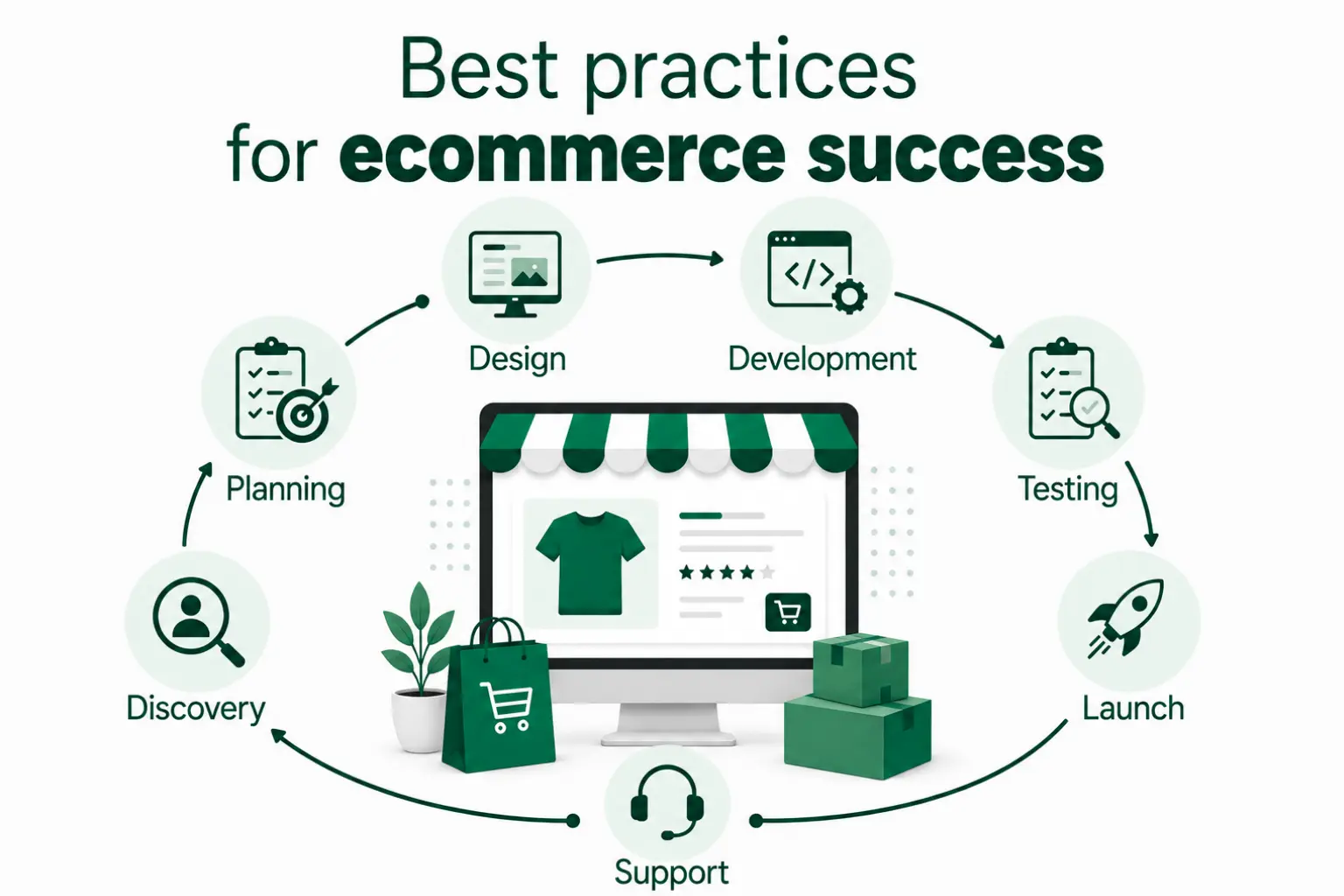
Here is a breakdown:
Discovery and Ideation
Conduct user research, surveys and competitor analysis to unlock customer pain points, expectations and market gaps.
Define the primary objective of building the website- whether to narrate the brand story, maximize conversions or integrate seamlessly across omnichannel touchpoints.
Map out the steps of customer journey in detail-from product discovery to checkout to avoid friction and make the process intuitive.
Align stakeholders early in the process and ensure clear documentation of goals, features and success metrics.
Strategic Planning
Select the right eCommerce platform (Shopify, Magento, Woocommerce, or custom builds) based on business needs, customization and scalability requirements.
Plan integrations early with CRM, ERP, logistics and payment gateways to streamline operations and avoid costly modifications later.
Establish a compliance roadmap that accounts for GDPR, and other accessibility standards ensuring legal adherence and customer trust.
Create a long-term scalability map to future proof ecommerce objectives and adapt to the rapidly evolving landscape.
Human-Centred Design
Prioritize mobile-first layouts, with thumb-friendly navigation, responsive grid and fast loading speed.
Create transparent visuals, clear policies, authentic reviews and visible security badges to build customer trust.
Make the site accessible to differently abled users by using inclusive designs and custom navigation.
Create an intuitive UI/UX that reduces friction, encourages seamless exploration of products and enhances user engagement.
Development Excellence
Optimize performance with lightweight frameworks, compressed assets and compliance with core web vitals.
Build scalable architecture with scalable cloud hosting to handle traffic spikes and future expansions.
Adopt milestone-driven sprints and CI/CD deployment for faster, reliable releases.
Integrate AI capabilities for smart product recommendations, predictive search and personalized experiences that drive customer retention.
Testing and Launch
Conduct comprehensive QA testing across devices, browsers and varying network speed to ensure consistency.
Perform security audits and validate payment gateways to safeguard sensitive customer data.
Leveraging a soft launch strategy, roll out for a smaller audience, gather feedback and refine the app before scaling.
Monitor early performance metrics to identify and resolve issues quickly.
Ongoing Support and Enhancements
Implement continuous monitoring for performance, uptime and user behavior analytics.
Use A/B testing to refine user checkout flows, product pages and conversion funnels.
As consumer needs evolve, add new capabilities to your eCommerce website like AR try-ons, voice commerce and sustainability badges.
Provide regular updates, backups and proactive issue resolution to maintain app reliability and remain competitive.
Top Tips for Creating a Memorable eCommerce Design
The best way to deliver a memorable eCommerce experience to customers is to design an attractive and easy to navigate website. Customers also expect speed, clarity and personalization. To enhance eCommerce design and development, businesses must focus on brand identity, usability and performance to create a site that drives customer loyalty.
Here’s how ecommerce brands can create memorable online shopping experiences
Showcase Brand Identity

Design With a Conversion Mindset
Every element of the website must be designed in a way that triggers the buying mindset of the customers. This means placing the CTA buttons strategically, minimizing distractions,and ensuring that the product pages highlight the benefits clearly. A conversion-focused design persuades the customer enough to make a purchase decision.
Communicate Product Value Clearly

While browsing through an eCommerce website, shoppers need to understand the relevance of the product and why it is worth buying. Clear product descriptions, transparent pricing and value addition make the offering unique. When customers are clear about the product benefits, they are more likely to purchase it.
Enable Easy Product Comparisons
The customer mindset often prompts them to evaluate and compare multiple products before buying. A clear design that enables side by side comparison of features, pricing and benefits simplifies decision-making. This also reduces customer hesitation and helps them feel more confident about their choice.
Build Trust Through Indicators
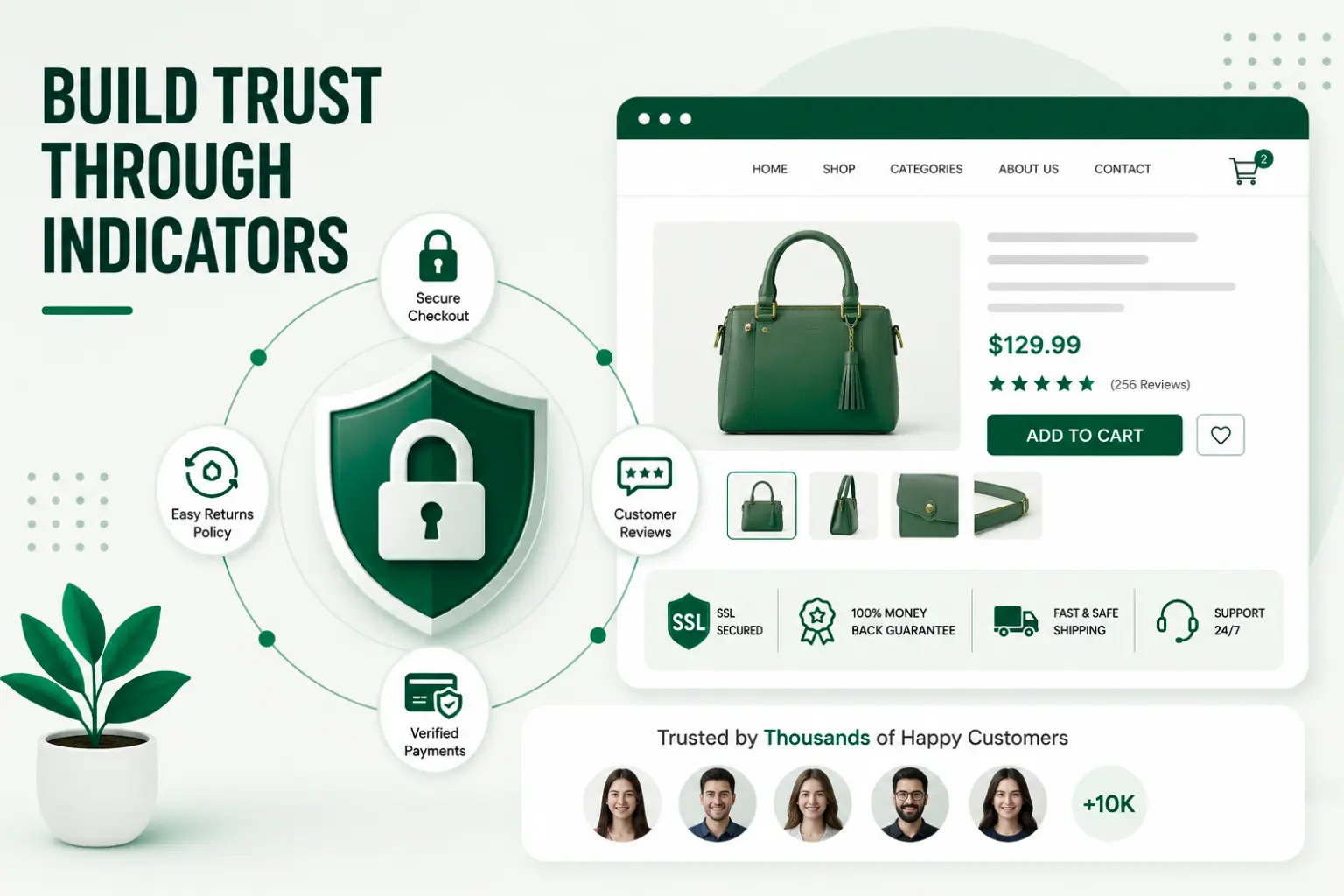
Trust is a non-negotiable factor in eCommerce. Security badges, transparent policies and visible customer reviews reassure buyers that they are making a safe and reliable purchase. By creating strong return and refund policies, businesses can earn user trust and loyalty easily.
Personalize the Shopping Experience
Personalized experiences make the customer feel valued. eCommerce businesses can tailor product recommendations, homepage layouts and promotions to individual preferences to create relevance. This improves customer experiences and also increases the probability of repeat purchases.
Incorporate Customer Feedback
The key to continuous improvement is responding to customer feedback. This feedback can be gathered through surveys, ratings and reviews and must be updated regularly on product pages, navigation and checkout flows. By incorporating customer feedback, businesses can demonstrate the efficacy of their brand value to customers.
Use High-Quality Visuals
Images, and videos are central to eCommerce design. High-quality visuals with AR experiences can showcase products in detail and help customers imagine how it fits into their lives. Videos that demonstrate the product functionality or narrate a user story can make the shopping experience even more engaging.
Simplify the Checkout Process
The biggest roadblock to a shopping experience is a complex checkout process. Business can make the checkout simple and convenient by streamlining the steps and enabling multiple payment modes. This makes the shopping seamless and reduces the number of abandoned carts.
Optimize Page Speed
Fast loading pages are the secret sauce in keeping a customer captivated to a shopping website. Optimizing images, scripts and hosting ensures that the pages load seamlessly across devices. A slow loading site frustrates users while a fast one improves customer satisfaction and drives conversions.
Prioritize Mobile-First Design
As most of the eCommerce transactions take place on smartphones, creating a mobile responsive site must not be ignored. This means responsive designs, thumb-friendly navigation and simplified menus that make a satisfying shopping experience on the small screen. By prioritizing a mobile responsive design, businesses can help their customers shop from anywhere, anytime.
Types of eCommerce Solutions
The eCommerce landscape is diverse and offers multiple models to reach customers and scale operations. Each solution is unique and addresses different needs- from wholesale operations to personalized customer experiences.Understanding these models helps organizations select the right approach to achieve their goals like expanding globally or innovating with technology.
Here are the types of eCommerce solutions for mid range businesses, nonprofits and startups:
1. B2B eCommerce Platforms
B2B business platforms include complex pricing models, account management features and integration with CRM or ERP tools. This focus on creating efficient user journeys, scalable architecture and cost-effective implementation tailored to business needs. A trusted partner will build reliable platforms, support end to end development, improve customer engagement and strengthen business relationships.
2. Omnichannel Retail
This integrates online and offline experiences ensuring that customers can shop seamlessly across websites, apps and physical stores. A lasting approach for creating a seamless omnichannel retail experience is to ensure real-time data sync, consistent customer experiences and streamlined operations. By integrating advanced technologies businesses can improve engagement and drive sales across every customer touch point.
3. B2C Commerce Platforms
Businesses to consumer platforms cater directly to individual customers by emphasizing user experience, personalization and trust. This makes the solution ideal for lifestyle, fashion and consumer goods brands. This requires intuitive design and the right technology to create scalable online stores. With seamless integrations and optimized performance these platforms provide the needful for evolving customer expectations.
4. Subscription Commerce
Subscription models provide recurring delivery of products or services to create a continuous revenue stream. They rely on loyalty programs, personalized experience and convenience to retain customers. Using automated billing cycles, and customer self service options, these portals improve retention and enhance customer satisfaction.
5. Multi Vendor Marketplace Development
Marketplaces allow multiple vendors to list products under a single platform. This requires scalable architecture, vendor dashboards and commission models to manage different sellers while offering variety to customers. By collaborating with expert eCommerce design and development services, businesses can enable secure payment management, customize catalogs and cloud based infrastructure.
6. Digital Goods and Electronic eCommerce
Digital goods include non physical items like software, ebooks or online learning courses. This category of eCommerce solution requires secure delivery licensing and instant access. Effective design and development of the platform ensures smooth transactions, instant delivery and reliable access management. Businesses can easily manage digital inventories, and provide a hassle-free shopping experience for customers.
7. Headless eCommerce Platforms
This category of eCommerce solution separates the front end design from the back end development. This enables flexibility, faster innovation and the ability to provide consistent experiences across web, mobile and smart devices. Decoupling the front end of the application from the backend provides fully customized user experiences. These solutions leverage modular architecture and advanced technologies to deliver adaptable storefronts that evolve with customer needs.
8. Voice eCommerce
Smart assistants and voice enabled devices allow hands-free shopping. It emphasizes convenience, quick reordering and natural language interactions. By defining the right strategy, choosing and selecting suitable technologies, businesses can provide unique experiences to their customers. Additionally, AI driven interactions provide convenient, intuitive and fast purchasing journeys for voice first consumers.
9. Progressive Web Apps (PWA) for eCommerce
PWAs bring app-like experiences directly to the browsers. They offer speed, offline functionality and responsive design even with poor connectivity. By combining web accessibility with advanced features,businesses can enhance user experience and drive high mobile sales.
10. Social Commerce
Social Commerce integrates shopping directly into social platforms like Instagram. Facebook and Tiktok. It relies on influencer marketing, shoppable content and seamless checkouts to boost impulse purchases. This solution enables seamless shopping experience directly into social channels. By reaching target audiences through social channels, businesses can drive conversions and boost sales.
11. Multi Store eCommerce Platforms
Multi store platforms allow businesses to manage several online stores under one roof. These are ideal for brands with diverse product lines or regional markets and provide a centralized experience. Businesses can offer a tailored shopping experience for different markets while ensuring a centralized control over data, inventory and operations for higher conversion rates.
Cost of Building an eCommerce Website
There are multiple factors that influence the cost while building an eCommerce website. It depends on the platform, custom functionality, design complexity, features and integrations and compliance standards. Some businesses only require a streamlined storefront with standard checkout while others require inventory, integrations with CRM/ERP, subscription billing or AI integration.
Development costs also increase with requirements like custom UX, headless commerce architecture, marketplace integration or enterprise scalability.
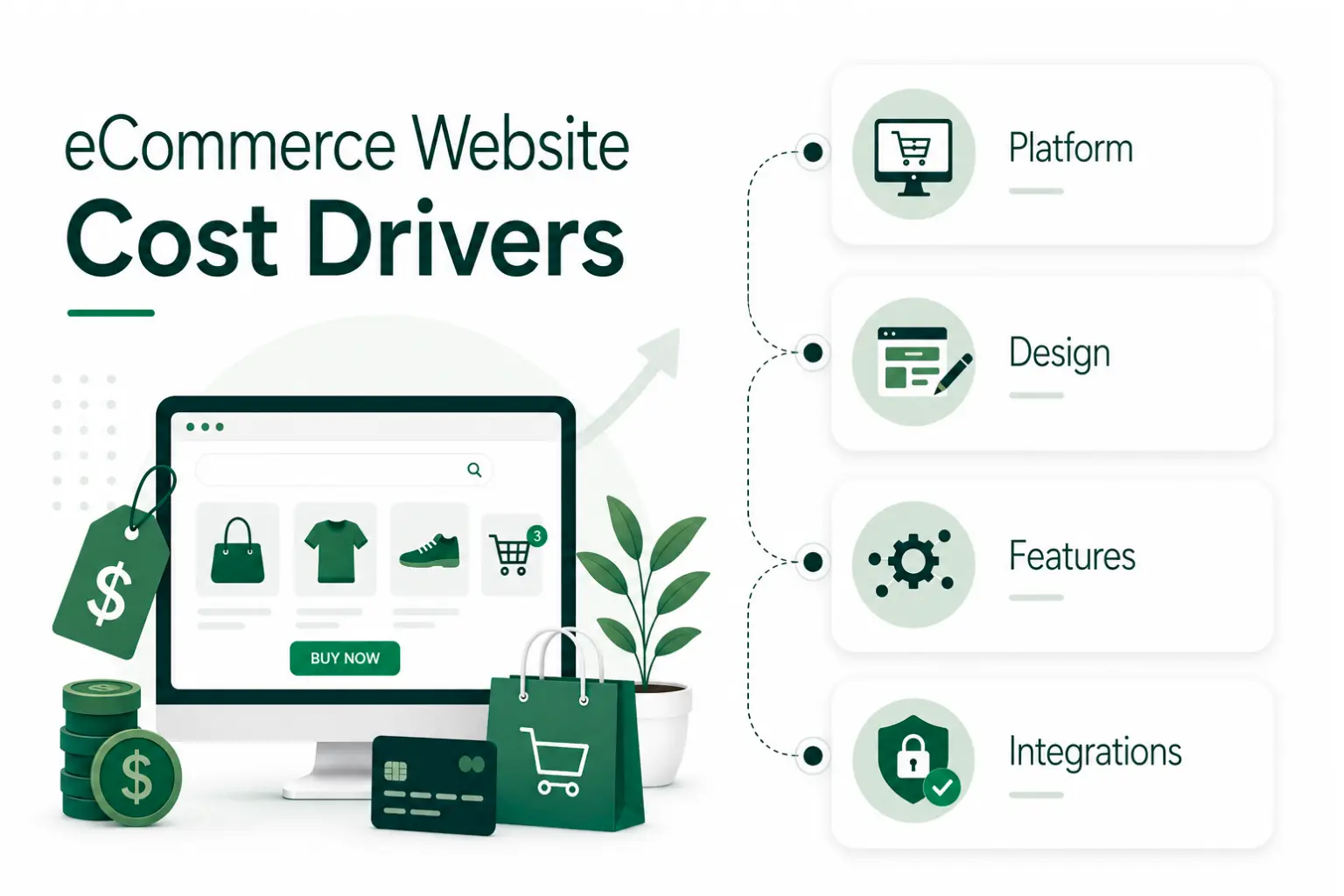
Here are some crucial factors that influence eCommerce website development cost
- Platform Choice- Shopify, Magento, WooCommerce or custom builds each come with different licensing, customization and scalability costs.
- Design Complexity- Custom UI/UX, animations and responsive layouts increase design costs as compared to template-based solutions.
- Features and Integrations- Adding CRM, ERP, logistics, AI, personalization or advanced payment gateways increases the development cost.
- Compliance and Security- Meeting compliance and accessibility standards requires additional resources for audits and implementation.
Typical Cost Range
| Type of eCommerce Website | Features and Scope | Estimated Cost Range |
| Basic eCommerce Website | Product catalogs, cart, payment, simple design | $3,000-$15,000 |
| Mid-Tier Website | Personalization, analytics, advanced integrations, responsive design | $15.000-$60,000 |
| Advanced Website | AI features, AR/VR visualization, multi vendor marketplace, enterprise compliance | $60,000-$100,000 |
Wrapping Up
eCommerce in 2026 is dynamic, competitive and full of opportunities for businesses who are willing to innovate. This includes a comprehensive understanding of global trends, evolving customer behavior and adopting cutting edge technologies like AI, AR/VR, PWA and Voice commerce. The ultimate success for eCommerce companies is building platforms that are customer centric and future-friendly. For design and development of a robust eCommerce platform businesses implement the best practices through discovery, planning, design, development and QA. This ensures that the websites are not only functional but also memorable. Ultimately, eCommerce in 2026 is about delivering trust, speed, personalization and sustainability. Businesses who adopt these practices will stand out in the crowded digital marketplace and create lasting customer relationships.
Ready to transform your eCommerce vision into reality? Connect with us and let us create a roadmap for your journey.
Frequently Asked Questions
Q1. What is the most important factor while building an eCommerce website?
The most important factor is understanding your customers. Every design, feature, integrations must be built around solving their pain points and making the shopping journey seamless. Customer centricity is the most crucial factor that drives business results.
Q2. How much does it cost to build an eCommerce website?
eCommerce website development cost varies depending on platform choice, design complexity and features. A basic website may cost between $5000-$15,000, while a mid -tier site ranges between $15,000-$40,000. Advanced eCommerce sites with AI, AR/VR or multi vendor capabilities cost $100,000+.
Q3. Which eCommerce solution is best for my business?
The right solution depends on your business goals. For wholesale, a B2B platform works best; for direct consumer sales, B2C is ideal; for variety, a multi‑vendor marketplace is effective; and for recurring revenue, subscription commerce is the right choice.
Q4. How can I make my eCommerce website stand out?
To make your eCommerce website stand out, focus on brand storytelling, trust indicators, personalization and mobile-first design. High quality visuals, fast page speed and simplified checkout also play a key role in creating a memorable user experience.
Q5. What ongoing support does an eCommerce website need?
An eCommerce website needs continuous monitoring, A/B testing, performance optimization and feature updates. Adding advanced capabilities like AI, AR try-ons, voice commerce or sustainability badges also ensure that the site remains relevant and competitive.