
 Design
 App Development
 Web Engineering
 AI Services
 Cloud
Cloud Staffing
 Startups
 Health / Fitness
 Education
 Social
 Nonprofit
 Fintech
 Construction
 Logistics
 Government
 Travel/Hospitality
 HR Software
 About Simpalm
 Our News
 Client Testimonials
 Careers
 Our Blog
 Awards
 Resources
 Information
Streaming changed how people listen to music more completely than almost any other shift in consumer technology. Owning a song used to mean owning a file or a disc. Now it means having access, instantly, to nearly everything ever recorded, plus podcasts, audiobooks, and increasingly, AI-generated audio. For founders and product teams, this creates a real opportunity, but only if the business model, the technology, and the legal foundation are built correctly from day one.
This guide walks through everything involved in building a music streaming app in 2026: how the technology actually works, what type of app fits your goals, the features and AI capabilities users now expect, the licensing reality nobody talks about enough, the tech stack, the realistic cost, and how to monetize and grow the product after launch.
What is a Music Streaming App?
A music streaming app lets users listen to audio content on demand without downloading a permanent copy of the file first. The audio is delivered in small chunks over the internet, decoded, and played in near real time. This is fundamentally different from a basic music player app, which only plays files already stored on the device.
A streaming app also has to manage a layer that most local player apps never deal with: licensing enforcement. Every play of a copyrighted track has to be logged, attributed, and eventually paid for. This single requirement shapes nearly every architectural decision in the product, from how content is cached to how offline mode works.
How a Music Streaming App Actually Works: The Technical Flow
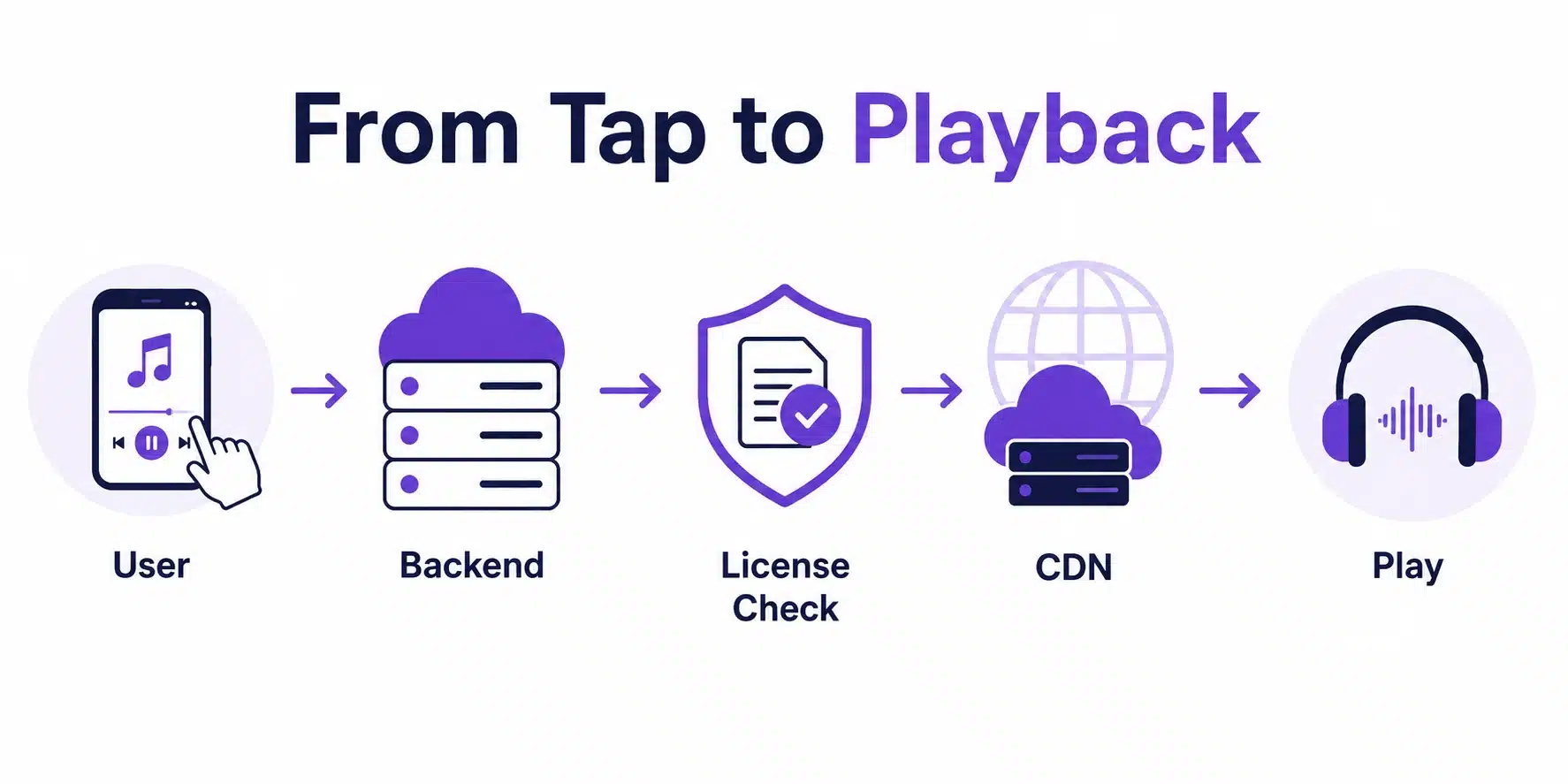
Here is what happens behind the scenes every time someone presses play.
- The user searches for or selects a track inside the app.
- The app sends a playback request to the backend, including the user’s account, subscription tier, and region.
- The backend checks licensing rules for that track in that region and confirms the user is entitled to play it.
- If approved, the backend issues a secure, time-limited streaming URL pointing to a content delivery network (CDN) edge server closest to the user.
- The app begins requesting small audio segments from the CDN using adaptive bitrate streaming, adjusting quality in real time based on network conditions.
- The player buffers a few seconds ahead, decodes the audio, and plays it.
- In parallel, the backend logs the play event for royalty accounting, analytics, and recommendation training.
- If the user is offline or has downloaded the track, a locally cached, DRM protected file is decrypted and played instead of streaming live.
This entire sequence typically completes in under a second for the initial play request, with playback starting almost instantly on a strong connection. The licensing check in step three is the part that determines whether you have a real business or a legal liability.
Music Streaming Market: Size, Growth, and the Business Case
The audio streaming market has moved well past the early adoption phase and into a mature, highly competitive stage where differentiation matters more than simple availability.
Global recorded music revenue has been growing steadily, with streaming now accounting for the large majority of that revenue across most major markets. Subscription audio streaming continues to outpace ad-supported listening in revenue per user, while podcast and audiobook consumption inside the same apps has become a meaningful secondary growth driver rather than a side feature.
What is driving growth in 2025 and 2026:
- AI-driven personalization has become the primary reason users stay loyal to one platform over another, since switching apps means losing a recommendation history that took months to build.
- Spatial and immersive audio formats are pushing premium tier adoption, particularly among users with newer headphones and devices.
- Independent and niche genre platforms are carving out profitable space by serving audiences the major platforms underserve.
- Labels and artists increasingly want direct relationships with listeners, creating demand for artist-owned or label-owned streaming products.
- Podcast and audiobook convergence inside music apps has expanded average session length and total time spent per user.
Why are music streaming apps growing so quickly? The short answer is that they have replaced ownership with access, and once a platform learns a listener’s taste well enough, switching costs become emotional as much as financial. That stickiness is exactly what makes the category attractive to build in, provided the product earns it.
Which Type of Music Streaming App Should You Build?
The right answer depends entirely on your audience, your licensing budget, and how much control you want over the catalog.
| App Type | Best For | Licensing Complexity | Typical Monetization |
| On-demand subscription (Spotify style) | Mass market listeners wanting full catalog access | Very high, full label negotiations required | Monthly subscription |
| Ad-supported freemium | Reaching large audiences fast, monetizing free users | High | Ad revenue, premium upsell |
| Theme-based or algorithmic radio | Listeners who prefer curated discovery over search | Moderate, often covered by blanket licenses | Subscription or ad-supported |
| Podcast and audiobook hybrid | Platforms expanding beyond music into spoken audio | Lower for original podcast content, moderate for music | Subscription, ads, exclusive content deals |
| Niche or genre-specific platform | Underserved audiences (classical, regional, indie) | Lower, direct artist or small label deals possible | Subscription, direct artist support |
| Label-owned or artist-direct app | Labels or artists wanting a direct fan relationship | Low for owned catalog, but limited to that catalog | Subscription, merch, ticketing tie-ins |
| Karaoke or social listening app | Audiences who want shared or participatory listening | Moderate, performance rights apply | Subscription, in-app purchases |
A founder building a niche jazz platform does not need the same licensing budget or engineering team as a founder trying to compete head to head with the major platforms. Picking the wrong category early is the single most common reason music app projects stall during the licensing phase.
Must-Have Features for a Modern Music Streaming App
Getting the features right matters, but getting the right features for your specific app type matters more.
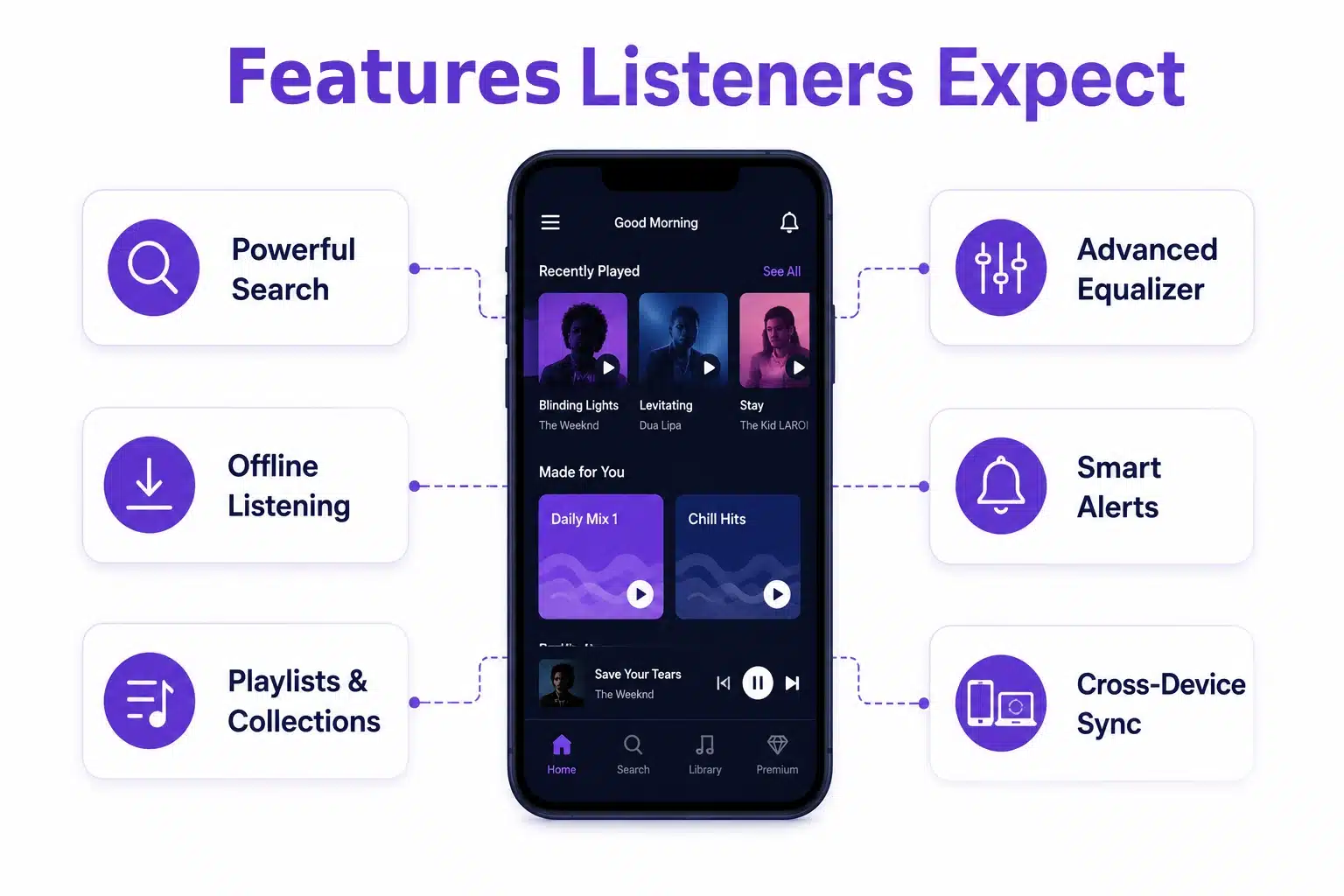
- Onboarding and Preference Capture. New users should be asked about genres, artists, and moods within the first few screens. This data feeds the recommendation engine from day one rather than waiting weeks for behavioral data to accumulate.
- Search and Discovery. Fast, typo-tolerant search across tracks, artists, albums, and playlists, paired with discovery surfaces like new releases and curated editorial picks.
- Adaptive Streaming Player. A player that adjusts bitrate automatically based on network conditions, with manual quality controls for users who want them.
- Offline Mode and Downloads. Users expect to download tracks for offline listening, especially on mobile data or during travel. This requires DRM protected local storage, not a plain file copy.
- Playlist and Library Management. Tools for creating, editing, and organizing playlists, along with saved albums and a clean library view.
- Social Sharing and Collaborative Playlists. The ability to share tracks externally and build playlists together with friends has become a meaningful driver of organic growth.
- Built-in Equalizer and Audio Personalization. Preset and custom sound profiles, including options tuned to headphones versus speakers.
- Push Notifications and Smart Alerts. New release alerts, playlist updates, and listening milestones, used sparingly enough that they feel useful rather than noisy.
- Cross-Device Sync and Casting. Seamless handoff between phone, desktop, and connected speakers, with playback state synced in real time.
- Podcast and Audiobook Support. Even music-first apps increasingly need a separate content type for spoken audio, including chapter markers, speed controls, and resume points.
AI-Powered Features Redefining Music Apps in 2026
AI is no longer an enhancement layer bolted onto a streaming app. It has become the core differentiator between platforms that feel personal and platforms that feel like a generic catalog.
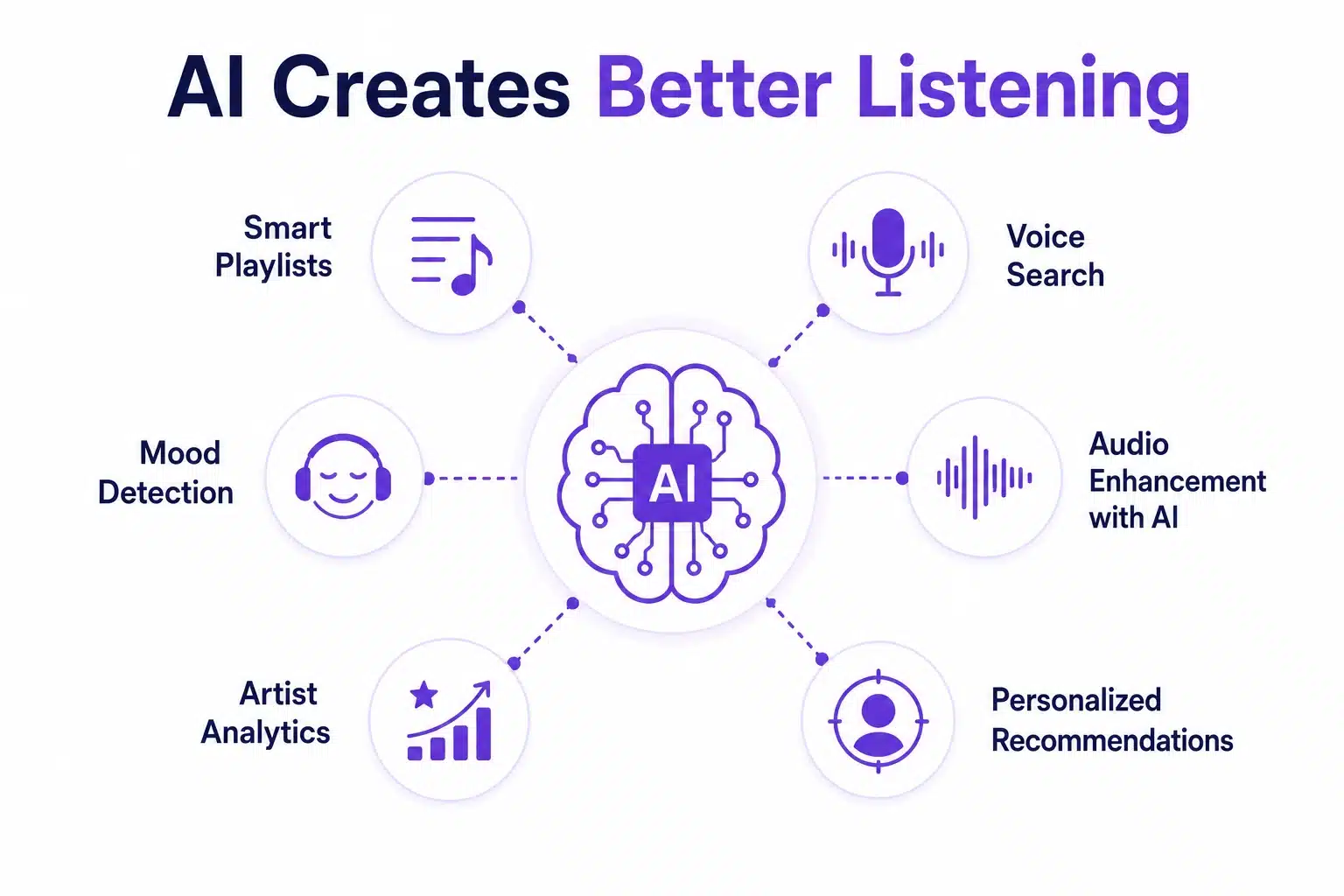
- Recommendation Engines and Personalized Radio. Machine learning models analyze listening history, skip behavior, and context to generate stations and queues that feel tailored rather than random.
- AI-Generated Playlists and Mood Detection. Users can describe a mood or activity in plain language, and the app assembles a playlist that matches it, adjusting in real time as listening patterns shift.
- Voice Search and Conversational Assistants. Commands like “play something upbeat for a workout” or “skip this artist for the rest of the day” are now handled conversationally rather than through manual search.
- AI Mastering and Audio Enhancement. Some platforms now offer real-time audio enhancement that adapts output to the listener’s specific headphones or speaker setup.
- Generative Audio Features. Emerging platforms are experimenting with AI-assisted remixing, transitions, and even short generative audio clips, though this area remains legally sensitive and needs careful rights handling.
- Artist and Label Analytics Dashboards. AI-powered dashboards give artists and labels listener demographics, engagement trends, and forecasted royalty earnings, which has become a competitive differentiator when courting catalog partners.
A Personalization Engine built on weak or sparse data will underperform no matter how advanced the underlying model is. The onboarding flow described earlier directly feeds the quality of every AI feature that follows.
Licensing, Royalties, and Rights Management
A Music Streaming License is required before a single track can be played inside your app, regardless of how small your user base is at launch. There are three core categories of rights to understand.
Mechanical licenses cover the right to reproduce and distribute a musical composition, separate from the actual sound recording. Performance rights cover the right to publicly perform a composition, which in a streaming context means every play counts as a performance. Sync licenses apply if your app pairs music with video content, such as artist promotional clips or user-generated content features.
In most major markets, performance rights are managed through Performing Rights Organizations, commonly known as PROs. In the United States these include ASCAP, BMI, and SESAC. A Direct License Negotiation with major labels is realistic only for platforms with significant funding and a clear path to scale, since major labels typically require minimum guarantees and revenue share terms that small platforms cannot meet.
For most new platforms, working through a licensed aggregator or distributor is the practical path. These intermediaries already hold the necessary agreements with labels and PROs, and they handle royalty calculation and payout on your behalf in exchange for a percentage of revenue. This trades some margin for a dramatically faster and less legally risky path to launch.
How to Build Rights Compliance Into Architecture From Day One
Royalty accounting has to be built into the system from the first line of code, not added after launch. Every play event needs to be logged with enough detail (track ID, user region, subscription tier, timestamp) to support accurate royalty calculation later. Region-based licensing restrictions need to be enforced at the catalog level, since the same track can be licensed in one country and entirely blocked in another. A Compliance Lead or licensing consultant should be involved in the product specification process before development begins, not brought in to review the app after it is built.
Audio Technology: Codecs, DRM, and Streaming Quality
The technical quality of playback is one of the few things users will notice immediately if it goes wrong.
Lossy formats like AAC and Opus are standard for most streaming because they balance file size and quality well, while lossless formats like FLAC are increasingly offered as a premium tier feature for audiophile users. Adaptive bitrate streaming, the same technique used by major video platforms, adjusts audio quality in real time based on the listener’s connection speed, preventing buffering at the cost of temporary quality reduction rather than playback interruption.
DRM protects downloaded content from being extracted and shared outside the app. Most platforms use a combination of encrypted local storage and time-limited license tokens that expire if a user does not renew their subscription, automatically disabling offline playback of previously downloaded tracks.
Spatial and immersive audio formats, sometimes marketed as 3D or surround sound for headphones, have moved from a novelty feature to a genuine premium tier driver, particularly as more devices ship with native support out of the box.
Music Streaming App Security: Architecture and Best Practices
Security in a music app protects two different things: user accounts and payment data on one side, and licensed content on the other.
Streaming URLs should always be short-lived and signed, so a captured link cannot be reused or shared outside the app. Account access should support multi-factor authentication, and biometric login has become a baseline expectation rather than a nice-to-have feature. All data in transit and at rest should be encrypted to current industry standards.
A Content Security Audit should specifically test whether downloaded or cached audio can be extracted from device storage, since this is the most common way licensed content leaks outside a platform’s control. Before launch, every app should go through penetration testing, a full code review, and a third-party security assessment of any payment or licensing related integrations.
Technology Stack for Music Streaming App Development
| Layer | Technologies | Why It Matters |
| Mobile and Web Frontend | iOS: Swift; Android: Kotlin; Cross-platform: React Native or Flutter; Web: React.js | Cross-platform frameworks reduce build time but native development still wins for high-fidelity audio controls on flagship devices |
| Backend and API Layer | Node.js or Python (Django, FastAPI), GraphQL or REST APIs, microservices architecture | Microservices allow independent scaling of streaming, recommendations, and royalty logging without one feature slowing down another |
| Database, Cache, and Real-Time Processing | PostgreSQL or MySQL, Redis, Kafka or RabbitMQ | Handles catalog metadata, caches frequently accessed tracks, and processes high-volume play event logging in real time |
| Streaming and Delivery Infrastructure | CDN (CloudFront, Akamai, Fastly), adaptive bitrate streaming protocols (HLS, DASH) | Determines playback speed, buffering behavior, and global delivery consistency |
| Licensing and Royalty Integration | Aggregator APIs (such as Believe, Symphonic, or similar), PRO reporting tools, custom royalty calculation engines | Connects your catalog to licensed rights holders and automates the accounting that keeps the business legally sound |
| AI and Recommendation Layer | TensorFlow or PyTorch for model training, vector databases for similarity search | Powers personalized recommendations, mood detection, and conversational search features |
| Cloud, Security, and DevOps | AWS, Google Cloud, or Azure; Docker and Kubernetes; HashiCorp Vault; monitoring via Datadog or CloudWatch | Provides scalable infrastructure, secrets management, and visibility into performance issues before users notice them |
Step-by-Step Music Streaming App Development Process
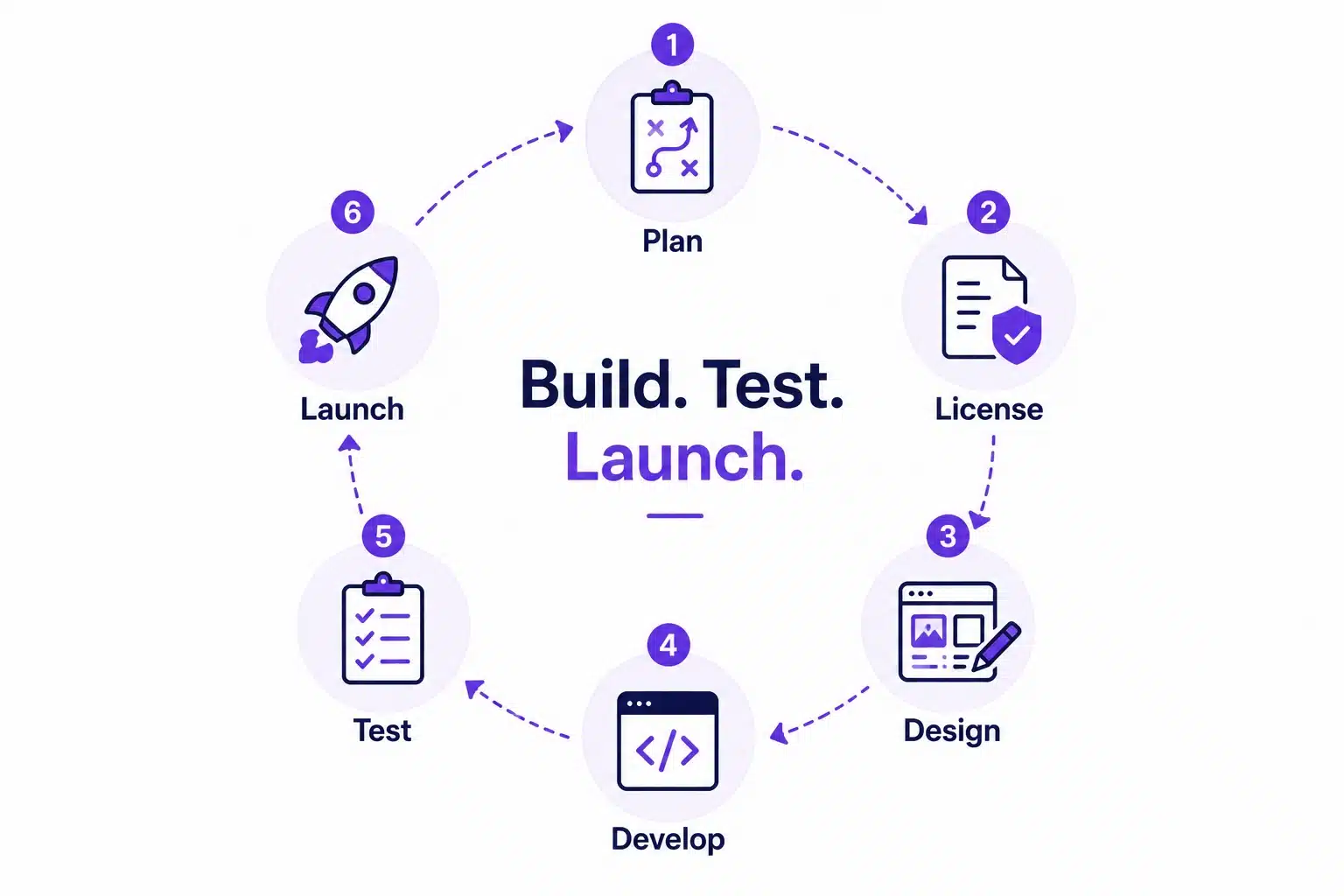
Step 1: Define App Type and Licensing Strategy
Decide which category of app you are building and whether you will license through an aggregator or pursue direct label deals. This single decision shapes your timeline and budget more than any other early choice.
Step 2: Market Research and MVP Scoping
Identify the audience your platform serves better than existing options, and define the smallest version of the product that proves that value.
Step 3: Catalog and Rights Sourcing
Begin licensing conversations early, since this process often takes longer than the engineering work itself. Engineering and licensing should run in parallel, not sequentially.
Step 4: UX Wireframing and User Flow Design
Map the core listening journey from onboarding through first play, keeping friction as low as possible before a user hears their first track.
Step 5: UI Design and Design System
Build a consistent visual system that reflects the mood of your catalog, whether that means clean and minimal or bold and expressive.
Step 6: Frontend and Backend Development
Build the player, catalog browsing, and account systems first, then layer in playlists, social features, and offline mode.
Step 7: AI and Recommendation Integration
Train initial recommendation models on onboarding data and licensed catalog metadata, refining continuously as real listening data accumulates.
Step 8: Security and Compliance Audit
Conduct penetration testing, DRM verification, and a royalty accounting review before any public launch.
Step 9: QA and Load Testing
Simulate peak concurrent streaming loads to confirm CDN and backend performance holds under real-world traffic spikes.
Step 10: Launch and Post-Launch Monitoring
Submit to app stores, run a soft launch with a limited audience, and monitor closely before opening to the full market.
How Much Does Music Streaming App Development Cost?
| App Tier | Estimated Cost | What’s Included |
| Basic (MVP / niche catalog app) | $15,000 – $40,000 | Core player, basic search, limited catalog, single platform |
| Mid-Tier (subscription app with social features) | $35,000 – $60,000 | Full catalog integration, offline mode, playlists, social sharing, basic AI recommendations |
| Enterprise (full platform with advanced AI and multi-region licensing) | $55,000 – $100,000+ | Multi-platform apps, advanced AI personalization, podcast support, multi-region licensing compliance, label analytics dashboards |
Key factors that drive cost up or down:
- Licensing strategy: aggregator-based licensing is faster and cheaper upfront than direct label negotiations, which can take many months on their own.
- Number of platforms: iOS, Android, and web each add development and testing time.
- AI feature depth: a basic recommendation system costs far less than a conversational AI assistant with mood detection.
- Catalog size and region count: every additional country adds licensing and compliance overhead.
- Offline and DRM complexity: secure offline playback requires more engineering effort than streaming-only access.
A Production-Ready Streaming Pipeline costs meaningfully more than a basic player, but cutting corners here is one of the most expensive mistakes to fix after launch, since rebuilding core playback infrastructure under active users is far costlier than building it correctly the first time.
How Businesses Can Monetize a Music Streaming App
- Subscription Plans. Tiered pricing based on audio quality, offline access, and ad-free listening remains the most predictable revenue model in the category.
- Ad-Supported Freemium. Free listening supported by audio and display ads, often used as a funnel into paid subscriptions.
- Artist and Label Partnerships. Revenue share agreements, exclusive release windows, and promotional placements create additional income streams beyond subscriptions.
- Merchandise and Ticketing Cross-Sell. Linking artist profiles to merchandise stores or concert ticketing has become a meaningful secondary revenue channel for platforms with strong artist relationships.
- Data Licensing and Trend Insights. Aggregated, anonymized listening trend data has commercial value to labels, marketers, and industry research firms, provided it is handled within privacy regulations.
Common Challenges in Music App Development and How to Solve Them
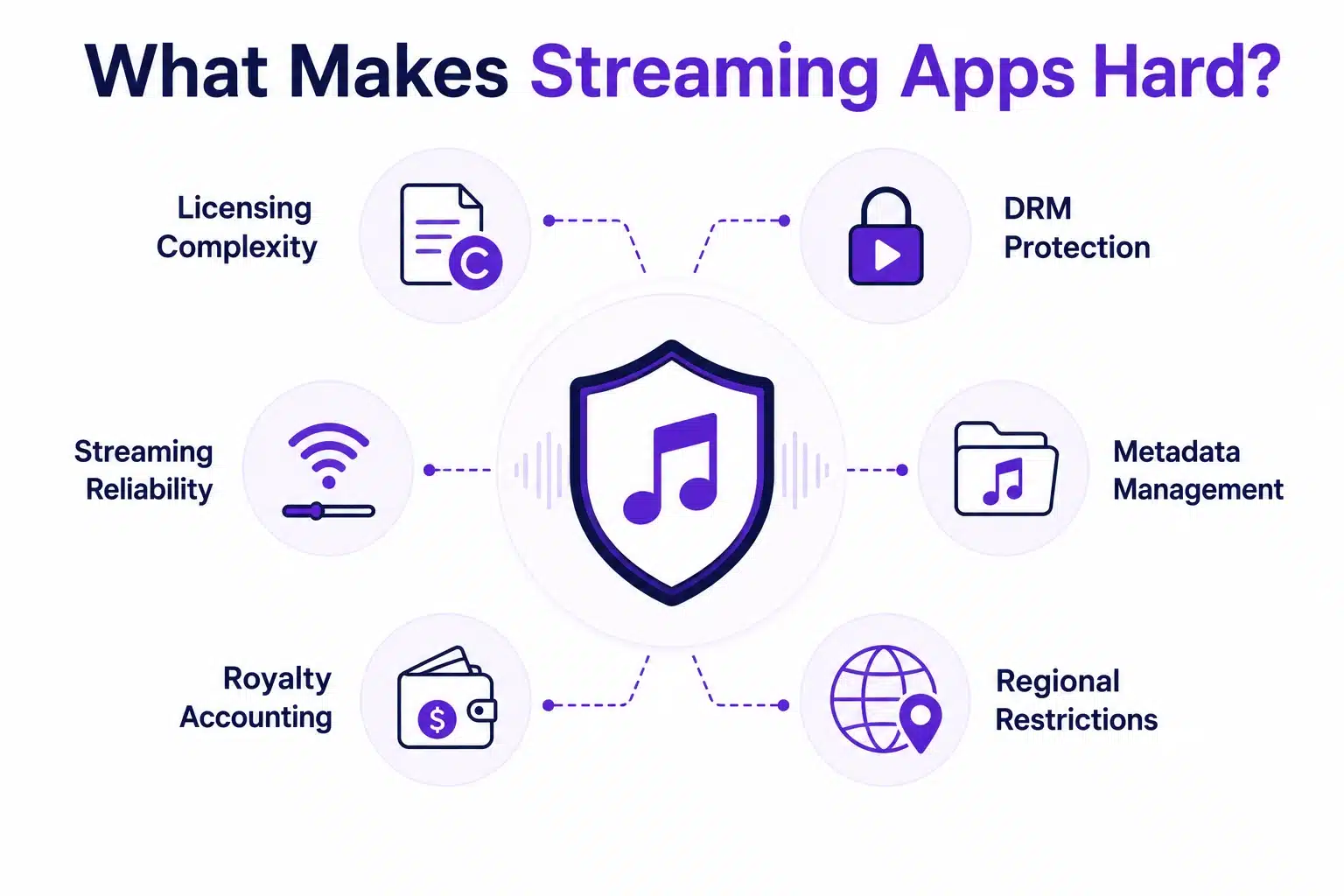
Licensing Complexity Across Regions
Different countries enforce different rights frameworks, and a track licensed in one region may be entirely restricted in another. The fix is building region-aware licensing checks directly into the catalog system rather than handling restrictions manually after launch.
Streaming Reliability at Scale
Buffering and playback failures during peak hours destroy user trust quickly. The fix is investing early in CDN coverage and adaptive bitrate streaming rather than treating performance as a post-launch optimization.
Royalty Accounting Accuracy
Inaccurate play logging leads to underpaid or overpaid royalties, both of which create serious problems with rights holders. The fix is treating play event logging as a core feature, tested as rigorously as payment processing in any fintech app.
Offline DRM Enforcement
Downloaded tracks need to remain protected even when a device is offline and disconnected from validation servers. The fix is using time-limited license tokens that expire automatically if a subscription lapses or a renewal check fails.
Catalog Metadata Quality
Inconsistent or incomplete metadata directly weakens search accuracy and recommendation quality. The fix is investing in metadata cleanup and standardization before scaling the catalog, since fixing metadata at scale is far harder than maintaining quality from the start.
Regional Content Restrictions
Some content is simply unavailable in certain markets due to rights limitations. The fix is transparent in-app messaging that explains restrictions clearly rather than leaving users confused by tracks that silently fail to play.
Post-Launch Maintenance and Growth Strategy
KPIs to track after launch:
- Monthly Active Users and average session length
- Skip rate and completion rate per track
- Free-to-paid conversion rate
- 30 and 90 day retention
- Offline download adoption rate
A Recommendation Model Refresh Cycle should run continuously after launch, since listener taste shifts over time and a model trained once at launch will gradually lose accuracy. Catalog expansion, new region licensing, and continuous A/B testing of discovery surfaces are what separate platforms that plateau early from platforms that keep growing years after launch.
How to Choose the Right Music App Development Company
Key qualities to look for:
- Direct experience with streaming infrastructure and adaptive bitrate delivery, not just general mobile app development.
- A clear understanding of music licensing and royalty accounting, or an established relationship with licensing consultants.
- A track record of building AI-driven recommendation systems, since this has become a baseline expectation rather than an advanced feature.
- Willingness to support the product after launch, since streaming platforms require continuous tuning and licensing maintenance.
Red flags to avoid:
- Agencies that treat licensing as the founder’s problem to solve separately rather than something they help plan for.
- No mention of CDN strategy or streaming infrastructure experience in their process.
- Vague answers about how royalty accounting or play logging would be implemented.
Ready to Build Your Music Streaming App?
Before moving forward, get clear answers to a few questions. What type of music app are you building, and who is it really for? How will you handle licensing, through an aggregator or through direct label relationships? What is the smallest version of the product that proves real listener value? How will the business generate revenue once the audience exists?
Getting these answers right before development starts saves months of rework later. Simpalm has experience building media-rich, scalable mobile and web platforms with complex backend and compliance requirements, and can help you think through both the product and the technical architecture before a single screen is designed.
Final Thoughts
Building a successful music streaming app comes down to three things. First, the licensing foundation has to be solid before a single feature ships, since no amount of good design fixes a legal problem. Second, the technology has to handle real-world conditions gracefully, from spotty connections to peak traffic, without users ever noticing the complexity behind a smooth play button. Third, personalization has to be earned through genuinely useful data, not bolted on as a marketing feature, because that is what keeps listeners loyal once the novelty of a new app wears off.
Get those three right, and everything else, the design, the growth, the partnerships, becomes much easier to build on top of.
Frequently Asked Questions
Q1. How long does it take to build a music streaming app?
A basic MVP with a limited catalog and core playback features typically takes four to six months. A full-featured platform with offline mode, AI recommendations, podcast support, and multi-region licensing compliance usually takes ten to sixteen months, largely because licensing negotiations often take longer than the engineering itself.
Q2. Do I need music licensing to launch a streaming app?
Yes, without exception. Every track played inside your app requires the appropriate rights, regardless of how small your user base is at launch. Most new platforms work through a licensed aggregator or distributor rather than negotiating directly with major labels, since aggregators already hold the necessary agreements and can get a catalog licensed far faster than an independent negotiation process.
Q3. What is the difference between a music player app and a music streaming app?
A music player app only plays files already stored on the user’s device, with no licensing or content delivery infrastructure involved. A music streaming app delivers audio in real time over the internet, requires licensing enforcement for every play, and depends on infrastructure like CDNs and adaptive bitrate streaming that a simple player never needs.
Q4. How much does it cost to build a Spotify-like app?
A platform with the full feature depth of a major streaming service, including a large licensed catalog, advanced AI personalization, offline mode, and multi-region compliance, typically falls in the $220,000 to $600,000-plus range. A smaller, niche-focused platform with a more limited catalog and feature set can launch successfully in the $40,000 to $90,000 range.
Q5. Can AI recommendation features be added after launch?
Yes, but the quality of those features depends heavily on the data collected from day one. Apps that capture genre preferences, listening behavior, and skip patterns from the very first session give any future recommendation model a significant head start, even if the AI features themselves are added in a later phase.
Q6. Is it cheaper to build a music streaming app in India than in the US?
Generally yes. Development agencies in India and similar markets often deliver comparable quality at a meaningfully lower cost than agencies in the US or Western Europe. That said, licensing negotiations and compliance work are usually tied to the markets you plan to launch in, so cost savings on development do not always extend to the legal and licensing side of the project.