
 Design
 App Development
 Web Engineering
 AI Services
 Cloud
Cloud Staffing
 Startups
 Health / Fitness
 Education
 Social
 Nonprofit
 Fintech
 Construction
 Logistics
 Government
 Travel/Hospitality
 HR Software
 About Simpalm
 Our News
 Client Testimonials
 Careers
 Our Blog
 Awards
 Resources
 Information
Key Takeaways
- Over 1 billion people globally live with a mental health disorder, yet the majority never receive treatment. Smartphones have become one of the most accessible entry points for mental health support.
- The global mental health app market is projected to reach $8.64 billion in 2026, growing at a CAGR of 15%+, driven by rising awareness, telehealth adoption, and AI-powered care delivery.
- Mental health apps are not a single category. Teletherapy platforms, CBT-based self-guided apps, mood trackers, meditation tools, and crisis intervention apps each carry distinct feature requirements, regulatory burdens, and clinical responsibilities.
- HIPAA compliance is the floor, not the ceiling. Apps serving global audiences must additionally navigate GDPR (EU), India’s DPDP Act, PIPEDA (Canada), and platform-level policies from Apple and Google.
- AI augments human care in mental health apps. It does not replace it. The ethical and clinical boundaries around AI deployment in this category are non-negotiable, not a product decision.
________________________________________________________________________________________
Mental health disorders affect more than a billion people globally, yet access to timely and affordable care remains a major challenge. As smartphones become a primary channel for healthcare delivery, mental health apps are helping bridge gaps through teletherapy, mood tracking, CBT programs, mindfulness tools, and AI-powered support.
For founders and healthcare organizations, the opportunity is significant. The global mental health app market is projected to reach USD 35.29 billion by 2034, driven by rising awareness, growing telehealth adoption, and advances in digital care. However, building a mental health app requires far more than great UX. Clinical oversight, privacy regulations, crisis management, ethical AI implementation, and security must be considered from day one.
This guide covers everything you need to know about mental health app development in 2026, from choosing the right app category and features to compliance, technology stack, development costs, and long-term growth strategy.
Understanding the Mental Health App Market in 2026
The global mental health app market is projected to reach $8.64 billion in 2026, growing at over 15% annually. This is not speculative growth. It is driven by three structural forces:
- A documented shortage of mental health professionals in most markets,
- Rising diagnostic awareness, particularly among younger adults, and
- Normalization of digital health tools following the pandemic.
The audience is broadening too. Gen Z consumers are more likely to turn to an app before a therapist. Corporate HR departments are purchasing mental wellness platforms as employee benefits. Healthcare providers and insurers are investing in digital tools to extend care capacity. Each of these represents a distinct go-to-market path with different product requirements.
The 5 Core Types of Mental Health Apps
Most competitor content lists these categories without helping founders choose between them. That choice is the most consequential product decision you will make.
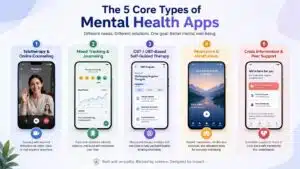
- Teletherapy and Online Counseling Platforms connect users with licensed therapists via video, voice, and text messaging. BetterHelp and Talkspace are the dominant examples. These carry the highest regulatory burden and operational complexity, but also the strongest revenue potential and clearest clinical value.
- Mood Tracking and Journaling Apps give users structured tools to log emotional states, identify patterns, and build self-awareness over time. The regulatory burden is lower, but these apps must be designed carefully to promote insight rather than reinforce rumination.
- CBT / DBT-Based Self-Guided Therapy Apps deliver structured therapeutic content through modules, exercises, and psychoeducation libraries. Clinical content review is non-negotiable in this category, and the distinction between therapeutic and wellness content has real legal implications.
- Meditation and Mindfulness Apps like Calm and Headspace sit at the wellness end of the spectrum. Clinical depth is lower, but so is the regulatory burden. This category also has the largest addressable consumer market and the most forgiving user acquisition economics.
- Crisis Intervention and Peer Support Apps serve users in acute distress or seeking community with others who share lived experience. These require the most thoughtful crisis escalation architecture and the most careful moderation infrastructure of any category.
A Decision Framework for Which Type to Build
The biggest mistake founders make is trying to build a little bit of everything—therapy, wellness, AI support, community, and crisis intervention, all in a single product. In reality, each category comes with different user expectations, clinical responsibilities, development costs, and growth models.
The right starting point becomes much clearer when you answer three strategic questions.
How clinical do you want to go?
The more clinical the product, the higher the regulatory burden, the greater the need for licensed clinical oversight, and the longer the development timeline. Clinical depth also builds the most defensible moat and the clearest path to insurance reimbursement.
Who is your primary user: individual consumer or B2B?
Consumer apps rely on mass-market acquisition and subscription revenue. B2B paths such as employer wellness programs, insurer partnerships, and healthcare provider integrations have longer sales cycles but dramatically better unit economics and retention.
What is your evidence strategy?
Some distribution paths, including insurance reimbursement, enterprise health systems, and FDA-regulated markets, increasingly require clinical evidence. If you need outcomes data to win, build outcome measurement in from day one.
Trying to build all five types at once is one of the most common and expensive mistakes in this category. Once you decide on the app type, the next important step is to review the feature set you should focus on in version 1.
Related Read | How to Develop a Healthcare App?: The Ultimate Guide
Popular Features for a Mental Health App
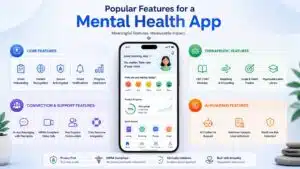
Every feature in a mental health app should solve a specific, measurable problem for a specific user. The clinical or behavioral rationale behind each feature should be explicit before development begins. Below are the features that matter, organized by function.
Core Features (Any App Type)
- User Onboarding and Mental Health Intake Assessment: First-session onboarding in a mental health app serves two purposes: it personalizes the experience from day one, and it screens for crisis risk before the user goes any further. A user disclosing active suicidal ideation needs an immediate escalation path, not a CBT module recommendation. This is not a UX detail. It is a clinical and ethical baseline.
- Intelligent Pattern Recognition: What adds value is AI-driven pattern recognition that correlates mood with sleep, physical activity, and time of day to surface insights the user could not identify on their own. This is the feature that drives meaningful retention beyond the first week.
- Secure Encrypted data: Journaling in a mental health context captures Protected Health Information (PHI). End-to-end encryption is not optional, and explicit disclosure to users about what is stored and who can access it is equally required.
- Push Notification System with Consent Architecture: Notifications in a mental health app require more nuance than in any other product category. A poorly timed push notification can interrupt a user at a vulnerable moment and damage trust. Granular consent management must be built into notification design from the start.
- Progress Dashboards That Show Meaningful Change: Streaks drive engagement in habit apps, but in a mental health app they can also create shame cycles when users miss days. Progress dashboards should show meaningful improvement over time, not just usage consistency.
Therapeutic Features
- CBT / DBT Module Library: with licensed clinical content review. The content inside these modules is not marketing copy. It must be clinically reviewed before it reaches any user.
- Guided Breathing and Grounding Exercises: with haptic feedback on mobile. These are evidence-based interventions for anxiety and acute distress that are practical, deployable within minutes, and among the highest-rated features in user research across the category.
- Goal Setting and Habit Formation Tracker: Behavioral activation is a core CBT intervention. A well-designed habit tracker does more than log streaks; it supports an active therapeutic process by helping users build structured, values-aligned activities into daily life.
- Psychoeducation Library: Users in distress do not read long articles. Short, clinically accurate explainers on anxiety, depression, and cognitive distortions build understanding and reduce stigma without overwhelming the user.
Connection and Support Features
- In-App Messaging with Therapists (Async and Real-Time): The ability to send a message between sessions, rather than waiting for a scheduled video call, is a core differentiator for teletherapy platforms. Asynchronous text messaging is often more comfortable for users who are not yet ready for live conversation.
- HIPAA-Compliant Video Calling: Any platform facilitating live therapy sessions must use HIPAA-compliant video infrastructure. Building video calling features from scratch is unnecessary and inadvisable. Telehealth SDKs such as Twilio and Daily.co already comes with Business Associate Agreements in place.
- Peer Support Communities (Moderated): Skipping moderation in a peer support community is not a cost-saving shortcut. It is a liability. Users sharing mental health struggles in an unmoderated environment can be exposed to harmful content, misinformation, or predatory behavior. Moderation is required, not optional.
- Crisis Resource Integration: Hotlines, emergency escalation paths, and local crisis resources must be prominent and always accessible. If a user in acute distress cannot locate crisis resources within seconds, the app has failed at its most important function.
AI-Powered Features
- AI Chatbot for Between-Session Support: AI support between therapy sessions is genuinely valuable for users who cannot access a therapist around the clock. However, AI must never present itself as a replacement for professional care, and users must always know they are interacting with a bot rather than a human.
- Sentiment Analysis on Journal Entries: NLP-driven analysis of journal content can identify emotional patterns, flag language associated with elevated risk, and trigger appropriate in-app responses. This is a passive safety layer that adds clinical value without adding friction to the user experience.
- Predictive Risk Detection: This is the most powerful and most ethically complex AI feature in the category. When implemented with strict clinical oversight and transparent disclosure to users, risk prediction models can connect at-risk users with support before a crisis event occurs. When implemented carelessly, they erode trust and create significant legal exposure. Clinical review before deployment is not optional.
Features by App Type at a Glance
| Feature | Teletherapy | Mood Tracker | CBT App | Meditation | Crisis App |
| Video calling | Yes | No | Optional | No | No |
| AI chatbot | Optional | Yes | Yes | No | Yes |
| Crisis escalation | Yes | Yes | Yes | Optional | Yes |
| Wearable integration | Optional | Yes | Optional | Yes | Optional |
| CBT module library | No | No | Yes | No | Optional |
| Peer community | Optional | Optional | Optional | Yes | Yes |
Tech Stack for Mental Health App Development
Frontend
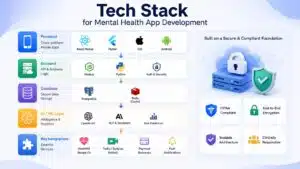
React Native and Flutter both support cross-platform development and are appropriate for most mental health apps. Native iOS or Android development becomes the stronger choice when deep device integration is required, such as wearables, Apple HealthKit, or Google Fit.
WCAG accessibility compliance is not optional in this category. Mental health users may include people with motor impairments, cognitive disabilities, or those on medications that affect fine motor control. Accessibility must be built in from the start and cannot be retrofitted effectively later.
Backend
Node.js and Python (Django or FastAPI) are standard for scalable API layers. Cloud infrastructure must be HIPAA-eligible: AWS (GovCloud or standard with BAA), Google Cloud Healthcare API, and Microsoft Azure all provide compliant environments. PostgreSQL is the standard for structured data storage, and encryption at rest is non-negotiable.
AI and ML Layer
NLP capabilities for chatbots and sentiment analysis can be built on OpenAI API, Anthropic API, or fine-tuned open-source models, depending on data residency and compliance requirements. Wearable integration uses Apple HealthKit, Google Fit, and Fitbit APIs. Risk prediction models require clinical oversight and validation before deployment. This is not a feature you test your way into during production.
Key Integrations
EHR/EMR integration via HL7/FHIR standards is increasingly expected for provider-facing tools and is the gateway to hospital system partnerships. Telehealth SDKs such as Twilio and Daily.co handle HIPAA-compliant video without requiring custom video infrastructure. Payment integrations for subscription billing and session payments must account for healthcare-adjacent compliance requirements.
| Layer | Recommended Technology | Purpose |
| Mobile Frontend | React Native / Flutter | Cross-platform iOS and Android |
| Backend | Node.js / Python (Django) | API, business logic, authentication |
| Database | PostgreSQL | Structured data with encryption at rest |
| Cache Layer | Redis | Session management, fast reads |
| Cloud Infrastructure | AWS / Google Cloud Healthcare API | HIPAA-eligible hosting |
| AI / NLP | OpenAI API / Anthropic API | Chatbot and sentiment analysis |
| Video | Twilio / Daily.co | HIPAA-compliant telehealth |
| Wearables | Apple HealthKit / Google Fit | Biometric data integration |
| Push Notifications | Firebase Cloud Messaging | Cross-platform notifications |
Step-by-Step Process To Develop a Mental Health App
Step 1: Discovery and Validation (2–4 Weeks)
Define your clinical scope before writing a single line of code. This decision determines your regulatory burden, your build timeline, your team requirements, and your launch strategy. A mood tracker and a teletherapy platform are fundamentally different products with fundamentally different builds.
Interview potential users and licensed clinicians before committing to a feature set. This step is skipped more often than any other and regretted in every case where it is skipped. Clinicians will surface information about user behavior, safety requirements, and clinical workflow that no amount of competitive analysis can replicate.
Define your evidence strategy early: will you need a pilot study, user outcome data, or a randomized controlled trial to reach your target distribution channels?
Step 2: Product Design and UX (4–6 Weeks)
Mental health UX requires specific design disciplines that general UX practitioners may not carry. Trauma-informed design principles are not aesthetic preferences. Avoiding triggering language, giving users explicit control over their experience, and building predictable interaction patterns directly affect user safety.
The design phase should produce calm visual language, clear crisis paths that are always accessible, and an absence of dark patterns. Prototype testing with a representative user group, including people with lived mental health experience, should happen before any code is written.
Step 3: MVP Development (3–6 Months)
Build the smallest version of the product that is still clinically safe and genuinely useful. Compliance architecture belongs at the start of development. HIPAA infrastructure added as an afterthought creates expensive rework and security gaps that are difficult to close without significant rebuild effort.
The feature prioritization framework for a mental health MVP is straightforward: include what is clinically necessary and technically required for safe operation, and defer everything else to version two.
Step 4: Clinical and QA Testing (4–8 Weeks)
Standard QA covering functional, performance, and security testing is necessary but not sufficient. A licensed mental health professional must review all therapeutic content before any version reaches users. User testing should include people with lived mental health experience, not just proxy users. Penetration testing is required before any launch.
Step 5: Launch Strategy
A phased rollout matters more in mental health than in almost any other app category. Discovering a broken crisis escalation path with ten beta users is a fixable development problem.
Before any launch, simulate a user in acute distress and verify that every escalation path works end to end. This test should be documented and formally signed off before the app goes live.
Step 6: Iterate Based on Outcome Data (Ongoing)
Engagement metrics tell you whether users return. Outcome metrics, including standardized tools like PHQ-9 for depression screening and GAD-7 for anxiety measurement, tell you whether users actually get better. Build outcome measurement into the product from day one. It is significantly harder to add later, and outcome data is the foundation for insurance reimbursement, enterprise sales, and clinical research partnerships.
Compliance, Privacy, and Legal: The Foundation You Cannot Skip While Building a Mental Health App
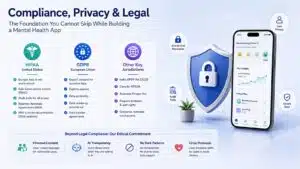
A mental health app is only as trustworthy as the systems protecting its users. Unlike many consumer applications, these platforms often handle highly sensitive information, including therapy records, symptom assessments, emotional journals, and crisis-related disclosures. A security failure is not just a technical issue. It can have serious personal, legal, and clinical consequences.
For that reason, compliance and privacy should be treated as core product requirements, not post-launch considerations. The regulations you must follow, the consent flows you design, the vendors you choose, and the safeguards you implement will influence every stage of development.
HIPAA (United States)
HIPAA governs any app that qualifies as a covered entity or business associate handling Protected Health Information. In a mental health context, PHI includes therapy notes, symptom assessments, crisis disclosures, and diagnosis-related data.
Key requirements include encryption at rest and in transit, role-based access control (RBAC) with least-privilege principles, audit trails for every access to PHI, and Business Associate Agreements with every third-party vendor that touches user data. The 2026 HIPAA updates have added mandatory MFA and stricter documentation requirements. These are now the baseline standard, not advanced practice.
GDPR (European Union)
Mental health data is classified as sensitive data under Article 9 of GDPR, requiring explicit user consent as the legal basis for processing. The right to erasure is particularly complex in a mental health context. What happens when a user in recovery wants their therapy history deleted from a platform that is integrated with an EHR system? This flow must be planned before you build, not after.
Data residency also matters for GDPR compliance. Storing EU user data on US servers requires explicit data transfer agreements to remain compliant.
Other Key Jurisdictions to Study
India’s DPDP Act (2023) applies to apps targeting Indian users and imposes consent, purpose limitation, and grievance redressal obligations on data fiduciaries. Mental health data falls under sensitive personal data categories under this framework.
Canada’s PIPEDA and Australia’s Privacy Act apply similar principles with jurisdiction-specific variations. If your distribution plan includes any of these markets, a legal review specific to each jurisdiction is not optional.
The Ethical Layer Beyond Legal Compliance
Legal compliance is the minimum standard. The ethical responsibilities in mental health app development go further.
Vulnerable users and informed consent: Users experiencing depression, anxiety, or psychosis may have impaired capacity to fully process complex privacy disclosures. Therefore, plain-language consent flows shall be designed for comprehension are an ethical obligation.
AI transparency: Users must always know when they are talking to an AI system. In a mental health context, this is not a disclosure checkbox. It is a fundamental condition of trust.
Dark patterns are particularly harmful in this category: Manipulative notification mechanics, addiction-driving engagement loops, and streak-shame designs belong in gaming apps. They have no place in a product used by people actively managing mental health conditions.
Crisis protocols: What is your app’s responsibility when a user discloses acute suicidal ideation? The answer must be decided, legally reviewed, and technically implemented before launch.
Also Read | How to Make a Nutrition App
How Much Does Mental Health App Development Cost?
Development cost in this category is consistently underestimated. The factors that drive cost up, including clinical content creation, compliance architecture, security audits, and AI development, are often invisible to founders who have not previously built in healthcare.
| App Tier | What You Get | Estimated Cost | Timeline |
| Basic MVP | Core features, basic compliance | $30,000 – $50,000 | 3–5 months |
| Mid-Tier | Full feature set, HIPAA-compliant | $60,000 – $150,000 | 5–9 months |
| Enterprise-Grade Platform | Enterprise-ready, full compliance | $150,000 + | 9–18 months |
What Drives Cost Up
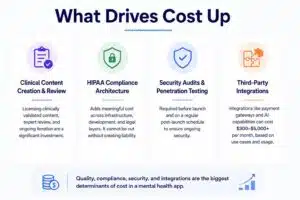
Clinical content creation and review are underestimated in nearly every mental health app project. Licensing clinically validated content, paying for expert review, and iterating on therapeutic materials represent a significant and ongoing investment.
HIPAA compliance architecture adds meaningful cost at the infrastructure, development, and legal layers. It cannot be cut without creating liability that far exceeds the savings.
Security audits and penetration testing are required before launch and on a regular post-launch schedule thereafter.
Third party integration: several third party integrations like payment gateways, AI capabilities can cost from $300-$5000 a month, depending upon the use cases and usage.
Where to Optimize Without Cutting Cost Corners
- Use HIPAA-eligible cloud services rather than building your own infrastructure.
- Leverage telehealth SDKs instead of building video from scratch.
- Start with a single platform before expanding to both iOS and Android.
- Nearshore and offshore development teams in Eastern Europe ($40–$70/hr) or India and Southeast Asia ($25–$50/hr) can deliver professional-quality work at meaningful cost savings when managed with clear specifications and clinical review processes.
Post-Launch Investment: The Cost Founders Most Often Ignore
Cloud infrastructure at scale runs $100–$5000 per month. Regular security audits, compliance updates, and content reviews are ongoing operational requirements. Plan to invest 25–35% of your initial build cost annually in maintenance, iteration, and clinical validation.
Who Do You Need on Your Team to Develop a Mental Health App?
The team composition for a mental health app is meaningfully different from a standard consumer app team.
- A Licensed Mental Health Consultant is required from day one. This is the most common gap in failed mental health app projects. Every piece of therapeutic content, every AI behavior, and every crisis protocol needs clinical review before it reaches users.
- A Product Manager with Healthcare Product Experience understands regulatory constraints, clinical workflow, and the critical difference between engagement metrics and outcome metrics. This background matters more than domain expertise in any specific app category.
- Frontend and Backend Engineers with Healthcare App Experience. HIPAA compliance, PHI handling, and audit logging are not skills that can be learned on the job during a mental health app build. These require engineers who have navigated healthcare requirements before.
- A UX Designer with Trauma-Informed Design Training. This is a specific discipline. A skilled general UX designer will not automatically know how to design safe onboarding flows for users disclosing mental health history, or how to structure crisis escalation paths that are clear under cognitive stress.
- A Security Engineer or Compliance Consultant for HIPAA BAA management, penetration testing oversight, and ongoing compliance maintenance.
- A Data Scientist or ML Engineer if AI features are in scope. In 2026, they typically are./span>
A note for early-stage founders: you do not need all of these roles from day one. You do need a licensed clinician in the loop from day one. This is the most common gap in projects that ultimately fail.
Post-Launch Maintenance Tips for Your Mental Health App
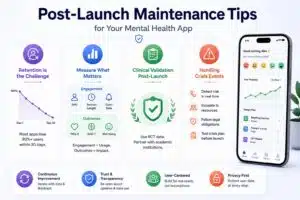
Retention is the Primary Challenge
Industry data consistently shows that most mental health apps lose 90% or more of users within 30 days. The primary reason is not poor UX or weak features. The app solves an acute problem once, and users do not have a compelling reason to return after that initial moment passes. Designing for ongoing value, rather than just a strong first-use experience, is the post-launch challenge that determines whether a mental health app becomes a sustainable product.
Measuring the Right Things
Engagement metrics such as DAU, session length, and notification open rates measure whether users come back. Outcome metrics, including PHQ-9 scores, GAD-7 assessments, and self-reported well-being, measure whether users actually get better. A mental health app that drives strong engagement while producing no measurable improvement in user wellbeing is not a success by any meaningful standard. Build outcome measurement into the product from day one.
Clinical Validation Post-Launch
Randomized controlled trial (RCT) data is increasingly required for insurance reimbursement, enterprise health system sales, and regulatory pathways. The 2025 Dartmouth Therabot RCT covering 210 adults over 8 weeks is an early model for the kind of outcome evidence the market is beginning to expect. Partnering with academic institutions for research validation is a practical first step that does not require the resources of a large clinical organization.
Handling Crisis Events
Your incident response plan for a user signaling acute suicidal ideation must be decided, documented, legally reviewed, and tested before launch. Legal and ethical obligations vary significantly by jurisdiction, and in some markets mandatory reporting requirements apply. Never launch without a tested crisis escalation path and a documented incident response protocol.
Popular Mental Health Apps to Take Inspiration From
The mental health app ecosystem is not a single market but a layered system spanning wellness, therapy, AI support, and clinical care. Leading platforms occupy clearly differentiated positions based on how they define “care” and how deeply they go into clinical intervention.
- Calm – focuses on mindfulness and stress reduction through guided meditations, sleep stories, and ambient audio. Its strength lies in highly polished content and strong consumer branding, positioning it as a daily wellness habit rather than a clinical tool.
- Headspace – extends mindfulness into structured mental fitness programs, helping users build guided routines for stress, focus, and sleep. It also expands into workplace wellness, making it more programmatic and habit-driven compared to purely content-led platforms.
- BetterHelp – operates as a large-scale teletherapy marketplace, connecting users with licensed therapists via chat, audio, and video sessions. Its core value is accessibility and speed of matching, although therapeutic consistency can vary depending on the provider and engagement quality.
- Talkspace – follows a similar teletherapy model but is more tightly integrated with healthcare systems through insurance coverage and structured treatment plans. This positions it closer to traditional therapy delivery, with a stronger emphasis on clinical workflow alignment.
- Woebot – takes an AI-first approach, using conversational CBT techniques to deliver real-time emotional support. It is designed for short, frequent interactions that help users manage mood and thought patterns, rather than replacing human therapists.
- Wysa – combines AI chatbot-based self-help with optional escalation to human coaches or therapists. It sits between wellness and clinical support, making it suitable for both individual users and enterprise mental health programs.
- Brightside – represents the most clinical end of the spectrum, integrating therapy with psychiatric evaluation and medication management. It is designed for users with moderate to severe conditions, operating closer to a digital psychiatry clinic than a wellness app.
Together, these platforms illustrate a clear spectrum: from wellness and habit formation to peer therapy, AI-assisted support, and full clinical care. Understanding these positioning choices is critical for identifying gaps, user expectations, and where a new product can meaningfully differentiate.
Conclusion
The treatment gap in mental health is real, measurable, and significant. Thoughtfully built apps can genuinely close part of that gap by providing access to support for people who cannot afford a therapist, cannot access one geographically, or are not yet ready to make that call.
The bar is high, and it should be. The users are vulnerable, the data is sensitive, and the consequences of a broken crisis path or a compliance failure are serious. The products that have earned lasting user trust in this category share three characteristics:
- They started with clinical grounding and kept a licensed clinician in the loop from day one.
- They built compliance architecture at the start rather than retrofitting it.
- They committed to measuring outcomes rather than just engagement after launch.
Your first step is not writing code. Define your clinical scope. Talk to ten potential users and three licensed clinicians before any development begins. The conversations you have in that discovery phase will shape every product decision that follows and will protect you from the expensive mistakes that happen when clinical and regulatory reality is discovered mid-development.
When you’re ready to move from validation to execution, make sure you’re working with expert healthcare app developers who understand HIPAA compliance, clinical workflows, mental health data privacy, and the unique responsibilities that come with building digital health products. In mental health app development, domain expertise is not a nice-to-have—it is often the difference between a product that earns trust and one that struggles to meet user, clinical, and regulatory expectations.
Frequently Asked Questions
What types of mental health apps can I build?
The five main categories are teletherapy and online counseling platforms, mood tracking and journaling apps, CBT/DBT-based self-guided therapy apps, meditation and mindfulness apps, and crisis intervention and peer support tools. Each carries different feature requirements, regulatory obligations, and clinical responsibilities. Choosing the right type based on your clinical scope, target user, and evidence strategy is the most consequential product decision you will make before development begins.
Do mental health apps need to be HIPAA compliant?
If your app qualifies as a covered entity or business associate handling Protected Health Information, which includes most apps offering therapy sessions, clinical assessments, or diagnosis-related data, HIPAA compliance is a legal requirement. Apps operating purely at the wellness level, such as meditation or general journaling without clinical content, may fall outside HIPAA’s scope. The distinction is not always clear and should be confirmed with legal counsel specializing in digital health.
How much does it cost to build a mental health app?
Development costs range from $45,000 to $80,000 for a basic MVP covering mood tracking and journaling, $80,000 to $200,000 for a mid-tier platform with CBT modules, AI features, and HIPAA compliance, and $200,000 to $500,000 or more for a clinical-grade platform with EHR integration and enterprise-ready architecture. Post-launch infrastructure, security audits, and clinical content maintenance add 25–35% of initial build cost annually.
How long does it take to develop a mental health app?
A basic MVP takes 3 to 5 months. A mid-tier platform with AI features and teletherapy functionality takes 5 to 9 months. A clinical-grade platform targeting enterprise health systems or FDA regulatory pathways typically requires 9 to 18 months. These timelines assume clinical review and compliance architecture are built in from the start rather than added later.
What AI features are appropriate for mental health apps?
AI chatbots for between-session support, sentiment analysis on journal entries, personalized content recommendations, and predictive risk detection with strict clinical oversight are all in active use in production mental health apps in 2026. The core constraint is that AI always augments human care in this category and does not replace licensed professionals. Users must always know when they are interacting with an AI system, and risk prediction models require clinical validation before any deployment.
What is trauma-informed design and why does it matter?
Trauma-informed design is a UX discipline that accounts for the likelihood that users have experienced trauma. In a mental health app context, it means avoiding triggering language in onboarding flows, giving users explicit control over their experience, building predictable and safe interaction patterns, and designing crisis paths that are immediately accessible. It is not an aesthetic preference. It directly affects user safety and clinical appropriateness.
How should I monetize a mental health app?
The most durable models are freemium subscription for consumer apps, B2B employer wellness programs for better unit economics, per-session billing for teletherapy platforms, and insurance reimbursement for the highest long-term value. Advertising and data monetization are ethically inappropriate in this category and should not be pursued.