
 Design
 App Development
 Web Engineering
 AI Services
 Cloud
Cloud Staffing
 Startups
 Health / Fitness
 Education
 Social
 Nonprofit
 Fintech
 Construction
 Logistics
 Government
 Travel/Hospitality
 HR Software
 About Simpalm
 Our News
 Client Testimonials
 Careers
 Our Blog
 Awards
 Resources
 Information
Have you struggled in deciding whether you should be doing offshoring, nearshoring or onshoring for your software project? The right answer does not lie in any of these, the right answer is a combination of having resources at all these locations depending upon the project size and budget.
Hybrid Shoring = Right Shoring
Hybrid shoring has evolved as a very strong model for projects of all sizes due to its success and value proposition. In this blog, we would discuss how organizations these days are using resources at various locations to come up with the outsourcing model that works right for them.
What is Right Shoring? (aka Hybrid Shoring)
Rightshoring means having the right resources at the right location to optimize the cost, timezone and project management for building any software. In the rightshoring model, the client facing team is in the continent where the client is, and the rest of the team is in another continent. For example, a USA based company can hire their senior team like PM, solution architect and designers in the USA and developers, testers in offshore locations. This model provides the best value and cost optimization. The following table shows how the rightshoring model is structured compared to other models.
| Offshore Model | All resources are in offshore locations like India or Eastern Europe, this model existed because of cost saving and resource availability. |
| Nearshore Model | All Resources are in nearshore locations like South America, this model started because of timezone alignment. |
| Rightshoring
Model |
Ownership team at Onshore (Solution Architect, Designer, PM)
Execution Team in Nearshore or Offshore locations (DevOps, Developers, Testers) |
What is the Value of Each Layer in Rightshoring Model?
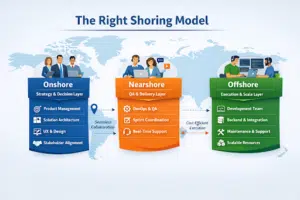
A well-structured rightshoring model is not just about selecting geographical locations—it is about delegating the right responsibilities to the right player of the organization.
Onshore (Strategy & Decision Layer)
- They own the product vision and roadmap
- The Onshore team does the solution architecture and system design.
- Onshore team does the stakeholder alignment and prioritization
- Onshore resources understand the users and business context so they give the UX direction and create UI design.
This layer ensures that decisions are made closer to the business and customer.
Nearshore (QA & Delivery Layer)
- They do QA, DevOps, and release coordination
- They can do Real-time collaboration with onshore teams and also handle dev issues when an offshore team is not available.
This layer enables speed, alignment, and rapid feedback cycles.
Offshore (Execution & Scale Layer)
- This team performs the frontend development based upon the design and user stories.
- They perform backend development and integrations
- They can scale up or scale down the development.
- They would perform Maintenance, support, and optimization.
This layer provides cost efficiency and scalability without impacting strategic alignment.
What is Right Shoring Based Upon the Project Size?
Rightshoring model can vary a bit based upon the size of the project. When companies are building a mid sized solution to large enterprise solutions, companies keep resources at various locations, playing different roles and responsibilities. Here is a right-shoring model for projects above $300K.
| Onshore | Product Design and Solution Architecture |
| Nearshore | Devops and QA |
| Offshore | Development, testing, scaling |
If the project is from $50K-$300K, usually companies don’t keep resources at three different locations, having a team at two different locations is considered rightshoring. For smaller projects, it will be difficult to manage companies located on three different continents.
| Onshore | Product Design and Solution Architecture |
| Nearshore or Offshore | Devops and QA, Development, testing, scaling |
For project under $50K, Hybrid shoring model can be overkill, smaller projects should be done by entire team located at one location so that they can quickly understand and execute the project.
Why Offshoring & Nearshoring are not the Default Option These Days?
Offshoring started around 30-35 years ago to leverage the cheaper talent in Asia and cut down the software development cost. It did work initially, however, it lost the sheen because of communication gap, lack of relationship building, cultural gap and time zone differences. Neashoring did pick up around 10 years ago as an alternative to offshoring, however it has its own issues. Following reasons define why offshoring and nearshoring are not the popular choice for companies in USA:
- The biggest challenge is not being able to convey the product culture and mindset. Every product is used in a culture, and that is difficult to communicate to a team in a different country.
- Nearshoring may not have timezone differences, however, it is always difficult to find enough talented people in South America. Also, some of the top talent start demanding similar salaries like in the USA so the cost benefit is not significant.
- Offshore and nearshore teams lack product ownership, they will just do what they have been asked. They will not come up with suggestions and ideas.
- There is less control on IP due to legal jurisdiction. Additionally, it is difficult to enforce contractual obligations as well.
Why Rightshoring Works for Most of the Cases?
Rightshoring comes with several benefits for the organizations
- Decision making: It helps you to keep strategic resources onshore, that helps to make better decisions and also control the whole SDLC better.
- Execution: Offshore teams focus on what they are good at, which is execution.
- Speed: It keeps the development cycle moving faster.
- Cost: Reduces the overall cost compared to the onshore model, yet provides the values similar to the full onshore model. Cost saving with hybrid shoring is around 30%-40% compared to onshore models.
- Scalability: You can easily scale up or scale down resources compared to onshore models where finding the right resource is not easy.
- Communication: It reduces the communication risk since the leadership is onshore, in the same culture and same timezone.
- Resource Risk: It helps you to diversify the risk of resources since you can access resources at multiple continents in this model.
- Job Creation: This model also helps in creating jobs at multiple locations. Higher value jobs are created onshore so keep most of the money onshore.
“Rightshoring is a resource operating model for software development.”
How Rightshoring reduces the risk
Talent Risk: You can easily get access to multiple resources at various locations and it helps to scale up or replace resources at speed.
Vendor Dependency Risk: having multiple vendors performing various roles reduces the risk of being dependent upon one vendor. Also, multiple vendors can keep checks and balances for each other.
Delivery Risk: Since the control is still with the onshore team, it reduces the communication and coordination risk among the teams and enhances the delivery.
IP and Compliance Risk: Since the architecture team is onshore so all the trade secrets, sensitive data and intellectual properties can be protected with the law of the land.
When Rightshoring can fail
Rightshoring is not a magic pill that would always work, if it is not properly designed and implemented, it can also fail. Here are some of the reasons, we have seen rightshoring model not working:
- If the roles are not properly defined between onshore, nearshore and offshore locations.
- Decision making is fragmented instead of keeping it centralized at onshore.
- If the onshore resources are not capable enough, they can not guide the rest of the team.
- If the communication model is not properly defined, then also it can collapse.
How Simpalm can Help?
Simpalm has 15+ years of experience in building software with rightshoring models. Our client-facing team is in the USA, which makes it easier for us to capture the product’s idea, roadmap, and objectives. Our client facing team works with our execution team, which is co-located in Offshore and Nearshore locations. Our team located on various continents have been trained for similar values, work culture and ethics, which makes it easier for them to communicate and deliver.