
 Design
 App Development
 Web Engineering
 AI Services
 Cloud
Cloud Staffing
 Startups
 Health / Fitness
 Education
 Social
 Nonprofit
 Fintech
 Construction
 Logistics
 Government
 Travel/Hospitality
 HR Software
 About Simpalm
 Our News
 Client Testimonials
 Careers
 Our Blog
 Awards
 Resources
 Information
Key Takeaways
- Frontend shapes the user experience through design, responsiveness and interactivity.Backend powers the logic, databases and server side performance.
- The technology stack for Frontend include HTML, CSS, Javascript with frameworks like React or Angular. Backend relies on Python, Java, node.js with frameworks like Django or Springboot.
- Both domains are inseparable in modern web engineering and offer strong career opportunities with competitive salaries.
- Full stack developers bridge the gap mastering both frontend and backend to deliver complete solutions.
________________________________________________________________________________________
In the world of web development, every website or application is the product of two interconnected disciplines- frontend and backend development. While these two applications work hand in hand, the impact on user experience is very different. The frontend is what the users can see and interact with, whereas the backend is the logic, data, server and performance of the application.
Imagine the web development process as a theatre production- the front end is the stage, costumes, experience.The backend is the crew, the scriptwriters, the sound engineers, and the directors-all of those who ensure that the show runs smoothly.
This distinction matters more than ever in 2026. With businesses competing to deliver seamless digital experiences, frontend developers focus on crafting responsive, intuitive and visually appealing interfaces using technologies like HTML, CSS, and JavaScript with frameworks such as React or Angular. Meanwhile, backend developers work behind the curtain with languages like Python, Java, Node.js, or PHP, designing APIs, managing databases, and ensuring security, scalability and performance.
What is Frontend Development?
Frontend development refers to the client side of web applications, the part that users directly see and interact with. It involves building the layout, design, buttons and interactive elements of a website or application. The frontend ensures that the user experience is smooth, responsive, and visually appealing. Using the frontend, users interact with the application by filling a form, clicking on a link or navigating a page.
In simple terms, frontend developers turn design concepts into functional code that runs in the browser on different devices.They bridge the gap between design and technology, making sure that what users see on their screens is both attractive and usable.
Core Technologies Used in Frontend
Frontend development is built on essential technologies that work together to ensure what users see and interact with. Frontend developers use different technologies to define the structure and behavior of modern web applications.
- HTML (HyperText Markup Language): Provides the structure of web pages, defining elements like headings, paragraphs, forms, and tables.
- CSS (Cascading Style Sheets): Adds styling to the structure, colors, fonts, spacing, and responsive layouts.
- JavaScript: Introduces interactivity, enabling features such as dropdown menus, sliders, form validation, and dynamic content updates.
- TypeScript (optional): Extends JavaScript with static typing, improving code quality and maintainability.
Frameworks and Libraries
Frameworks and libraries simplify the process of building frontends by providing reusable components, pre-written codes and structured approaches to development. They help developers create applications faster, maintain consistency and deliver seamless user experience.
- Modern frontend development often relies on frameworks and libraries to streamline work and add advanced functionality.
- React, Angular, Vue.js: Popular JavaScript frameworks for building dynamic, single-page applications.
- Bootstrap, Tailwind CSS: CSS frameworks that simplify responsive, mobile-first design.
- React Native, Flutter, Ionic: Tools for building cross-platform mobile applications using web technologies.
Roles and Responsibilities of a Frontend Developer
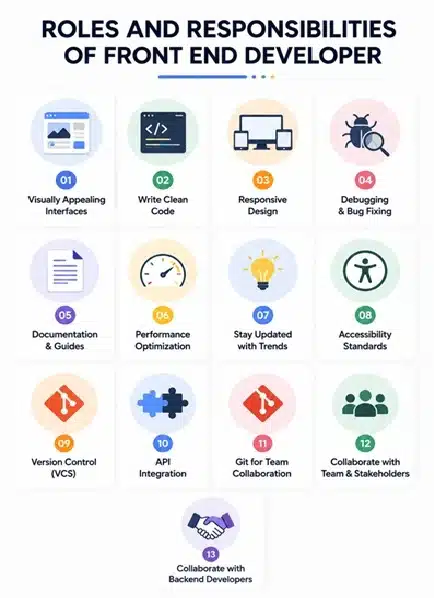
Here are some roles and responsibilities required for frontend developers:
- Building user interfaces that are visually appealing and functional.
- Write well-structured and functional codes using programming languages like HTML, CSS and Javascript.
- Ensuring responsiveness across devices and screen sizes.
- Identifying and fixing errors and bugs in the application.
- Creating functional documentation and guides
- Optimizing performance for fast load times and smooth rendering.
- Stay updated with the latest industry trends and technology.
- Implementing accessibility standards to make applications usable for all users.
- Knowledge of VCS (Version control system) where the developers can track and make changes to the code file.
- Collaborating with backend developers to integrate APIs and data.
- Using version control systems like Git for team collaboration.
- Collaborating with backend developers and other stakeholders for smooth functioning of the application.
Career opportunities and Salary of Frontend Developers
Frontend developers have diverse career opportunities across diverse industries. They can work as UI/UX engineers, frontend specialists, mobile app developers with React Native or Flutter.design system specialists or Full stack developers for both frontend and backend development. Beyond coding, experienced professionals also move into leadership, product management and strategy roles. The demand for frontend developers is high in the IT services industry, global capability centers and freelancing markets making it a future-friendly career path. According to the US Bureau of Labor statistics, overall employment of web developers and digital designers is projected to grow 7% from 2024 to 2034.
Salary of Frontend Developers
| Experience Level | United States | Europe (Average) |
| Fresher (0–2 yrs) | $55K–$70K annually | €40K–€55K annually |
| Junior (2–3 yrs) | $70K–$85K annually | €50K–€65K annually |
| Mid-Level (3-6 yrs) | $85K–$120K annually | €60K–€80K annually |
| Senior Level (6-9 yrs) | $120K–$160K annually | €80K–€120K annually |
| Lead (9+ yrs) | $160K–$250K+ annually (equity/bonuses extra) | €120K–€160K annually |
Why Frontend Development Matters
- First impressions: The frontend is the face of a product and shapes how users perceive a brand.
- User engagement: A well-designed interface encourages users to stay longer and interact more.
- Business impact: A strong frontend improves conversions, customer satisfaction, and retention.
What is Backend Development?
Backend Development refers to the server side of the application. It is the backbone of the website, consisting of servers, database and application logic. This part is responsible for powering the frontend by receiving the user query, searching the database, filtering results and sending the right data to be displayed to the user. The backend of an application is the part that the users cannot see or interact with directly but it handles the business rules, authentication, and communication with external databases or other platforms.
The main components of the backend development include servers, databases, application logic, APIs and authentication and security. The backend developers handle the security, load and performance of the application and also create strategies for building resilient applications for carrying out reliable, behind the scenes action.
Core Technologies Used in Backend
Backend development is based on technologies that power the business logic, data and behind the scenes functions. Though users do not interact directly with the backend, it ensures that the application runs smoothly, efficiently and scales with business needs. Backend developers use different technologies to manage databases, server logic and connect frontend with the business logic to ensure the application runs efficiently.
- Commonly used programming languages are JAVA, Python, PHP, Ruby and Javascript (Node JS).
- SQL databases like MySQL, PostgreSQL, and Oracle, as well as NoSQL options like MongoDB and Cassandra, store and manage application data.
- REST and GraphQL APIs enable communication between frontend and backend systems.
- Tools like Nginx, Apache, AWS, Azure, and Google Cloud provide hosting, scalability, and deployment support.
Frameworks and Libraries
Frameworks and libraries simplify backend development by offering reusable modules, structured workflows and built-in tools for security, authentication and database management. Leveraging this, developers can build scalable applications and maintain consistency across projects.
Modern frameworks include:
- Express.js, Django, Spring Boot, Laravel: These provide routing, middleware, and database integration.
- Hibernate, SQLAlchemy, Mongoose: Libraries for database management and connect those with code.
- Authentication Libraries: Tools like Passport.js or JWT for secure user login and session handling.
Roles and Responsibilities of Backend Developers
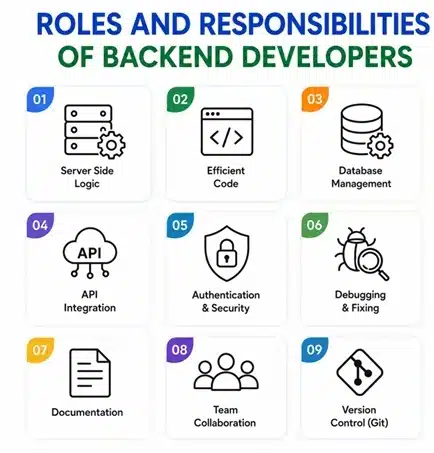
Here are some roles and responsibilities of backend developers:
- Designing and maintaining server side logic of the application.
- Writing efficient, secure and scalable code in backend programming language.
- Managing databases and maintaining data integrity.
- Building and integrating APIs for frontend and backend communication.
- Implementing authentication, authorization and security measures.
- Debugging and fixing server-side errors.
- Creating documentation for backend processes.
- Collaborating with frontend developers and other stakeholders.
- Use version control systems like GIT for team collaboration.
Career Opportunities and Salaries of Backend Developers
The career opportunities for backend developers are numerous as they can work across industries as server-side engineers, cloud engineers, API specialists, database administrators, cloud engineers, or full stack developers who have both frontend and backend expertise.Backend developers are in high demand in product companies, IT services, global capacity centres, and freelancing markets.
Salary of Backend Developers
| Experience Level | United States | Europe |
| Fresher (0–2 yrs) | $60K–$75K annually | €45K–€60K annually |
| Junior (2–3 yrs) | $75K–$90K annually | €55K–€70K annually |
| Mid‑Level (3–6 yrs) | $90K–$110K annually | €65K–€85K annually |
| Senior Level (6–9 yrs) | $120K–$150K annually | €90K–€120K annually |
| Lead (9+ yrs) | $150K–$200K+ annually (equity/bonuses extra) | €120K–€160K annually |
Why Backend Development Matters?
- Application Stability- The backend ensures that the data flows correctly between front and backend and systems run in a secured way.
- Security- Protects sensitive data through authentication, encryption and secure APIs.
- Scalability- Enables applications to handle growth in users, data and traffic.
- Business Logic- Translates real-world processes into functional code that drives the product.
A Tabular Representation of Frontend vs Backend Development
Modern web engineering consists of two facets while building modern applications- frontend and backend. The frontend or the user side of the application is what the users see and interact with and the backend consists of the servers, database and business logic. Together, the frontend and the backend enhances the usability and functionality of the application.
Here is a quick glimpse of the key differences:
| Aspect | Frontend Development | Backend Development |
|---|---|---|
| Definition | Everything users see and interact with | Server side powering the application-logic, database, infrastructure |
| Primary Focus | User Interface (UI) and user experience (UX) | Application functionality, data management, server communication |
| Core Technologies | HTML, CSS, Javascript | Java, Python, PHP, Ruby, C#, Node.js |
| Frameworks and Libraries | React, Angular, Vue.js, Bootstrap, Tailwind CSS | Django, Flask, Spring, Laravel, Ruby on Rails |
| Responsibilities | Build responsive layouts Implement design and interactivity
Optimize performance Ensure accessibility Collaborate with backend for APIs |
Manage databases
Handle server logic Build APIs Ensure security & authentication Optimize performance & scalability |
| Databases | Rarely interacts with databases | Works directly with databases (SQL, MongoDB, PostgreSQL, MySQL) |
| Tools | Version control (Git), package managers (npm, yarn), build tools (Webpack, Vite) | Version control (Git), server tools (Apache, Nginx), containerization (Docker, Kubernetes). |
| Output | Visual elements- buttons, forms animations, layouts | Data processing, API responses, authentication, server side rendering |
| Performance Concerns | Page load speed responsiveness, smooth animations | Query optimization, server response time, scalability under load |
| Security | Implements client-side validation,
mitigates UI vulnerabilities |
Handles authentication, authorization, encryption, data protection |
| Career Opportunities | Frontend developer, UI/UX engineer, web designer | Backend engineer, database engineer, DevOps engineer |
| Emerging Trends | Progressive web apps (PWA), Micro interactions,AI-driven personalization | Cloud-native development, serverless computing, microservices, API-first architecture |
Where Frontend Meets Backend: The Power of Full Stack App Development
Full stack development is the practice of building both the front and back end of an application. A full stack developer is an expert in both front end programming languages like HTML, Javascript and CSS and backend technologies like database, business logic and server side. This level of proficiency allows them to create a seamless user experience and develop a robust backend architecture of the application at the same time.
Since a full stack developer is an expert in handling both the frontend and the backend of the application, they can handle all the phases of web engineering. This expertise makes them eligible to apply for diverse roles in creating processes for both user-side and server side of the application.
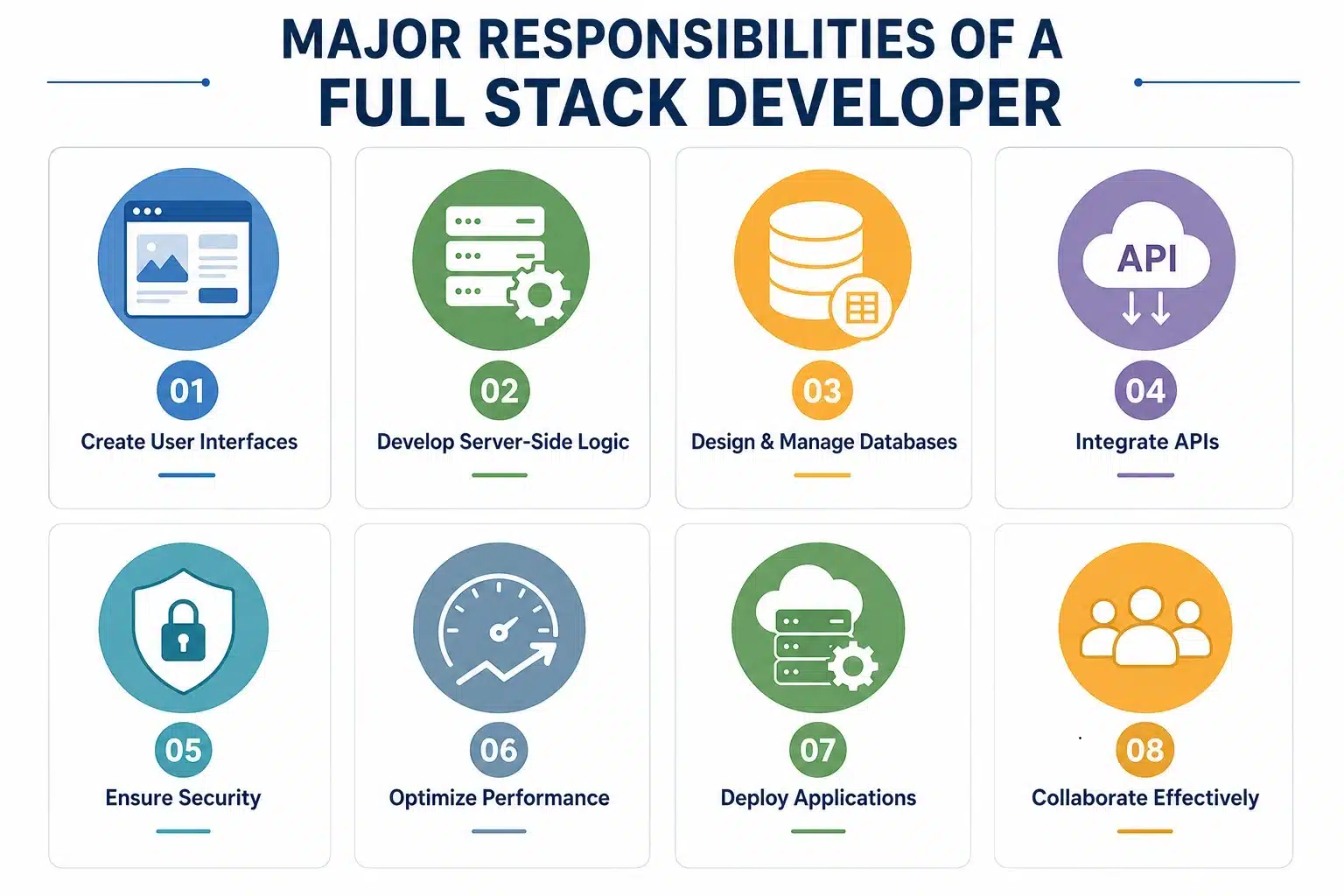
The major responsibilities of a full stack developer are:
- Creating user-friendly and attractive user interfaces using HTML, CSS3, Javascript
- Developing server-side of the application using Python, Java, PHP.
- Designing and managing databases like MySQL, MongoDB or PostgreSQL.
- Integrating APIs to connect the frontend with the backend.
- Building application security, authentication and data protection.
- Improve performance at the client-side and the server side of the application.
- Deploying applications using DevOps tools like Docker, Kubernetes and CI/CD pipelines.
- Collaborating with multiple stakeholders to deliver complete solutions.
Techniques Used in Full Stack Development: Agile vs Waterfall
Full stack developers follow a specific methodology to manage the complexities of both frontend and backend of the application. The two most widely used methodologies are Agile and Waterfall both of which have their own strengths and weaknesses.
| Methodology | Characteristics | Pros | Cons | Use Cases |
| Agile | Iterative and incremental approach
Project is divided into short sprints Continuous feedback and collaboration loops Between developers, test engineers and other stakeholders |
Flexible and adaptable to changes
Faster delivery of working features Encourages collaboration and transparency |
Requires frequent and strong collaboration
Budget and timelines are prone to change Stakeholder involvement is non-negotiable |
Dynamic projects like modern web app development where requirements evolve |
| Waterfall | Linear sequential approach
Each phase is completed before moving on to the next phase |
Clear structure and documentation
Easy to manage for small projects Predictable budget and timelines |
Late discovery of issues
Non-adaptable to changes |
Project with fixed requirements like government or compliance-heavy projects |
;
Frontend vs Backend Development: Why Both Matter in Building Modern Web Applications
Both frontend and backend development plays crucial roles when it comes to building websites or app development. The frontend ensures that users have a seamless, engaging and visually appealing experience. The backend powers the logic, manages databases and handles security making the application functional. Both of these areas are equally important in building applications and one part cannot do without the other.
How frontend impacts web development?
- The frontend drives the first impression of the product through design and usability.
- Ensures responsiveness and accessibility across devices and audiences.
- Drives user engagement and satisfaction.
- Boosts business outcomes with conversions and retention.
How backend impacts web development?
- Powers business logic that makes the application reliable.
- Manages data storage, retrieval and security.
- Ensures scalability and performance under heavy user loads.
- Provides integration with APIs and third party services.
Understanding the fundamentals of frontend vs backend development gives a holistic view of how secure and scalable web applications are built. It also lays the groundwork for expertise and domain interest before choosing frontend or backend development.
Summing Up
In the evolving digital landscape,understanding frontend vs backend development is the key to modern web engineering. The frontend ensures seamless user experience with attractive interfaces, design and responsiveness while the backend powers the business logic, data and security that makes the application reliable. Full stack development bridges the gap between front end and backend of the application to deliver end-to-end solutions.
Ready to dive deeper into building well planned, secure and scalable web applications? Connect with us!
Frequently Asked Questions
Q1.What is the difference between frontend and backend development?
Frontend focuses on the user interface and experience, while backend handles server logic, databases, and application functionality. Together, they create complete web applications.
Q2.Why are both frontend and backend development equally important in modern web engineering?
Frontend ensures usability and design appeal, while backend guarantees performance, scalability, and security. Neither can function effectively without the other.
Q3.What skills are required to become a full stack developer?
A full stack developer needs proficiency in frontend languages (HTML, CSS, JavaScript), backend technologies (Python, Java, PHP), database management, API integration, and DevOps tools.
Q4.What career opportunities are available for full stack developers?
Full stack developers can work as web engineers, software developers, product developers, or technical leads, making them highly versatile and in-demand across startups, enterprises, and tech firms.
Q5.What is the main role of frontend in a web application?
The frontend is the user-facing side of a web application. Its main role is to deliver a clear, responsive, and interactive interface that users interact with. The frontend handles layouts, design, and interactivity using programming languages like HTML, CSS, and JavaScript, while connecting with the backend to display data to the users.