
 Design
 App Development
 Web Engineering
 AI Services
 Cloud
Cloud Staffing
 Startups
 Health / Fitness
 Education
 Social
 Nonprofit
 Fintech
 Construction
 Logistics
 Government
 Travel/Hospitality
 HR Software
 About Simpalm
 Our News
 Client Testimonials
 Careers
 Our Blog
 Awards
 Resources
 Information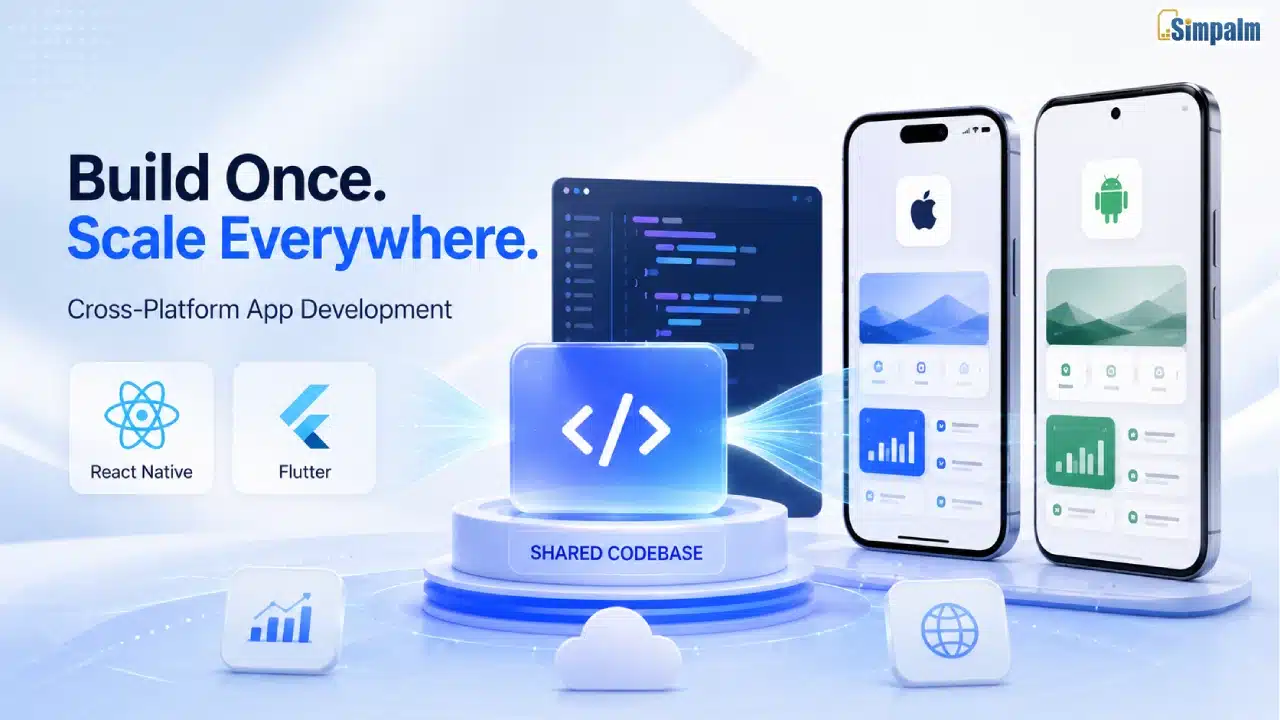
Imagine launching your app on iOS first, only to realize your team now has to build and maintain a separate Android version. What starts as a simple mobile app project quickly turns into duplicated development efforts, higher costs, slower releases, and ongoing maintenance complexity.
This is why cross-platform app development has become a strategic choice in 2026 rather than just a cost-saving approach.
Modern frameworks like React Native and Flutter allow teams to share up to 70–95% of their codebase across iOS and Android while still delivering near-native performance. This helps businesses launch faster, reduce development overhead, and maintain a more consistent user experience across platforms.
For product teams, the benefits are clear:
- Faster time-to-market
- Lower development and maintenance costs
- Unified user experience
- Easier updates and feature rollouts
However, cross-platform development is no longer just about “write once, run everywhere.” Choosing the right approach requires understanding the trade-offs between native, hybrid, and cross-platform development models.
In this guide, we’ll cover what cross-platform app development is, how it compares with other approaches, the top frameworks in 2026, and how to decide if it’s the right fit for your project.
What is Cross-Platform App Development & How Does It Work?
Cross-platform app development is an approach to developing mobile applications that allows a single codebase to run on multiple operating systems, primarily iOS and Android, without writing the code for each platform. Instead of maintaining two entirely separate projects in platform-specific languages, developers write code once and deploy it across multiple operating systems.
Cross-platform frameworks run on one principle: “write once, run everywhere.” The framework or runtime layer handles the translation between the shared codebase and the native APIs of each targeted platform.
Depending on the framework, anywhere from 30% to 95% of the codebase can be shared across platforms, with small portions reserved for platform-specific logic or UI adjustments.
This wasn’t always possible. In the early days of smartphone development, building an iOS app meant writing code in Swift or Objective-C, and developing an Android app meant writing code in Java or Kotlin. That means managing two entirely separate projects, two codebases, two teams, and double the maintenance burden. Cross-platform development emerged as a response to that fragmentation, evolving rapidly from early WebView-based wrappers to dedicated frameworks that deliver near-native performance.
The Problem Cross-Platform Approach Solves
Smartphone Operating System fragmentation creates a genuine resource challenge for development teams. A company that wants to reach both iOS and Android users has traditionally faced difficult challenges:
- Invest twice the budget for separate native development
- Delay one platform’s launch
Beyond cost, there are serious time-to-market pressures. Coordinating two separate development cycles means product updates, bug fixes, and new features rarely ship simultaneously across both platforms. Cross-platform development directly addresses this by unifying the development cycle. Teams share not just code but also product logic, design systems, and testing infrastructure.
Cross-Platform vs. Native vs. Hybrid Development Approach: Understanding the Differences
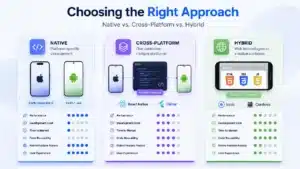
Choosing the right development approach is one of the most consequential early decisions in any mobile app project. Here’s a clear breakdown of these three approaches.
1. Native App Development
Native development means building an app specifically for a single platform using platform-specific languages and tools. iOS apps are built with Swift (or legacy Objective-C) in Xcode, while Android apps are built with Kotlin (or Java) in Android Studio.
Because native apps are developed directly for their target operating system, they offer the highest level of performance and platform integration. However, that performance advantage also comes with higher development and maintenance complexity across platforms.
Here’s a quick overview of the key advantages and trade-offs of the native development approach:
| Advantages | Disadvantages |
|
|
2. Cross-Platform Development
Cross-platform development allows developers to build a single application that runs on both iOS and Android using a shared codebase. Modern frameworks like React Native and Flutter no longer rely on simple browser-based wrappers. Instead, they render native UI components or use advanced rendering engines to deliver a much more responsive and app-like experience.
In most projects, teams can reuse 70–95% of the codebase across platforms, while handling only a small portion of platform-specific logic separately. This significantly reduces development effort, simplifies maintenance, and accelerates release cycles compared to managing separate native applications.
As these frameworks have matured, the performance gap between cross-platform and native apps has narrowed considerably. For most business applications, eCommerce platforms, SaaS products, social apps, and content-driven mobile experiences, modern cross-platform apps now deliver performance that feels nearly identical to native apps.
Here’s a quick overview of the main strengths and limitations of the cross-platform approach:
| Advantages | Disadvantages |
|
|
3. Hybrid App Development
Hybrid apps are often confused with cross-platform apps, but the two are meaningfully different. A hybrid app is essentially a web application, built with HTML, CSS, and JavaScript, running inside a native WebView container. Frameworks like Ionic and Apache Cordova are used to develop apps under a hybrid approach.
The key distinction in the hybrid approach is in rendering.
Hybrid apps render through a browser engine, while cross-platform frameworks like React Native render through actual native UI components, and Flutter renders through its own custom graphics engine. This difference matters because it affects performance, access to native APIs, and the overall feel of the app. Hybrid apps are best suited for content-driven applications, internal tools, or projects where web development skills need to be leveraged with minimal investment, but this approach is not suitable for complex, interaction-heavy consumer apps.
At-a-Glance: Comparison Among Different App Development Approaches
| Factor | Native | Cross-Platform | Hybrid |
| Development Cost | High | Medium | Low |
| Time to Market | Slow | Fast | Fastest |
| Performance | Best | Near-native | Limited |
| Code Reusability | 0% | 70–95% | 95–100% |
| Native Feature Access | Full | Mostly full | Limited |
| User Experience | Excellent | Very good | Acceptable |
| Maintenance Complexity | High | Medium | Low–Medium |
The Top Cross-Platform Development Frameworks in 2026
The cross-platform ecosystem has matured considerably, with two frameworks dominating the industry, and several other frameworks serving important niches.
1. React Native
React Native, created and maintained by Meta (formerly Facebook), is one of the most widely adopted cross-platform frameworks in the world, powering more than 32,000 apps across industries. It uses JavaScript, the world’s most widely used programming language, and React’s component model to build mobile UIs that map to actual native components. This means a React Native button isn’t a fake button drawn on a canvas; it’s a real iOS or Android button rendered by the OS.
The framework’s core strength is its ecosystem. React Native benefits from the enormous JavaScript community, a mature library ecosystem, and a low barrier to entry for web developers transitioning to mobile. It also offers Hot Reloading, which lets developers see code changes reflected in the app instantly without a full rebuild.
In 2026, React Native continues to evolve with its New Architecture, centered on JSI (JavaScript Interface) and the Fabric rendering system, which significantly reduces the overhead of the JavaScript-to-native bridge, improving performance and enabling synchronous native module access.
| Notable apps built on React Native include Facebook, Instagram, Shopify, and Walmart. |
2. Flutter
Flutter, Google’s open-source UI framework, takes a fundamentally different approach from React Native. Rather than mapping to native UI components, Flutter uses its own high-performance rendering engine called Skia (and increasingly, the newer Impeller engine). This gives Flutter apps an exceptionally consistent look across platforms while still allowing developers to mimic platform-specific design when needed.
Flutter uses Dart, Google’s programming language optimized for client-side development. While Dart isn’t as mature as JavaScript, it’s clean, strongly typed, and beginner-friendly, and developers typically feel productive within days. Flutter’s widget-based architecture makes it straightforward to build beautiful, complex UIs with smooth animations.
The Impeller rendering engine, which became the default in recent Flutter versions, eliminates the shader compilation jank (used to avoid lag when a new operation is executed in the app) that affected earlier Flutter apps. Flutter has also expanded its web and desktop support significantly in 2026.
| Notable apps built on Flutter include Google Pay, Alibaba’s Xianyu, BMW’s My BMW App, and thousands of startups globally. |
3. Other Notable Frameworks
While React Native and Flutter dominate the market, several other frameworks continue to serve specialized use cases in development niches within the cross-platform mobile app ecosystem.
.NET MAUI (formerly Xamarin) is Microsoft’s cross-platform framework for C# developers. It’s an excellent choice for teams already invested in the .NET ecosystem, offering deep integration with Visual Studio and Azure services. It compiles to native UI components, similar in concept to React Native.
Ionic remains a popular option for teams who want to leverage web skills (HTML, CSS, Angular/React/Vue) to build mobile apps. It is basically a hybrid development approach but has evolved significantly, offering Capacitor as a modern runtime. It’s best suited for enterprise internal tools, content apps, or teams with primarily web development expertise.
Kotlin Multiplatform (KMP) from JetBrains represents a different philosophy. Rather than replacing native development, KMP allows teams to share business logic (networking, data persistence, domain models) across platforms while keeping UI code native on each platform. It’s ideal for teams that want the performance and flexibility of native UI with the efficiency of shared logic, and it’s gaining traction among larger engineering organizations due to its effectiveness in delivering better performance.
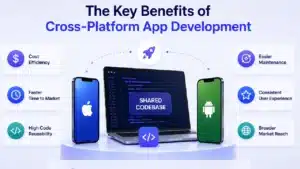
The Key Benefits of Cross-Platform App Development
1. Cost Efficiency
The most immediate advantage of cross-platform development is cost reduction. By maintaining a single codebase instead of two, development teams are typically 30–40% smaller, infrastructure costs are lower, and the ongoing maintenance burden is significantly reduced.
For startups and mid-sized businesses, this means the same budget can deliver a polished, multi-platform product rather than a strong app on one platform and a delayed or inferior one on the other.
2. Faster Time to Market
Cross-platform development enables simultaneous launches on both iOS and Android. Rather than staggering release cycles, which often means Android users wait months after iOS launches or vice versa, teams can ship to both platforms at once.
This unified development cycle also accelerates rapid prototyping and iteration during early product discovery.
3. Code Reusability
Depending on the app’s complexity, 70–95% of the codebase can be shared between platforms. This includes core business logic, API integrations, state management, data models, and most of the UI. Only platform-specific behaviors, such as push notification handling, in-app purchase flows, and OS-specific UX patterns, require separate attention.
The result is a leaner, more maintainable codebase that a smaller team can confidently own and manage.
4. Easier Maintenance and Updates
Bug fixes, feature additions, and content updates applied to a cross-platform codebase automatically propagate to both iOS and Android. There’s no risk of a bug being fixed on one platform but lingering on another due to independent development cycles.
This consistency is especially valuable for apps with frequent release cadences.
5. Consistent User Experience
Brand consistency is easier to achieve and maintain when a single design system drives both platforms. Design tokens, typography, color schemes, and component libraries can be defined once and applied everywhere.
Cross-platform frameworks like Flutter and React Native make it straightforward to adapt the same underlying components to the appropriate visual components of each OS.
6. Broader Market Reach from Day One
Launching on both iOS and Android simultaneously means the full addressable market is available from the first day of launch. There’s no need to choose between Android’s dominant global market share and iOS’s high-value demographics while launching your new app in the market. A single cross-platform app captures both, and that too simultaneously. This is particularly valuable for businesses building applications powered by conversational AI, where delivering a consistent experience across multiple platforms is critical for user engagement and customer satisfaction.
Challenges and Limitations of Cross-Platform App Development You Should Know
Cross-platform development isn’t without trade-offs. Understanding the limitations upfront prevents costly mid-project reworks.
1. Performance in Demanding Scenarios
For most applications, such as social apps, e-commerce platforms, productivity tools, dashboards, and content apps, cross-platform performance is entirely sufficient. However, applications with intensive graphical demands can still expose gaps. Complex 3D animations, real-time physics, and computationally heavy graphics pipelines are better handled natively or through game engines like Unity.
React Native’s New Architecture and Flutter’s Impeller engine have narrowed this gap considerably, but for frame-rate-critical or GPU-intensive apps, the abstraction layer still carries a cost.
2. Access to Platform-Specific Features
When Apple or Google introduces new OS features, such as a new camera API, a fresh biometric authentication method, or a novel AR capability, it typically takes time for cross-platform frameworks to support them. Native developers get day-one access, while cross-platform developers often have to wait weeks or months for official framework support, or must write custom native modules to bridge the gap.
For apps that compete on cutting-edge OS feature adoption, this delay matters.
When it comes to choosing platform-specific features, one challenge our CTO frequently points out is that many businesses choose a development approach too early.
“One mistake we often see is companies choosing cross-platform too early without evaluating future hardware or performance requirements. If an app roadmap heavily depends on AR, advanced camera processing, or real-time rendering later, those decisions should influence architecture from day one, not after scaling begins.”
Insight from CTO, Oracle
3. User Experience Nuances
iOS and Android have distinct design philosophies. Android prefers Material Design while iOS focuses on Human Interface Guidelines. And users on each platform have developed expectations shaped by those conventions. Navigation patterns, typography, button placement, and gesture behaviors differ meaningfully. Getting cross-platform apps to feel truly native on both platforms requires deliberate platform-specific customization, which partially offsets the code-sharing advantages.
4. Framework-Specific Learning Curve
While cross-platform frameworks eliminate the need to master two completely separate mobile ecosystems, they still come with their own learning curve. Developers need to understand Flutter’s Dart language, React Native’s component-based architecture, and each framework’s tooling, state management patterns, testing methods, and debugging workflows. For teams moving from web or backend development into mobile, adapting to these development aspects and workflows usually takes dedicated onboarding time.
5. App Size
Cross-platform apps tend to be larger than their native counterparts. Flutter bundles its own rendering engine, and React Native includes the JavaScript runtime, both of which add to the download size. For users in markets with limited storage or bandwidth-constrained connections, this can be a meaningful consideration.
When Should You Choose Cross-Platform Development?

Cross-platform development is not the right solution for every mobile application. The ideal approach depends on factors such as product complexity, performance requirements, scalability goals, development timelines, and long-term maintenance plans. Let’s evaluate various use case scenarios.
1. Ideal Situations for Cross-Platform
Cross-platform mobile app development is a strong fit when you’re
- When heavy user experience is not desired
- Building an MVP
- Enterprise app
- Internal business apps.
- When the budget is limited.
In all cases, a cross-platform approach helps you validate product-market fit quickly without committing to the cost of dual native development. It’s also well-suited for apps with standard mobile functionality, such as authentication flows, data display, CRUD operations, notifications, and API-driven content, where the performance ceiling of cross-platform frameworks is more than sufficient.
Thus, derivatively, budget-constrained projects, early-stage startups, and agencies building client products across multiple verticals all benefit significantly from the efficiency of a shared codebase. The same applies to content-driven applications like media apps, e-learning platforms, and productivity tools, where the UI is primarily informational and interaction complexity is manageable.
2. When Native Development Makes More Sense
Certain use cases genuinely call for native app development. These use cases include games, especially 3D or action games, which are typically built with native code or a game engine like Unity or Unreal, where cross-platform mobile frameworks don’t offer meaningful advantages. Likewise, applications centered on augmented reality, virtual reality, or machine learning inference on a device often require deep, low-level access to platform hardware that cross-platform frameworks can’t easily provide.
Other cases where native app development is more efficient –
- Apps that need to adopt brand-new iOS or Android features immediately at launch
- Apps that rely heavily on adopting newly released OS features before their competitors in the market.
3. A Decision Framework
When evaluating your approach, ask the following questions:
- What is the primary audience of the app, and does either iOS or Android significantly limit that demographic?
- What is the budget and timeline?
- Does the team have existing JavaScript or Dart experience that lowers the cross-platform learning curve?
- Are there performance, hardware, or cutting-edge API requirements that native access would better serve?
- What is the long-term maintenance plan, and how large will the team be?
In most cases, if the app’s core functionality can be delivered without specialized hardware access or extreme graphical demands, cross-platform development is the more pragmatic and cost-effective path.
How Modern Cross-Platform Frameworks Are Closing the Performance Gap
Performance has historically been one of the biggest concerns around cross-platform app development. But in 2026, improvements in rendering engines, framework architecture, and developer tooling have significantly narrowed the gap between cross-platform and native apps.

To understand how this shift happened, it’s important to look at three areas shaping modern cross-platform performance: the current state of framework capabilities, the optimization techniques developers rely on, and the tooling used to monitor performance at scale.
1. Current State: Frameworks Delivering Near-Native Performance
The narrative that cross-platform apps are inherently slow is becoming increasingly outdated. The gap between cross-platform and native performance has narrowed dramatically over the past several years. Flutter’s Impeller rendering engine delivers smooth 60fps (and even 120fps on supported hardware) animations with reduced jank. React Native’s New Architecture eliminates the asynchronous bridge that was a major performance bottleneck in older versions, enabling synchronous, low-latency communication between JavaScript and native modules.
For the overwhelming majority of commercial app use cases, a well-built cross-platform app is indistinguishable from a native one in day-to-day use.
2. Optimization Techniques
The same principles that apply to optimizing the performance of native apps apply to cross-platform apps. Efficient memory management, avoiding retained references, using lazy loading for images and lists, and properly disposing of resources, is foundational. CPU and battery optimization involves avoiding unnecessary background work, batching network requests, and using platform-specific background processing APIs appropriately.
UI rendering is often the most visible performance dimension. Reducing widget tree depth in Flutter, avoiding unnecessary re-renders in React Native with memoization (useMemo, React.memo), and using virtualized list components (FlatList in React Native, ListView in Flutter) are all standard practices that dramatically improve scrolling performance in list-heavy apps.
3. Performance Monitoring
Both major frameworks have mature tooling for profiling and performance monitoring. Flutter DevTools provides detailed timelines of frame rendering, memory allocation, and CPU profiling.
React Native integrates with Flipper for network inspection, layout debugging, and performance tracing. For production monitoring, tools like Firebase Performance Monitoring, Datadog, and Sentry work seamlessly with both cross-platform frameworks.
The Future of Cross-Platform Mobile Development
Cross-platform mobile app development is no longer viewed as a workaround or a secondary option. It has become a mainstream approach to building modern mobile applications. Frameworks have matured rapidly, and in 2026, the tooling, performance capabilities, and developer ecosystems around React Native and Flutter are now comparable to many native development environments.
Industry adoption continues to expand across both startups and large enterprises. Companies such as Google, Meta, Alibaba, Microsoft, and BMW are actively using cross-platform frameworks within major parts of their mobile ecosystems. This level of adoption signals that cross-platform technologies are fully capable of supporting large-scale, production-grade applications with high traffic and complex user experiences.
Key Trends Shaping the Future of Cross-Platform Development
- Kotlin Multiplatform is gaining traction as a hybrid development approach. As it enables teams to share business logic while keeping native UI layers intact.
- Flutter is rapidly expanding beyond mobile, with stronger support for web and desktop platforms, moving closer to a true multi-platform ecosystem.
- AI-assisted development tools are becoming a standard part of cross-platform workflows, helping teams speed up code generation, testing, debugging, and refactoring.
- Advancements in 5G connectivity and edge computing are reducing network latency and improving the real-time performance capabilities of modern mobile applications.
Why the Right Development Partner Makes All the Difference
Architecture decisions may seem straightforward early on, but they directly affect development speed, scalability, maintenance complexity, and long-term product costs.
That is why choosing an experienced development partner matters as much as choosing the framework itself. Simpalm has 15+ years of expertise in providing niche digital products. As a cross-platform app development company, we help businesses evaluate, design, and build unified applications that balance speed, usability, and long-term maintainability.
One of our eCommerce clients reduced mobile development costs by 38% and launched its customer engagement app on both iOS and Android nearly four months faster by moving from separate native development plans to a unified ReactNative-based architecture. The result was faster user adoption, simpler maintenance, and a significantly more efficient product roadmap moving forward.
Industry adoption trends further highlight the efficiency of cross-platform development. Google Pay reported a 70% reduction in engineering effort after adopting Flutter, while eBay achieved 98.3% shared code and 2× faster development compared to their prior native approach.
For businesses evaluating cross-platform development in 2026, the right architecture, supported by an experienced product and engineering team, can significantly improve development efficiency, scalability, and long-term product growth.
Conclusion
Cross-platform app development has evolved into one of the most practical and scalable ways to build modern mobile products. With frameworks like React Native and Flutter, businesses can launch applications on both iOS and Android using a shared codebase while still maintaining strong performance, faster release cycles, and consistent user experiences. For many companies, this approach has helped them to reduce development costs by 30 to 40% and significantly shorten time to market compared to maintaining separate native teams.
Cross-platform solutions are now the preferred choice for most startups, healthcare providers, fintech companies, eCommerce brands, and SaaS platforms looking to scale efficiently across devices.
For companies evaluating how to build and scale mobile products efficiently in 2026, the right development approach can create a measurable advantage in both speed and long-term product growth, especially when supported by an experienced cross-platform development team.
Frequently Asked Questions
Q1. What is the difference between cross-platform and native app development?
Ans. Cross-platform development uses a shared codebase for iOS and Android, while native development requires separate apps for each platform, offering deeper OS-level optimization.
Q2. Is cross-platform app development good for startups in 2026?
Ans. Yes. Cross-platform frameworks like React Native and Flutter help startups reduce development costs, launch faster, and maintain apps more efficiently across platforms.
Q3. Which is the best cross-platform app development framework in 2026?
Ans. Flutter and React Native remain the leading frameworks in 2026 due to their strong ecosystems, near-native performance, and high code reusability for iOS and Android apps.
Q4. Can cross-platform apps deliver native-like performance?
Ans. Modern cross-platform frameworks now deliver near-native performance for most business, fintech, healthcare, SaaS, and eCommerce applications through advanced rendering engines and optimized architectures.
Q5. When should businesses avoid cross-platform app development?
Ans. Businesses should consider native development for graphics-heavy apps, AR/VR experiences, advanced gaming, or applications requiring immediate access to new iOS and Android hardware features.