
 Design
 App Development
 Web Engineering
 AI Services
 Cloud
Cloud Staffing
 Startups
 Health / Fitness
 Education
 Social
 Nonprofit
 Fintech
 Construction
 Logistics
 Government
 Travel/Hospitality
 HR Software
 About Simpalm
 Our News
 Client Testimonials
 Careers
 Our Blog
 Awards
 Resources
 Information
Key Takeaways:
- Build for trust first. Security, compliance, and reliability are as important as the trading experience.
- Real-time performance is non-negotiable. Low latency and accurate market data directly impact user confidence.
- Start with an MVP, then scale. Launch core trading features first and expand based on user feedback.
- Choose your technology wisely. The right architecture and APIs determine your app’s scalability, performance, and long-term cost.
________________________________________________________________________________________
Mobile trading has fundamentally changed how people invest. Twenty years ago, checking your portfolio required logging into a desktop website during business hours. Today, millions of people manage millions of dollars in trading positions from their phones, at any time, from anywhere on earth.
This shift is not slowing down. The global mobile trading app market reached $7 billion in 2024 and is expected to grow by 11 percent annually through 2030. More retail investors are opening accounts than ever before. Demand for real-time data, instant order execution, and sophisticated analysis tools is higher than it has ever been.
If you are thinking about building a trading app, now is the time to understand what it actually takes. This guide walks through everything: what makes a trading app work, what features matter, what it costs, and what goes into a successful launch.
What is a Mobile Trading App?
A mobile trading app is software that lets people buy, sell, and manage investments directly from their phone. That sounds simple. The reality is much more complex.
Understanding Mobile Trading Applications
A mobile trading app is different from a traditional brokerage platform in several key ways. A brokerage website is built for detailed research and careful decision-making. A mobile trading app is built for speed, accessibility, and action.
The app connects directly to market data feeds that refresh in real-time. It processes orders instantly. It shows your positions, profits, and losses as markets move. It has to work flawlessly during market hours when millions of transactions are happening across the entire financial system.
This is why trading apps are fundamentally harder to build than most other consumer finance apps. They are not just tools. They are direct connections into the financial markets.
Types of Mobile Trading Apps
Different types of trading apps serve different purposes and different users.
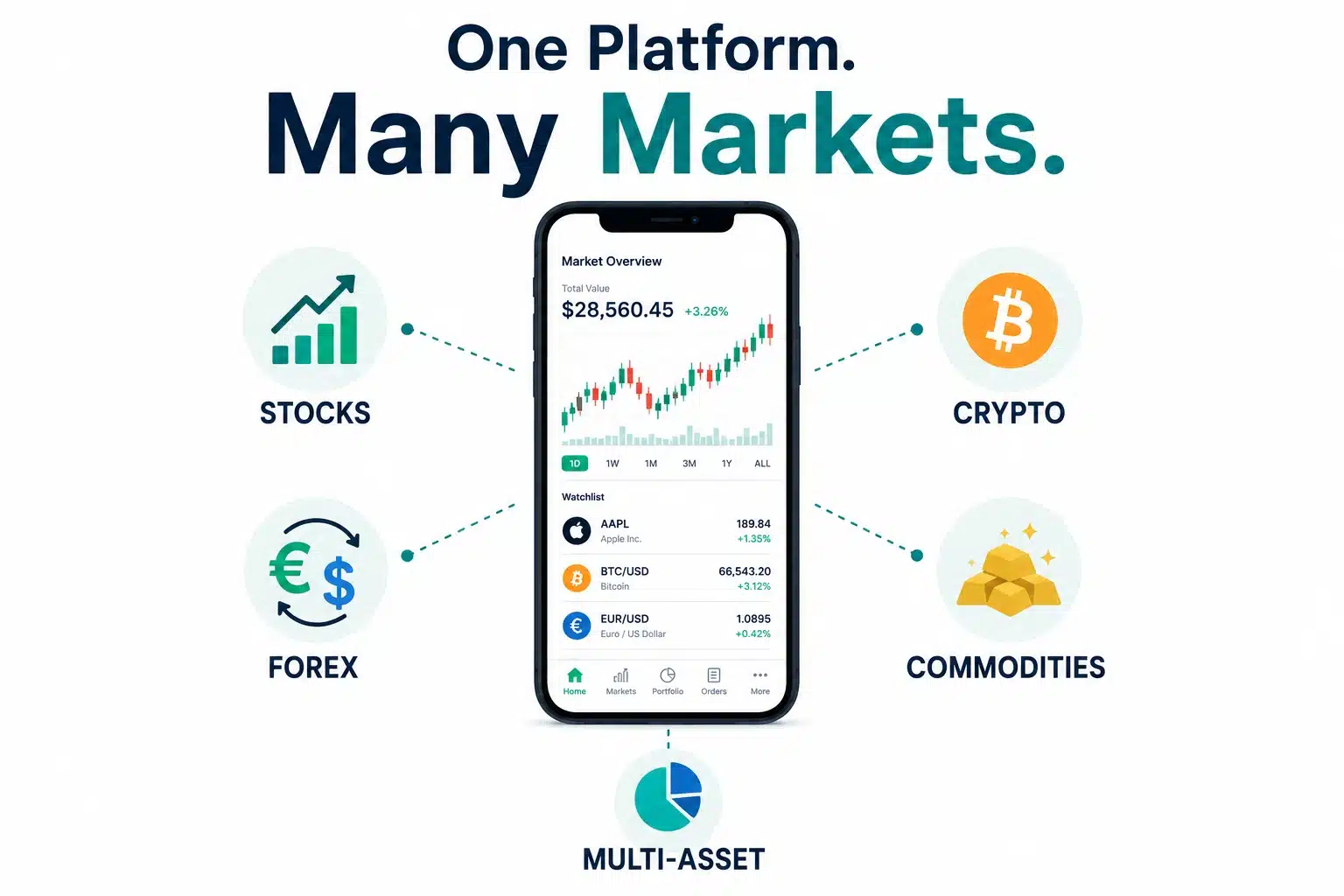
Stock trading apps let people buy and sell shares in public companies. Apps like Robinhood and TD Ameritrade started here. They target everyone from complete beginners to experienced investors.
Forex trading apps focus on currency trading. Traders exchange one currency for another, trying to profit from price movements. These apps attract professional traders and financial institutions more than retail users.
Cryptocurrency trading apps let people buy and sell digital assets like Bitcoin and Ethereum. Apps like Coinbase and Kraken dominate this category. The crypto market trades 24/7, which creates unique challenges for app builders.
Commodity trading apps focus on oil, gold, and other raw materials. These are less common in the mobile space but growing as interest in alternative assets increases.
Multi-asset trading platforms combine all of the above. You can trade stocks, crypto, forex, and commodities in one app. This is where the market is heading, and it is also where the complexity multiplies.
How Mobile Trading Apps Work
The flow is straightforward, but the infrastructure behind it is extremely complicated.
A user registers and verifies their identity. They link a bank account. The app pulls real-time market data from exchanges and data providers. The user sees live prices and decides to place an order. They tap buy or sell. The app sends the order to an exchange or broker partner. The order executes. The app updates the user’s portfolio instantly. The user can see the position, set alerts, and manage their investment in real-time.
Every step of this process has layers of complexity underneath. The app has to authenticate users securely. The data feed has to update in microseconds. The order system has to be rock solid because mistakes cost real money. The portfolio update has to be instantaneous so users always see accurate positions.
Essential Features of a Mobile Trading App
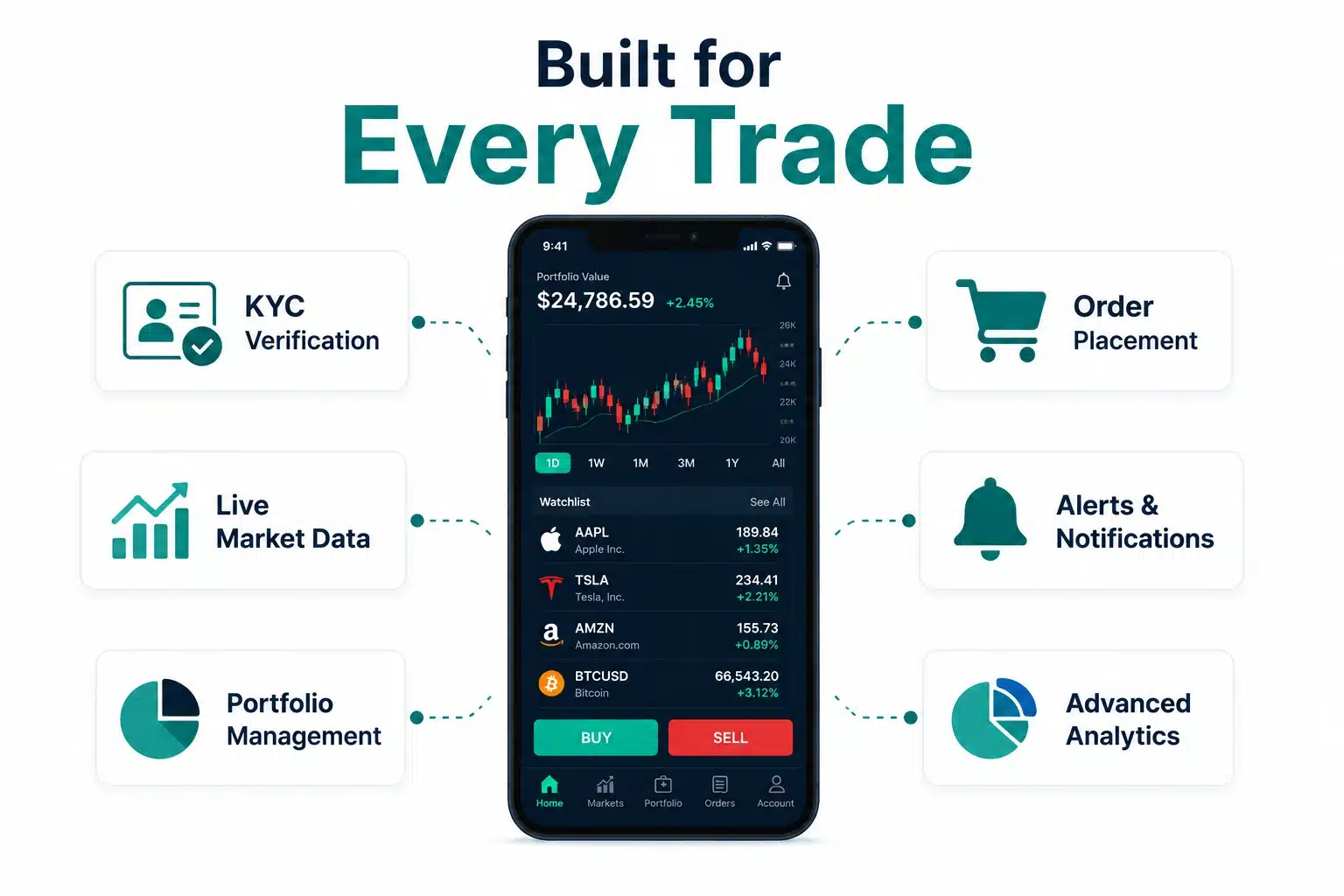
If your trading app is missing any of these features, users will notice immediately. These are the foundations. Everything else builds on top.
User Registration and KYC Verification
Before anyone can trade, they must verify their identity. This is a legal requirement called Know Your Customer, or KYC. The process should take less than five minutes. Users upload an ID photo and answer security questions. Some apps use facial recognition to confirm the user is real.
AML checks run automatically to screen users against government watchlists. The registration experience is the first impression. If it feels slow, users delete and try competitors.
User Dashboard and Watchlists
The dashboard shows the portfolio at a glance. Account balance. Total gain or loss. Asset allocation. Users should customize what they see based on what matters to them.
Users also want watchlists to track securities they might buy. A watchlist is easy to add to or remove from. It updates in real-time. Users set alerts for specific price levels.
Real-Time Market Data and Order Placement
Market data that is delayed by 15 minutes is useless for trading. Users expect live quotes and charts. Real-time data costs money from providers like Bloomberg or Yahoo Finance. It is an ongoing expense but essential.
The order placement system is where money actually moves and must be rock solid. Users place market orders that execute immediately. Limit orders that execute at specific prices. Stop-loss orders that protect against big losses. Always show a confirmation screen before execution.
Pro Tip: Always show a confirmation screen before an order executes. Show the exact number of shares, price, total cost, and any fees. Make it impossible for a user to accidentally place an order they did not intend.
Portfolio Management and Alerts
Portfolio tools let users see cost basis, gains and losses, and return on investment for each position. They show diversification across sectors. They model “what if” scenarios.
Push notifications keep users informed about price alerts they set up. The best apps let users control notifications completely. Big price moves. News events. Never send notifications just to push more trading.
Charts, Analytics, and Customer Support
Interactive charts let users zoom in and out, see different timeframes, and overlay technical indicators. Charts must work smoothly on phone screens.
Users need to get money in and out of their accounts securely. This is heavily regulated. In-app customer support helps users immediately instead of waiting for email responses. A chatbot can answer basic questions about using the app.
Advanced Features That Differentiate Modern Stock Trading Apps
Once the foundation is solid, these advanced features separate great apps from good ones.
AI-Powered Insights and Robo-Advisory
AI systems learn your investing style and surface relevant opportunities. They analyze news and market data to identify trends. They can recommend rebalancing or suggest positions that match your criteria.
Robo-advisors automate investment management. Users answer questions about risk tolerance and investment timeline. The system builds a diversified portfolio and rebalances automatically. This appeals to investors who want better returns than savings accounts but do not want to pick individual stocks.
Algorithmic and Copy Trading
Advanced users want to automate trading using rules like “sell if price drops 5 percent” or “buy if volume spikes.” This is complex but increasingly expected for serious traders.
Copy trading lets users automatically replicate trades from experienced traders. This has value but needs clear disclaimers. Inexperienced users might follow traders with poor track records and lose money.
Social Trading and Personalization
Social features let users follow other traders and share ideas. Personalized recommendations adapt to each user’s portfolio and behavior. “You are underexposed to tech stocks” or “Rebalance your portfolio.”
Voice-based assistance lets users ask questions like “What is Apple’s current price?” This makes financial information accessible while driving or exercising.
Mobile Trading App Development Process
Building a trading app follows a process. Skip steps, and you will regret it. Let us have a look at how each stage is performed while building a mobile stocks trading app:
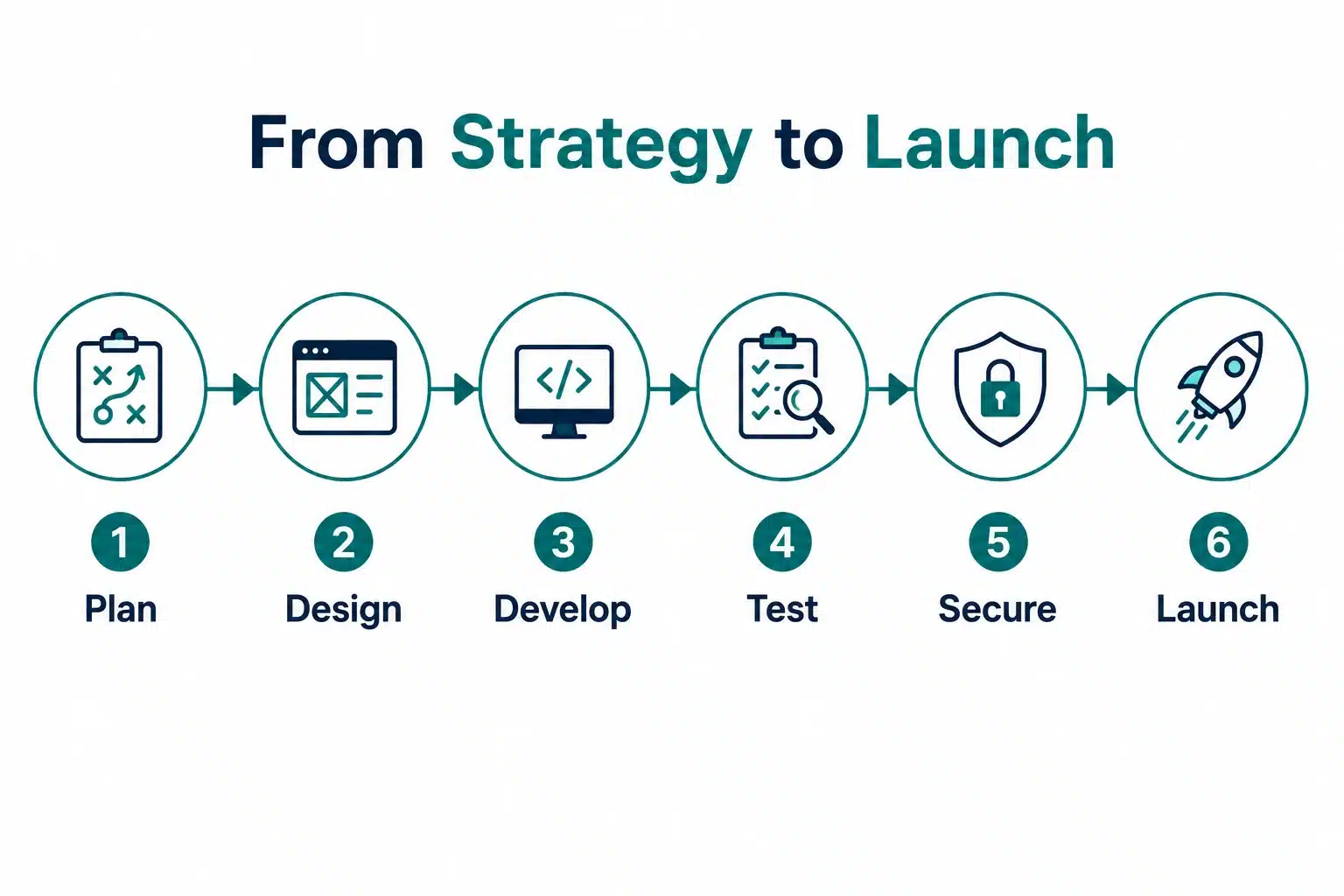
Planning and Strategy
Define your business goals clearly. Are you building for beginners, experienced traders, or crypto enthusiasts? Each has different needs.
Conduct market research. Download and use your competitors’ apps. Look for gaps and opportunities.
User Research and Design
A successful investment app starts with understanding who will use it. Design requirements vary significantly between Gen Z users, senior citizens, working professionals, active day traders, long-term investors, and even different user preferences across demographics. Conduct thorough user research to identify their goals, behaviors, and pain points, then create intuitive user journeys tailored to each audience. Validate these designs through usability testing with real users before development begins to ensure the app is simple, accessible, and aligned with actual user needs.
Development and Integration
Choose your technology stack based on what your team knows best. React Native or Flutter for cross-platform development. Node.js or Python for the backend.
Integrate with broker APIs for order execution and market data providers like IEX Cloud or Polygon.io for real-time prices. Build robust backends that handle real-time data and high transaction volume.
Testing and Launch
Test thoroughly. A trading app handling money requires more rigorous testing than most software. Test every order type. Test network failures. Test peak volume scenarios.
Beta test with real users trading with real money on a test server. Monitor performance constantly after launch. Plan for ongoing updates and maintenance.
Pro Tip: Set up comprehensive monitoring and alerting for your trading app before launch. Use tools like Sentry for error tracking and DataDog for performance monitoring. When something breaks during market hours, you need to know about it in seconds, not minutes.
Security and Compliance Testing
Security should be validated before your app goes live, especially when handling sensitive financial data. Conduct comprehensive penetration testing to identify and eliminate vulnerabilities, verify compliance with standards such as SOC 2 and PCI DSS, and ensure secure authentication, encryption, and data storage practices are in place. Regular security audits and compliance testing help protect user information, build trust, and meet regulatory requirements.
Technology Stack for Mobile Trading App Development
The technology choices you make determine what is possible and what is difficult.
| Technology | Best For | Trade-offs |
| Frontend Technologies | ||
| React Native | Cross-platform (iOS and Android with one codebase) | Slightly slower than native apps |
| Flutter | Beautiful UI and fast performance | Smaller developer ecosystem |
| Native iOS (Swift) | Maximum performance on iPhone | Must build a separate Android version |
| Native Android (Kotlin) | Maximum performance on Android | Must build a separate iOS version |
| Backend Technologies | ||
| Node.js | Real-time trading platforms, APIs, and high-concurrency backend services | CPU-intensive workloads may require additional optimization |
| Python (Django/FastAPI) | AI-powered investing features, analytics, and rapid backend development | Not as efficient as Node.js for highly concurrent real-time applications |
| Java (Spring Boot) | Large-scale enterprise investment platforms with strong security requirements | Higher development complexity and longer implementation time |
| Common APIs To Choose | ||
| REST APIs | Standard CRUD operations, third-party integrations, and public APIs | Can require multiple requests to retrieve complex data |
| GraphQL | Data-intensive dashboards and personalized investment portfolios | More complex to implement and cache than REST APIs |
| WebSockets | Real-time stock prices, order execution updates, and live portfolio tracking | Requires persistent connections and more backend infrastructure |
Frontend Technologies
React Native and Flutter let you build one app that works on both platforms. This saves time and money. The trade-off is that they are slightly slower than native apps built specifically for each platform.
For trading apps where performance matters but not microsecond-level performance, cross-platform frameworks usually win. You ship faster and can update both platforms simultaneously.
Backend Technologies
Node.js is popular for trading app backends because it handles real-time data well. Python is popular for data processing and machine learning components. Java is solid for large-scale systems that need to handle massive volume.
The key is choosing something your team knows well. A team of Node.js experts will build a better system than a team of Java experts forced to learn Node.
Database Solutions
PostgreSQL is rock solid and widely used for financial data. MySQL also works well. MongoDB is popular for storing historical price data and logs.
Most trading apps use multiple databases for different purposes. PostgreSQL for user accounts and balances. Redis for caching real-time data. Time-series databases like InfluxDB for storing historical price data.
Cloud Infrastructure
AWS is the most common choice, but Azure and Google Cloud both work. The key is choosing a provider that has data centers in the regions where your users are and that has strong security credentials.
For trading apps, compliance and security certifications matter. You need SOC 2 compliance. You need data encryption. You need redundancy so that if one server goes down, another takes over instantly.
Market Data and Trading APIs
You will integrate with providers like Alpha Vantage, IEX Cloud, Polygon.io, or exchange-specific APIs. These providers give you real-time price data, company fundamentals, and news.
Trading execution happens through broker APIs. You integrate with firms like Alpaca, Interactive Brokers, or TD Ameritrade so your users can actually place orders.
| Component | Provider Examples | Key Consideration |
| Real-Time Data | IEX Cloud, Polygon, Twelve Data | Cost per API call and data latency |
| Order Execution | Alpaca, Interactive Brokers, TD Ameritrade | Commission structure and asset coverage |
| News and Sentiment | Finnhub, NewsAPI, MarketWatch | Accuracy and timeliness of information |
| Authentication | Auth0, AWS Cognito, Firebase Auth | Ease of integration and MFA support |
Security and Compliance Requirements for Trading Apps
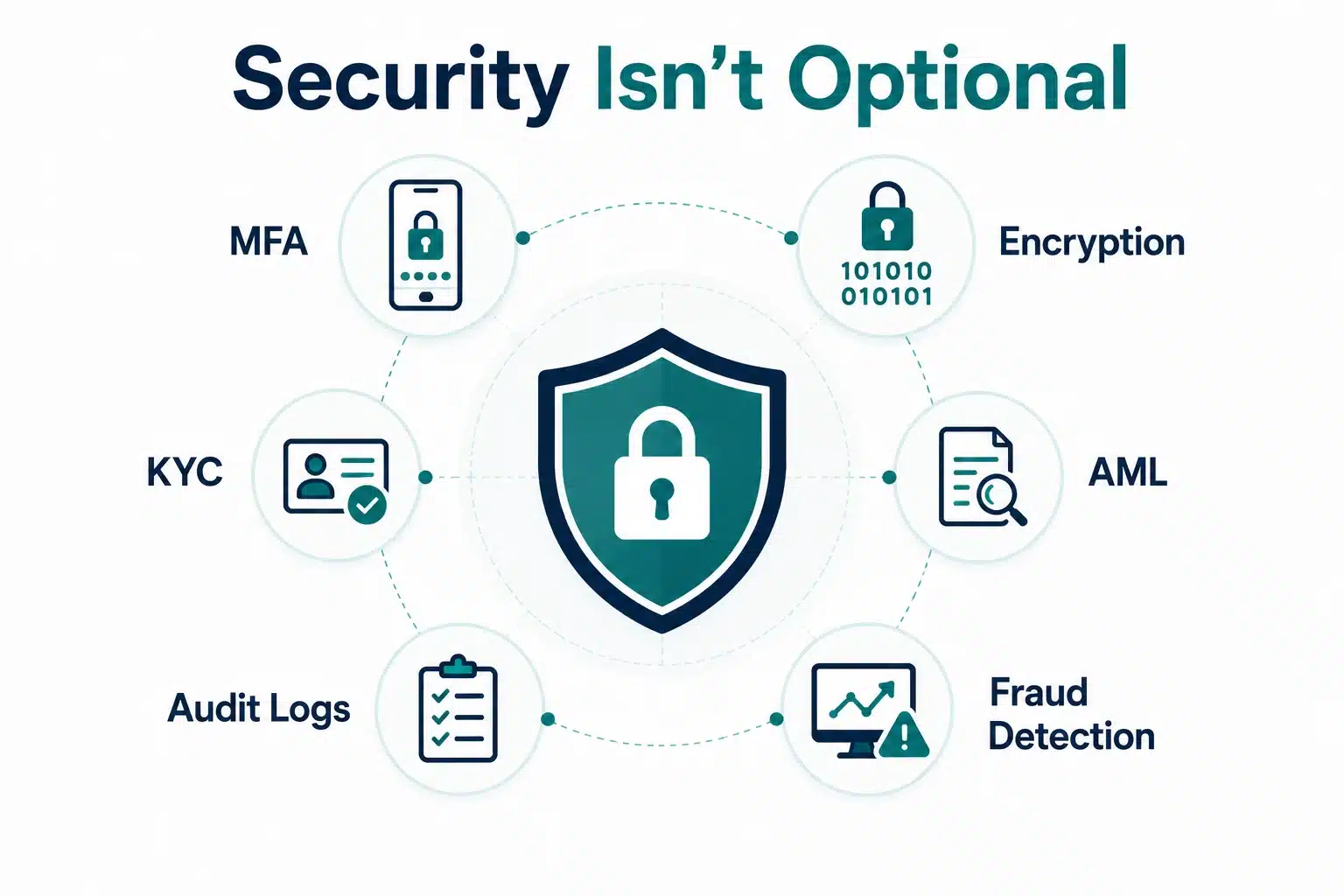
Security is not optional. It is existential. A security breach in a trading app does not just cost money. It destroys trust permanently.
End-to-End Encryption
All data moving between the user’s phone and your servers needs to be encrypted. This happens via HTTPS by default. You should also encrypt sensitive data in your database so that even if someone gains access to the database, they cannot read private information.
Multi-Factor Authentication
Users should be required to verify their identity in multiple ways. A password plus a code sent to their phone is the minimum. Biometric authentication adds an extra layer.
Secure Payment Processing
You are not storing credit card data. You use a payment processor like Stripe or Square that is certified to handle payment data. Your app connects securely to their system.
Data Privacy Compliance
GDPR in Europe, CCPA in California, and other privacy laws require you to handle user data carefully. Users have the right to know what data you collect, why you collect it, and to delete it if they want.
KYC and AML Requirements
Know Your Customer and Anti-Money Laundering are legal requirements. You have to verify who your users are and check them against watchlists. This is not something you can skip.
Audit Trails and Monitoring
Every action a user takes needs to be logged. Every trade. Every login. Every transfer of funds. If something goes wrong, you need a record of what happened.
Fraud Detection Systems
You need to watch for suspicious activity. Someone is logging in from a different country. Multiple failed login attempts. Large trades that are out of character. A system flagging suspicious behavior protects both users and your company.
Regulatory Considerations for Different Markets
The United States has SEC and FINRA rules. Europe has MiFID II regulations. Singapore has specific requirements. Japan still has different rules.
If you are launching in multiple countries, you need legal expertise to understand what you have to do in each one. Compliance failures can result in fines or even prosecution.
Pro Tip: Before you start development, talk to a fintech lawyer who knows trading app regulations in your target market. Thirty minutes of legal advice can save hundreds of thousands in regulatory fixes later. Regulations are complex, but they exist to protect users, so take them seriously.
How Much Does Mobile Trading App Development Cost?
Budget depends heavily on features and complexity. For general understanding, you can consider the following benchmarks –
A basic MVP with core matching, charts, and portfolio management costs $20,000 to $50,000. A mid-level platform with advanced features, multiple asset types, and premium features costs $50,000 to $130,000. An enterprise solution with AI, robo-advisory, and white-label options costs $130,000+ or more.
| App Type | Features Included | Estimated Development Cost |
| Basic MVP | User authentication, portfolio management, watchlists, stock charts, core trading functionality | $20,000 – $50,000 |
| Mid-Level Platform | Multiple asset classes, advanced charting, market insights, portfolio analytics, premium features, third-party integrations | $50,000 – $130,000 |
| Enterprise Solution | AI-powered recommendations, robo-advisory, algorithmic trading, white-label platform, advanced security, enterprise integrations, compliance features | $130,000+ |
Hidden costs include compliance and legal fees, data provider subscriptions, hosting and infrastructure, and ongoing maintenance. Plan for at least 10-15 percent of the development cost annually for support and updates.
Challenges in Mobile Trading App Development
Building a trading app surfaces unique problems. Real-time data at scale is hard. Handling high order volume is hard. Ensuring orders execute instantly at the right price is hard.
Meeting regulatory requirements in different countries adds complexity. Protecting against fraud and cyber threats requires constant vigilance.
The teams that succeed test aggressively before launch, design with scalability in mind from the start, and hire security experts. Treating the launch as version one of a never-ending product is more important than shipping the perfect version one.
Trading apps depend on third-party APIs for market data, payments, KYC verification, bank account linking, and notifications. Services like Plaid, Stripe, and market data providers charge recurring fees based on users, transactions, or API usage. These costs can increase significantly as your app scales, making API selection and cost optimization an important part of long-term planning.
Pro Tip: Get cybersecurity insurance before launch. If a breach happens, insurance covers notification costs and potential user compensation. It is inexpensive relative to the cost of a major breach.
Future Trends in Mobile Trading App Development
The trading app market is evolving fast. Staying ahead of trends helps you build apps that do not feel outdated in two years.
AI and Predictive Analytics
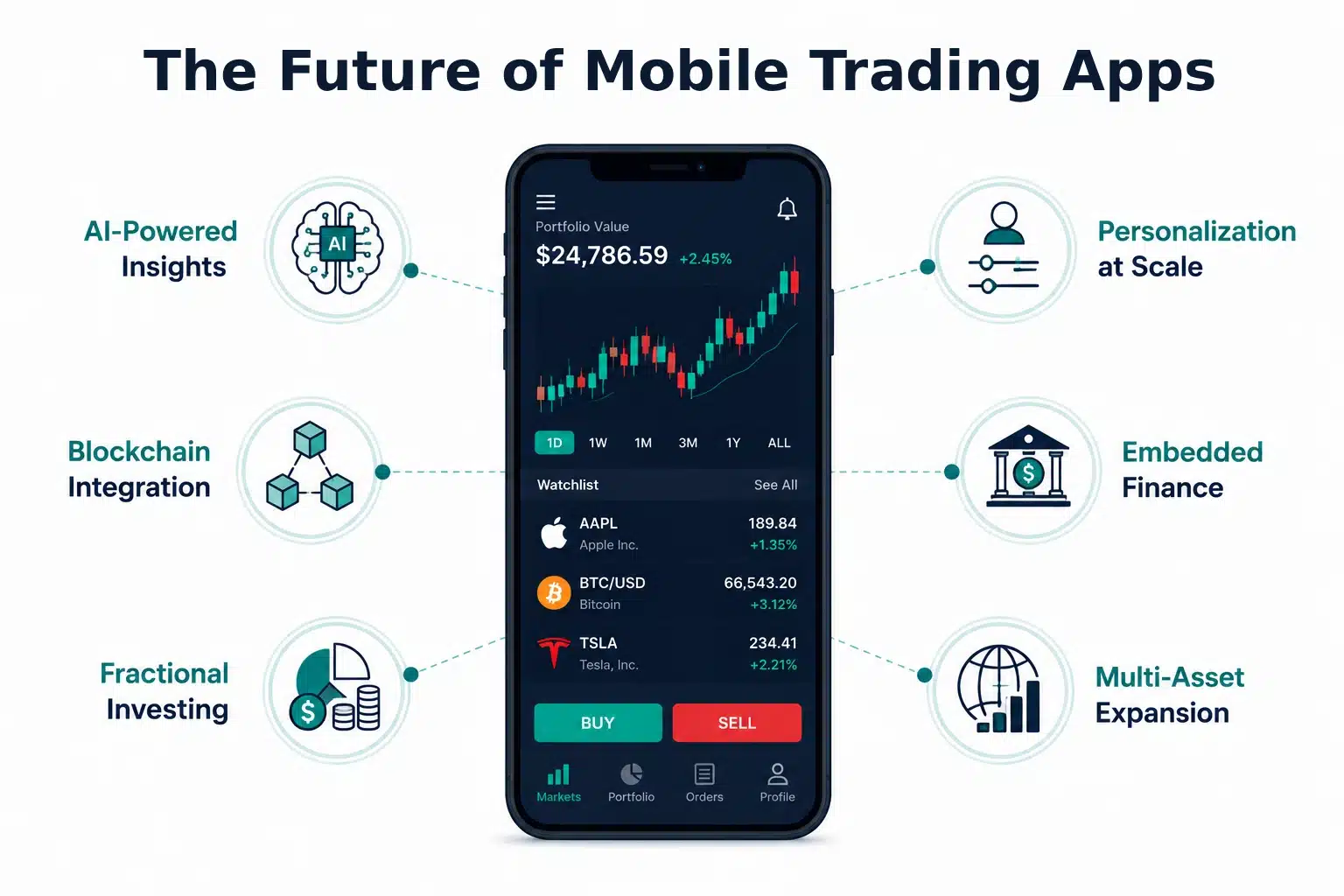
Machine learning is moving from nice-to-have to expected. Users increasingly want AI to help them make better decisions or automate decisions entirely.
Blockchain-Based Trading
Blockchain enables decentralized trading where users control their own assets rather than trusting a broker to hold them. This is still evolving but will become more mainstream.
Hyper-Personalized User Experiences
Apps that adapt to each user’s style and level of knowledge perform better. Beginners see educational content and simple tools. Advanced traders see complex features and professional-grade data.
Embedded Finance
Trading is becoming embedded in other apps. You do not need a separate trading app. You trade directly from your banking app or a social media app.
Fractional Investing
Letting users buy a fraction of a share instead of a whole share removes the price barrier. Someone with fifty dollars can own Apple stock instead of needing thousands.
Cross-Platform Trading Ecosystems
Apps are connecting different asset classes. You manage stocks, crypto, commodities, and forex all in one app. This is complicated but increasingly expected.
Choosing the Right Mobile Trading App Development Partner
If you are not building this yourself, the partner you choose makes an enormous difference. While choosing the right trading app development partner here are some deciding factors that you should consider and request in quote:
Industry Experience
Look for teams that have actually built and launched trading apps. Not just apps. Trading apps. The challenges are unique, and experience matters.
Security Expertise
Ask about their approach to security. How do they handle encryption? What security testing do they do? Have they dealt with security incidents before? How would they handle one?
Regulatory Knowledge
Do they understand the compliance requirements in your target market? Have they worked with fintech lawyers before? Can they explain what you need to do to comply with regulations?
Scalability Capabilities
Can they build a system that handles your expected volume on day one but also scales to ten times that volume? This requires architectural thinking, not just coding.
Post-Launch Support
Building the app is one job. Supporting it after launch is another. Ask about the post-launch support and what their maintenance and support model looks like?
Conclusion
Building a successful mobile trading app requires serious planning, deep technical expertise, and genuine focus on user experience and security. The market rewards apps that are fast, reliable, secure, and simple to use.
The difference between a trading app that users love and one that fails is usually not the features. It is the execution. It is the attention to detail. It is building an app that works flawlessly when markets are moving fast and stress is high.
If you are considering building a trading app, start by clearly understanding your target user and what problem you are solving. Map out your business model. Research your competition. Then find a partner who has built trading apps before and has the security and compliance expertise this type of product demands.
Simpalm is a product development company that has worked on fintech apps across trading, banking, and investment platforms. They understand the regulatory landscape, the technical complexity, and the user experience challenges that come with building in this space. If you are evaluating partners for your trading app, they are worth a conversation.
Frequently Asked Questions
Q1. How long does it take to develop a mobile trading app?
Ans. The timeline depends on the app’s complexity. A basic MVP typically takes 2-4 months to build, while a full-featured trading platform can take anywhere from 6 – 8 months or longer.
Q2. What technologies are best for mobile trading app development?
Ans. Popular choices include React Native for cross-platform development, Node.js or Python for the backend, PostgreSQL for database management, and AWS for scalable cloud infrastructure.
Q3. How much does it cost to build a stock trading app?
Ans. Development costs vary based on features and complexity. A basic trading app may cost between $20,000 and $50,000, while advanced or enterprise-grade solutions can be more than $130K.
Q4. What security features are essential in a trading app?
Ans. Key security features include multi-factor authentication, end-to-end encryption, fraud detection systems, real-time monitoring, and secure payment processing.
Q5. Can AI be integrated into a trading application?
Ans. Yes. AI can be used to deliver personalized recommendations, detect fraudulent activity, analyze market trends, predict price movements, and support robo-advisory services.
Q6. What regulations apply to mobile trading apps?
Ans. Regulatory requirements depend on the market you operate in. For example, trading apps in the United States must comply with SEC and FINRA regulations, while European platforms are subject to MiFID II requirements.
Q7. Should I choose Flutter or React Native for a trading app?
Ans. Both frameworks are excellent choices, however, ReactNative has emerged as a leader in cross platform app development for various types of apps including financial apps. React Native benefits from a larger ecosystem and talent pool. The right choice often depends on your team’s expertise and project requirements.
Q8. How do trading apps handle real-time market data?
Ans. Most trading apps use WebSocket connections to stream live market data, combined with intelligent caching and optimized data delivery to ensure fast updates and low latency.
Q9. Is it possible to build a multi-asset trading platform?
Ans. Yes. A single platform can support stocks, ETFs, forex, cryptocurrencies, and other asset classes. However, multi-asset trading apps require additional integrations and are generally more complex to develop.
Q10. What are the biggest challenges in trading app development?
Ans. Some of the biggest challenges include managing real-time market data, ensuring low-latency trade execution, handling high transaction volumes, maintaining security, and meeting regulatory requirements.