
 Design
 App Development
 Web Engineering
 AI Services
 Cloud
 Staffing
 Startups
 Health / Fitness
 Education
 Social
 Nonprofit
 Fintech
 Construction
 Logistics
 Government
 Travel/Hospitality
 HR Software
 About Simpalm
 Our News
 Client Testimonials
 Careers
 Our Blog
 Awards
 Resources
 Information
Key Takeaways
- On-demand marketplaces stand apart because they don’t just list services, they actively coordinate time, location and people in real-time.
- The success of an on-demand app depends heavily on choosing a clear niche, understanding demand and supply, and starting small before expanding.
- A good MVP focuses only on the essentials – bookings, provider assignment, payments, tracking, and ratings.
- Real-time features like live location, instant notification, dynamic availability, and fast provider matching are what make the experience seamless.
- Building and scaling such a marketplace is a staged journey, with MVPs costing around $40k-$80k and full-scale platforms reaching $150k-$250k plus ongoing cloud and acquisition costs.
_________________________________________________________________________________________
On-demand apps are ruling the marketplace now with instant service requirements, reliability and complete transparency being the need of the customers, whether you need food delivery, a cab ride, a massage therapist or a plumber. The rise of the gig economy has played a major role in making this possible. An on-demand marketplace connects customers and providers under one roof and coordinates the experience in real-time. The global on-demand services market is poised for significant growth, starting at USD 216 Billion in 2026 and projected to reach USD 346 Billion by 2035 with a CAGR of 5.4% from 2026 to 2035.
But many businesses misunderstand on-demand marketplace apps to be advanced versions of the marketplace, multi-vendor or ecommerce apps. A typical marketplace focuses on helping buyers find sellers and complete the transaction while an on-demand app continuously coordinates people, services, time, location availability and payments, all in minutes or seconds.
This makes the technology of an on-demand marketplace app different from a traditional buying and selling platform. It is not just about putting customers and providers in the same app but building a foundation that can coordinate the entire experience in real-time efficiently. This guide talks about building future-ready on-demand apps that work effectively on mobile and web platforms.
What is an On-Demand Marketplace App and How Does it Work?
An on-demand marketplace app connects customers with service providers, sellers or delivery partners at the moment they need something. Unlike traditional marketplaces that simply display listings, an on-demand platform actively coordinates the entire transaction.
What Makes a Marketplace On-Demand?
A marketplace becomes on-demand depending on how quickly and intelligently it responds to customer needs. It is about delivering services in real-time with minimum friction. Apps like DoorDash, Uber Eats, and Grubhub have helped drive the value of the US food delivery market past $74 billion.
- Customers can request a service or product instantly – Users don’t wait for callbacks or manual confirmations; they get immediate access to what they need.
- Providers accept or schedule requests based on availability – Delivery partners or professionals only take jobs when they are free, keeping the system flexible.
- Platform handles matching, payments, tracking and fulfillment – It acts as the coordinator connecting both sides so the transaction runs smoothly.
- Real-time updates are part of the experience – Customers get visibility into provider arrival, order status and ETAs, reducing uncertainties.
How the On-Demand Marketplace Works?
Every on-demand marketplace follows a predictable flow, guiding the customer and the provider through each step until the transaction is complete.
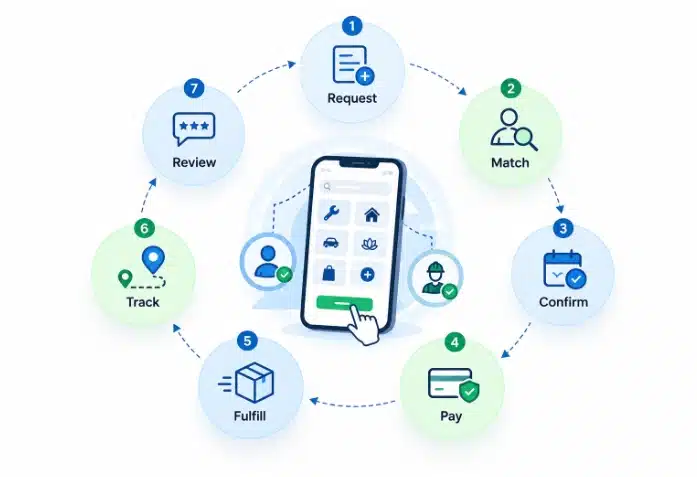
- Request – The customer chooses the service or product and submits the details of what they need.
- Match – The platform identifies the suitable provider based on location, availability and skills.
- Confirm – The provider accepts the request or the system automatically assigns it to ensure quick fulfillment.
- Pay – The customer completes a secure payment through the app before the service or delivery begins.
- Fulfill – The provider performs the service or delivers the product based on the customer request.
- Track – The customer can see the progress in real-time from provider arrival to order completion.
- Review – Both customers and providers leave ratings and feedback to maintain quality and trust in the marketplace.
On-Demand vs Traditional Marketplace vs Ecommerce
All three models serve the same purpose, connecting buyers with what they need, but they operate differently. While traditional ecommerce focuses on inventory, marketplaces focus on listings and on-demand marketplaces focus on instant fulfillment of services.
| Factor | On-Demand Marketplace | Ecommerce | Traditional Marketplace |
| Sellers/Providers | Multiple providers | Single seller | Multiple sellers |
| Availability | Real-time availability | Inventory-based | Listing-based |
| Matching | Auto-matching | Customer choice | Customer choice |
| Fulfillment | Platform coordinates | Seller | Seller |
| Location | Very important | Not important | Sometimes required |
| Booking/Scheduling | Core feature | Limited | Optional |
| Real-Time Tracking | Mandatory | Yes | Rare |
Also Read: E-commerce Website Design & Development Best Practices
Types of On-Demand Marketplace Apps
Although on-demand marketplaces have a similar foundation, the actual workflows change depending on the deliverable. It can be a service, a product, a rental or a real-time delivery. The type you choose shapes how the provider operates and how fulfillment happens. The global short-term rental market size was estimated at USD 138.05 billion in 2025 and is predicted to increase from USD 153.06 billion in 2026 to approximately USD 371.54 billion by 2035.
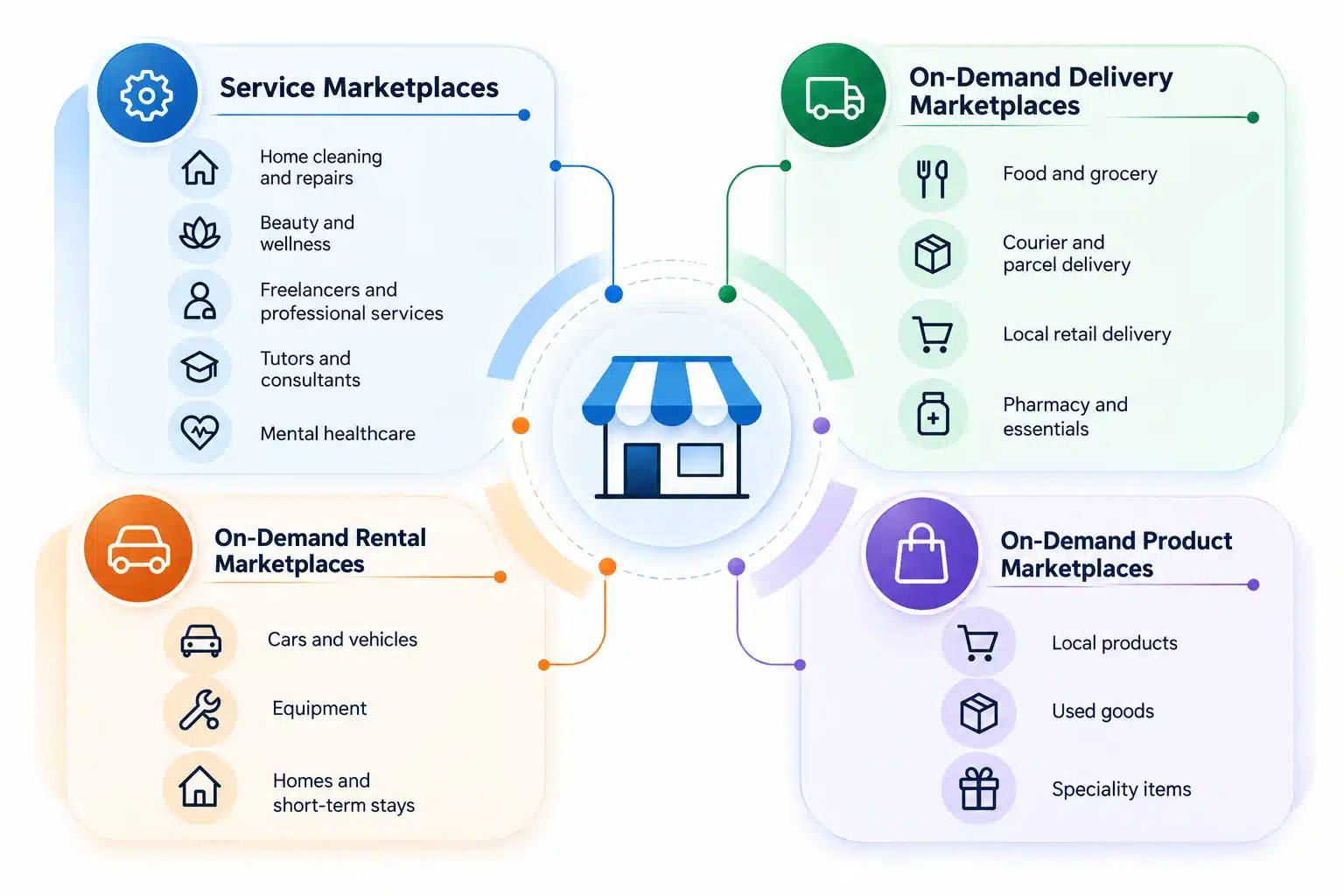
Service Marketplaces
- Home cleaning and repairs – Apps like Handy or TaskRabbit let users book cleaners or handymen who arrive at the scheduled time.
- Beauty and wellness – Apps like Glamsquad send beauticians or stylists to a customer’s home for on-demand grooming.
- Freelancers and professional services – Upwork and Fiverr match clients with freelancers who can take projects instantly.
- Tutors and consultants – Apps like Wyzant connect learners with tutors who can start sessions online or in person.
- Mental healthcare – BetterHelp or Talkspace apps connect users with licensed therapists for virtual counselling and emotional support.
On-Demand Delivery Marketplaces
- Food and grocery – DoorDash and Instacart deliver meals or groceries within minutes or hours.
- Courier and parcel delivery – Postmates (now part of Uber) let users send items across town through a nearby courier.
- Local retail delivery – Shipt delivers items from stores like Target or CVS on the same day.
- Pharmacy and essentials – Walgreens Delivery or Rite Aid apps deliver medicines and urgent essentials quickly.
On-Demand Rental Marketplaces
- Cars and vehicles – Turo lets users rent cars from local hosts for short-term use.
- Equipment – Home Depot Rentals allows customers to rent tools or equipment for DIY projects.
- Homes and short-term stays – Airbnb offers instant booking for homes, rooms and vacation stays.
On-Demand Product Marketplaces
- Local products – Apps like GoPuff deliver snacks, drinks and essentials sourced from local micro-warehouses.
- Used goods – OfferUp connects buyers with local sellers for quick pickup or delivery of second-hand items.
- Speciality items – Etsy offers handcrafted or niche products that can be shipped quickly.
What to Define Before You Create Marketplace App?
Before you start doing anything related to development, you need clarity on how the marketplace will work in the real world. On-demand platforms succeed when the business model is well-defined, the target users are understood and the supply-demand mechanics are mapped out.
Below is an account of everything that comes before development.
01. Define target customers and providers
Every on-demand marketplace has two sides that must benefit from the platform’s growth. Understand who you are building the app for and why they must choose you over other alternatives.
The audience – Identify your primary customer segment like busy professionals, families, students, travellers or businesses, and their expectations around speed, convenience and price.
The provider – Define your supply side clearly, whether you have independent contractors, verified professionals, delivery partners, local sellers or rental hosts. Their capability and availability will shape your entire workflow.
The problems – Customers may struggle to find reliable providers quickly, while providers may struggle to get consistent work or reach the right audience.
The goal – Identify why both sides use the platform. Customers want convenience and trust while providers want predictable earnings and easy job management. If the platform does not provide value, it won’t sustain long-term engagement.
02. Choose Your Niche Service Area
On-demand marketplaces work best when they start focused, both in service category and geography.
Hyperlocal vs regional vs global – A hyperlocal launch serves a city or neighbourhood and helps you control quality and balance supply-demand before expanding to larger regions or multiple cities.
One category vs multi-category – Starting with one service like home cleaning or food delivery keeps operations simple. Multi-category marketplaces require more complex workflows and provider management.
Immediate vs scheduled services – Decide whether your platform supports instant fulfillment or scheduled bookings. The choice affects matching logic, provider availability and notifications.
Local supply-demand balance – Study how many providers exist in your target area and how frequently customers need the service. A marketplace with too many or too few providers will struggle to grow.
How the Marketplace Will Match Demand with Supply?
The heart of an on-demand marketplace resides in matching the service needs. The way you connect customers and providers will determine the speed, efficiency and user satisfaction of the on-demand app.
- Customer-selected provider – Customers browse profiles and choose a provider manually. This is ideal for services where trust and expertise drive the experience.
- Provider acceptance model – Providers receive requests and choose whether to accept them. This is common in home services, repairs or freelance marketplaces.
- Automatic provider matching – The system assigns the best provider instantly based on predefined rules. This suits fast-moving categories like rides, food delivery or courier services.
- Location-based matching – Providers close to the customer’s location get priority. This is crucial for logistics and heavy categories where distance impacts ETA and cost.
- Availability-based matching – Providers who are free at the requested time are matched first, which is ideal for scheduled services like beauty treatments or home cleaning.
Define Your MVP
Your MVP (Minimum Viable Product) should focus on enabling one complete and successful transaction and nothing more. This will help to validate the model quickly.
Must-Have Features (Part of the Core Flow)
- Listings – Your customers must be able to view services or products with clear details, pricing and availability.
- Booking – Create a simple booking flow that allows customers to request a service or place an order without friction.
- Provider assignment – Whether manual or automatic, the system must reliably connect the customer with a provider.
- Payments – Secure payment processing is essential for completing the transaction and establishes customer trust.
- Tracking – Customers must be able to check real-time updates like order status or delivery progress.
- Ratings – Reviews help maintain quality and build trust on both sides.
Also Read: AI in MVP Development: Process, Cost, Features & Challenges
Future Enhancements (Can be done later)
- Advanced analytics – This is useful for app optimization but not required in MVP or early stage validation.
- AI recommendations – AI integration is important for personalization but there must be enough data to train the model.
- Loyalty programs – These are great for retaining customers but not essential during the initial launch.
- Complex automation – Automate workflows only after you understand real user behavior and operational challenges.
Key Features of An On-Demand Marketplace App
Your on-demand app will only work when all three sides – customers, providers and admins – have the right tools to move a transaction from request to completion without any roadblocks.
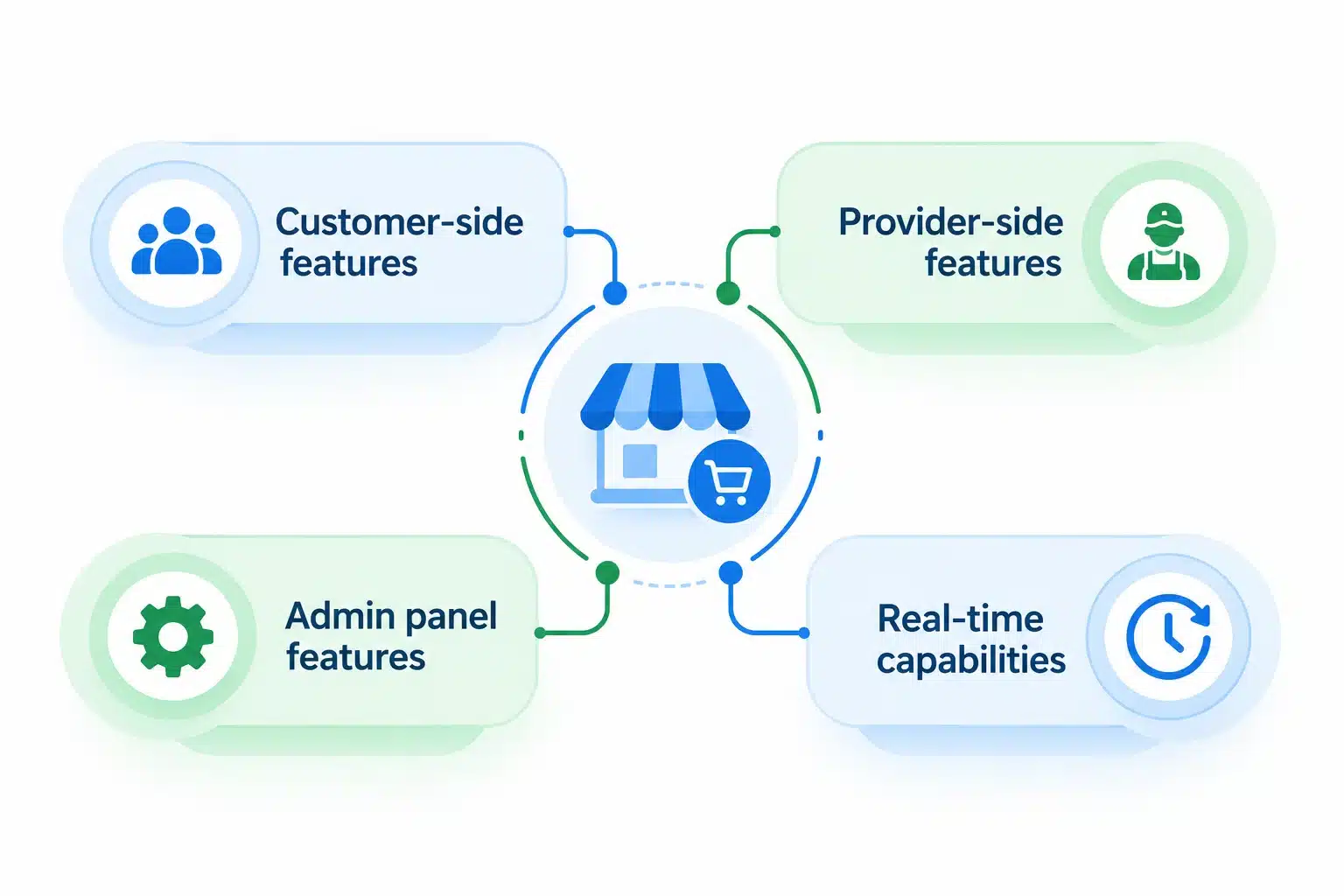
Below is a detailed breakdown of the essential features for each side and why these matter.
Customer-side features
The customer app shapes the conversation, speed and trust of the on-demand app. It must be created in a way that users find what they need easily and service delivery is prompt and frictionless.
- Location detection – The app automatically identifies the user’s location to show nearby providers, accurate ETAs and relevant services.
- Search and discovery – Customers can browse categories, filter options and find the exact product or service they are looking for.
- Service/Product details – Clear descriptions, pricing, photos and provider information help customers make smart decisions.
- Real-time availability – Users can see the services or items that are available and can order immediately. This reduces confusion and improves conversions.
- Instant or scheduled booking – Customers can book a service immediately or schedule for future dates.
- Provider selection/matching – Users can choose a provider manually or let the system auto-assign the best expert for the service.
- Secure checkout – On-demand apps integrate payment gateways with secure third-party providers, making the transaction process safe and seamless.
- Live tracking – Customers can track provider arrival, order status, or delivery progress in real-time.
- In-app chat/call – Built-in communication helps customers clarify details, share instructions or coordinate with the provider.
- Ratings and reviews – Customers can read reviews before booking and also rate their experience, enabling trust and transparency.
- Push notifications – Users stay updated about booking status, provider arrival, offers, and important updates.
Provider-side features
This part of the app is designed to help service professionals, delivery partners or sellers manage their work efficiently and earn consistently.
- Registration and verification – Providers sign up and complete identity and skill verification to ensure trust and safety.
- Provider profile – A detailed profile shows provider expertise, services, pricing and ratings to attract customers.
- Availability management – Providers can mark themselves as available, busy or offline, ensuring accurate matching.
- Service/product listing – Sellers can add product/service offerings with descriptions, pricing and photos.
- Incoming request management – Providers receive new requests instantly and can view details before accepting.
- Accept/reject options – They can choose to take the jobs based on their schedule and capacity.
- Scheduling – Providers can manage upcoming bookings and plan their schedule accordingly.
- Navigation/location – Integrated maps help providers reach the customer location quickly and accurately.
- Customer communication – Using in-app chat, providers can ask customers about their coordinates or location.
- Earnings and payouts – They can track completed jobs, earnings, commissions and payout schedules.
- Ratings and performance – Customer feedback helps providers improve their service quality and maintain high standards.
Admin Panel Features
This is the control center of the on-demand marketplace app and ensures smooth operations, quality control and business growth.
- Customer and provider management – Admins can edit, approve, or block users and providers when needed.
- KYC verification – Identity checks ensure that only trusted providers join the platform.
- Booking/order management – A dashboard shows all ongoing, completed, or cancelled transactions for monitoring and support.
- Matching controls – Admins can adjust matching rules, priority settings, and assignment logic.
- Commission management – The platform can set and update commission rates for different services or providers.
- Payment/refund handling – Admins can manage disputes, refunds, failed payments, and payout issues.
- Dispute resolution – Handle customer-provider conflicts and maintain platform trust.
- Promotions and notifications – Admins can create offers, send push notifications and run marketing campaigns.
- Reports and analytics – Insights into revenue, demand patterns, provider performance and customer behavior.
Real-time capabilities that make an app truly on-demand
What sets an on-demand marketplace app apart from a regular marketplace app is real-time functionality. These features also make the experience fast, transparent and reliable.
- Live location – The app tracks provider or delivery partner movement to show accurate locations.
- Availability updates – Providers’ availability changes instantly, and this feature ensures that customers only see the real options.
- Instant notifications – Alerts keep both sides informed about new requests, status changes and important updates.
- Real-time booking status – This ensures that customers see every step including request sent, provider assigned, on the way, service started and completed.
- Provider assignment – The system instantly finds and assigns the best provider based on rules like distance, ratings, or availability.
- ETA updates – Dynamic ETAs adjust based on traffic, provider movement, and real-time conditions.
- Dynamic pricing – Prices can adjust automatically based on demand, supply, peak hours, or surge pricing.
6 Proven Steps for Building an On-Demand Marketplace App
To build an on-demand marketplace app, first understand the problem, validate that real people will use the app, design intuitive workflows, and launch in a controlled data-driven environment so you can measure, learn, and improve. This is also where the right development partner comes into the picture. They can help you avoid common pitfalls and turn ideas into a working MVP faster.
Step 1: Identify the problem and demand
Before you invest time and money into building the app, confirm the problem that the app will solve. This will help justify the need for an on-demand solution.
- Talk to customers and providers – Engage in real conversations with both sides to understand their problems and their willingness to use a digital platform.
- Understand current solutions – Find out how they are solving the problem currently, whether through phone calls, local shops, referrals, or manual processes.
- Check the frequency of the problem – Understand whether the problem occurs often and requires a quick solution.
- Study demand and supply – Analyze how many customers need the service and how many providers are available in your target area. An on-demand app works better when both sides have good numbers.
Step 2: Validate the demand and supply together
Once you identify the problem, see whether both sides (demand and supply) can coexist in your platform.
- Estimate service capacity – Create an estimate of how many jobs each provider can handle per day or week. This will help you avoid overload or underutilization.
- Predict request volume – Estimate how many customer requests you can expect based on research and early marketing.
- Start small – Launch in one neighbourhood or one category to keep operations manageable and learn from feedback.
- Avoid early expansion – Do not scale too early, because it can hurt the marketplace if demand and supply are not in the right proportion.
Step 3: Map the marketplace workflows
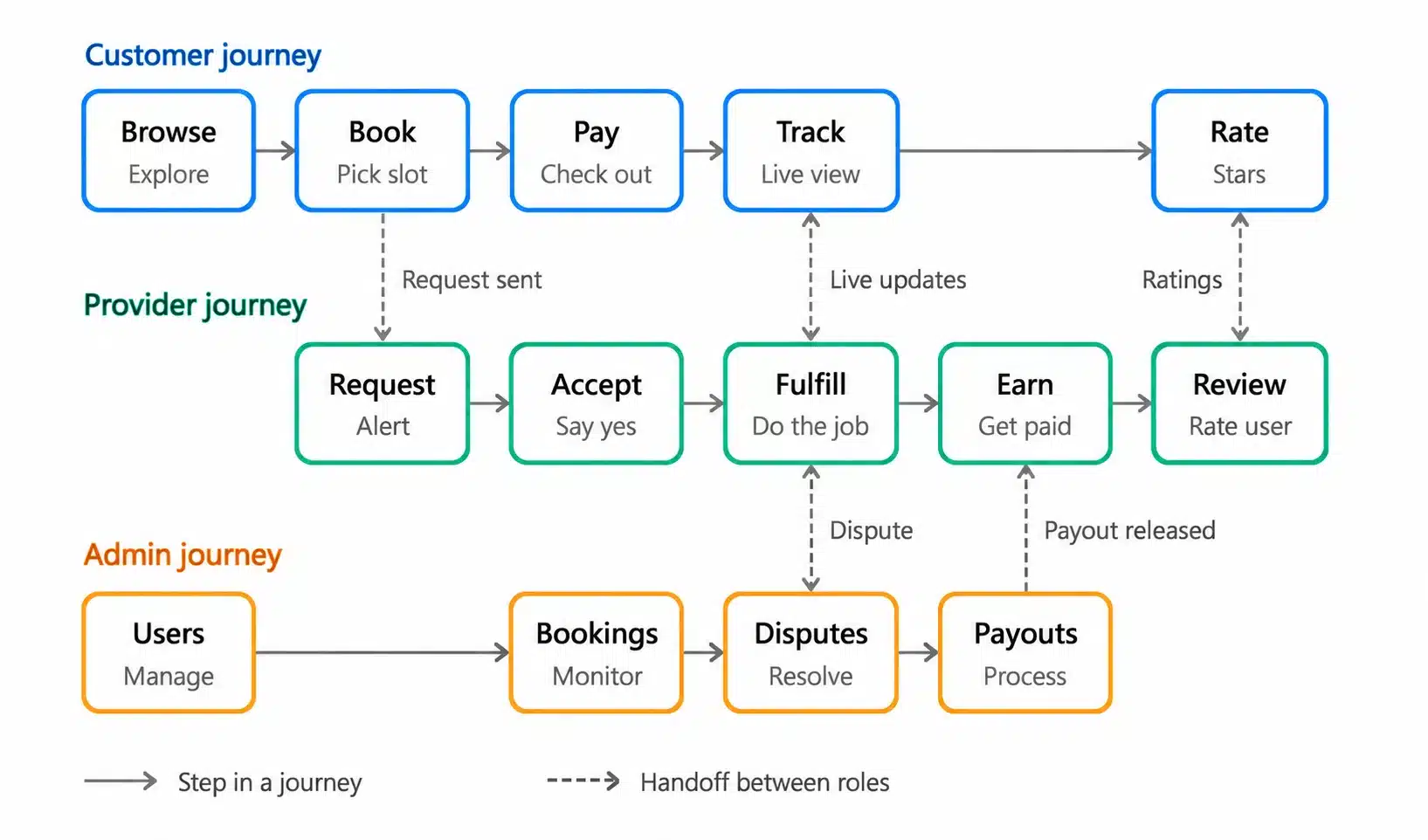
An on-demand marketplace has many moving parts. Map the workflows to ensure that every step from customer request to payout is smooth and predictable.
Here is the complete transaction flow to avoid friction and create a seamless experience.
Step 4: Design the UI/UX
Your app’s design determines how easily users can navigate, book and trust the on-demand platform. They expect the app to feel fast, intuitive and transparent.
Here is a priority check:
- Fast onboarding – Users should be able to sign up and start using the app within seconds.
- Easy discovery – Add clear categories, filters and search options to help customers find what they need quickly.
- Provider info – Profiles, ratings, photos, and reviews can help customers make confident choices.
- Availability – Show real-time availability so users know exactly who is ready to serve them.
- Simple booking – Keep the booking flow short, clear and frictionless.
- Status updates – Make status updates transparent so customers always know what is happening.
- Trust signals – Enable secure payment options, verified providers and clear policies to make users feel safe.
Also Read: How Good Design Impacts App Retention (And Why Your Business Can’t Afford to Ignore It)
Step 5: Develop and integrate the MVP
Once the workflows and design are ready, you can build the MVP, the simplest form of the app that can complete a full transaction.
Integrate the following features:
- Payments – Secure payment gateways like Stripe, PayPal, Razorpay.
- Payouts – Automated provider payouts with clear commission rules.
- Maps/Location – GPS tracking, distance calculation, and provider navigation.
- Push notifications – Real-time alerts for booking updates, provider arrival and offers.
- Chat – In-app messaging for coordination between customers and providers.
- Identity verification – KYC checks to ensure provider authenticity and customer safety.
Step 6: Test, Launch and Improve
On-demand apps rely heavily on real-time interactions so thorough testing is mandatory. Testing the app ensures that it works flawlessly in real-world conditions.
Perform the following tests:
- Functional testing – This ensures that every feature works as expected.
- Payment testing – This verifies smooth transactions, refunds and payout flows.
- Real-time tracking testing – Check location accuracy, ETA updates, and provider movement.
- Security testing – Protect user data, payments and communication with this testing.
- Performance testing – Ensure the app handles multiple requests without lag.
- Cross-device testing – Test on different devices and screen sizes.
- User acceptance testing – Let your users try the app and share feedback so you can improve accordingly.
Once the testing shows proper results, do the following:
- Launch in a limited area – Start the app in a small neighbourhood for one category and limited users.
- Measure actual usage – Track booking times, provider acceptance rates, cancellations and customer satisfaction.
- Iterate quickly – Improve based on real data and not guesswork.
Also Read: What is Android Application Development? [Complete Guide]
Cost of Building an On-Demand App
Founders face this pressing question when they conceptualize on-demand app development.
The answer depends on how complex your workflows are, how fast you want to scale, and the type of app that you plan to build. It could range from a simple local marketplace to a multi-region platform with real-time logistics.
We have penned down a practical comparison table to help you understand the cost:
| Aspect | Custom Marketplace Build |
| Initial Cost | $50,000 – $150,000 |
| Time to Market | 4–8 months |
| IP Ownership | Full Ownership |
| Customization | Fully Customizable |
| Scalability | Cloud-Native |
| Monthly Cost | $1,000 – $2,000 |
MVP development cost
The MVP is the fastest way to validate the app and understand whether customers and providers will use the marketplace. A typical MVP cost ranges between 40,000 USD-80,000 USD. This includes:
- Customer app
- Provider app
- Admin dashboard
- Payments
- Basic analytics
- Booking + Matching + Tracking
Full-scale marketplace cost
Once the MVP works, you can expand across cities or categories and the investment increases. The cost of a full scale marketplace typically ranges from 150,000 USD-250,000 USD. This stage includes:
- Advanced matching
- Microservices architecture
- AI recommendations
- Fraud detection
- Multi-region support
- Automated payouts
- Enterprise DevOps
Infrastructure and DevOps
Infrastructure is a recurring cost, not a one-time expense.
Monthly cloud cost:
- Early stage – 1000 USD-3000 USD
- Growth stage – 5000 USD-20,000 USD
Marketing and user acquisition cost
A marketplace needs both sides, customers and providers, to show up at the same time.
Typical acquisition cost:
- Customer: 10 USD-50 USD depending on category
- Providers: 20 USD-100 USD depending on skill level
Also Read: Mobile App Maintenance Complete Guide: Types and Cost
Common Mistakes to Avoid While Building an On-Demand Marketplace App
Even strong on-demand marketplace ideas can fail if they fall into predictable traps. Avoiding these mistakes can help you early and save months of rework and cost.
- Building everything before validating demand – Many founders invest heavily in advanced features and complex workflows before understanding what customers want. It is better to validate liquidity before making heavy investments.
- Launching in too many locations early – Expanding across multiple cities without stable demand and supply leads to inconsistent user experiences. It is better to launch an on-demand platform hyperlocal in the beginning.
- Ignoring provider onboarding and training – Providers are the backbone of a marketplace. Weak onboarding leads to poor service quality, low acceptance rates, and unreliable fulfillment, which can affect traction negatively.
- Over-focusing on customer experience and ignoring provider UX – Both customer and provider interfaces are equally important for an on-demand app. A beautiful customer app does not add value if providers struggle to accept jobs, manage schedules or track earnings.
- Treating real-time features as optional – Live tracking, instant notifications and dynamic availability are core to on-demand app behavior. Without these features the platform feels slow and outdated.
- Underestimating payment complexity – Delayed payments, failed transactions and unclear commission rules can cause providers to leave the platform. Predictable and stable payments help ensure platform success.
- Adding AI too early – AI-based matching or recommendations only work when you have sufficient users and a healthy data volume. Adding AI prematurely increases costs without improving outcomes.
- Ignoring post-launch optimization – On-demand marketplaces evolve constantly, and ignoring user feedback, failing to refine matching logic or delaying improvements can stall growth.
Building an on-demand marketplace app is a multi-stage journey from validating ideas to scaling across regions. Each stage comes with its own challenges which only a seasoned development partner can solve. They can make the journey smoother, faster and more predictable.
While building the app, look for a marketplace app development partner who has worked with mid-market businesses and startups across different business models. They understand the fine nuances of real-time workflows, demand-supply balance and scalable architecture. A reliable partner can add value by following a structured development process to reduce risks, accelerate development and build an on-demand marketplace that can scale efficiently.
Wrapping Up
On-demand marketplaces thrive because they solve real problems in real time. These apps connect people who need something instantly and those who are ready to deliver it. Building an on-demand marketplace app is not just about the features or technology, it is about validating demand, designing smooth workflows and balancing both the user and provider sides of the marketplace seamlessly. With the right strategy, thoughtful approach and a reliable development partner, you can turn a simple MVP into a high-impact platform that users can rely on.