
 Design
 App Development
 Web Engineering
 AI Services
 Cloud
 Staffing
 Startups
 Health / Fitness
 Education
 Social
 Nonprofit
 Fintech
 Construction
 Logistics
 Government
 Travel/Hospitality
 HR Software
 About Simpalm
 Our News
 Client Testimonials
 Careers
 Our Blog
 Awards
 Resources
 Information
Key Takeaways
- A medical website is the digital front door of a practice and shapes patient trust within seconds.
- Patient‑centered design,simple navigation, clear information, and mobile‑friendly layouts are essential for a smooth experience.
- Security, privacy, accessibility, and compliance must be built into the website from day one.
- Continuous monitoring, updates, and performance checks keep the website reliable and patient‑friendly over time.
- The right development partner guides the practice through strategy, design, development, testing, and long‑term support to build a strong digital asset.
_________________________________________________________________________________________
According to Worldmetrics, Digital marketing is proving its effectiveness as patient search and engagement shift strongly to mobile and online discovery, with 82% using mobile to access healthcare sites and search intent for medical queries rising 35% since 2020. This number itself signifies the first impression that online healthcare creates in patients. Patients in 2026, do not visit the clinic directly; they go to the website first and judge it by the look, clarity, tone, and trust it builds in a few seconds.
A medical practice website is the digital clinic of the healthcare provider. It contains information of the provider including the experience of the doctor, service location, booking particulars and more. It provides answers to all patient queries and bridges the patient provider communication gap.
The purpose of a medical website goes further than listing information. A strong one is the digital front door of a practice that understands patient conditions, directs them to the right specialist and supports them with practical tools. In contrast to a general business website, a practice site focuses on trust, empathy, safety and compliance-the foundation of long-term relationships.
And that’s exactly why a medical website design and development is about creating confidence and ingenuity. Let’s explore what actually goes into it.
Why is a Patient-Centered Website Essential?
A patient-focused medical website development is the foundation of how modern medical practice communicates, builds trust and guides people towards the care they need. Patients who search for a website online have questions, concerns and limited time. 70% of global respondents say they have requested or would consider requesting a test, treatment or prescription based on information from search engines.The website becomes the place where the first impression is created and their preliminary queries are resolved. A warm and easy to navigate experience sets the stage for future communication.

Understanding Patient Expectations
In 2026 patients expect the same level of convenience from healthcare that they get from banking, travel or shopping.They want quick answers, simple navigation and the ability to take action without making a single phone call.If the website does that without any friction, it meets half their expectations.
Building Trust and Credibility
Trust is built way before the first appointment. Patients look for signs of credibility like professional bios, clear service descriptions, real customer reviews, and up-to-date websites. These parameters are the signs of a competence, and reflected properly, it helps patients choose the service over others.
Making Information Easy to Find
Website visitors usually become frustrated when hunting for basic details like clinic hours, insurance and booking process becomes a painstaking job. A patient-centered website has structured information, with every information available with a single click. This reassures the patient and builds credibility for the medical website.
Balancing Patient Needs with Caregiver Goals
A well-designed medical website supports both the patients and the practice. When the information is displayed clearly, forms are easy to fill and submit, scheduling is streamlined and the staff is working on value added tasks, the website meets patient expectation while allowing the medical practice to operate efficiently.
Essential Features of a Medical Website
The best medical website must feel effortless on both the patient and the provider side. Patients must get the clarity and confidence they deserve while the providers must communicate their expertise without any roadblocks. When these two sides work in tandem, the website becomes a living replica of the practice.
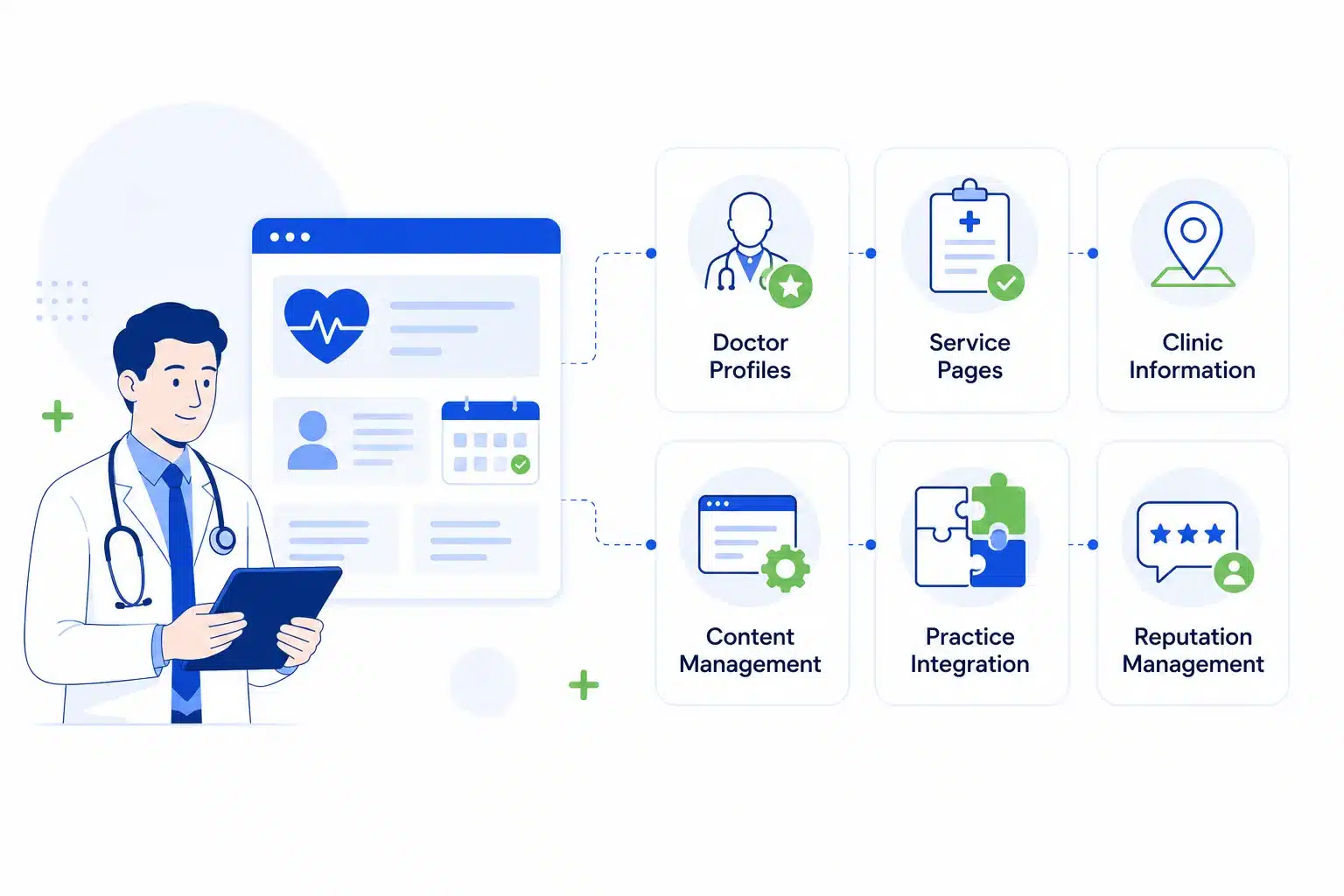
Provider Side: Core Features that Keep the Practice Running
This is the backbone of the website that keeps the doctors, clinics and staff present themselves clearly and run operations smoothly.
Clear Doctor and Team Profiles- A strong profile that highlights qualifications, expertise, specializations, and experience builds instant credibility.
Structured Service and Team Pages- Each service needs its own page with symptoms, treatments, recovery expectations and when to seek help. This reduces repetitive patient queries.
Clinic Information and Policies- The practice can avoid confusion with accurate timings, locations, insurance details, payment options, and emergency instructions.
Content Management Systems- Healthcare providers need an easy way to manage their digital resources like blogs, services, announcements or health tips.
Integration with Practice Tools- Staff can avoid juggling multiple dashboards with integration with scheduling tools, telemedicine platforms, and patient forms.
Review and Reputation Management- A dedicated page that showcases patient testimonials, and Google reviews helps build patient trust and credibility.
Patient Side: Tools that Simplify the Patient Journey
This part is crucial as it signifies the patient interaction with the healthcare provider and decides whether they will stay or leave.

Jargon-Free Information- This includes clear information that answers patient queries and helps them understand conditions and treatment without feeling overwhelmed.
Online Appointment Booking- A clean and fast booking flow helps patients choose a slot, confirm it and get a reminder in a matter of minutes.
Telemedicine Access- This feature makes care accessible for remote patients with virtual consultations, chat options or video calls.
Easy-to-fill Forms- Patients can avoid queues and save time with patient forms, consent forms and prescription refill forms.
Location and Contact Tools– Using maps, locations, directions and click to call options, patients can reach the clinic easily.
Patient Resources Hub- Blogs, case studies, downloadable resources and FAQs empowers patients and positions the caregiver as a trusted provider.
Mobile Experience- Mobile-friendly layouts, large fonts and fast loading ensures that every patient can navigate effortlessly on smaller screens.
Also read: Creating Life Sciences Website in Maryland [Step by Step
How to Make a Medical Website Plan Before Development
A clear plan is necessary before practitioners build website for medical practice. The website is the first point of interaction with the practice and the experience here shapes future communications. Proper planning helps to avoid clutter, stay intentional and make the website feel engaging.
Define Website Goals
It is important to identify website goals- increasing appointment bookings, educating patients, reducing front-desk workloads or showcasing providers. Clear goals makes every design choice and feature feel worthwhile.
Identify Target Patients
Different patients have different expectations. A pediatric clinic, a physiotherapy center or a dermatological website , all have unique requirements and audiences. Understanding the target audience helps to choose the right tone, visuals and content for the website.
Determine required functionalities
Providers must list out the website objective. Whether it is for online appointment booking, telemedicine, or insurance information, to blend information with action and prevent surprises later in the process.
Map the Patient Journey
It is important to map a patient journey and understand what he/she is looking for. This also helps to follow the path to reach the service or the specific treatment provider. Mapping the patient journey creates a website that feels both intuitive and supportive.
Choose the Right Platform, Domain and Hosting
The technical foundation is the important aspect of the website. This includes:
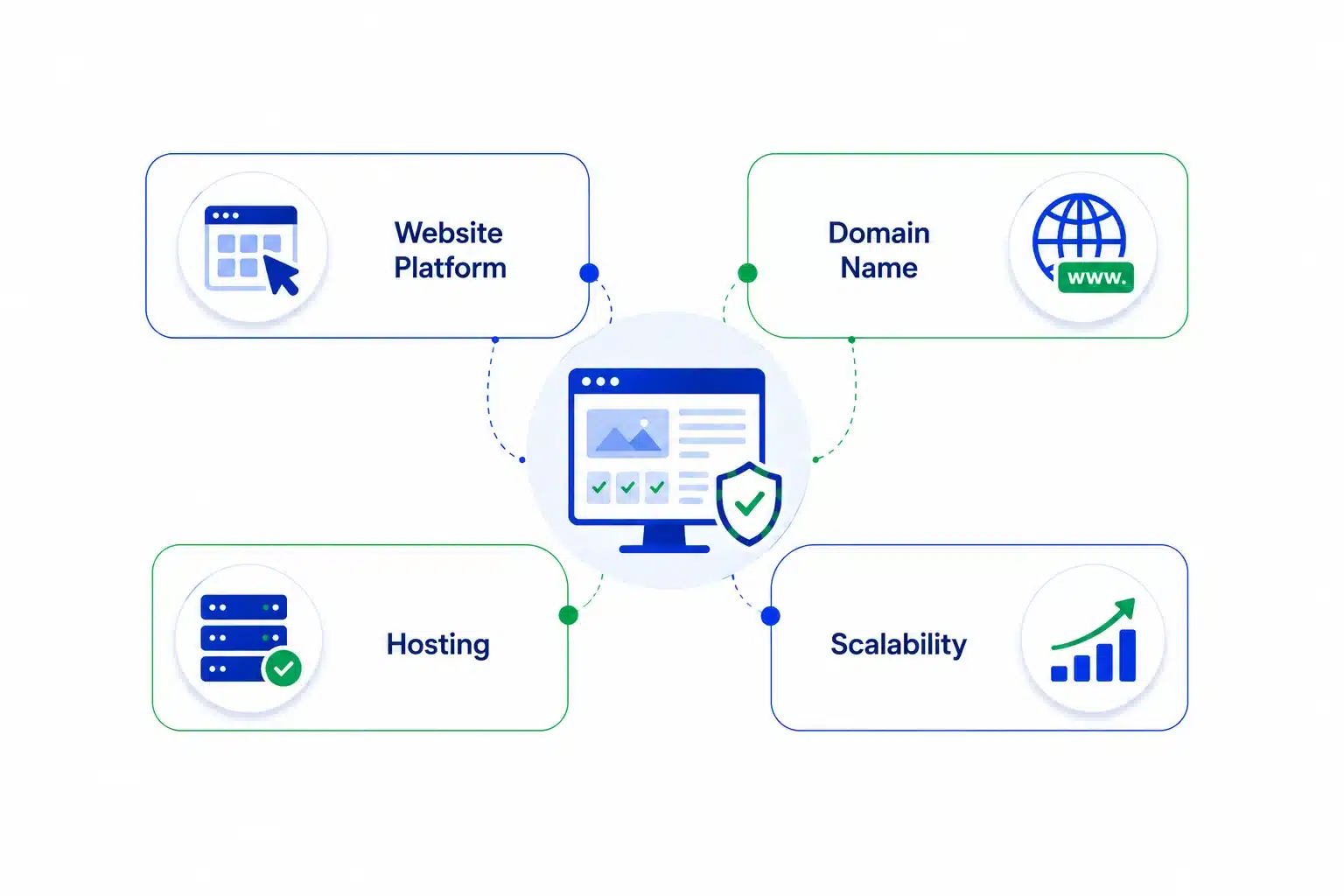
Website Platform- Some of the platforms are WordPress, Webflow and Healthcare-Specific CMS and practitioners must choose an appropriate platform that is flexible and easy to update.
Domain Name– It is necessary to keep the domain name simple, memorable and aligned with the practice.
Hosting– Reliable hosting ensures that the website loads fast as slow loading platforms lose visitors quickly.
Scalability- A medical website must grow with the practice. It is important to choose tools and platforms that support new services, locations, or digital features without needing a rebuild.
Create a Clear Website Structure and Essential Pages
A strong website structure post planning helps to shape the site itself. Providers can present information in a structured way and patients can find the required information easily.
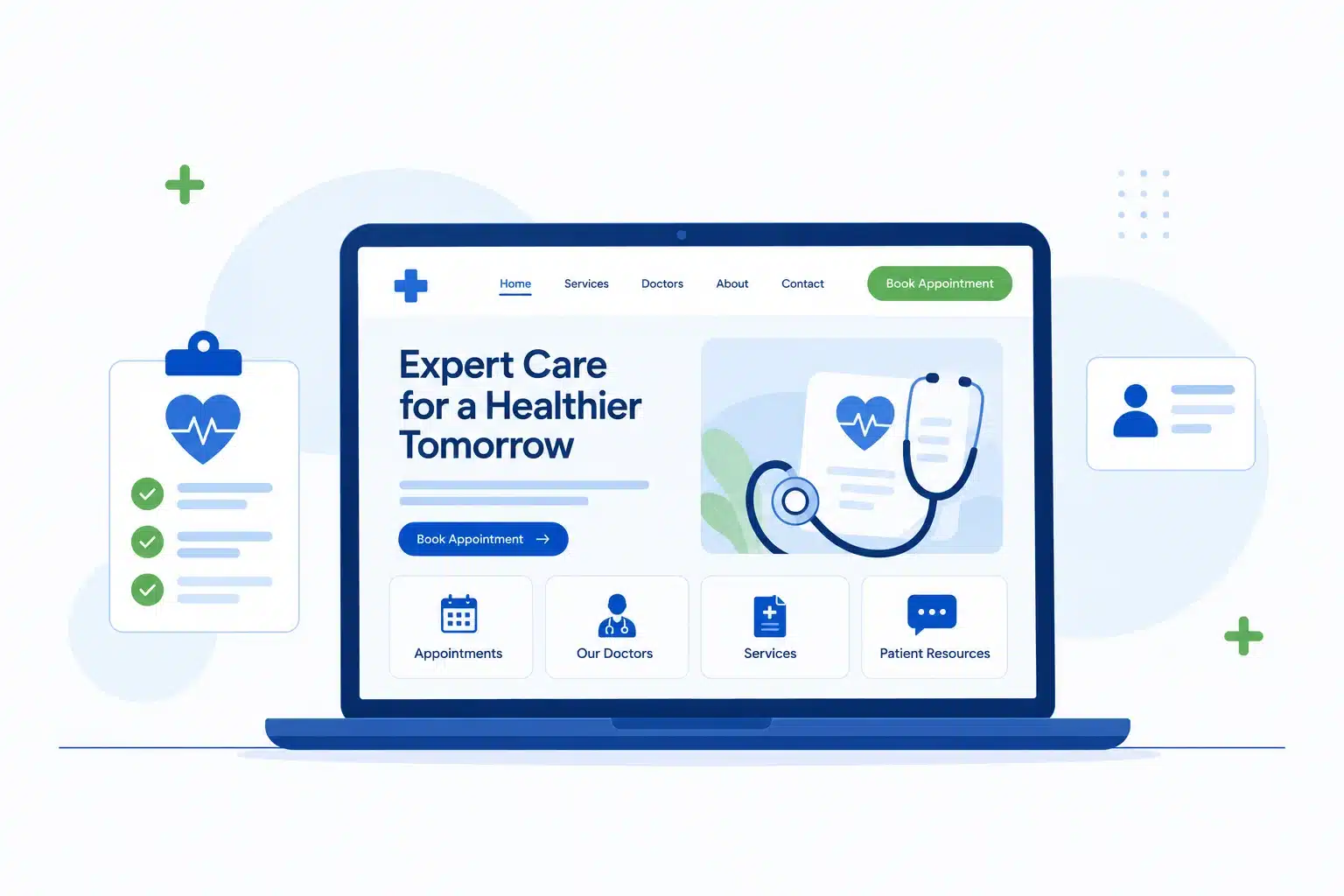
Homepage– This page tells the visitor about the provider, services offered, and ways to take the next steps. Clear navigation, simple layout and warm visuals make the homepage feel welcoming.
Services and Treatment Page– Each service deserves a dedicated page. Patients want to understand symptoms, treatment, procedures, recovery expectations, and support. These pages reduce confusion and provide actionable information before the first booking.
Provider and About Pages- Provider information, team introductions and an “About Us” page builds trust and makes the practice human.
Contact, Location and Patient Resources- Clear contact details, clickable phone numbers, maps, directions and whatsapp buttons reduce patient confusion. FAQs, forms, insurance information and guides help visitors find information without visiting the clinic.
Also read: Web Development Challenges & How to Solve Them.
5 Steps to Design a Medical Practice Website for Better Patient Experience
A medical practice website design signifies how the patient feels when they first interact with the platform. A thoughtful design makes the website feel intuitive, reassuring and genuinely useful. Given below are the 5 steps needed to build a website that supports patients and supports practice operations.

01. Simple Navigation to Make Key Actions Effortless
Patients arrive at a website to find what they need. A simple navigation with clear menus, and clutter-free experience makes every interaction feel natural and engaging. This includes easy to find action buttons like “Book Appointment”, “Request a Visit” or “Schedule Consultation”. These call to actions must be visible on the homepage, about page, service page and provider page. Effortless booking options motivates the patients to move forward with the provider.
Visual design also plays a key role in creating a medical website. A clean, calm and professional looking site reduces anxiety and reassures the patient. Soft colours, clean layouts and real photos of the clinic and the healthcare provider makes the website feel human.
Here the must-have features that make the website genuinely useful:
- Online appointment scheduling so the patients can book easily without calling.
- Patient forms and portal access to reduce waiting room queues and paperwork.
- Telehealth and virtual care options for remote consultations.
- FAQs, search tools and patient support to answer common queries.
- Integrations with existing practice systems for a unified platform.
The unavoidable feature is creating a mobile-friendly website. Most patients browse on their phones on the go, so the website must be fast loading, clean and suitable for all screen sizes.
Finally, avoiding medical jargon and using patient-friendly language makes treatment options and services less intimidating and easy to grasp.
02. Prioritizing Security, Privacy, Accessibility and Compliance
Besides providing patient care, a medical practice website carries responsibility as patients trust their healthcare providers with sensitive information. A website must protect the information and establish the trust that patients expect.
Any website or portal must use secure encryption tools and follow best practices for data handling. If the practice operates in regions with HIPAA compliance, it is imperative to understand the requirements clearly. This includes telehealth, patient information and digital communication practices.
Accessibility should be a part of the design from day one. Readable fonts, alt text, keyboard navigation and screen-reader compatibility ensures every patient- regardless of age or ability can use the website comfortably.
Transparency matters and patients want to know how their data is used, what information is stored and how privacy is followed. Clear privacy policies and simple explanations build trust and authority.
To ensure that patients can find the website easily on search engines, it is important to improve search visibility and follow SEO best practices. This includes optimizing pages for medical keywords, adding schema markups and making sure that the site loads fast.
03. Creating Content Around Patient Search Intent
For Medical website development, it is necessary to keep in mind that patients search with intent. They look for symptoms, treatments, specialists and locations. The content on the website must align with these real-world queries.
This can be done by optimizing service and location pages. Each service page must have a clear explanation, symptoms, treatment steps, recovery expectations and when to seek care. Location pages must include maps, directions, parking details and landmarks.
A medical website can strengthen local search visibility by optimizing “Near Me” queries by updating Google business profile. This is essential as most patients choose a clinic within a few kilometers of their home or workplace.
Accurate and helpful medical content like blogs, FAQs and guides help patients understand their underlying condition and this builds trust in the clinic’s expertise. A genuinely helpful content builds confidence in patients in choosing the practice.
04. Testing and Launching the Website
Testing the website before launch is an integral part of medical website design and development.The objective of testing is to make every page relevant, easy to navigate, fully functional, and capable of guiding users through proper actions. Here are some questions that need quick answers:
- Does the booking process feel smooth?
- Are forms easy to fill?
- Can you find insurance information easily?
Checking performance, security and accessibility must not be an afterthought. Slow websites and inaccessible pages lose patients in seconds or build frustration. Weak security puts patient sensitive data at risk. A thorough pre-launch test ensures that the site works for every patient and protects data from the moment it is launched.
Optimized SEO and analytics set up helps to track website traffic and activities easily. Law firms can understand what is working and what needs improvement.
04. Maintaining the Website Post Launch
A medical website is not a “launch it and forget it” project. It needs continuous monitoring to improve the website experience over time. It is necessary to keep practice information correct, update timings, services and insurance information as required.
The website performance must be monitored regularly as a medical website is only useful when it is fast, stable and responsive. Regular checks will also help understand how the site will behave in real-world conditions. Analytics tools will suggest what patients interact with the most, what they ignore and where they get stuck. These insights help to fix issues before they erode trust.
Security and technical updates are also a part of website performance. Outdated plugins, expired certificates or slow servers can also degrade performance. Keeping everything updated ensures that the website remains reliable with growing practice.
How much does it cost to build a medical website?
A medical website development is a long-term investment as it lays the foundation for patient trust and practice growth. The cost mainly depends on the features and customization the practice needs. These range from simple informational pages to advanced tools like online booking, telehealth and patient forms. Most medical practices fall within clear cost ranges depending on whether they choose a basic template, a mid-level custom build or a fully integrated website.
| Website Type | What You Get | Estimated Cost |
| Basic Template Website | Simple design, essential pages, basic contact forms | $1500-$4000 |
| Mid Level Custom Build | Custom design, provider profiles, service pages, online booking | $4000-$12,000 |
| Advanced Website | Full custom build, telehealth, patient forms, integrations | $12,000-$30,000 |
| Enterprise Website | Multi-clinic structure, advanced workflows, CRM/EHR integrations | $30,000-$75,000 |
Also read: How Much Does it Cost to Build a Website [Complete Guide]
Common Mistakes to Avoid while Building a Medical Website
Avoiding a few common mistakes can significantly improve the website experience and make it trustworthy and easy to use.

Using a Generic Template– Without a proper strategy, a generic template does not reflect the capacity of the medical practice. Patients expect clarity, reassurance and easy access to care specific to medical practices.
Putting too Much Information on One Page– Healthcare information can be dense and putting everything on one page can be overwhelming for patients. It is feasible to break content into structured sections that helps absorb information confidently.
Hiding Appointment and Contact Details- A well developed medical website must have the relevant CTAs and buttons located strategically. These actions must be visible on all the pages including the homepage, service pages and provider profiles.
Ignoring Mobile Experience- Most patients browse for the website on their phones. A website that looks perfect on the desktop but breaks on mobile devices erodes trust. Mobile-first design is non-negotiable for medical practice websites.
Collecting Patient Information without Privacy Rules– Medical websites must treat patient data with care.Unsecured forms, outdated plugins or unclear privacy practices can put sensitive information at risk.
Treating the Website as a One-Time Project– A medical practice website needs ongoing monitoring and support. This includes updating new services and timings, creating fresh content and performing security audits.
Also read: How to Build Scalable Web Applications [Complete Guide]
How to Choose the Right Design and Development Agency?
Choosing the right website design and development partner can transform the entire process. Building an in-house team is a time-consuming process and costly process. A trusted partner
who understands healthcare, patient behavior and digital best practices brings the expertise needed to transform goals into clear strategy.
A reliable partner understands how patients think and what drives them towards booking. They also bring the technical expertise that a medical practice website needs. They start with discovery and ideation to understand the goals, move to a patient friendly design and development to build secure and reliable features, handle testing before launch and provide ongoing support and maintenance to keep the website running smoothly.
The Bottom Line
Building a Medical practice website is a patient experience project that has to be handled with intention, design, security, clarity and accessibility. Avoiding common mistakes and choosing the right development partner ensures every step works seamlessly. In the end a well-built medical practice website becomes a long-term asset that strengthens trust, improves patient experience and helps the medical practice scale with confidence.
Frequently Asked Questions
Q1. What is medical website design?
Medical website design is the process of creating a digital experience that helps patients understand your services, find the right information quickly, and book appointments without confusion. It combines clean layouts, simple language, secure forms, mobile‑friendly pages, and healthcare‑specific features to make the website both trustworthy and easy to use.
Q2. What features should every medical website include?
Every medical website should have clear service pages, provider profiles, online appointment booking, patient forms, telehealth options, FAQs, location details, and strong security safeguards. These features make the website useful for patients and reduce workload for your staff.
Q3. Why is mobile‑friendly design important for medical websites?
Most patients browse on their phones. A mobile‑friendly website loads fast, looks clean, and makes booking or finding information effortless, improving patient satisfaction and reducing drop‑offs.
Q4. How does SEO help a medical practice website?
Healthcare SEO improves your visibility on search engines so patients can find your practice when searching for symptoms, treatments, or providers. It boosts local rankings, increases website traffic, and helps attract the right patients.
Q5. How often should a medical website be updated?
A medical website should be updated regularly, especially when services, timings, insurance details, or provider information change. Frequent updates keep the site accurate, secure, and aligned with patient expectations.
Q6. Do medical websites need special security measures?
Yes. Medical websites handle sensitive patient information, so they require secure hosting, encrypted forms, strong privacy policies, and regular security checks. These safeguards protect patient data and build trust.